
[Found in “HE MOOLELO NO KAMEHAMEHA I, Ka Na=i Aupuni o Hawaii”]
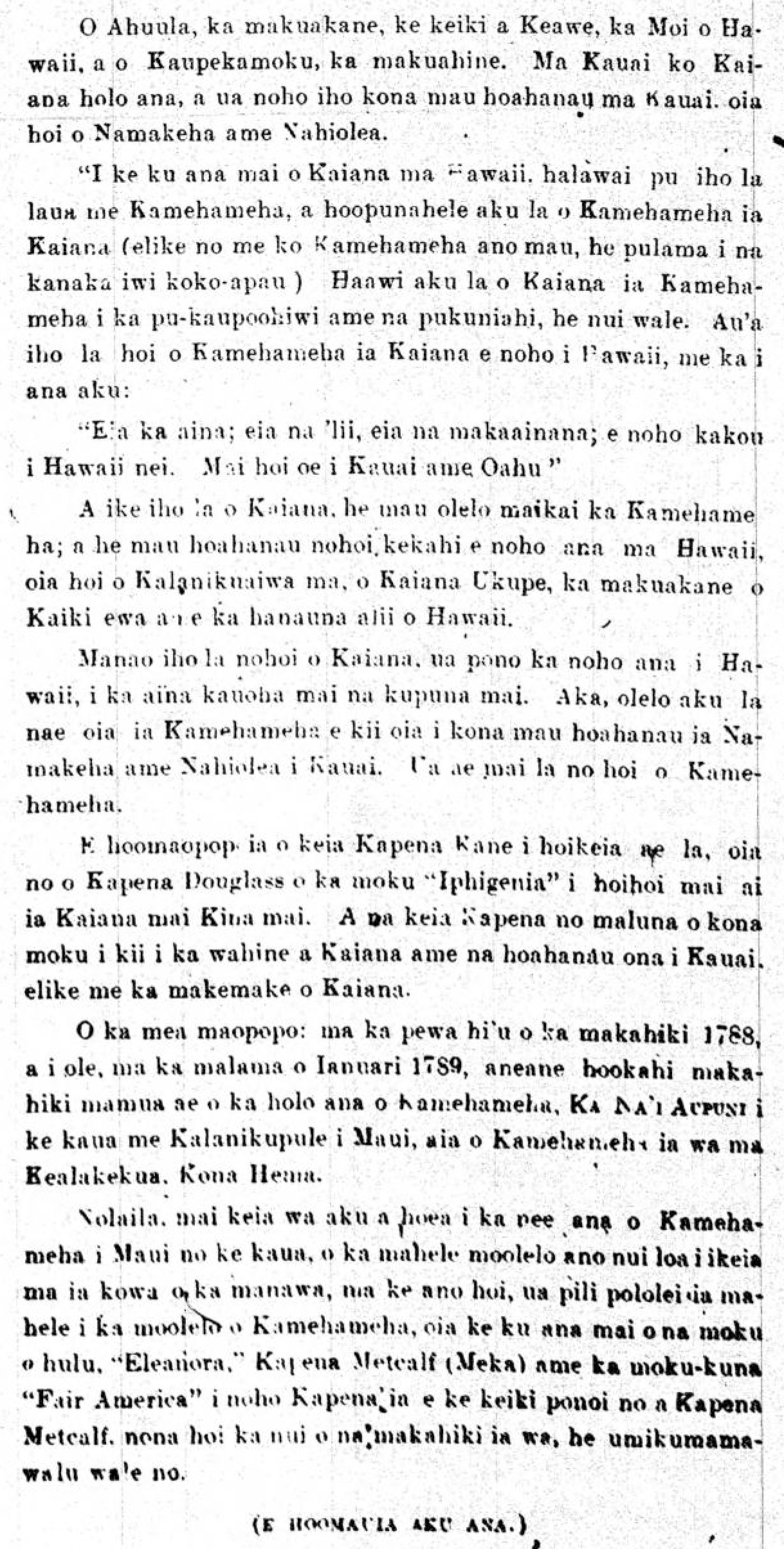
Ahuula, the father, the son of Keawe, the King of Hawaii; and Kaupekamoku, the mother. Kaiana sailed for Kauai and his brothers stayed on Kauai, they being Namakeha and Nahiolea.
When Kaiana stopped at Hawaii, he met with Kamehameha, and Kamehameha made Kaiana one of his favorites (as is usual of Kamehameha, who cherished all of the living). Kaiana gave Kamehameha many rifles and cannons. Kamehameha held back Kaiana to remain on Hawaii, saying:
“Here is the land; here are the alii; here are the makaainana; let us live here on Hawaii. Do not go back to Kauai and Oahu.”
And Kaiana recognized that the words of Kamehameha were fine ones; also he had some relatives of the same generation living on Hawaii, they being Kalanikuaiwa folks; Kaiana Ukupe, the father of Kaikioewa; and those of chiefly rank of Hawaii.
Kaiana believed it was well to live on Hawaii, the entrusted lands from the ancestors. But he said to Kamehameha that he was going to fetch his brothers Namakeha and Nahiolea on Kauai. Kamehameha agreed.
Know that it was this Kapena Kane shown above, that is Captain Douglas of the ship Iphigenia who brought Kaiana back from China. And this captain aboard his ship went to fetch the wife of Kaiana and his brothers on Kauai, as per the desire of Kaiana.
Something to recognize: the ending of the year 1788, or January 1789, was nearly a year before Kamehameha, the Conqueror of the Nation, sails off to go to war with Kalanikupule on Maui; Kamehameha was at the time in Kealakekua, South Kona.
Therefore from here on until Kamehameha goes to Maui to wage war is an important part of history seen in that period, being that this part directly connects to the history of Kamehameha, that being the anchoring of the sealing ships, Eleanora, Captain Metcalf (Meka), and the schooner Fair America, commanded by the biological son of Captain Metcalf, who was at the time only eighteen years old.
{To be continued.}
 nupepa