
Today i noticed there is yet another volunteer project trying to get people to type in text from the Hawaiian-Language Newspapers using images that are not clear. This time people are being asked to correct text done by Cambodians. I won’t speak on the ramifications of using Cambodians to OCR Hawaiian newspapers, because that is a whole separate issue in itself.
I will say once again, however, that i believe the information written in the Hawaiian-Language Newspapers is important enough to reproduce accurately so that we can search and find what was originally written within its pages. I don’t know if there is anyone who feels any different.
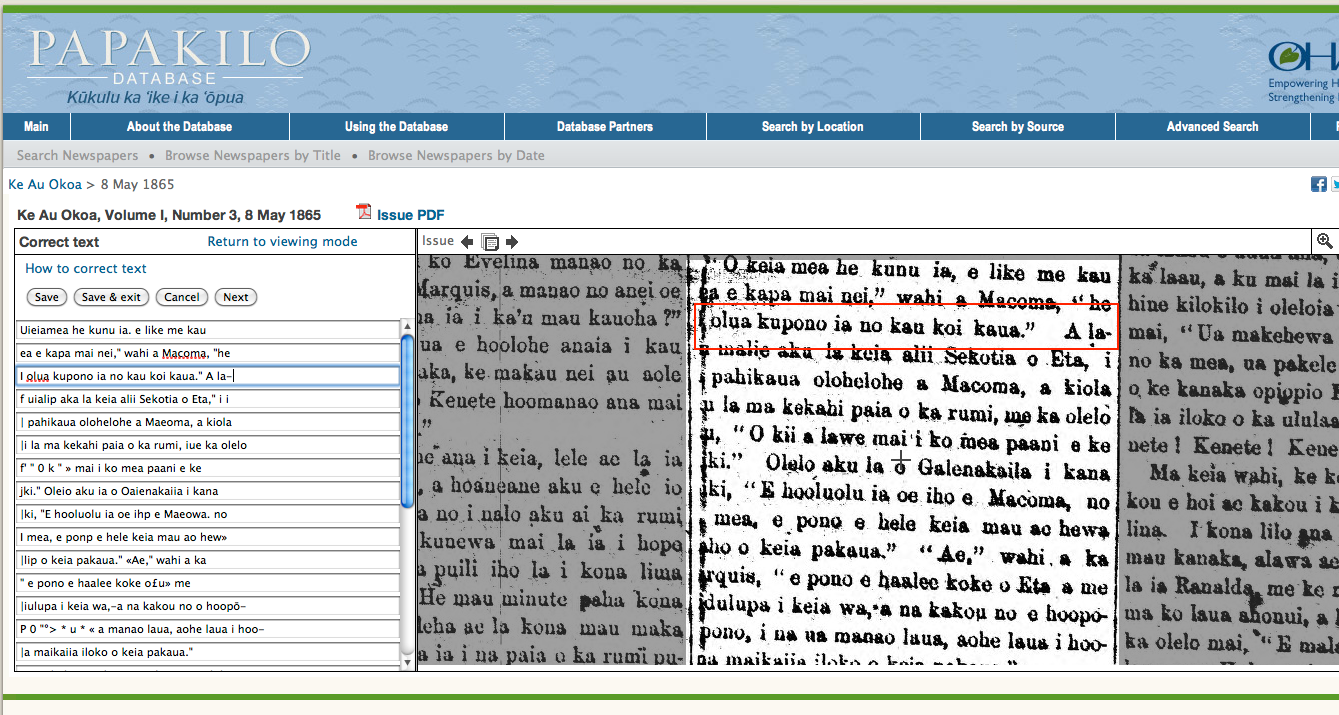
The example given in the ad calling for volunteers shows precisely why we need to FIRST get good, clean images of the newspapers AND THEN typescript them so they are word-searchable. The highlighted column will never be fully legible using this image, because there is a big fold running down the left side, obscuring two or three letters in each line. There are pages and pages like this (and many are even less legible).
Is getting 70 or 80 or 90% of the words sufficient? What if your kupuna wrote something or was written about; would 90% of it be good enough for you? What if the one time her name was mentioned in the article was a part that was folded over, or was too dark to read…
Volunteer for the inside???
 nupepa
He aha ua polokalamu la, e pili ana i ka limahana o na Cambodia?
LikeLike
Aloha,
I agree very much. For the awaiaulu / ‘ike ku’oko’a project, I tried to let OCR help me transcribing, and it made a huge difference, wether the images were clear and STRAIGTHENED or not.
Anyway, how can we find the new project? Could you provide the link?
Mahalo.
LikeLike
Aloha, i am not sure where that is happening…
LikeLike
Aloha mai e na hoa nupepa,
You are correct, it would be better if all the newspapers that needed reshooting were done first. And in a perfect world where everyone knew the importance of this work and put every effort forth to save and preserve this knowledge for the myriad of important projects that are sure to come of this work, this would be not only ideal but a natural step.
But unfortunately, even after all the media attention, after all the presentations and rallying that was done throughout ‘Ike Ku’oko’a, its still just us…with no more $$ but lots of back patting and admiration for the effort and still the papers are not back in the mainstream and not all searchable.
So this is not another newspaper project, its the same old mules plugging along hoping that in this lifetime we who love these newspapers can focus all our efforts on getting as much of them up and searchable as can…and perhaps with another project or another push we will get the much needed re-shooting done but for now, we plan on getting the 60,000 pages up by November.
Hawai’i and the world thru ‘Ike Ku’oko’a only accomplished 16,000 of the 60,000 goal, so now in addition to editing the 16,000 we are also exploring the possibility of editing the computer generated OCR work done as backup…and the struggle continues with the newly impassioned and inspired 2,000+ volunteers who made ‘Ike Ku’oko’a happen…and we gotta be grateful for that! I just know that our kupuna are looking down favorably at us knowing that we didn’t just stop because everything wasn’t perfect.
Ke aloha no,
Kau’i
LikeLike
Aloha kakou.
As brought up before this all started, if clear pictures were taken first with the money from one of the two projects (whether from DL Consulting and Cambodia or Ike Kuokoa), and then just one project was done thereafter (and if there wasn’t enough money, just a select number of newspapers could have been funded to start off with), that would have made more sense, and the typescripts could have been closer to the originals. And with clear images of the originals, people would be able to immediately check online where there are questionable passages. There isn’t ever going to be a perfect typescript, but at least if done from clear images, the results would have been more faithful to what was written with care all those years ago. The oldsters didn’t spend a fortune on stationery to write down their thoughts and send them in to the paper just because they had nothing better to do; they wanted the future generations to know. There are so many passionate letters in the newspapers complaining when editors deleted passages. There was one i ran across the other day where the writer was so upset that his submission was not printed in one paper after waiting week after week that he submitted it to another paper.
When the pages go up in November, and someone finds their kupuna (what is scary is that maybe they won’t even get to find them) amidst the @@@@, i imagine they will certainly feel a need to go back to the original newspapers (instead of being able to check a clear online image). The more the newspapers are touched before there can be good images taken, the worse off they will be, and there is a good chance that there will be cases where legible images can never then be obtained. I hope those pages don’t cover anything important.
And if by luck, we ever get to a point when clear images of the papers are taken, the typescripts will of course have to be redone in entirety, because who knows where errors lie…
This i speak with all sincerity.
LikeLike
Hopefully, all of the work being done now to develop interest, volunteers and initial searchable product, though flawed, will generate enough force and support to finally do full justice to the original repository. If people embrace forward motion on what has been dormant for a century, it’ll provide possibilities for almost any outcome. If we don’t gain the motion, all goals become unreachable.
LikeLike
We all knew in advance that the digital images were generally not clear to begin with. Instead of working from partially illegible images, and doing two totally different typescripts, if only there was foresight and all the money spent on one of the two projects was used to take clear images of some of the newspapers first and then typescripts were done from those clear images, that would have been the best use of funds and time spent.
This would have developed the same amount of interest and force without all of the added flaws, and justice would have been closer at hand, and motion would still have taken place.
LikeLike
If the “we” were a larger circle, a lot of things would be possible. That circle is now growing, as momentum develops. Now, more than ever, there’s a lot of hope for what can be accomplished.
LikeLike
To re-visit the beginning, we could not have generated all the support, volunteers and what little funding was available if we had started with re-shooting because no one was willing or able to see the value of this work until they were able to put their hands on it and see first hand the names and stories of their own kupuna or familiars. Without the strong and aggressive awareness push this would still just be the three of us having another “if only” discussion.
It is building and they are coming…lets look with hope to the future knowing that we each did the best we could to make this happen so that the collective voice of the oldsters will be heard once more.
LikeLike
Oh, actually i was just talking about using the funding from one or the other project to do the re-shooting of the images.
LikeLike
Hopefully someone will take on the Garden Island Newspapers. Where are all these newspapers that you are working from? I’ve heard stories about newspapers being thrown away after they were microfilmed (TGI) because they were “done”. All those lovely photographs…lost
LikeLike
To date, Chronicling America has put up 5/2/1911 to 12/26/1922 of the Garden Island! And the images are generally very legible! See here for a list of English newspapers from Hawaii put up by Chronicling America: http://chroniclingamerica.loc.gov/newspapers/?state=Hawaiiðnicity=&language=
LikeLike
I had searched and scoured the Chronicling America website before and was very thrilled when, after beginning my search many, many years ago, I found a plethora of references to my Tutu man. If only the Hawaiian language newspapers could get to that level. I know I and many others are very, very interested in perpetuating the papers through re-scanning what originals we have. I know many of us are doing it ourselves in our own private collections. I would like to see all of our efforts, large and small, organized to make the most out of all our hard work. There are many, many people who have their own private collections of translations and newspapers. If there were a place where we could share these and make them available to the public, that would be a step in a positive direction. To comment on the re-scanning of the documents, it should be a priority that is paramount. Why do bad work when we can do it right the first time? I realize that the mentality that “anything is better” is widely adhered to today. I remember my Tutu telling me “sometimes, nothing is better than something.” Just a thought. I don’t want this to be taken the wrong way because I have endless gratitude for all that everyone has done to preserve, transcribe, and translate this most important resource. I think it is important to do the highest quality work without exception and with the realization that we are running out of time to save these irreplaceable documents I suggest we not act like we have the luxury of putting the re-scanning of the newspapers on the back burner.
LikeLike
The majority of the Hawaiian-Language Newspaper originals are divided between the Bishop Museum, Hawaiian Historical Society, Mission Children’s Society and State Archives…
As for Chronicling America, I do like the site, but even their text accuracy isn’t the best. So if you are looking for names and places, there are many articles that cannot be located by word search. OCR is still not perfect! I want better for the Hawaiian-Language Newspapers.
Hopefully one day soon, people and organizations with kuleana and with the means will come to the realization that the pearls in the Hawaiian-Language Newspapers are priceless, and that they are worth the effort and expense to rescan so that the resulting digital images are the clearest they can be. I believe in my heart that it will happen soon. If not, i would have given up on the newspapers years ago…
LikeLike