
A STORY
ABOUT
KANA, THE ROPE GRANDSON OF ULI
THE EXPERT OF HAWAII, AND THE MYSTERIOUS ONE WHO LOWERED THE FAMOUS PEAK OF HAUPU WHICH REACHED INTO THE HEAVENS—THE ONE WHO ALSO FETCHED THE SUN AT KUKULU O KAHIKI.
Hookaakaa ka Lani
Kakaa ka Iloli
Wehiwehi ka Mauna
Palamoa ka Opua
E Kana—e
Hina ia i o Uli ala
Ko Kupunawahine.
* ∗ * ∗ * ∗
[The Heavens Turn
Rolling are the pangs of pregnancy
Bedecked are the mountains
Dense are the clouds
O Kana
It is Hina and Uli is there
Your Grandmother.
* ∗ * ∗ * ∗]
(By the kindness of Hon. W. H. Rice of the Island Sun-Snatching Island.)
Uli (f) dwelt with Ku (m), born was Hakalani-leo (f), and she was called another name, Kuahuula. Kuahuula (f) dwelt with Haka (m), born was Kukahikapo (m), Halekamakamaole (m), Kuluakapo (m), Kukolukapo (m), Hanalolo (m), Ouwaikaaha (m), Paukukaula (m), Awepumaia (m), Kaeekowali (m), Pinawelewele (m), Niheu (m) and Kana. Uli (f) was born in Hilo, Hawaii, and she had a number of siblings. Manu (m) is from below in Milu, and Wakea (m) is from below in Papanuihanaumoku. They were high chiefs. Uli’s work was planting all growing things and making kapa.
Hakalani-leo (f) was one of the most beautiful women of her time, and her beauty was like that of the sun, and her skin was just like the feathers of the mamo, the oo, and the olokele, and the children who she gave birth to numbering eleven were all wondrous children, all except for Kana, and this is how they were wondrous. The ten children, they were each ten feet tall, and as for Niheu, he was five feet tall.
The eleven children were fierce competitors, and here is an example: There is a pond still in Hilo that is called Waiakea, and in it there was a single huge fish, an ulua, in that pond, and its size reached ten anana [distance between tips of fingers of opposite hands with arms extended], that being its length, and its circumference was one anana and one iwilei [distance from collarbone to tip of fingers with arm extended]; and each of the children except Niheu attempted to lift this great fish and couldn’t; but Niheu could do it without exertion. But let us move on to the story of Kana.
[This is how the story of Kana as given by Kauai’s William Hyde Rice begins. It runs in the Hoku o Hawaii from 2/27/1908 to 5/14/1908.]
(Hoku o Hawaii, 2/27/1908, p. 1)
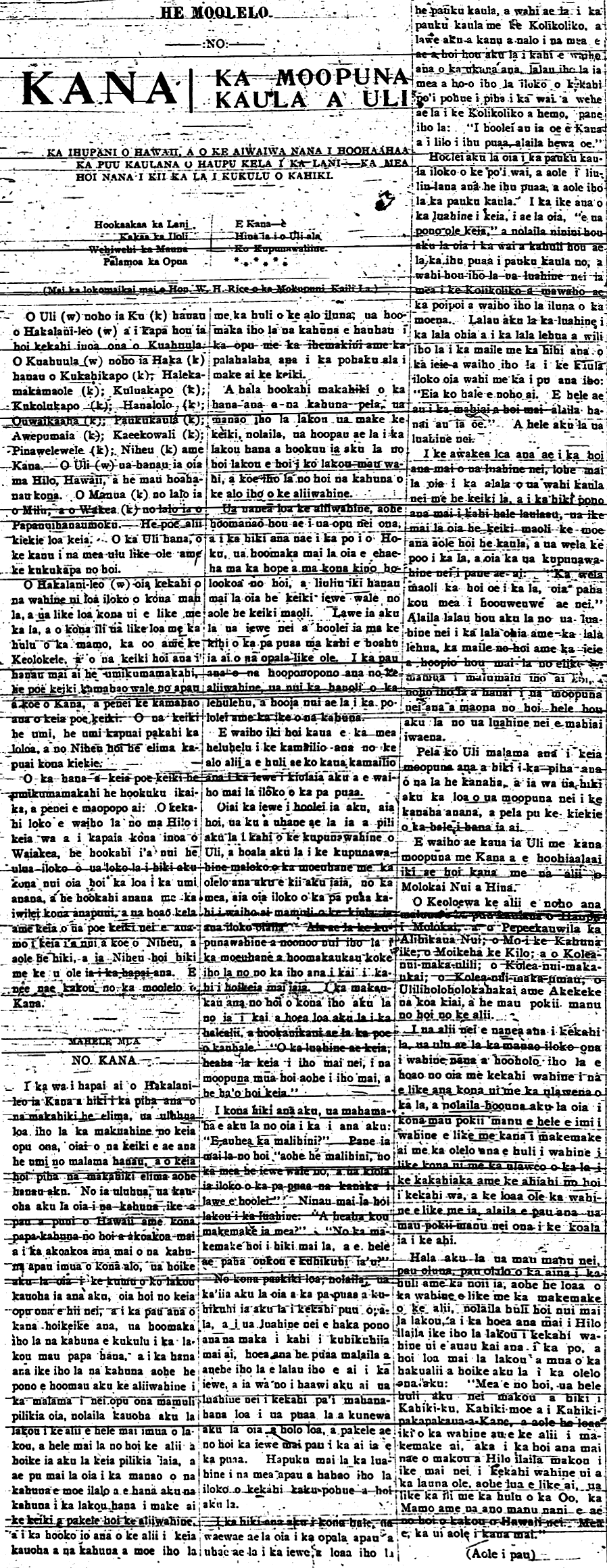
Ka Hoku o Hawaii, Volume II, Number 44, Aoao 1. Feberuari 27, 1908.


Been seeing lots of translations of his stories in KHOH, anyone know if they’re compiled elsewhere (in either language)?
LikeLike
A collection is available in English online from the Bishop Museum. “Hawaiian Legends by William Hyde Rice.” Bernice P. Bishop Museum, Bulletin 3, published in 1923.
It seems that W. H. Rice collected the moolelo originally in the Hawaiian language and then later translated them into English. If you compare the English to the Hawaiian of Kana, for instance, the Hawaiian seems to be more detailed.
LikeLike
Do you happen to know if Rice was doing his own translations or if the KHOH editor was maybe translating Rice’s English into Hawaiian?
LikeLike
aloha!
Do you have the rest of these articles from Hoku o Hawaii? It doesn’t go back that far on Ulukau…
Or where did you access this/these?
Mahalo!!! Steve
LikeLike
Alas, I am also waiting for it to it appearing online and being word searchable! In the meanwhile, they are at a number of libraries on microfilm until that day. The early Hoku o Hawaii newspapers are filled with awesome information!
Also, I would not look to Ulukau for Hawaiian-Language Newspapers, because they only have a limited number of newspapers. Other than for Hae Hawaii articles, I would suggest doing your searching at Papakilodatabase.com
LikeLike
aloha! I’ve worked on his “Pele a me Kona Kaikaina Hiiakaikapoliopele” which was also published in Hoku o Hawaii, starting in Mei 1908 I believe. Typed out, it is 38 pages; the “translation” in his “Hawaiian Legends” (also typed out, same font, etc.) is only 8 pages. His English collection is not a “translation” per se, but a summary of what is in the Hawaiian. For example: all the chants and the mo’okū’auhau for the Pele ‘ohana in the Hawaiian version are not included in the English. Moreover, as a fluent speaker in Hawaiian, his translations of common Hawaiian phrases (pali ke kua, mahina ke alo comes to mind as one example) are not only not literally, they have a very male (and arguable haole, or foreign) perspective. I’ve written about the differences between the texts, and John Charlot has also written about the Hawaiian text. mahalo!
LikeLike
p.s. to reply to Tiani – Rice’s manuscripts (the ones I’ve seen) are in Hawaiian, and my understanding of his work in my research over the years is that he was fluent in Hawaiian and collected mo’olelo ma ka ‘ōlelo Hawai’i, and later translated his own work to English.
LikeLike