Where are these hiding?! 1868

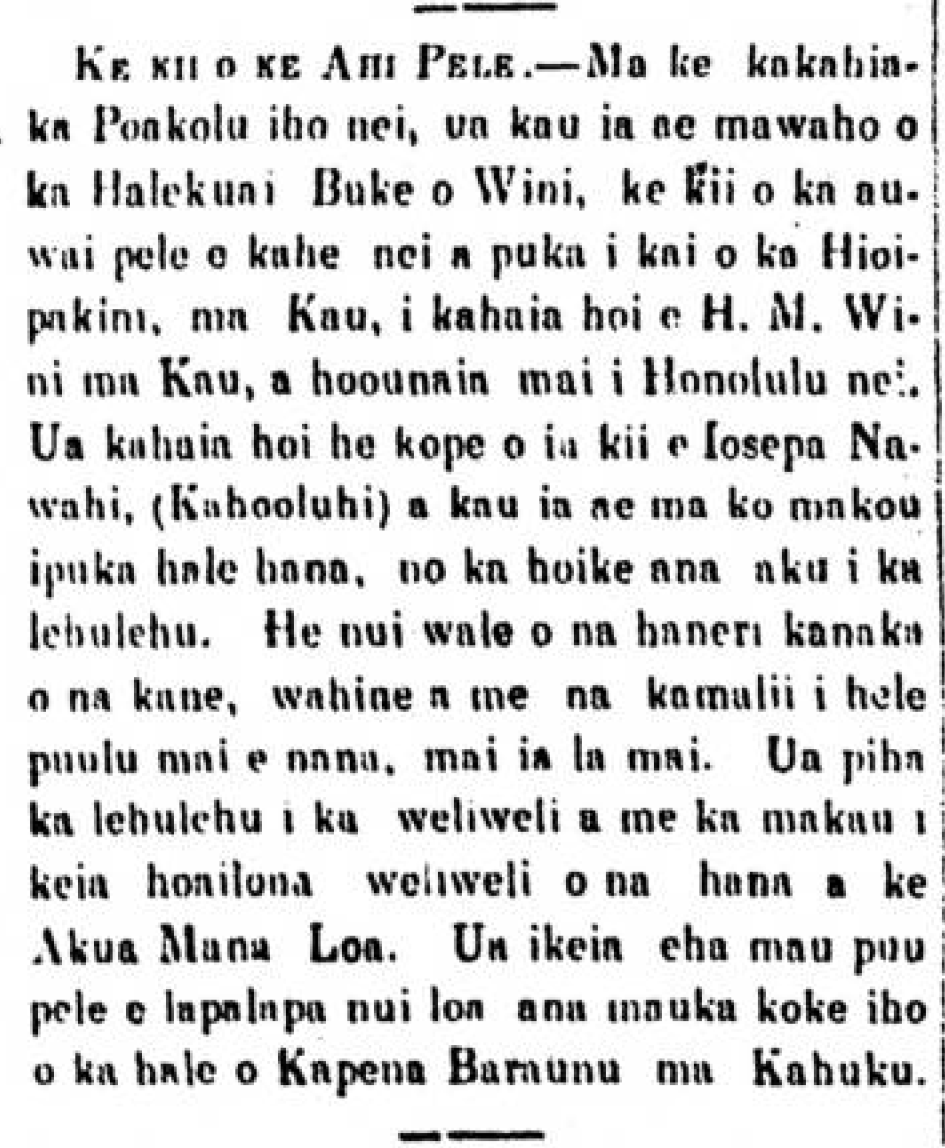
Picture of Lava.–In the morning of this past Wednesday (4/15/1868), hung outside Whitney’s Book Shop was a drawing of a river of lava going out into the sea of Hioipakini at Kau, drawn by H. M. Whitney at Kau, and sent here to Honolulu. A copy of that picture was drawn by Iosepa Nawahi (Kahooluhi) [Joseph Nawahi], and hung on the door of our workplace to show to the public. There have been many hundreds of men, women, and children who have come in droves to see it from that day. The crowd was filled with dread and fear at this dreadful representation of the works of Almighty God. Seen are four volcanic mounds ablaze upland, close to Captain Brown’s house at Kahuku.

Kuokoa, 4/18/1868, p. 3)

Ka Nupepa Kuokoa, Buke VII, Helu 16, Aoao 3. Aperila 18, 1868.

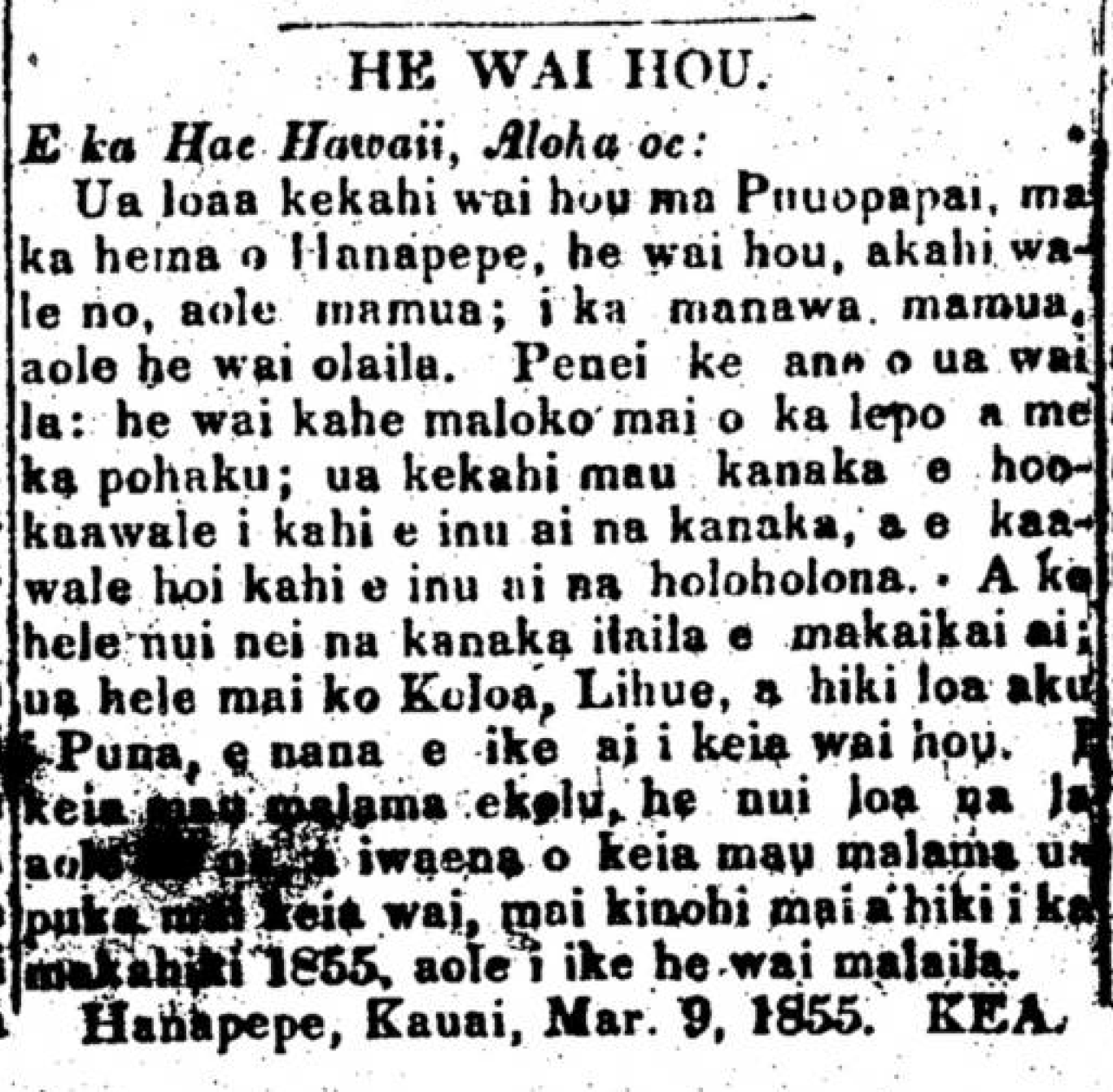
Discovery of a new water source at Puuopapai, Kauai, 1856.

A NEW WATER SOURCE.

O Ka Hae Hawaii, Aloha oe:

A new water source was found at Puuopapai, to the south of Hanapepe. It is a new water source found only now, not before. In earlier days there was no water there. This is the nature of that water: It is water that flows within earth and stone; some people have divided it into a place where people drink, and where animals drink. There are many who are going there to sightsee, from Koloa, Lihue, and all the way to Puna, to go and see this new water source. These past three months, there were a lot of sunny days without rain, and it was during these months that the water appeared. From the beginning to the year 1855, water was not seen there.

Hanapepe, Kauai, Mar. 9, 1855. KEA.

(Hae Hawaii, 4/16/1856, p. 25)

Ka Hae Hawaii, Buke I, Helu 7, Aoao 25. Aperila 16, 1856

News from Kawaihae, Hawaii, 1903.

Aloha oe, O Kuokoa Newspaper: On the night of the 10th of February, the compassionless hands of death fetched the breath of life from the baby of our Dr. J. Atcherley and took it away.

The Doctor tried with what he knew, but the strength of the sickness was greater. In the morning of the following day, the body of the baby was returned by the parents to Waimea.

PERTAINING TO THE SUGARCANE.

The sugarcane of Puako will be milled once again; the land of that barren field is green and beautiful.

This is under the leadership of the Head Luna, W. Vredenburg.

PRAISE.

We have much praise for you, O J. Seleni, for your prompt actions in the committee requesting funds for the Church of Kawaihae Kai and Uka, and to William Hookuanui for his thatching of the Kawaihae Kai Church at no cost, and to Z. Paakiki for his assisting with the bundles of pili so that the Kawaihae Kai Church could be completed.

Sincerely yours,
JOHN KULA JR.,
Kawaihae, Hawaii, Feb. 20, 1903.

(Kuokoa, 2/27/1903, p. 6)

Pertaining to the first law proclaimed, 1895.

“MAMALAHOE KANAWAI.”

The above are the first words of the very first law proclaimed upon the villages of Hawaii nei, and those words continue to be spoken by some in authority in our times. This is how the rest of the proclamation of the law truly went:

“Splintered Paddle Law–Let the old men go and lie by the road; let the old women go and lie by the road; let the children go and lie by the road.”

This first law proclamation was spoken by Paiea (Kamehameha I) after his head was struck by some fishermen on a shore at Puna, Hawaii, after he was mistaken for someone else. When his head was hit by the stroke of the paddle, the people fled. There were five of them. And them Paiea rose and grabbed a rock, and he started to chase after them, but one of his feet got stuck in a rock crevasse. And his chase was soon cut short. The rock in his hand was released and there was no time to catch them. And it was this unfulfillment of his intent that led him to proclaim those words of power and fame in our story. The place where Paiea’s foot was caught is still known to this day.

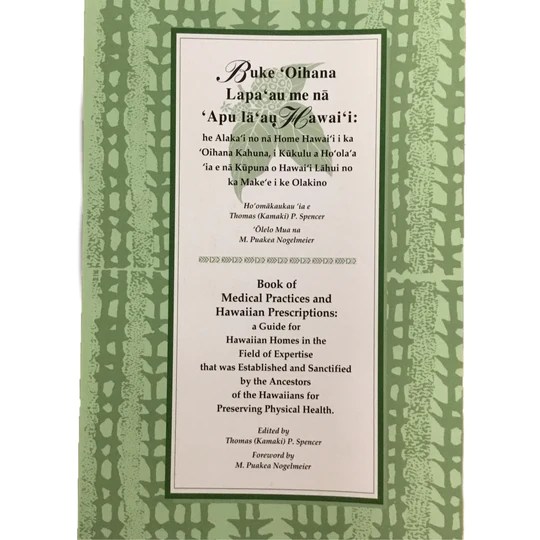
Here, we take what is shown on pages 94 and 95 of “Ka Buke Lapaau me na Mea Pili Kaulana” recently published by Thomas P. Spencer [Kamaki].*

“Right after this battle (Kepuwahaulaula), brought before Kamehameha by the warrior chiefs were the fishermen who struck his head with the paddle to the toward the sea some years prior. That shameless act carried out by them was made known to Kamehameha face to face. His warrior chiefs thus urged him that the fishermen should be killed by stoning.

“Kamehameha’s aloha for people led him to speak for the first time the famous pardon with these words:

“Splintered Paddle Law: You are prisoners of war, but you are being pardoned from your foolishly striking my head–I escaped but was almost in danger.”

Here, O readers, you see,–aloha for people was the cure whereby those rebels of Puna were forgiven by Kamehameha, without him considering the calls for killing them by his warrior chiefs. This is a good example for President Dole of the Republic. He and his Executive Power do not get close to 1/100 of the Splintered Paddle Law for the Hawaiian prisoners of the civil war of January 17, 1895, who remain imprisoned while the lahui is united in their desire for their release. That was a period of ignorance when they were pardoned victoriously by Kamehameha, while this is a period of enlightenment and learning. Still there has been no pardon which Dole has proclaimed for the Hawaiian captives, for the fame of his name and his Nation.”

Our explanation pertaining to this famous story differs from Spencer’s, but the gist of his explanation for Kamehameha’s pardoning those people who hurt him, that is something we want to clarify widely for this time, so that true aloha for people is recognized within them.

(Makaainana, 11/25/1895, p. 5)

Ka Makaainana, Buke IV—-Ano Hou, Helu 22, Aoao 5. Novemaba 25, 1895.

*This book by Tamaki Spencer was republished by the Bishop Museum Press twenty years ago, but unfortunately it is out of print today.

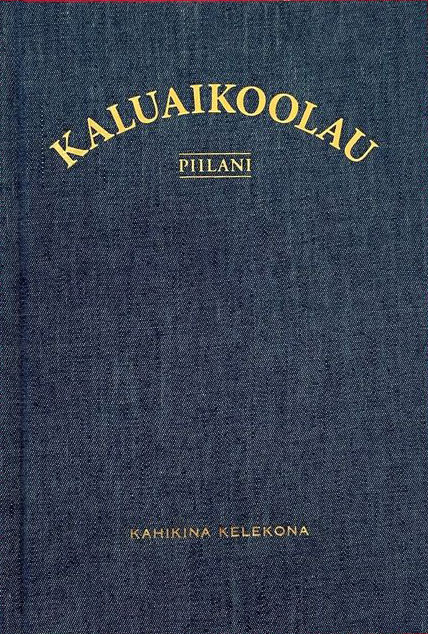
Just the other day, I saw that the Hawaiian Historical Society published a reprint of an important book, “Kaluaikoolau,” written by Kahikina Kelekona and first published in 1906.

The Queen’s Protest. 1893.

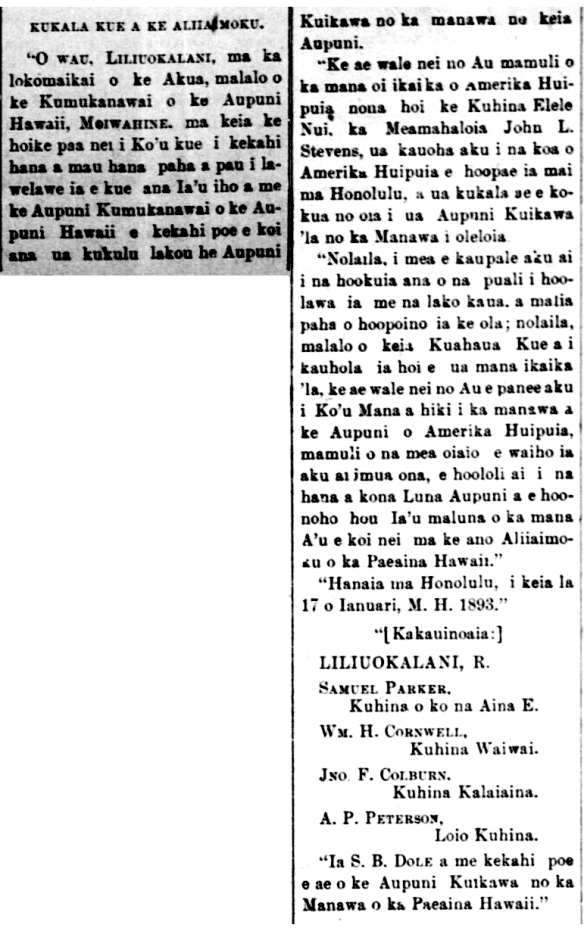
KUKALA KUE A KE ALIIAIMOKU.

“O wau, Liliuokalani, ma ka lokomaikai o ke Akua, malalo o ke Kumukanawai o ke Aupuni Hawaii, Moiwahine, ma keia ke hoike paa nei i Ko’u kue i kekahi hana a mau hana paha a pau i lawelawe ia e kue ana Ia’u iho a me ke Aupuni Kumukanawai o ke Aupuni Hawaii e kekahi poe e koi ana ua kukulu lakou he Aupuni Kuikawa no ka manawa no keia Aupuni.

“Ke ae wale nei no Au mamuli o ka mana oi ikaika o Amerika Huipuia nona hoi ke Kuhina Elele Nui, ka Meamahaloia John L. Stevens, ua kauoha aku i na koa o Amerika Huipuia e hoopae ia mai ma Honolulu, a ua kukala ae e kokua no oia i ua Aupuni Kuikawa ’la no ka Manawa i oleloia.

“Nolaila, i mea e kaupale aku ai i na hookuia ana o na puali i hoolawa ia me na lako kaua, a malia paha o hoopoino ia ke ola; nolaila, malalo o keia Kuahaua Kue a i kauhola ia hoi e ua mana ikaika ’la, ke ae wale nei no Au e panee aku i Ko’u Mana a hiki i ka manawa a ke Aupuni o Amerika Huipuia, mamuli o na mea oiaio e waiho ia aku ai imua ona, e hoololi ai i na hana a kona Luna Aupuni a e hoonoho hou Ia’u maluna o ka mana A’u e koi nei ma ke ano Aliiaimoku o ka Paeaina Hawaii.”

“Hanaia ma Honolulu, i keia la 17 o Ianuari, M. H. 1893.”

“[Kakauinoaia:]

LILIUOKALANI, R.

Samuel Parker,
Kuhina o ko na Aina E.

Wm. H. Cornwell,
Kuhina Waiwai.

Jno. F. Colburn,
Kuhina Kalaiaina.

A. P. Peterson,
Loio Kuhina.

“Ia S. B. Dole a me kekahi poe e ae o ke Aupuni Kuikawa no ka Manawa o ka Paeaina Hawaii.”

[I Liliuokalani, by the grace of God and under the constitution of the Hawaiian Kingdom, Queen, do hereby solemnly protest against any and all acts done against myself and the constitutional Government of the Hawaiian Kingdom by certain persons claiming to have established a provisional government of and for this Kingdom.

That I yield to the superior force of the United States of America, whose minister plenipotentiary, His Excellency John L. Stevens, has caused United States troops to be landed at Honolulu and declared that he would support the said provisional government.

Now, to avoid any collision of armed forces and perhaps the loss of life, I do, under this protest, and impelled by said force, yield my authority until such time as the Government of the United States shall, upon the facts being presented to it, undo the actions of its representatives and reinstate me in the authority which I claim as the constitutional sovereign of the Hawaiian Islands.

Done at Honolulu this 17th day of January, A. D. 1893.

Liliuokalani, R.

Samuel Parker,
Minister of Foreign Affairs.

William H. Cornwell,
Minister of Finance.

John F. Colburn,
Minister of the Interior.

A. P. Peterson,
Attorney-General.

To S. B. Dole and some others of the Provisional Government of the Hawaiian Islands.]

(Hawaii Holomua, 1/18/1893, p. 2)

HawaiiHolomua_1_18_1893_2.png

Hawaii Holomua, Buke III, Helu 141, Aoao 2. Ianuari 18, 1893.

J. T. Unea retires after over 20 years as newspaper agent, 1919.

Did you see the recently launched Sacred Hearts Archives website? One of their searchable collections is of images from Kalaupapa. Here for instance is a link to a portrait of John T. Unea, the newspaper agent for Kalaupapa.
https://sacredheartsarchives.pastperfectonline.com/photo/8D2012C5-C8B8-4651-A1D6-544452427616

nupepa's avatarnupepa

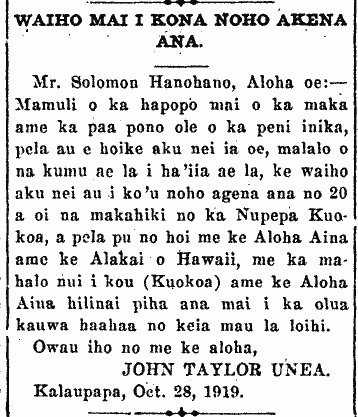
LEAVES HIS POST AS AGENT.

Mr. Solomon Hanohano, Aloha oe:—Due to me going partially blind, and not being able to hold properly a fountain pen [peni inika], I am therefore announcing to you, because of those reasons mentioned above, I am setting aside my position as agent for 20 years and more for the Nupepa Kuokoa, and also for the Aloha Aina and Alakai o Hawaii, with great appreciation for your (Kuokoa) and Aloha Aina‘s full trust in me, your humble servant, for these many days.

Me, with aloha,

JOHN TAYLOR UNEA.

Kalaupapa, Oct. 28, 1919.

(Kuokoa, 11/17/1919, p. 3)

WAIHO MAI I KONA NOHO AKENA ANA. Ka Nupepa Kuokoa, Buke LVII, Helu 45, Aoao 3. Novemaba 7, 1919.

View original post