This is an independent blog. Please note that I am nowhere near fluent, and that these are not translations, but merely works in progress. Please do comment if you come across misreads or anything else you think is important.
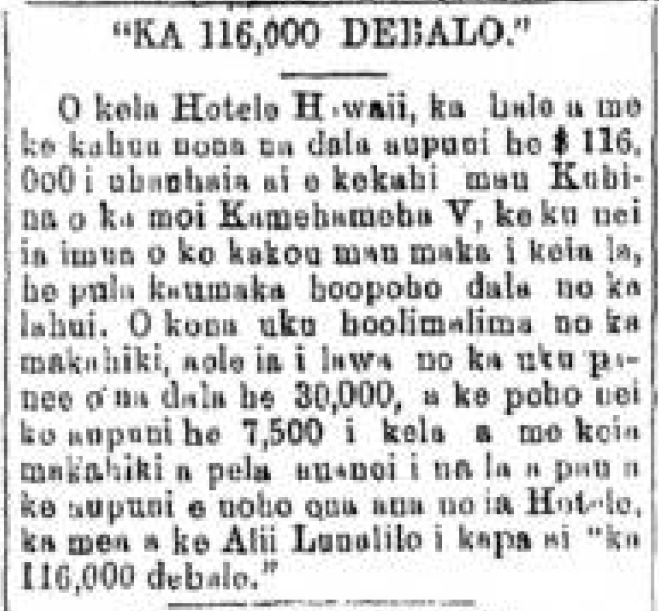
That Hawaiian Hotel, the building and grounds, which costed the government $116,000 which was squandered by a number of Ministers of King Kamehameha V. It stands in front of our eyes this day, a reminder of wasted money of the lahui. Its lease for the year is not enough to cover the interest of 30,000, and the government is losing 7,500 every year, and so forth everyday that the government remains the owner of the hotel which Chief Lunalilo has called, “the 116,000 devil.”
The year 1828 was famous for Kaahumanu going to Hawaii and retrieving Lilinoe on Mauna Kea, who was an ancient woman; a thousand and more years she was left on the mountain of Mauna Kea, according to her sworn statement. It was said that Lilinoe remained with body unspoiled, her hair remained affixed and had not fallen out. And should you want to see her descendants, they can be found by way of Huanuiikalailai; she became a kupuna of the alii, and came forth was Umiokalani, the son of Keawenuiaumi and Hoopiliahoe. But it was stated that Lilinoe was not found by Kaahumanu and that she was hidden away. Liloa, Lonoikamakahiki, Kauhoa, and Lole are the only ones who were found by Kaahumanu at Waipio, and they were brought to Kaawaloa. The alii in Hale o Keawe were from the ancestral chiefs to Kalaniopuu and Kiwalao. Hale o Keawe was filled with the bones of the alii, they were arranged and secured in kaai. They were taken to Kaawaloa and a majority of them were burned in fire. That is a very wicked example in Boti’s mind.
Here is another, Kaikioewa was indebt to Mikapalani [William French], that being the haole trader; the other alii were greatly indebted to him, but in his transactions he was a haole who was beyond reproach. The sandalwood that was thrown away by some haole traders were purchased by Mr. French, and therefore he was also called by the name Hapuku because of he indiscriminately gathered [hapuku] the white sandalwood as well as the very small branches, and he was relied upon by the alii and greatly liked; therefore, the alii were much indebted to him. Kaikioewa was one who was indebted, and because he had no sandalwood to pay his debt, therefore Kaikioewa paid his debt with the land of Kawalo [Kewalo] and Kulaokahua which went to Mr. French. So Mr. French prepared to build wooden structures at Kulaokahua adjacent to Waikiki where the Olohe sank.

 nupepa