Hawaiian Dictionary, 1913.

Hawaiian Word Dictionary

A great number of experts makes a Book a highly valuable Book, divided into many categories, each of which is given to a certain leader to think over, should it be intended to become a useful book; however, if it is composed by just one or two, the explanations will be limited and not complete.

When the English Dictionary, known as the “Standard Dictionary,” was published, it is said that the number of people who produced it is 500 or more, and that is one of the most complete dictionaries of the English language known these days. Within it, there are some Hawaiian words found within the language of the Maoris. And so too with the Hawaiian language, the producing of a Dictionary which clearly defines each word, is now being considered.

We have been told that our Queen Liliuokalani has been asked to help in this great endeavor, and she agreed. It is true, our Queen is very adept at English and understands that language, as well as her own mother tongue, and it is rare to find a person like her amongst the Hawaiians; therefore, it is proper that she agreed to give her assistance to this big project which will become an unforgettable monument for her people and for all people in the future.

(Holomua, 10/4/1913, p. 4)
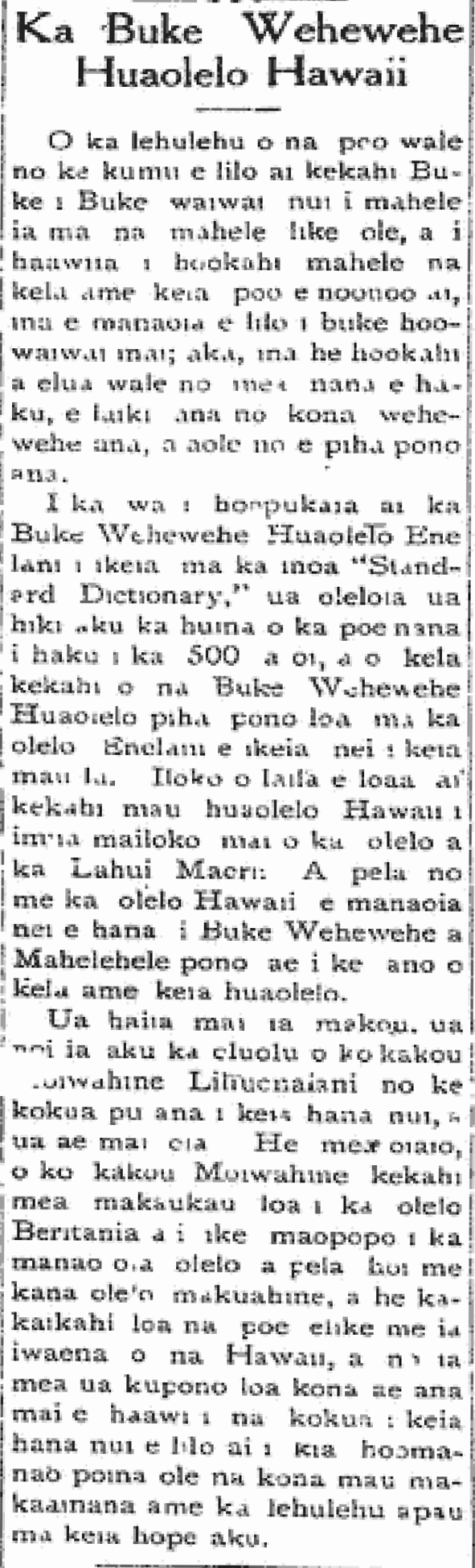
Ka Buke Wehewehe Huaolelo Hawaii

Holomua, Buke I, Helu 1, Aoao 4. Okatoba 4, 1913
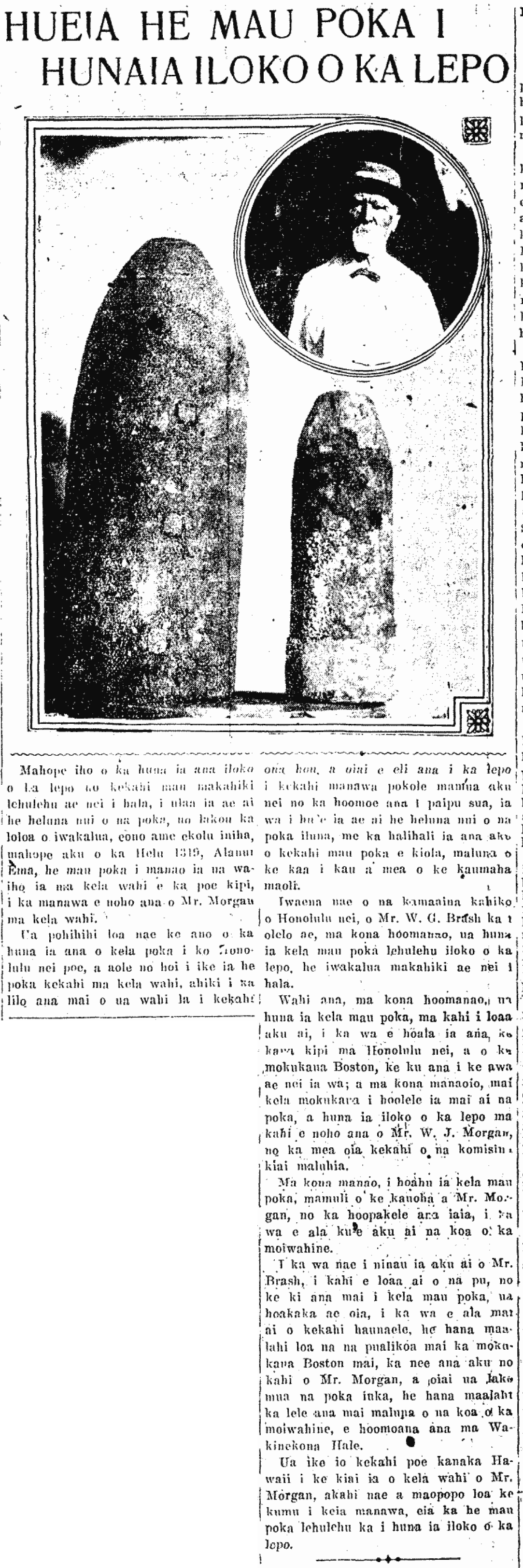
Bullets stored on shore by men of the USS Boston during the overthrow?

Bullets Dug Up Hidden in Dirt.

After being hidden in dirt for many years, many bullets were uncovered: twenty, six, and three inches in length, behind 1319 Queen Emma Street. These are bullets thought to have been left by the rebels when Mr. Morgan was living there.

The hiding of these bullets were cloaked to Honolulu’s people, and it was not known that bullets were in that location until the land changed owners; while the dirt was being dug a little while ago to lay sewer pipes, a great number of bullets were dug up, and some were carried away by car for disposal because it was so heavy.

Amongst the old timers of Honolulu, Mr. W. G. Brash said, according to his recollection, all of those bullets were hidden underground twenty years ago.

He stated, according to what he remembered, those bullets were hidden where they were found, when the revolution in Honolulu was started, and when the warship Boston was in the harbor; and he believed that the bullets were transported from the warship and hidden in the dirt at the residence of Mr. W. J. Morgan, because he was one of the commissioners who oversaw safety [komisina kiai maluhia?].

He thinks the bullets were stored under the orders of Mr. Morgan, to save him should the soldiers of the queen stand in opposition.

However, when Mr. Brash was asked where the guns were to shoot the bullets, he explained that when an uprising broke out, it would be a very easy thing for the soldiers from the Boston to move to Mr. Morgan’s place, and being that the bullets were previously stored on shore, it would be short work to come down upon the troops of the queen encamped at Washington Place.

Some Hawaiians witnessed that Mr. Morgan’s place was being guarded, but the reason for this is only now clear; come to find out, there were bullets buried underground.

(Kuokoa, 4/30/1915, p. 3)

HUEIA HE MAU POKA I HUNAIA ILOKO O KA LEPO

Nupepa Kuokoa, Buke LIII, Helu 18, Aoao 3, Aperila 30, 1915.