This is an independent blog. Please note that I am nowhere near fluent, and that these are not translations, but merely works in progress. Please do comment if you come across misreads or anything else you think is important.
[Found under: “NA MEA KUPONO NO NA HOME” (Things Good for the Home)]
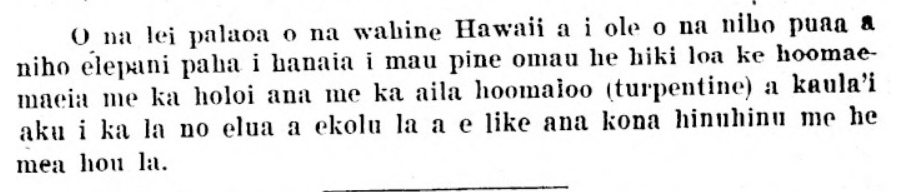
For Hawaiian women’s lei palaoa, or boar tusk, or perhaps elephant ivory fashioned into stick pins, they can certainly be cleaned with turpentine [aila hoomaloo], and dried out in the sun for two or three days; and its shine will be like a new one.
Kalanikiekie, the hanai of Lucy Peabody escaped from a bullet errantly shot by a P. G. soldier while she was standing at a window. The bullet flew and struck above her head a she stood, exited, and struck a bedpost, and the bullet fell down. Continue reading →
On the 20th of July, Toma Manono died at Waimea, Kauai. Manono was an alii; he was with Kekuaokalani folks when they were fighting at Kuamoo. Continue reading →
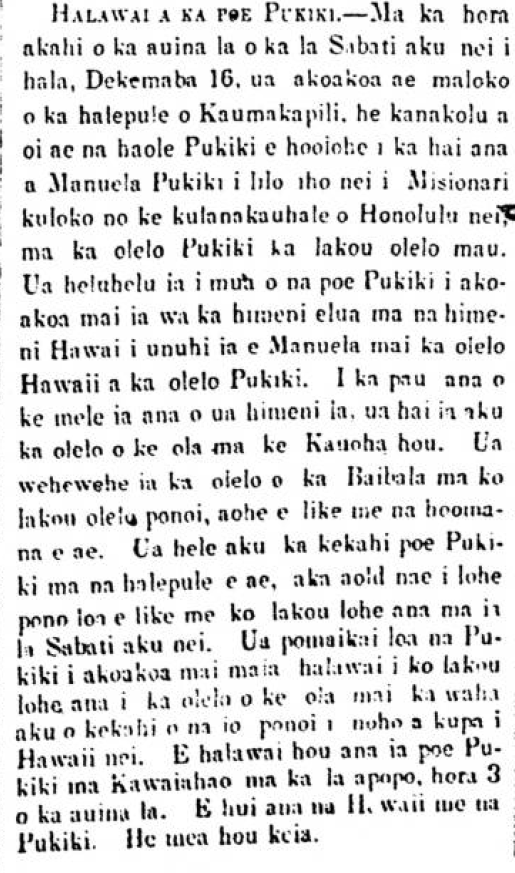
Meeting of the Portuguese.–At one in the afternoon of this past Sunday, December 16, thirty or more haole Pukiki gathered in Kaumakapili Church to hear the talk of Manuela Pukiki who just became a local missionary for the town of Honolulu. They generally speak in Portuguese. Read before the Portuguese gathered at that time were two hymns translated by Manuela from Hawaiian to Portuguese. When the hymns were done being sung, the word of life was told from the New Testament. The words of the Bible were explained to them in their own language, not like the other religions. Some of the Portuguese have gone to other churches, but they did not listen carefully like the did this past Sunday. The Portuguese who got together at that gathering were blessed to have heard the words of life from the mouth of one of their own flesh who have lived until familiar with Hawaii nei. The Portuguese will meet again at Kawaiahao tomorrow at 3 in the afternoon. The Hawaiians and the Portuguese are meeting together. This is something new.
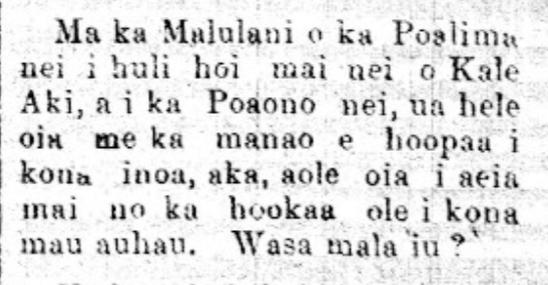
Kale Aki [William Charles Achi] returned aboard the Malulani of this past Friday, and on Saturday he went intending to register, but he was not allowed because he did not pay his taxes. Wasa mala iu?
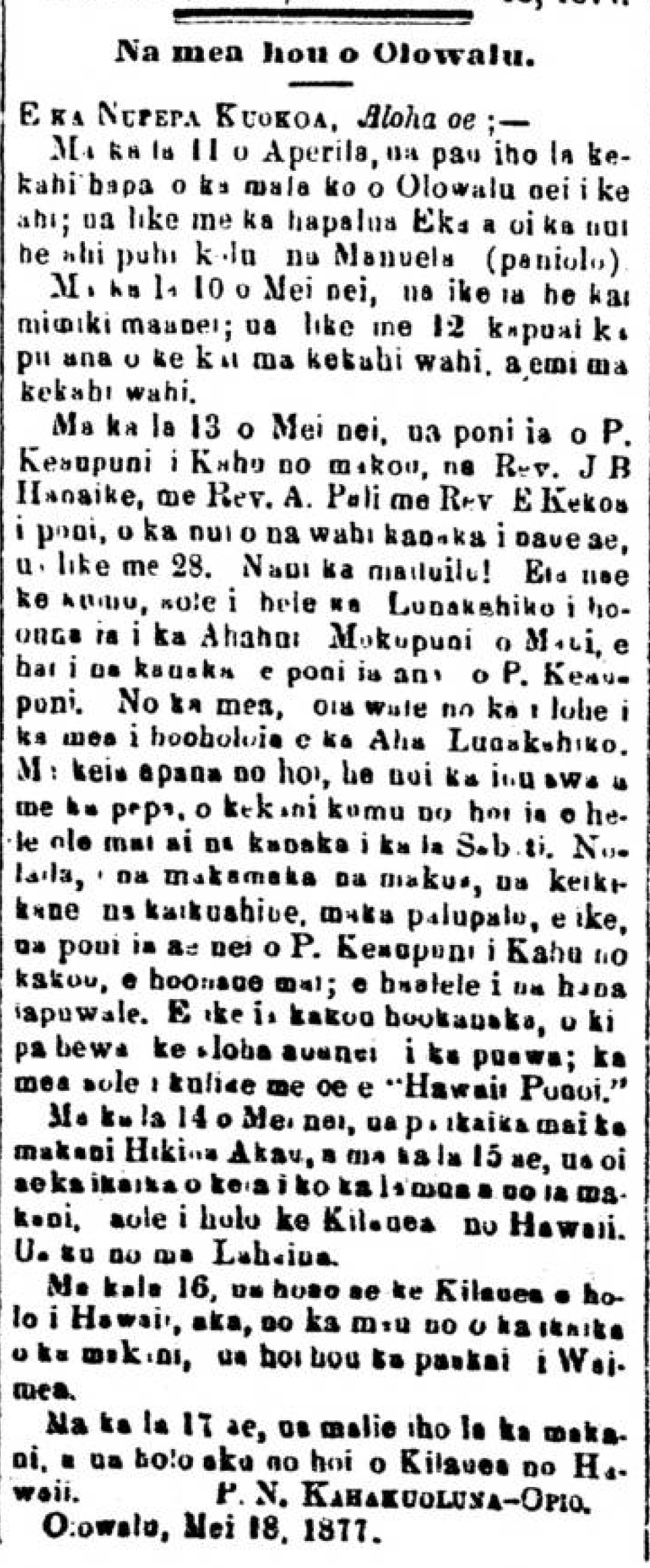
On the 11th of April, a portion of the cane field of Olowalu was destroyed by fire; it was about half an acre or more. It was a fire to burn kolu weed set by Manuela (Spanish).
On the 10th of May, a tsunami was seen; the sea rose 12 feet in some places and less in other places.
On the 13th of May, P. Keaupuni was ordained as a Kahu for us, the ordination was performed Rev. J. B. Hanaike, Rev. A. Pali, and Rev. E. Kekoa. The number of those who came was about 28. So few. This is the reason. The Elder who was sent by the Maui Island Conference to announce to the people that P. Keaupuni was getting ordained did not come. Because only he knew what was decided by the meeting of elders. In this district, there is much awa drinking and playing cards, which is some of the reasons why people do not come on the Sabbath. Therefore, friends, parents, boys, tender-eyed girls, let it be known that P. Keaupuni was ordained as a Kahu for us. Come, and give up worthless activities. Recognize your fellow man lest your love be wasted on an awa stock; that which is not like you, O Hawaii’s Own.
On the 14th of May, the North East wind was strong, and on the following 15th, it was stronger than the previous day. The Kilauea did not sail for Hawaii and remained in Lahaina.
On the 16th, the Kilauea attempted to sail for Hawaii, but because the strong winds continued, it returned.*
On the following 17th, the wind calmed down and the Kilauea sailed for Hawaii.
P. N. Kahokuoluna Jr. [Peter Noah Kahokuoluna Jr.] Olowalu, May 18, 1877.
*”Hoi hou ka paakai i Waimea,” Said when someone starts out on a journey and then comes back again. ON 1028
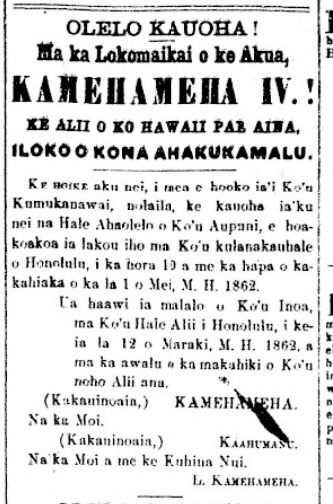
By the Grace of God: KAMEHAMEHA IV, King of the Hawaiian Islands: In Privy Council:
We make known that, in pursuance of the provisions of our Constitution, we hereby convoke and order the Legislative Chambers of our Kingdom to assemble at our Capital of Honolulu at half-past ten A. M. of the First Day of May A. D. Eighteen hundred and sixty-two.
Given under our Royal Sign Manual at our Palace, in the City of Honolulu, this twelfth day of March A. D. Eighteen hundred and sixty-two, and in the Eighth year of our Reign.
KAMEHAMEHA.
Kaahumanu.
By the King and Kuhina Nui. L. Kamehameha.
[Long before Lei Day was proclaimed, there was this.]
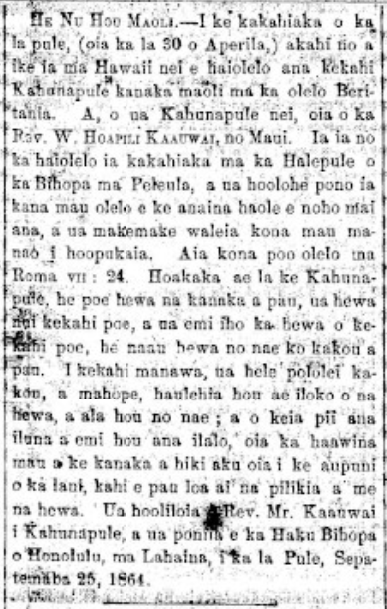
Real News–On Sunday morning (that being the 30th of April), there was seen here in Hawaii nei for the first time, a Hawaiian reverend preaching in English. And that reverend is Rev. W. Hoapili Kaauwai, from Maui. While he was preaching on that morning at the Anglican Church at Peleula, the haole congregation there was listening carefully, and the ideas he expressed were greatly appreciated. His topic was from Romans VII:24. The reverend clarified that all people are sinners; some are very sinful while other are less; but we all have sinful hearts. Sometimes we go straight, and thereafter we fall into sin, yet we rise up again; and this getting up and falling back down is something all people do until they reach the nation of heaven, where all troubles and sins are no more. Rev. Mr. Kaauwai became a reverend, and he was ordained by the Lord Bishop of Honolulu [Thomas Nettleship Staley], at Lahaina, on Sunday, September 25, 1864.
[This William Hoapili Kaauwai wrote a lengthy autobiography of his travels around the world. “Ka Moolelo no ka Makaikai ana a Puni ka Honua, i Kakauia e William Hoapili Kaauwai.” It appears in the Kuokoa from 8/29/1868 and abruptly stops on 1/9/1869. On 1/30/1869, in the article, “He mau olelo hoakaka,” explained is that Kaauwai returned to Wailuku with promises to continue writing from there.]


 nupepa