Fish prices, 1918.

NEW PRICES SET FOR FISH UNTIL APRIL 30

Here following is the new prices for fish set by the food commission upon the various fishes; and this will be the only prices announced on fishes big to small, until April 30th when it will end.

 Per Lb.
Aalaihi  $           0.12
Aawa  $           0.12
Aha  $           0.12
Ahi  $           0.14
Aholehole  $           0.15
Aku  $           0.08
Akule  $           0.15
Amaama  $           0.20
Alalauwa  $           0.05
Awa  $           0.17
Awakulamoho  $           0.15
Awaaua  $           0.20
Aweoweo  $           0.12
Hahalalu  $           0.20
Hapuupuu  $           0.16
Hauliuli  $           0.12
Hee (squid)  $           0.20
Hihimanu  $           0.14
Hilu  $           0.12
Hinalea  $           0.10
Honu (turtle)  $           0.05
Humuhumu  $           0.07
Iheihe  $           0.16
Kahala  $           0.16
Kaku ?  $           0.17
Kala  $           0.10
Kalikali [?]  $           0.16
Kawakawa  $           0.16
Kawelea  $           0.17
Kihiihi  $           0.05
Kole  $           0.16
Kumu  $           0.23
Kupoupou  $           0.17
Kupipi  $           0.16
Lauhau  $           0.05
Laenihi  $           0.10
Lai  $           0.17
Mahimahi  $           0.15
Maiii  $           0.16
Maiko  $           0.16
Maka-a  $           0.05
Malamalama  $           0.05
Malolo (flying fish)  $           0.16
Mamami  $           0.16
Manini  $           0.16
Mano (shark)  $           0.03
Mikiawa  $           0.10
Moano  $           0.25
Moi  $           0.26
Mu  $           0.15
Muhee  $           1.50
Naia  $           0.05
Naenae  $           0.05
Nenue  $           0.15
Nohu  $           0.05
Nunu  $           1.00
Oama  $           0.15
Oio  $           0.17
Olali  $           0.05
Omaka  $           0.15
Omilu  $           0.17
Ono  $           0.15
Oopu  $           0.20
Opakapaka  $           0.18
Opelu  $           0.17
Opule  $           0.17
Opelu Palahu  $           0.17
Pakii  $           0.15
Papai  $           0.07
Palani  $           0.10
Panuhunuhu  $           0.17
Papiopio  $           0.10
Pauu  $           0.10
Poopaa  $           0.10
Pualu  $           0.10
Puhi  $           0.15
Puhikii  $           0.15
Uhu  $           0.17
Uku  $           0.16
Ulae  $           0.10
Ulaula  $           0.19

[This list is very interesting for many reasons! Just seeing what fishes are listed is informative.]

(Aloha Aina, 3/1/1918, p. 1)

KAU IA KE KUMUKUAI HOU O KA I'A A HIKI I APERILA 30

Ke Aloha Aina, Buke XXIII, Helu 9, Aoao 1. Maraki 1, 1918.
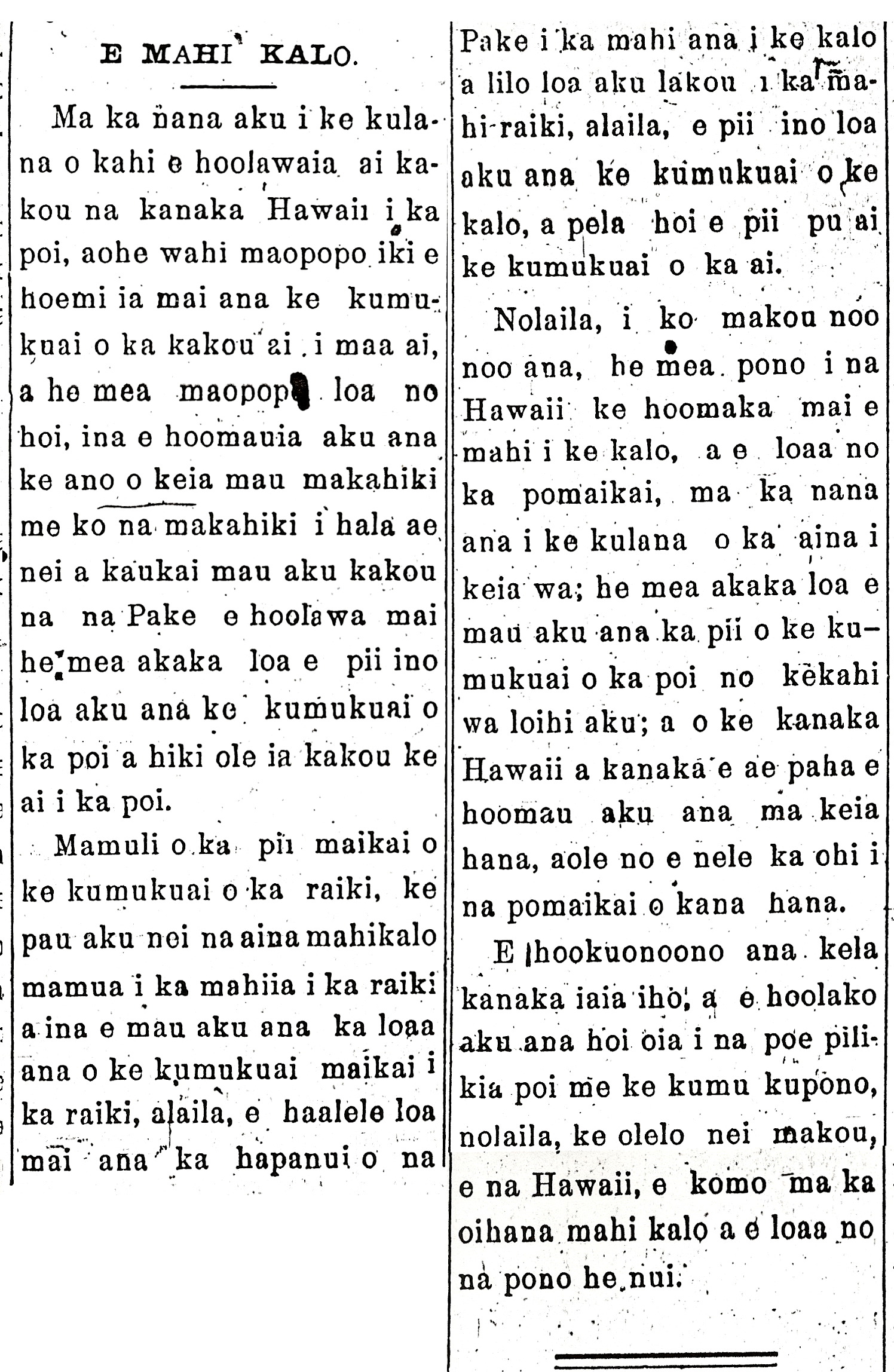
On kalo, poi, and life, 1901.

FARMING KALO.

When considering how we Hawaiians are being supplied with poi, there is not the slightest indication that the cost of our staple food will decrease, and it is also very clear that if what has happened in the past years continues on into the upcoming years, and we continue relying on the Chinese for our supply, it is obvious that the price of poi will shoot up, and we will not be able to eat poi.

As a result of the increase in the price of rice, the former taro lands are being planted with rice, and should the rice market continue to be favorable, then a majority of the Chinese will abandon taro and become rice farmers, then, the cost of kalo will skyrocket, and as a result, so too will the price of poi.

Therefore, in our opinion, Hawaiians should start farming kalo, and obtain its benefits; looking at the land situation these days, it is very clear that the price of poi will continue to rise for long into the future; and the Hawaiians or others perhaps who continue this occupation will not fail to reap its benefits.

That man will make himself prosper and he will supply those who are lacking poi at a fair price, and so we say, O Hawaiian people, go into the occupation of kalo farming, and there shall be many blessings.

[While rice is no longer being planted here, perhaps in its place are being planted buildings. What is there to be done today?]

(Lahui Hawaii, 6/22/1901, p. 4)

E MAHI KALO.

Ka Lahui Hawaii, Buke III, Helu 25, Aoao 4. Iune 22, 1901.


Rice cultivation in Hana, Maui, 1862.

[Found under: “NEWS OF HAWAII NEI.”]

RICE.—We are overjoyed to see that rice is planted by one of our friends, S. Kamakahiki, in Hana, East Maui; there is a lot of grain and it is of good quality; why O Friends, are you dallying on planting this good source of money? We are amazed at the small number of people undertaking the growing of rice in Hana, for this is how it is, according to the letter of S. Kamakahiki, like this:

“I am the only one growing Rice here in Hana; I am harvesting the Rice and storing it at my house; I am filled with joy that I have found this good occupation.”

(Kuokoa, 2/15/1862, p. 2)

Raiki.

Ka Nupepa Kuokoa, Buke I, helu 12, Aoao 2. Feberuari, 15, 1862.

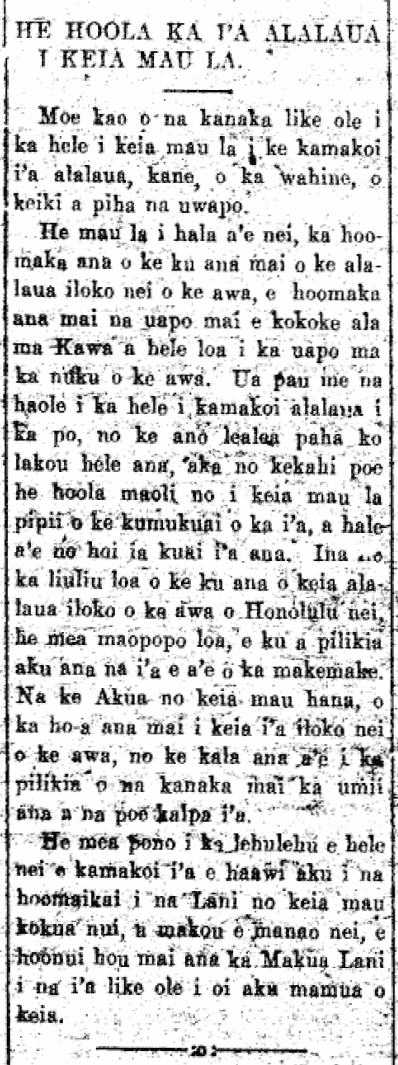
Big run of alalaua, 1917.

THE ALALAUA¹ FISH IS A LIFE SAVER THESE DAYS.

All sorts of people are heading together these days to go pole fishing for alalaua: the piers are full of men, women, and children.

A few days ago is when the run of alalaua began by the piers near the prison of Kawa all the way until those by the mouth of the harbor. Even the haole went alalaua fishing at night, probably just for fun; however, for some, it is a true lifesaver, with the high cost of fish, where they can escape from buying fish [??]. If the alalaua keeps running in Honolulu Harbor, it is clear that the other desired fishes will be in trouble. God is the one who is controlling this, the prodding of this fish into the harbor; it is to alleviate the troubles of the people from the vise of the fish mongers.

All those going pole fishing should give their thanks to the Heavens for this great assistance, and we believe that the Heavenly Father will increase all kinds of fish more than this.

¹Alalaua (also seen as Alalauwa) is the juvenile stage of the Aweoweo.

(Aloha Aina, 9/14/1917, p. 4)

HE HOOLA KA I'A ALALAUA I KEIA MAU LA.

Ke Aloha Aina, Buke XXII, Helu 37, Aoao 4. Sepatemaba 14, 1917.