This is an independent blog. Please note that I am nowhere near fluent, and that these are not translations, but merely works in progress. Please do comment if you come across misreads or anything else you think is important.
[Found in “HE MOOLELO NO KAMEHAMEHA I, Ka Na=i Aupuni o Hawaii”]
Ahuula, the father, the son of Keawe, the King of Hawaii; and Kaupekamoku, the mother. Kaiana sailed for Kauai and his brothers stayed on Kauai, they being Namakeha and Nahiolea.
When Kaiana stopped at Hawaii, he met with Kamehameha, and Kamehameha made Kaiana one of his favorites (as is usual of Kamehameha, who cherished all of the living). Kaiana gave Kamehameha many rifles and cannons. Kamehameha held back Kaiana to remain on Hawaii, saying:
[Found in “HE MOOLELO NO KAMEHAMEHA I, Ka Na=i Aupuni o Hawaii”]
On this return of Kaiana from China, the ship did not stop here in Hawaii first, but past all the shores of America, and there the ship went trading for a long period; so all of the animals that were given him died. On the ship’s sail to Hawaii, they heard of Kaeo’s bad intentions toward him, so they sailed all the way and arrived at Hana, Maui on December 6, 1788 and from there they arrived at Kealakekua.
[Found in “HE MOOLELO NO KAMEHAMEHA I, Ka Na=i Aupuni o Hawaii”]
There were a great many ships from other lands that stopped here in Hawaii from 1786 to 1790, the year that Kamehameha traveled to war with Maui.
In the month of August 1786, the ship Nootka, commanded by captain Meares, stopped here. And this is the ship that took Kaiana to Kahiki, that being Canton, China. It is said that there were three Hawaiians who traveled with Kaiana on this journey to China, to the city of Canton. It was reported that when Kaiana folks were in the city of Canton, they were welcomed by the British who were living there.
On the 3rd of March the whaling ship Gay Head, Captain Shorey, left from the port of San Francisco on the 18th of December last year, made a stop at this port. The ship sailed slowly while keeping a lookout for spouting whales. And on the birthday of George Washington, with the ship far outside of Kealakekua, they spotted five sperm whales [kohola pama] spouting, so they chased and speared them with harpoons, after they were caught, they worked at rendering the oil. Continue reading →
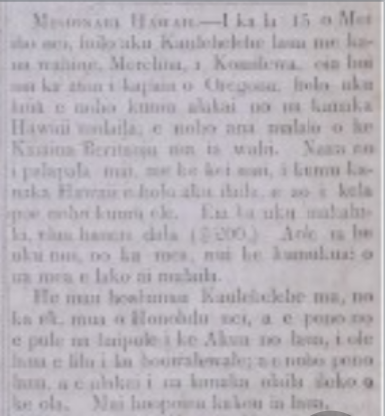
Hawaiian Missionaries.–On the 15th of May past, Kaulehelehe and his wife Merelina sailed for Komilewa, that being the land called Oregon; they went to live there as teachers for the Hawaiians there who live under the British Governor there. It was he who wrote requesting that Hawaiian teachers sail there to teach those people who are living without a teacher. This is the annual salary, two hundred dollars ($200). That is not a lot of money, because the cost of living there is high.
Kaulehelehe folk are members of the first church of Honolulu, and the devout must pray to God for them lest they be lost to temptation; and that they live properly and guide the people there in life. Let us not forget them.
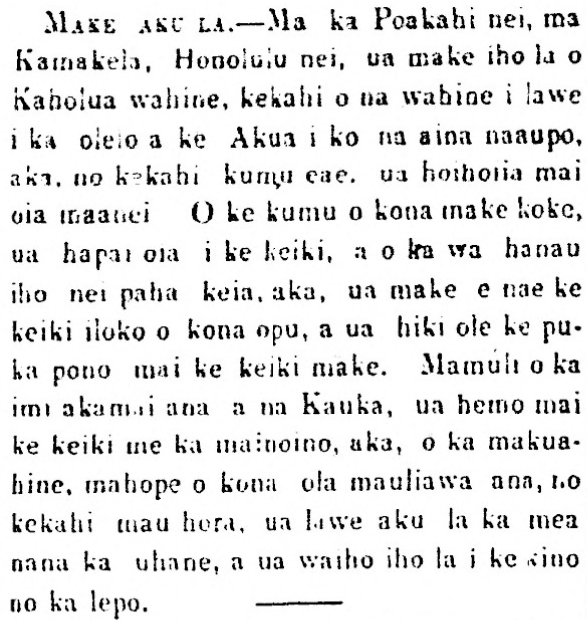
Died.–This past Monday, at Kamakela, here in Honolulu, Kaholua wahine, one of the women who took the word of God to the ignorant lands, but for other reasons she was returned here. The cause of her quick death was that she was pregnant, and perhaps it was while she was giving birth, the baby died within her belly, and the dead baby could not come out. Because the doctors’ skillful attempts, the child was expelled disfigured, but as for the mother, after she gasped for life for some hours, the one who belongs the soul took hit away, and left the body behind for the earth.
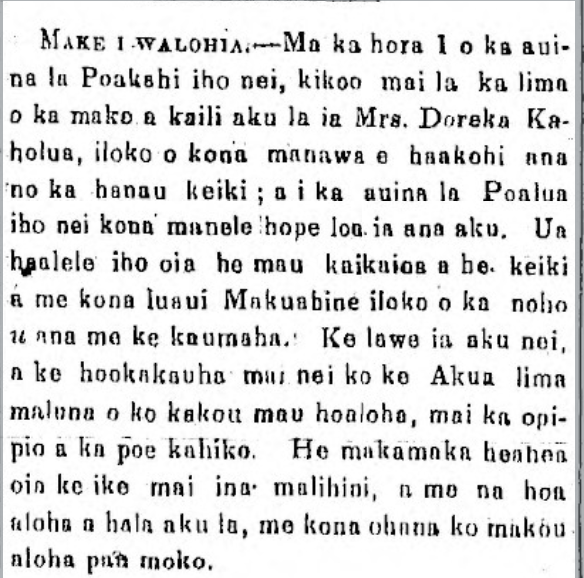
A Sorrowful Death.–At 1 o’clock in the afternoon, this past Monday, the hand of death reached out and snatched Mrs. Doreka Kaholua while she was bearing down giving birth; and on Tuesday afternoon she was carried away for all times. She left behind a number of younger siblings and a child, and her birth mother who grieve for her. God’s hand stretches out above our friends, from the young to the old. She was a welcoming host, should she see a stranger or friends, until she passed. With her family goes our sympathy.
(Au Okoa, 9/16/1869, p. 2)
Ke Au Okoa, Buke V, Helu 22, Aoao 2. Sepatemaba 16, 1869.
Did you see Bishop Museum’s He Aupuni Palapala blog the other week about Hawaiians in the Marshall Islands? See more about the Daniela and Doreka Opunui. Click here.
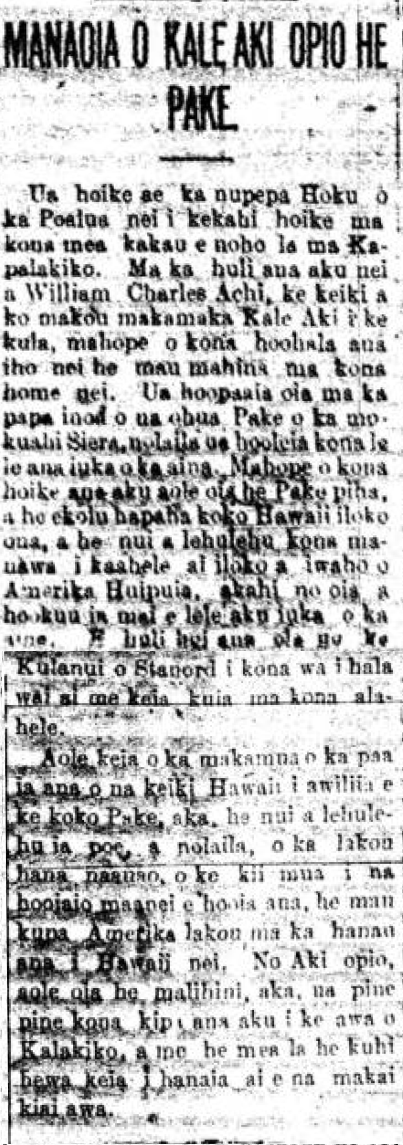
This Tuesday’s Star published a report from a correspondent living in San Francisco. When William Charles Achi, the son of our friend Kale Aki, was returning to school after spending some months at home, his name was on the list of Chinese passengers on the steamer Sierra, so he was not allowed to debark. After he stated he was not full Chinese and that he was three-fourths Hawaiian, and that he traveled in and out of the United States many times, and this was the first time he was released to go ashore. He was returning to Stanford University when he met with this obstacle on his trip.
This wasn’t the first time that a Hawaiian with mixed Chinese blood was detained, but there were many of those people, Therefore the wise thing for them to do would be to get in advance proof that they are American citizens by being born in Hawaii nei. Achi Jr. is not a stranger, but he has frequently visited the port of San Francisco, and it is as if this was an error carried out by the port security officers.
Also, did you see the quilt the Achis gifted to the family W. C. Achi Jr. was staying with in Chicago posted by Bishop Museum the other day? Click here to check it out.]
[Found under: “HE LETA MAI KO NA AINA E, KAKAUIA E REV. Z. S. K. PAALUHI.”]
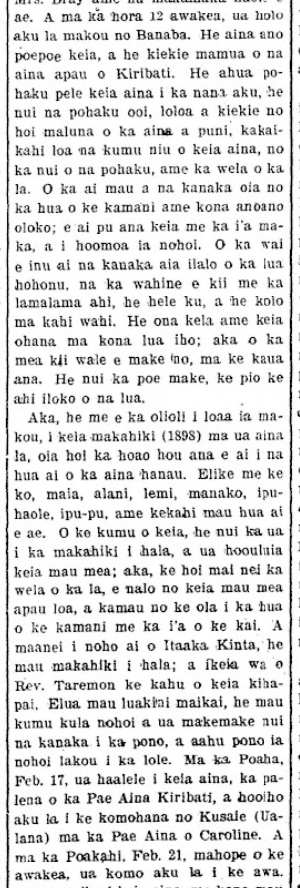
…And at 12 noon we sailed to Banaba. This is a land that is somewhat circular, and it is higher than all of the other lands of Kiribati. This land appears to be a heap of volcanic rock. There are a lot of sharp, long, and tall rocks all over on this land, and there are very few coconut trees, because of the many rocks and the heat of the sun. The fruit of the kamani and the seed within is the staple food of these people; this is eaten together with raw fish, and it is also cooked. Water that is drunk by the people is below in deep caves; the women fetch it with torches. You walk standing upright and some places you crawl. Each family are the owners of their own cave; and if someone just takes [without permission], they will die in war. There are many who die when the torch goes out in the cave.
But we are extremely joyful this year (1898) on that land, that is because we are trying once more to eat the fruits of our land of birth. Like sugarcane, banana, orange, lemon, mango, watermelon, pumpkin, and some other fruits. The reason for this is that there was a lot of rain this past year, and these things were grown; but the heat from the sun is returning and all of those things will disappear. Life is sustained with the fruit of the kamani and the fish of the sea. It was here that Itaaka Kinta used to live some years ago; and these days Rev. Taremon is the pastor of this parish. There are two fine churches, some school teachers, and the people greatly desire righteousness, and they wear clothes correctly. On Thursday, Feb. 17, we left this land, the edge of the Kiribati Archipelago, and went west for Kusaie (Ualana) in the Caroline Archipelago.
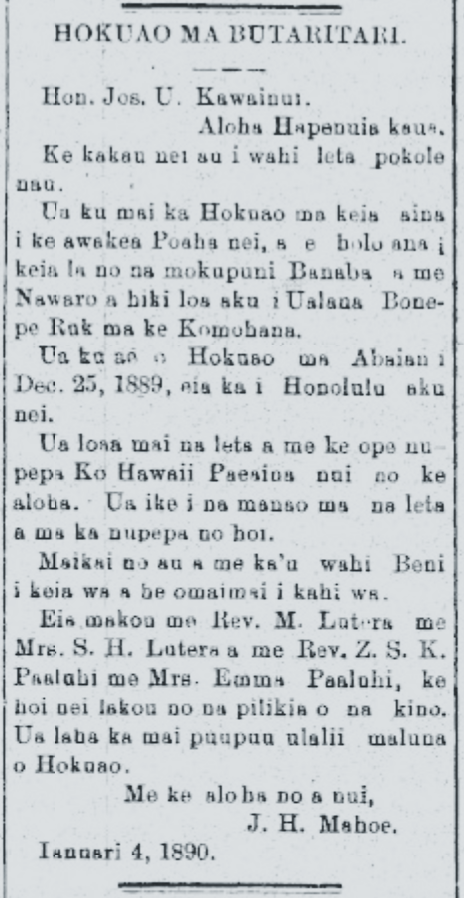
The Morning Star stopped at this land on midday Thursday, and today it sails for the islands Banaba and Nawaro and all the way to Ualana, Ponape, Ruk in the West.
The Morning Star [Ka Hoku Ao] stopped at Abaiang on Dec. 25, 1889, and now is on its way to Honolulu.
We received the letters and the bundle of Ko Hawaii Paeaina newspapers; much aloha. We saw the ideas in the letters and the newspapers as well.
I and my Beni are fine now but sick sometimes.
We are with Rev. M. Lutera [Martina Lutera] and Mrs. S. H. Lutera and Rev. Z. S. K. Paaluhi [Zadaio Solomon Kalua Paaluhi] and Mrs. Emma Paaluhi; the are returning because of health issues. Smallpox has spread on the Morning Star.
With much aloha, J. H. Mahoe.[Joel Hulu Mahoe] January 4, 1890.
(Ko Hawaii Paeaina, 3/22/1890, p. 4)
Ko Hawaii Paeaina, Buke XIII, Helu 12, Aoao 4. Maraki 22, 1890.
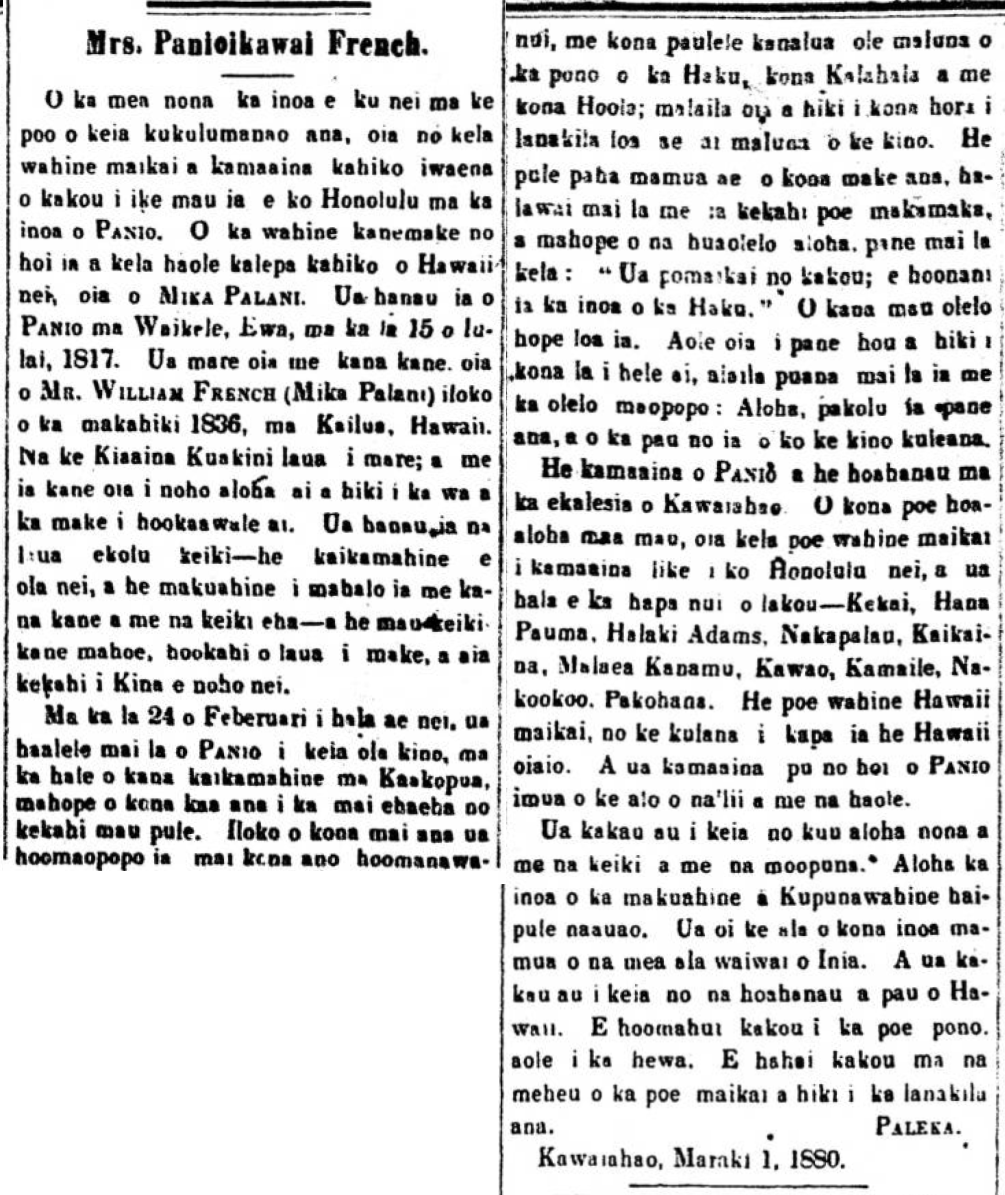
The one whose name appears at the title of this essay, is that fine woman and old time familiar one amongst us who was always known by Honolulu’s people by the name of Panio. She was the widow of that old haole trader of Hawaii nei, that is Mika Palani. Panio was born in Waikele, Ewa, on the 15th of July 1817. She was married to her husband, Mr. William French (Mika Palani) in the year 1836 at Kailua, Hawaii. Governor Kuakini was the one who married the two; and she lived together with her husband until death separated them. They had three children–and a daughter survives today; she is a mother who is respected along with her husband and their four children–there are twin boys, one who has died, and the other lives in China.
On this past 24th of February, Panio left this bodily life, at the residence of her daughter at Kaakopua, after being confined with a painful sickness for several weeks. While sick, her patient nature was apparent, along with her unwavering faith in the righteousness of the Lord, her Savior and her Salvation; and there she remained until her hour in which she was victorious over her body. There perhaps was a prayer before her death; met with her were some friends, and after words of aloha, she responded: “We are blessed; praised be the name of the Lord.” Those were her very last words. She did not say anymore until the day she left, when she said clearly: “Aloha,” three times and her bodyʻs function was over.
Panio was a familiar and a brethren of Kawaiahao Church. Her constant friends were the fine women who were also kamaaina to the people of Honolulu, and most of them have passed on–Kekai, Hana Pauma, Halaki Adams, Nakapalau, Kaikaina, Malaea Kanamu, Kawao, Kamaile, Nakookoo, Pakohana. They are fine Hawaiian women of the stature referred to as a true Hawaiian. Panio was also a kamaaina in the presence of the alii as well as the haole.
I wrote this down because of my aloha for her and her children and grandchildren. Aloha for that mother and grandmother of devout heart. Her name is more perfumed than the costly perfumes of India. And I write this for all of the brethren of Hawaii. Let us emulate the righteous and not the sinful. Let us follow the footsteps of the good until we overcome.

 nupepa