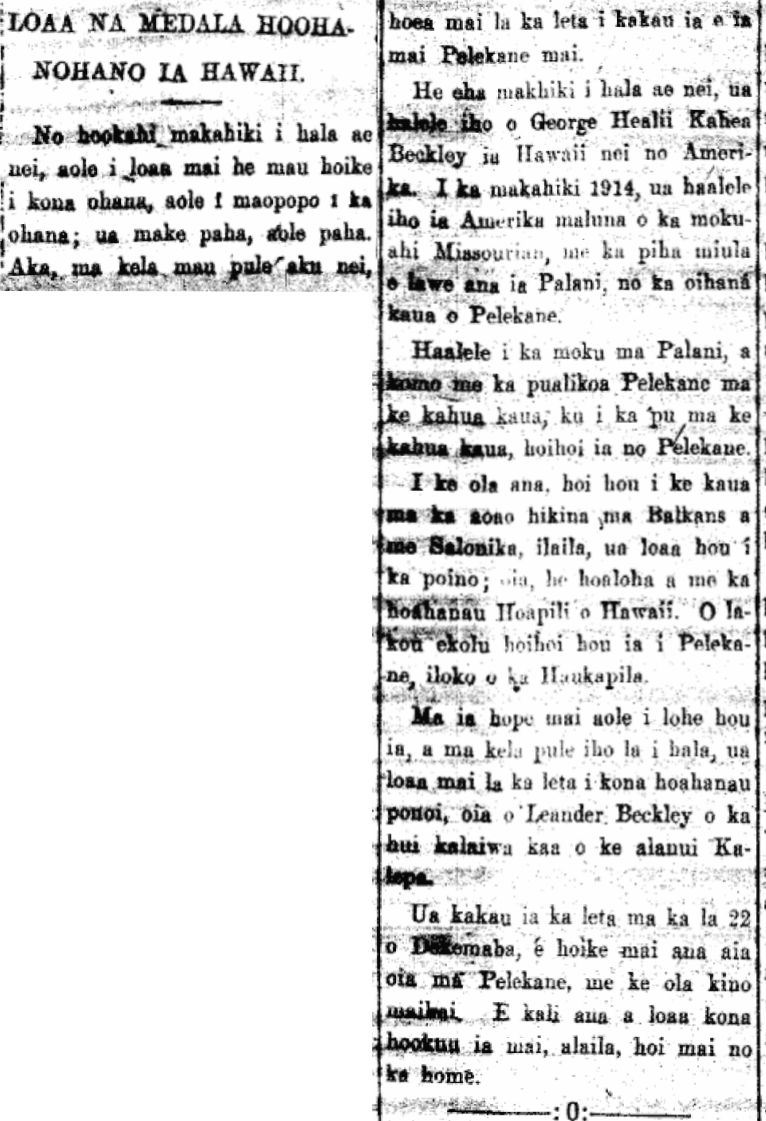
George Healii Kahea Beckley awarded military medal, 1919.

MEDALS AWARDED, BRINGING HONOR TO HAWAII.

For the past year,  there has been no word to his family, and they did not know whether he was dead or not. However, during the past couple of weeks, a letter arrived written by him from Britain.

Four years ago, George Healii Kahea Beckley left Hawaii for America. in 1914, he departed America aboard the steamship Missourian, full of mules to take to France for the armed forces of Britain.

He got off the ship in France, and entered the battlefield with the British Army; he was shot and returned to Britian.

After he recovered, he joined the war once again on the east side at the Balkans and Salonika; there he again faced injury: he, a friend, and his cousin Hoapili from Hawaii. The three of them were returned to Britain to the Hospital.

Thereafter, he was not heard from again, but last week, his cousin, Leander Beckley,  of the group of car drivers of Fort Street, received a letter from him.

The letter was written on the 22nd of December, saying that he was in Britain, and in good health. He is awaiting his discharge, and then he’ll return home.

[I am not sure about the first reference to “four years ago” and then “1914”… Also, does anyone know who this Hoapili refers to?]

(Aloha Aina, 2/8/1919, p. 2)

LOAA NA MEDALA HOOHANOHANO IA HAWAII.

Ke Aloha Aina, Buke XXXIV, Helu 5, Aoao 2. Feberuari 8, 1919.

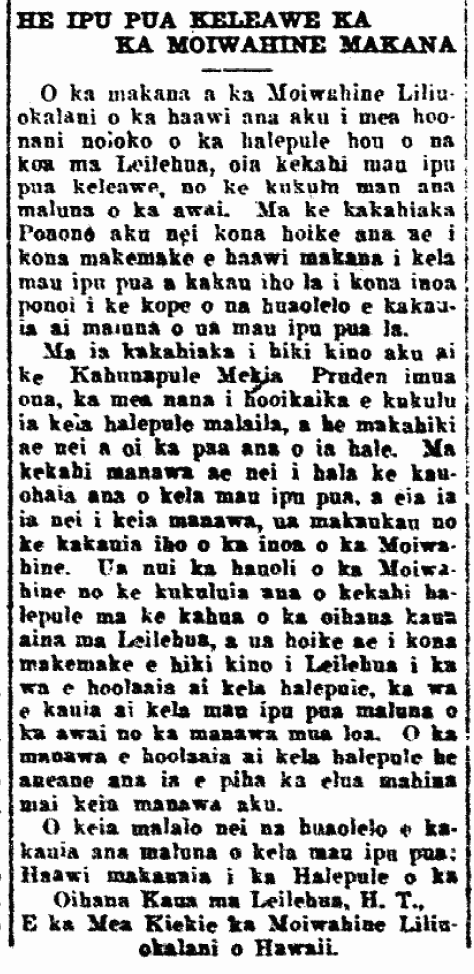
Gift from Liliuokalani to the soldiers of Leilehua, 1912.

BRONZE VASE, A GIFT BY THE QUEEN

The gift of Queen Liliuokalani, given to decorate the interior of the new church of the soldiers of Leilehua, were some bronze flower vases to be always stood upon the pulpit. On the morning of this past Saturday, she told of her interest in presenting the vases, and signed her own name on the paper with the words to be inscribed upon those vases.

On that morning the Chaplain, Major Pruden came before her, the one who worked at getting a church built there, and it took over a year to build. Sometime earlier, they vases were ordered, and here they now are ready to inscribe the name of the Queen. The Queen is overjoyed at the building of a chapel at the military base at Leilehua, and she expressed her desire to go in person to Leilehua when the church is consecrated, when the vases shall be placed upon the pulpit for all times. The date of the consecration of the church is almost two months from now.

Here below are the words inscribed upon the flower vases:

The Armed Forces at Leilehua, H. T.,
By Her Highness, Queen Liliuokalani of Hawaii.

[I wonder where these are today!]

(Kuokoa, 8/9/1912, p. 6)

HE IPU PUA KELEAWE KA KA MOIWAHINE MAKANA

Ka Nupepa Kuokoa, Buke XLVIII, Helu 32, Aoao 6. Augate 9, 1912.

A Touching letter from Diamond Kekona, in far away Britain, to his father in Hawaii, 1916.

LETTER FROM BRITAIN

Dear Papa:–Here are some words for you; my wife and I are healthy, and we are believing that you and the family are doing likewise. My dear wife is completely cured of her sickness, after I put great efforts into finding a cure–partly as a result of the doctors and partly because of the Lord Jesus Christ–as I prayed all the time to the Lord to give health to my wife, as you instructed me earlier.

She was sick for 12 weeks from the time she gave birth, and because of God’s love she regained her health. I take her walking around every day for 2 hours, and she is beginning to eat and regain her weight.

Father, I have joined the armed forces, as I told you earlier. The doctor gave his permission, and I received my papers, to the regiment #30, of married men, under the command of Lord Derby. I wear the symbol of my regiment on my left arm, just as other soldiers do in the army of Britain. I will receive my orders in June or July to proceed to the battlefield without delay for the honor of the Hawaiian people and for the flag of the homeland of my beloved wife.

We will send you a picture on the next boat, and when I receive my uniform, I will send you a picture, and that will be my last picture for who knows how long, but I find my relief in God. Tell August Kekona, don’t come to this land; there are no jobs, no money, there is lack in daily needs; tell him to go to America because it is a land where you can make it, where you can make money and get other things to make you happy. I say this because I was there for many years. Tell him my advice. I am thinking this is enough writing for the time being. Papa, give my love to Kuku Makalohi and uncle, Mrs. Lonohiwa, Bro. August and Hugo Kekona, and the rest of my love, to you my Papa. You son,

DIAMOND KEKONA,
87 Blackwell St., Kidderminster, England.

Aloha Papa:–Here are some thoughts to you, those being these: I am doing well, I am over my sickness, because of the tireless efforts of my loving Daimana for me.

Papa, tell August Kekona, don’t leave Hawaii. If he listens to my advice, he will be happy; he should live in Honolulu with you. There is no work for men here; women work, and take care of their husbands. Women are more than half of the workforce here in Britain now. Also, the pay here is very low. Papa, you are probably puzzled that my Daimana has joined the 30th regiment of married men, under the command of Lord Derby. I believe that this war is one of the worst; I am very afraid. There will be many more casualties of the men joining this war–both from the Allied side and the German side, before the war is over.

Daimana and I sent our picture to you, but my picture isn’t so good because I have just recovered from my sickness. I will go again later to take a picture and send it to you. I look at my picture and it is as if I am a totally different girl. I think I will end here. I wish you and everyone there the best in this new year. Papa, don’t forget to give my aloha to Mrs. Lawe Lonohiwa (I will write her when I have some time). Give my love to August Kekona. Your daughter,

AMY KEKONA.
78 Blackwell St., Kidderminister, England.

(Kuokoa, 2/18/1916, p. 2)

LETA MAI PELEKANE MAI.

Ka Nupepa Kuokoa, Buke LIV, Helu 7, Aoao 2. Feberuari 18, 1916.
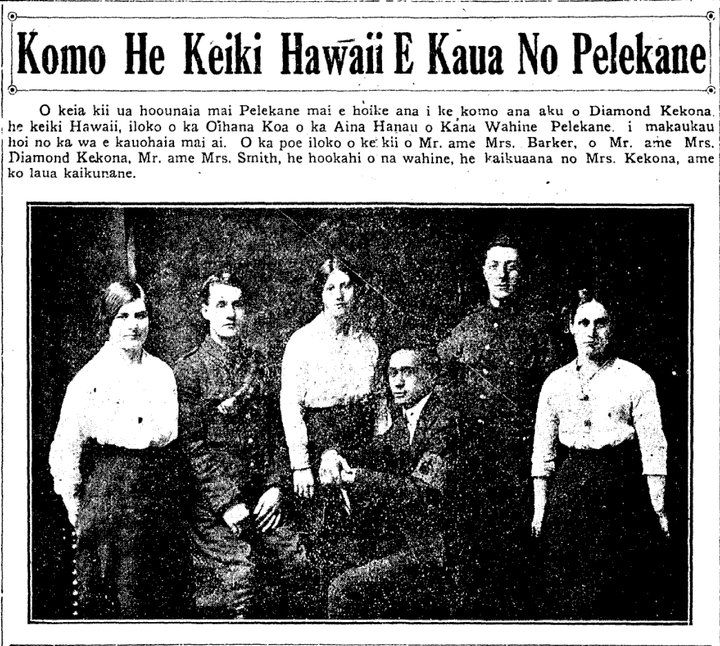
Speaking of Hawaiians serving in the military, does anyone remember Diamond Kekona? 1916.

A Son of Hawaii Goes to War for Britain

This picture was sent from Britain giving notice that Diamond Kekona, a Hawaiian, was enlisting in the Military of the homeland of his wife, Britain. He is prepared for when he will be called to service. Those in the picture are Mr. and Mrs. Barker, Mr. and Mrs. Diamond Kekona, and Mr. and Mrs. Smith. One of the women is an older sister of Mrs. Kekona’s. And one of the men is their brother.

[When i was posting to the old Hoolaupai Face Book page, there were many letters sent by Diamond Kekona from England to his father Dick [Richard Kekona] which were posted. If anyone wants to see them reposted here, where they will be easily searchable, i can do that. I will post the first letter i found in the papers right after this as an example.]

(Kuokoa, 3/31/1916, p. 1)

Komo He Keiki Hawaii E Kaua No Pelekane

Ka Nupepa Kuokoa, Buke LIV, Helu 13, Aoao 1. Maraki 31, 1916.

More Hawaiians serving in the military, 1922.

A LETTER FROM A SON TO HIS MOTHER.

A Hawaiian boy whose name is John Gilman Kealoha, who is working on the Submarine R—23, as the one who operates the Radio aboard that submarine mentioned, wrote a letter on the 26th of this past August, to his mother, Mrs. Cecilia J. Kealoha of this town, describing how he is living and also the love he has for his parents; and the thoughts in his letter written in English can be seen translated for the benefit of the readers of the Kilohana [“the Foremost,” an epithet for the Kuokoa], below:

U. S. S. R.—23,

New London, Aug. 26, 1922.

My beloved mama:—

I am writing to tell you that I’m currently working aboard the Submarine U. S. S. R.—23 as the one who operates the Radio Telephone. I have submerged 22 times from when I first boarded this vessel. Our captain is good, and so are the 30 people aboard this craft. I am in good health and I hope you two are as well, as well as everybody else living at home. Our submarine will leave here to travel on to Norfolk, Virginia with another submarine, the R—27, and while in Norfolk, the ship will be filled with fuel and food supplies and from there it will travel to Charleston, Key West, and then to New Orleans to gather for when the convention of delegates will meet, and there the submarines will show how they submerge so the people there can see, and the rest of the time will be spent by us at Coco Solo, near the Panama Canal [alawai o Panama], where the submarines will stop.

Mama, in my opinion, it is for the best if younger brother, Kalei, stays with you two at home always; he was paid two months ago; if he is at home, give him a lot of my aloha, and also to the people at home; this way, I know that I will get word by letter from some of them, mainly from Younger brother Herman and sister, and from you two as well.

It has been nearly three years that I’ve been away from home, and it is you mama who I think a lot about, and papa as well; and it is for you two that I always pray at night and day, until we meet once again. I wrote to you before this, but I did not receive a reply to that letter, maybe you sent one, but I didn’t receive it, maybe because you sent it to the wrong address; here is where to write again:

JOHN GILMAN KEALOHA,

U. S. S. R.—23,

New London, Conn.

O Mama, I just put in money into my savings again, at the Navy Savings Bank, [83 Sands Street], Brooklyn, N. Y.; I’m putting away $20 a month, and when my money accumulates, I will send it to the Bank of Hawaii in Honolulu by remittance. I have the number of that Bank book with me.

I have decided to spend my New Year (Nu I-a) at Coco Solo. I end here and wait for your reply.

Give my big aloha to papa and all the family and friends at home.

From your loving child,

JOHNNIE.

[If this is the same person as the “John Kealoha Gilman” whose grave at Punchbowl is recorded here, he was only 16 years old in 1922…]

(Kuokoa, 10/12/1922, p. 7)

HE LEKA NA KEKAHI KEIKI HAWAII I KONA MAKUAHINE.

Ka Nupepa Kuokoa, Buke LXI, Helu 41, Aoao 7. Okatoba 12, 1922.