
Eddie Bush, Hawaiian, Sees Hawaii First Time
Take the musical notes C to G and you have a tenor, go higher from G to C and you have a head tone singer, then from that C to F you have a falsetto crooner. Go Still higher, an octave above high C, and you’ve got—Eddie Bush.
Eddie Bush, the Hawaiian who until this week never saw Hawaii, has puzzled the best musical authorities with that voice of his. Finally they decided to call him a lyric soprano.
“It may be the proper technical name,” says Eddie, “but it sounds kind of sissy to me.”
The young singer—he’s 21—is here with Mel Peterson and Earl Randall for the opening of the Club Morocco and for a series of radio appearances.
Born On Mainland
This is because back in 1901 Eddie’s mother and father left Hawaii for professional careers on the mainland, his mother being an actress and his father a composer. Eddie, then, was one of five children born on the mainland.
At the age of four years, believe it or not, Eddie began his professional career, appearing as a kid singer on the stage. And continued to appear until he was 14 when, his voice changing, he lost his singing voice. For a whole year the lyric beauty of his voice was stilled. Then the triumphant return.
At tender 15 Eddie teamed with Paul Gibbon and Bill Seckler as the Biltmore Trio, a combination that clicked well enough to become nationally famous. From then on it was roses for the young singer. The records show him with his own trio, including Russ Colombo and Art Fleming, with the Three Rhythm Boys, one of whom was Bing Crosby, with his own bands appearing on the west coast, in Cincinnati, in Texas; at the Palace theater in New York, and with Phil Harris at the Coconut Grove, appearing variously on the stage, in night clubs and over the radio.
Double In Movies
Then there was an interlude in…
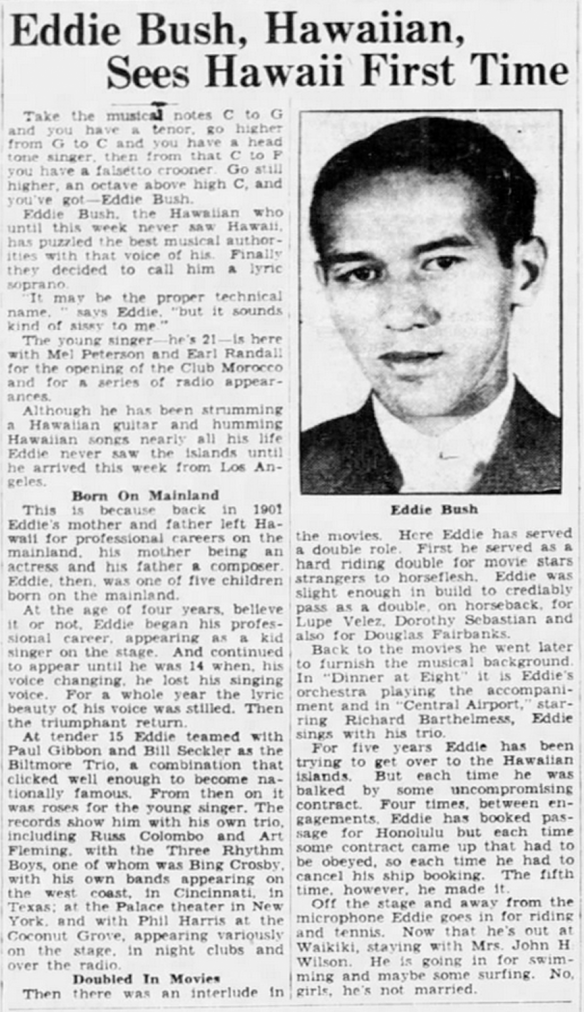
Eddie Bush
…the movies. Here Eddie has served a double role. First he has served as a hard riding double for movie stars strangers to horseflesh. Eddie was slight enough in build to crediably pass as a double, on horseback, for Lupe Velez, Dorothy Sebastian and also for Douglas Fairbanks.
Back to the movies he went later to furnish the musical background. In “Dinner at Eight” it is Eddie’s orchestra playing the accompaniment and in “Central Airport,” starring Richard Barthelmess, Eddie sings with his trio.
For five years Eddie has been trying to get over to the Hawaiian islands. But each time he was balked by some uncompromising contract. Four times, between engagements, Eddie has booked passage for Honolulu but each time some contract came up that had to be obeyed, so each time he had to cancel his ship booking. The fifth time, however, he made it.
Off the stage and away from the microphone Eddie goes in for riding and tennis. Now that he’s out at Waikiki, staying with Mrs. John H. Wilson. He is going in for swimming and maybe some surfing. No girls, he’s not married.
(Star-Bulletin, 10/28/1933, p. 5)
Honolulu Star-Bulletin, Volume XLI, Number 13017, Page 5. October 28, 1933.
 nupepa