This is an independent blog. Please note that I am nowhere near fluent, and that these are not translations, but merely works in progress. Please do comment if you come across misreads or anything else you think is important.
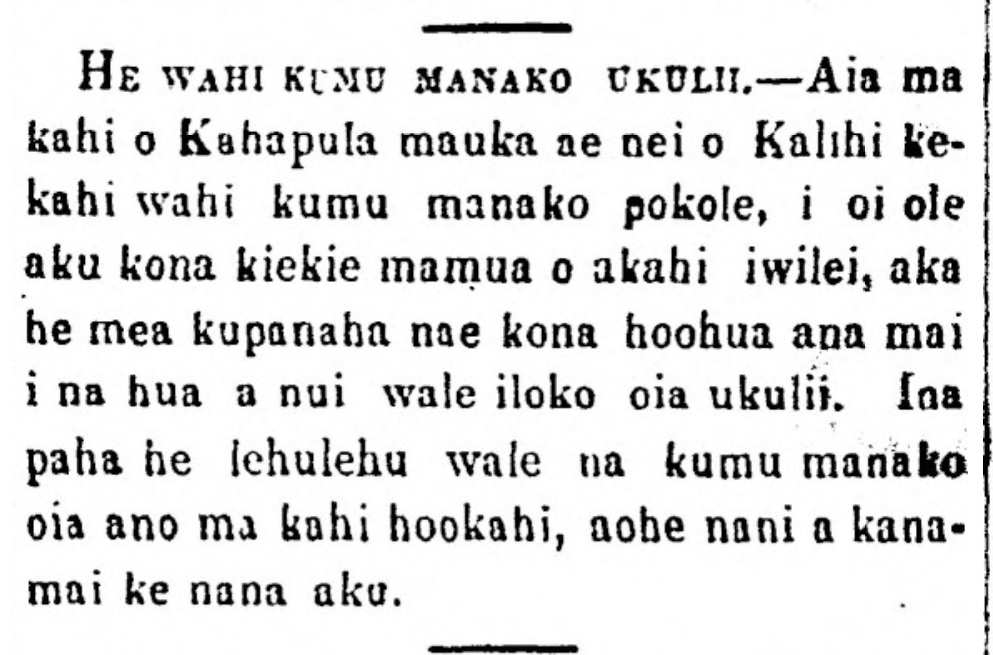
A tiny mango tree.–At Kahapula’s1 place in the uplands of Kalihi, there is a short mango tree, its height not more than an iwilei.2 But it is amazing that while it is so tiny, it produces so much fruit. Should there be many of those mango trees in one place, there would be nothing more beautiful to see.
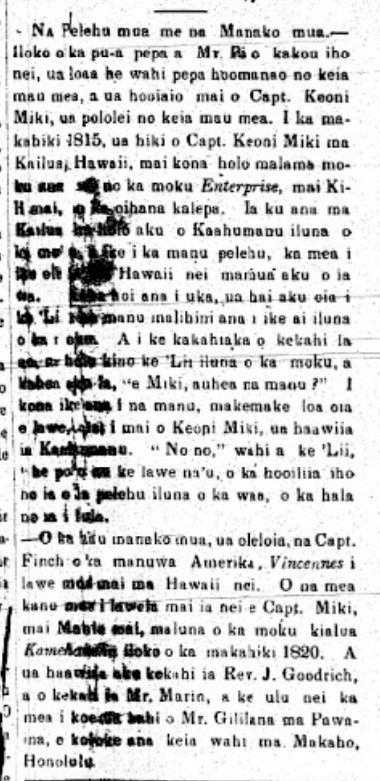
The first Turkeys and the first Mangoes.–In the sheaves of paper belonging to our Mr. ???, there was a memo pertaining to these things, and Captain John Meek [Capt. Keoni Miki] confirmed the information. In 1815, Capt. John Meek arrived in Kailua, Hawaii, as a mate of the ship Enterprise, from Chili, on a trading voyage. When he landed in Kailua, Kaahumanu boarded the ship and saw the turkeys, which were not seen here in Hawaii before that. She went back to shore and told the King about the unfamiliar birds she saw on the ship. In the morning of some following day, the King boarded the ship in person and called out, “O Miki, where are the birds?” When he saw the birds, he very much wanted to take them, but John Meek said that they were given to Kaahumanu. “No, no,” said the King, “I should take them for myself.[“] They were placed upon a canoe and taken ashore.
The first mango tree, it is said that it was Capt. Finch of the American warship Vincennes who first brought it to Hawaii nei. The first plants imported by Capt. Meek from Manila [Mania], were aboard the double-masted Kamehameha in 1820. Some were given to Rev. J. Goodrich, and some to Mr. Marin, and the others are growing at Mr. Gilliland’s place at Vineyard; this place is near Makaho, Honolulu.
(Ko Hawaii Ponoi, 6/18/1873, p. 2)
Ko Hawaii Pae Aina, Buke I, Helu 1, Aoao 2. Iune 18, 1873.
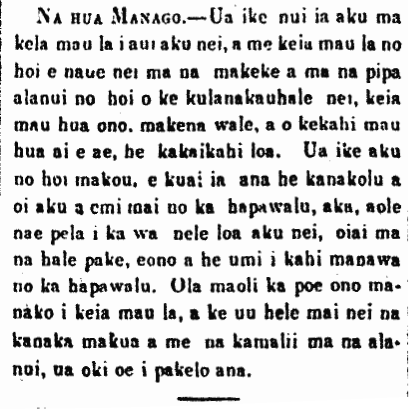
Mango Fruit.—The past days, and these days as well, a lot [makena wale] of this delicious fruit is seen often at the markets and on the street sides of this town, but other fruits are very rare. We have seen thirty or more or less being sold for an eighth of a dollar [hapawalu], but it was not so recently when there wasn’t any; at that time at the Chinese stores it was six or ten for an eighth of a dollar. Those who crave mango are saved these days, and the adults and children peel them as they walk about the streets; and much is the diarrhea.
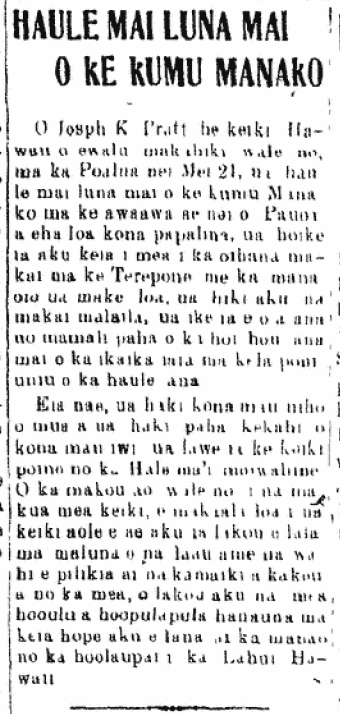
Joseph K. Pratt, a Hawaiian boy of just eight years of age, on this Tuesday, the 21st of May, fell from a Mango tree in Pauoa Valley, and his cheek was severely hurt; this information was given to the police department over the Telephone with belief that he was dead, but the police arrived there and it was seen that he was alive, perhaps because he regained consciousness from the dizziness after falling.
However, he broke his front teeth and maybe he broke some of his bones; the injured child was taken to Queen’s Hospital. Our instruction to parents of children is to watch over them and not allow them to climb on trees and places that would put the children of ours in danger, for they are the ones who will increase and procreate the generations here forward and through which there is hope for the increase of the Hawaiian Race.
[Words to live by: whether in 1912 or a hundred years later in 2012.]
(Kuokoa Home Rula, 5/24/1912, p. 1)
Kuokoa Home Rula, Buke X, Helu 21, Aoao 1. Mei 24, 1912.


 nupepa