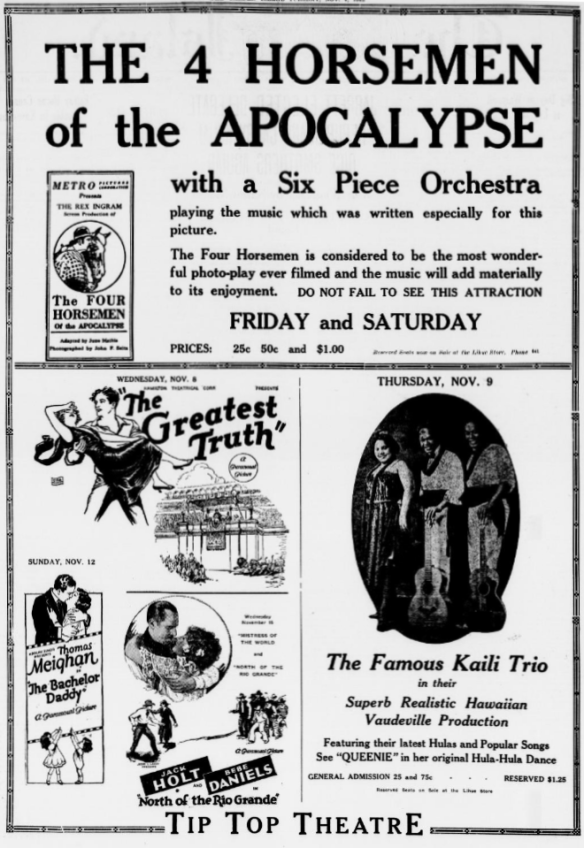
Kaili Trio performing at Kauai’s Tip Top Theatre, 1922.

THE 4 HORSEMEN of the APOCALYPSE

with a Six Piece Orchestra

playing the music which was written especially for this picture.

The Four Horsemen is considered to be the most wonderful photo-play ever filmed and the music will add materially to its enjoyment. DO NOT FAIL TO SEE THIS ATTRACTION

FRIDAY and SATURDAY

PRICES: 25c 50c and $1.00 Reserved Seats now on Sale at the Lihue Store, Phone 641

WEDNESDAY, NOV. 8

HAMILTON THEATRICAL CORP. PRESENTS

“The Greatest Truth”

A Paramount Picture

SUNDAY, NOV. 12

ADOLPH ZUKOR PRESENTS

Thomas Meighan in “The Bachelor Daddy”

A Paramount Picture

Wednesday

November 15

“MISTRESS OF THE WORLD

and

“NORTH OF THE RIO GRANDE”

JACK HOLT AND BEBE DANIELS

in

“North of the Rio Grande”

THURSDAY, NOV. 9

The Famous Kaili Trio

in their

Superb Realistic Hawaiian
Vaudeville Production

Featuring their latest Hulas and Popular Songs
See “QUEENIE” in her original Hula-Hula Dance

GENERAL ADMISSION 25 and 75c – – – RESERVED $1.25

Reserved Seats on Sale at the Lihue Store

TIP TOP THEATRE

(Garden Island, 11/7/1922, p. 2)
GardenIsland_11_7_1922_2.png

The Garden Island, Volume 18, Number 45, Page 2. November 7, 1922.

Ernest Kaai’s Hawaiian Troubadours in New Zealand, 1925.

AMUSEMENTS.

“NIGHT IN HONOLULU.”

The ukulele, the hula-hula, and the steel guitar, as entertaining products of Hawaii, are known all over the civilised world that comes under the influence of vaudeville circuits, but such segregated examples as have hitherto been shown in Auckland are mere museum specimens compared with the living actuality of the performance given in His Majesty’s Theatre on Saturday night by Ernest Kaai’s Hawaiian troubadours. These minstrels exhibited ukulele and guitar with all the sweet setting of their native haunts, the strains of the strings enriched by vocal harmonising in which the Hawaiian exccels, and the harmonising enhanced by quaint falsetto and yodelling effects that thoroughly delighted a house packed to the doors.

The curtain rose on a pretty palm-fringed beach scene, when it could be seen, for the house was in darkness when a harmonious chorus of Hawaiian voices, with stringed instrument accompaniment, was lifted in song to welcome the doming dawn. It was a native harmonising chorus set to music by Queen Liliuokalani, and entitled “Aloha Oe,” which swells to a paean of joy as the rising sun lights up the expectant world—in this case quite an effective stage scene. A similar characteristic effort of voice, strings, and light, symbolising twilight, with the stage fading melodiously into darkness, marked the ending of the first part of the programme, while in between dawn and twilight came a series of novel, interesting and thoroughly entertaining items. An Island folk-song by eddie Kniley, a ballad by Frank Luiz, hula dances by Gertila Byrnes and Layley Leywood, and a steel  guitar selection by Thelma Kaai were given with effective voice and string accompaniments. It was the part-singing in trios, however that most captivated the audience. One such number by David Kaili, Thelma Kaai and Eddie Kinley was emphatically encored, but when Queenie and David Kaili and Thelma Kaai appeared in whimsical part songs in which Queenie appeared as a soubrette of talent with a quaint gift for vocal ornamentation, the house was so vastly entertained and amused that the party were recalled four or five times. Continue reading

Hawaiian music in Aotearoa, 1925.

NEW ZEALAND IS JOYFUL WITH HAWAIIAN MUSIC.

A news item published in the newspaper Auckland Star on the 20th of April past described the enthusiasm of the people of New Zealand for Hawaiian songs, given at the concert held by Ernest Kaai and his band which is going around New Zealand.

When one of the concerts opened in the theater, the interior of the theater was decorated with greenery, and the theater was darkened, and when the music began, accompanied by the voices of the singers, it was as if the scene then was the coming of light at the break of dawn; and the audience held their breath when Aloha Oe was sung, as the instruments played along. Continue reading