A description of Honokohau, Maui, 1872.

The Features of Honokohau.

O Nupepa Kuokoa; Aloha oe:

May it please you and your Editor to insert this bundle of aloha in some open space of your depository, and it will be for you to share it amongst our masses.

Looking at the lay of the land, it is a beautiful place indeed; there is a deep river, and there is much taro; the area planted with kalo is approximately 5 miles long.

Pertaining to the evenness of the land.—The flat lands here are on the east side of the river, that being the famous plains of Kalaulaolao, and a mele for this fame is written of by the people of old.

Pertaining to the crops.—Things that are planted grow stuntedly [kakanalii] because of aphids [Eleao]; talk of the Eleao is all over Hilo Paliku. Continue reading
Hui Makaainana Hawaii and the farming of kalo, 1939.

Planting Taro

THE ORGANIZATION HAS STARTED THIS EFFORT

The Hui Makaainana Hawaii has Begun to Work on Land at Kapiolani

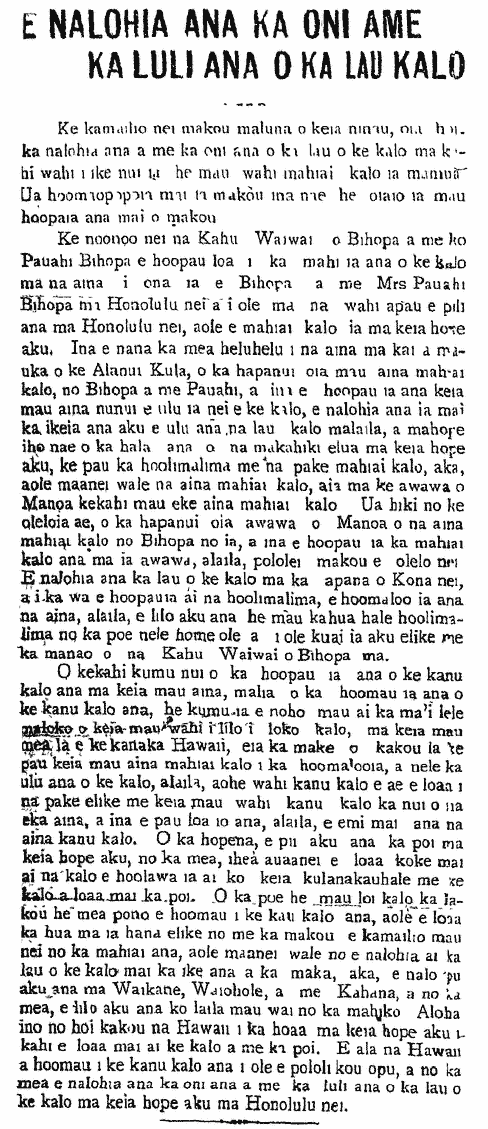
The idea of farming of kalo thought up by the Hui Makaainana Hawaii is now being carried out, according to Johnson Kahili, the chairman of the managing committee [komite hoohana].

The organization received approval to do this on government land near Kapiolani School [ke Kula o Kapiolani], and should the work go well, then perhaps some twenty acres of undeveloped land, nearly four acres, will be farmed, according to him. Continue reading

More on the state of taro, 1911.

Don’t Neglect the Planting of Kalo

It is to you, O Hawaiians, who we strongly encourage in regard to this question about kalo here forward, for large kalo-growing lands here in Honolulu will be dried out and put an end to by those who own them. Should those lands where kalo is being grown today truly be left to dry out, by our estimation, nearly 300 acres of kalo lands will be lost here in Honolulu, or perhaps four hundred or more acres of kalo lands will not be planted anymore. Therefore, to make up for this lost acreage, it is for all of you people outside of Honolulu to plant dry-land taro in fields and small patches, or in large loi where taro can constantly be cultivated.

If you have an abundance of kalo, then feed the sows, the hens, the turkeys, the ducks, and animals from which a person who plants a lot of taro can benefit; for you can eat the kalo, and the animals can eat the stalks [haha kalo], the leaves [luau], the watery residue from poi making [kale ai]; all these things are of great help to the farmer of kalo. Therefore, O Hawaiians, don’t be weary to grow kalo, and don’t neglect this lively endeavor on the land.

(Kuokoa Home Rula, 8/18/1911, p. 2)

Mai Hoopalaleha i ke Kanu Kalo

Kuokoa Home Rula, Buke IX, Helu 33, Aoao 2. Augate 18, 1911.

The inspiration to Alvin Kaleolani Isaacs’ “Eating of the Poi”? 1866.

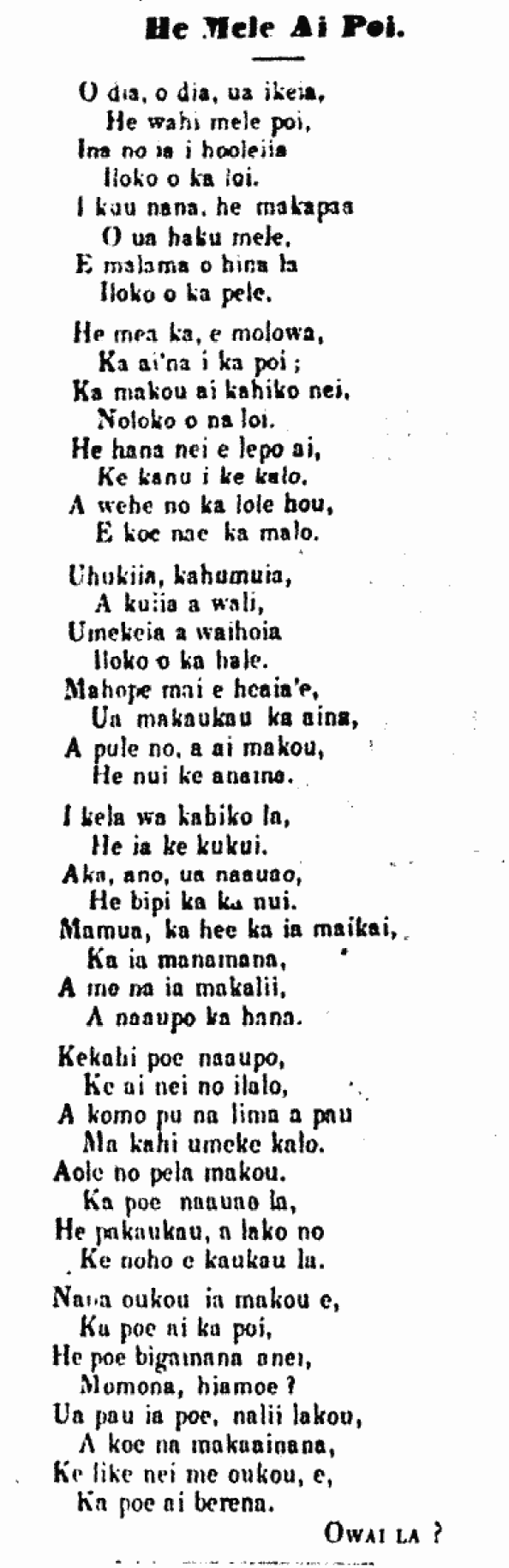
He Mele Ai Poi.

O dia, o dia, ua ikeia,
He wahi mele poi,
Ina no ia i hooleiia,
Iloko o ka loi,
I kuu nana, he makapaa,
O ua haku mele,
E malama o hina la,
Iloko o ka pele.

He mea ka, e molowa,
Ka ai’na i ka poi;
Ka makou ai kahiko nei,
Noloko o na loi,
He hana nei e lepo ai,
Ke kanu i ke kalo,
A wehe no ka lole hou,
E koe nae ka malo.

Uhukiia, kahumuia,
A kuiia a wali,
Umekeia a waihoia,
Iloko o ka hale,
Mahope mai e heaia’e,
Ua makaukau ka aina,
A pule no, a ai makou,
He nui ke anaina.

I kela wa kahiko la,
He ia ke kukui,
Aka, ano, ua naauao,
He bipi ka ka nui,
Mamua, ka hee ka ia maikai,
Ka ia manamana,
A me na ia makalii,
A naaupo ka hana.

Kekahi poe naaupo,
Ke ai nei no ilalo,
A komo pu na lima a pau,
Ma kahi umeke kalo,
Aole no pela makou,
Ka poe naauao la,
He pakaukau, a lako no,
Ke noho e kaukau la.

Nana oukou ia makou e,
Ka poe ai ka poi,
He poe bigamana anei,
Momona, hiamoe?
Ua pau ia poe, nalii lakou,
A koe na makaainana,
Ke like nei me oukou e,
Ka poe ai berena.

Owai la?

(Kuokoa, 3/3/1866, p. 4)

He Mele Ai Poi.

Ka Nupepa Kuokoa, Buke V, Helu 9, Aoao 4. Maraki 3, 1866.