This is an independent blog. Please note that I am nowhere near fluent, and that these are not translations, but merely works in progress. Please do comment if you come across misreads or anything else you think is important.
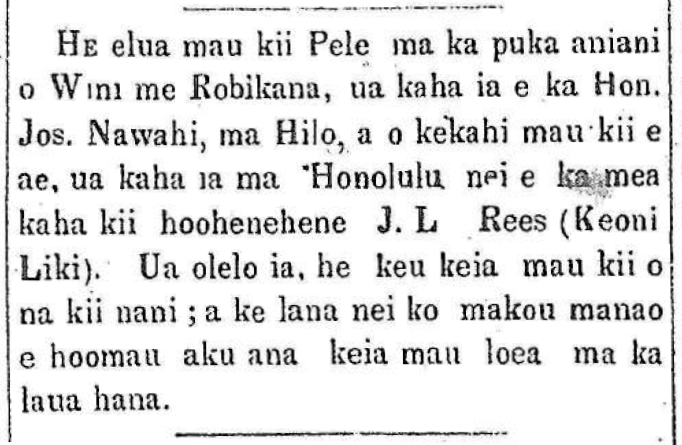
There are two Lava drawings in the window of Whitney and Robinson, drawn by Hon. Joseph Nawahi, at Hilo, and the other was drawn here in Honolulu by the caricaturist, J. L. Reese (Keoni Liki). It is said that these are very beautiful; and we hope these experts will continue with this work.
(Elele Poakolu, 7/13/1881, p. 1)
Ka Elele Poakolu, Buke II, Helu 19, Aoao 1. Iulai 13, 1881.
My favorite Aloha Aina, allow me some space. At 3 o’clock in the afternoon, this past Friday the 26th of May, the breath of my dear Sam P. Lohiau. He was born from the loins of Mr. and Mrs. Kawaa Lohiau, at Okoe, South Kona, and it is the sister of his mother who is writing. He entered Lahainaluna School in the year 1900, and in this coming July he was to graduate from that school.
MEMBERS OF THE HOUSE PREFER THE HAWAIIAN LANGUAGE AND HAVE TAKEN TO DEBATING IN THAT TONGUE WITHOUT ANY INTERPRETATION—LONG DISCUSSION MEANINGLESS TO THE ENGLISH-SPEAKING PUBLIC.
Tomorrow, November 28, is the Independence Day of Hawaii nei, and it will be the fiftieth year of our living as an Independent Nation, and being recognized by the enlightened nations of the world. This is the jubilee year; however, the plunderers believe that they hold the steering paddle and that we will not have a joyful jubilee on that day. What of that; let us be patient, for there will come a day that the lahui will be joyful and be pleased to no end. Hold your breaths! It will come!
(Lei Momi, 11/27/1893, p. 4)
Ka Lei Momi, Buke I, Helu 17, Aoao 4. Novemaba 27, 1893.
Hiram P. Kahele, known to many as “Buck” Kahele, died at 9:45 o’clock yesterday morning at his home, 10 Dewey Court, Waikiki, after a week’s illness. Kahele was a victim of broncho-pneumonia, following influenza. Continue reading →
Mr. Editor of the Kuokoa, Aloha amongst us:—Please allow me once again some open space of the Pride of the Lahui, for my sad offering placed above, so that all of the family from Hawaii to Niihau will see our lei, David Kaonohi Peleiholani, shortened to D. K. Pele Jr., [left this] life in America.
In the happiness of this life and the enjoyment, one becomes dejected when you had not expected sad news would arrive.
The telegraph of Puuloa informed me, “your son, David Kaonohi Pele, died at the navy hospital in America on the 26th of February, 1921, because he had persistent pneumonia for six weeks. Auwe, my sorrow for you! Auwe what anguish!
I thought of my later days with you, my hiapo, for I saw how you help me while you were in front of me, and so…
Because we come across all sorts of names, and because we believe that the Law passed on the 24th of August, 1860; that being the Law called, “An Act to regulate names” [“He Kanawai e hooponopono ana i na inoa”] has not been followed, therefore, we wanted to discuss this Important matter with our friends. So that our friends do not fail to recognize this, we print the aforementioned Law, and here it is:
AN ACT TO REGULATE NAMES.
Be it enacted, By the King, the Nobles and Representatives of the Hawaiian Islands, in Legislative Council assembled:
Section 1. All married women now living, and all that may be married hereafter on these Islands, shall, from and after the passage of this Act, adopt the names o f their husbands as a family name.
Section 2. All children born in wedlock after the passage of this Act…
Be it Enacted, By the King, the Nobles and Representatives of the Hawaiian Islands, in Legislative Council assembled:
Section 1. All married women now living, and all that may be married hereafter on these Islands, shall, from and after the passage of this Act, adopt the names of their husbands as a family name.
Section 2. All children born in wedlock after the passage of this Act shall have their father’s name as a family name. They shall, besides, have a Christian name suitable to their sex.
Section 3. All illegitimate children born after the passage of this Act shall have their mother’s name as a family name. They shall, besides, have a Christian name suitable to their sex.
Section 4. All children up to the age of twenty years shall adopt the names of their fathers as a family name.
Section 5. All names so adopted shall be reported to the agents appointed to take the census of the people during the present year.
Section 6. It shall not be lawful to change any name adopted or conferred under this law. It shall also not be lawful to change any name adopted or conferred before the operation of this.
Section 7. The father or mother of any child born subsequently to the passage of this Act, shall report the name or names of such child to the Registrar of births for the district in which such child was born, within three months after the birth of such child.
Section 8. This law shall take effect from and after the date of its passage.
Approved this 24th day of August, A. D. 1860.
KAMEHAMEHA.
Kaahumanu.
[Unfortunately, the issue in which this law would have been printed in Kumu Hawaii is not available online. 8/15/1860 to 9/5/1860 are not online. It would have read as written below.]
HE KANAWAI E HOOPONOPONO ANA I NA INOA.
E hooholoia e ke Alii me na ‘Lii a me ka Poeikohoia o ko Hawaii Pae Aina i akoakoa iloko o ka Ahaolelo kau Kanawai:
Pauku 1. O na wahine mare a pau e ola nei, me na wahine a pau e mare ia ana ma keia hope aku, ma keia Pae Aina, mai ka la aku o ka hooholo ana o keia Kanawai, e lawe no lakou i ka inoa o ka lakou mau kane i inoa ohana.
Pauku 2. O na keiki a pau i hanauia iloko o ka mare ana, mai ka hooholo ana aku o keia Kanawai, e lawe no lakou i ka inoa o ka makuakane, i inoa ohana. E lawe no hoi lakou i inoa Keritiano kupono no ko lakou ano, he kane a he wahine paha.
Pauku 3. O na keiki kamehai a pau i hanauia mahope o ka hooholo ana o keia Kanawai, e lawe no lakou i ka inoa o ka makuahine i inoa ohana. E lawe no hoi lakou i inoa Keritiano kupono no ko lakou ano, he kane a he wahine paha.
Pauku 4. O na keiki a pau malalo o na makahiki iwakalua, e lawe no lakou i ka inoa o ka makuakane i inoa ohana.
Pauku 5. O na inoa a pau i laweia e like me ia e hoakaka aku no ia, i na luna i hoonohoia e helu i ka nui o kanaka o ka makahiki e noho nei.
Pauku 6. Aole no e ku i ke Kanawai ke hoololiia kekahi inoa i laweia a haawiia paha mamuli o keia Kanawai. Aole no hoi e ku i ke Kanawai ke hoololiia kekahi inoa i laweia a haawiia paha mamua o ke kau ana o keia Kanawai.
Pauku 7. O ka makuakane a makuahine paha o kekahi keiki i hanau ia mamua o ka hooholo ana o keia Kanawai, e hoike aku ia i ka inoa, a mau inoa paha, o ua keiki nei i ka mea nana i kakau i na hanau no ka apana kahi i hanauia’i ua keiki nei, iloko o na mahina ekolu mai ka hanau ana o ua keiki nei.
Pauku 8. E lilo keia i Kanawai o keia Pae Aina mai ka la aku o ka hooholo ana.
Ua aponoia i keia la 24 o Augate, M. H. 1860.
KAMEHAMEHA.
Kaahumanu.
(Polynesian, 9/1/1860, p. 1)
The Polynesian, Volume XVII, Number 18, Page 1. September 1, 1860.

 Ka Lei Momi, Buke I, Helu 17, Aoao 4. Novemaba 27, 1893.
 nupepa