Continuation of O. H. Gulicks letter from Japan, 1871.

LETTER FROM JAPAN.

(Continuation From Last Month.)

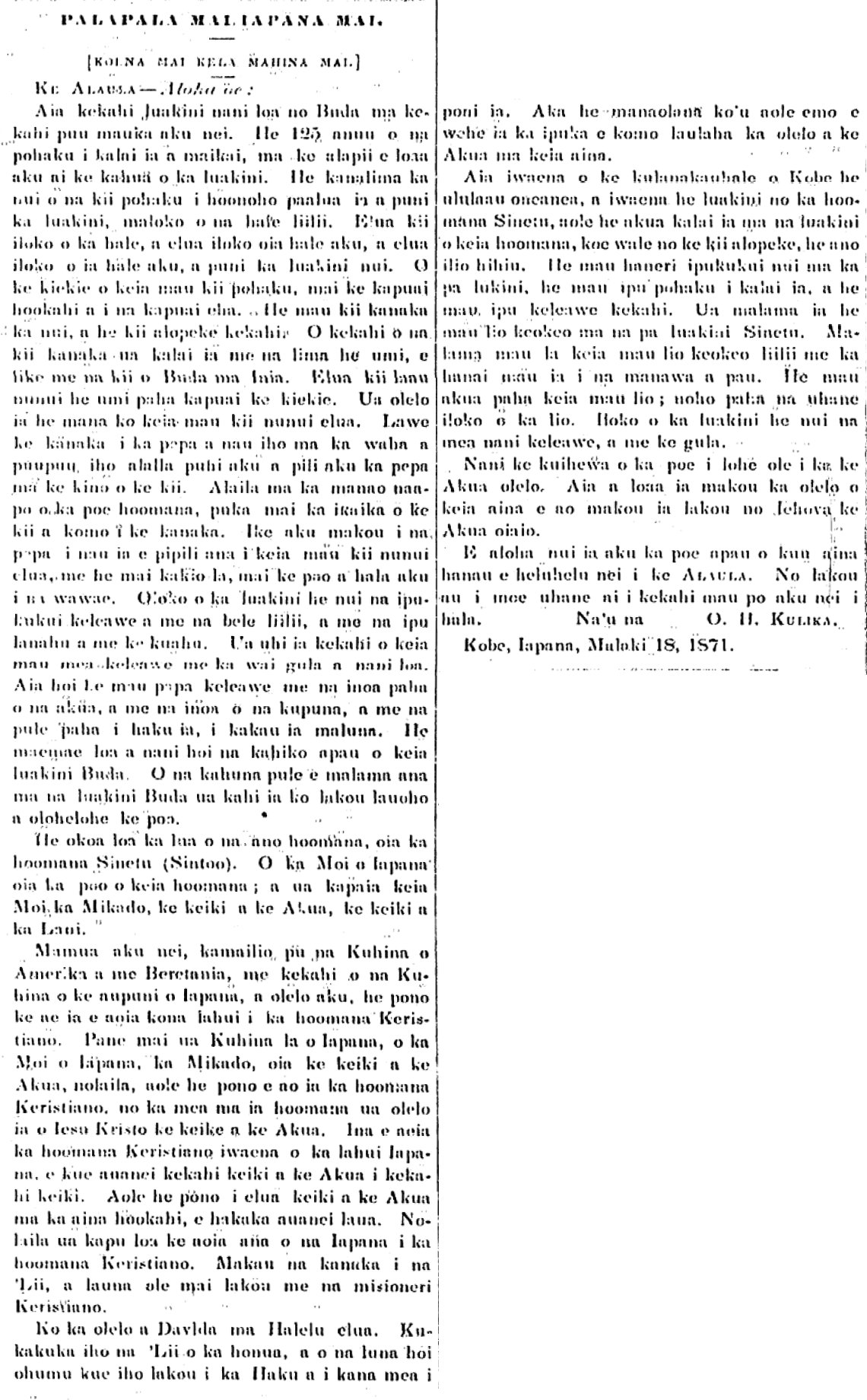
Ke Alauala:—Aloha oe:

There is a beautiful temple to Buddha on a hill inland of here. There are 125 nicely hewn stone steps leading to the grounds of the temple. There are fifty stone statues placed in pairs all about the temple, in small buildings. There are two in one structure, and two in the next, and two in the next, all around the great temple. The height of these stone figures are from one to four feet tall. Most are human figures, but there also some of foxes. One of the human statues was carved with ten hands, like the Buddha statues of India. There are two huge wooden statues maybe ten feet tall. It is said that these two huge figures possess mana. A person a piece of paper and chews it in his mouth until it is wadded up; then he spits it out, sticking it on to the body of the statue. According to the ignorant beliefs of the worshipers, the power of the statue comes out and enters the person. We saw paper that was chewed up and stuck to these two great statues; it looked like a case of rash from head to foot. Within the temple there are numerous metal lanterns and tiny bells, and coal burners and altars. Some of the metal objects are beautifully decorated in gold. There are some metal plates with perhaps the names of the gods and names of ancestors and perhaps prayers that were composed written upon them. All of the decorations within this Buddhist temple are very fine and beautiful. As for the priests caring for the Buddhist temple, their heads are shaved bald.

The second religion is totally different, that being Shinto. The Ruler of Japan is the head of this religion; he is called the Mikado, the child of God, the child of the Heavens.

Earlier, American and British diplomats were talking to those from Japan, and said that the teaching to their people of Christianity should be allowed. The Japanese diplomats said that the Ruler of Japan, the Mikado, was the son of God,  and therefore, it isn’t right to teach Christianity, for in that religion, it is said that Jesus Christ is the son of God. If Christianity is allowed amongst the Japanese people, then one son of God would end up opposing another. There should not be two sons of God in one nation, lest they fight each other. So the teaching of Christianity to the Japanese is strictly prohibited. The people fear the rulers, and do not associate with the Christian missionaries.

According to the words of David in Psalms 2: The kings of the earth set themselves, and the rulers take counsel together, against the Lord, and against his anointed. However, I am hopeful that in no time, the doors will open and the words of God will enter far and wide in this land.

In the city of Kobe, there is a deserted forest, and within it is a Shinto shrine; there is not carved god in the shrine of this religion, except a fox statue, a type of wild dog. There are hundreds of large lanterns on the grounds of this shrine, lanterns carved out of stone, and some metal ones as well. White horses are kept on the grounds of  Shinto shrines. These small white horses are always kept, and they are fed all the time. Perhaps these horses are gods; spirits perhaps live within the horses. Within the shrine, there are numerous beautiful things made of brass and gold.

How misguided are those who do not hear the word of God. When we learn the language of this land, we will teach them about Jehovah, the true God.

Much aloha to all the people of my homeland who are reading the Alaula. It is of them who i dreamt of some nights ago.  From me, O. H. Gulick.

Kobe, Japan, March 18, 1871.

(Alaula, 6/1871, p. 10)
PALAPALA MAI IAPANA MAI.

Ke Alaula, Buke VI, Helu 3, Aoao 10. Iune, 1871.
Hawaii missionaries in Japan, 1871.

LETTER FROM JAPAN.

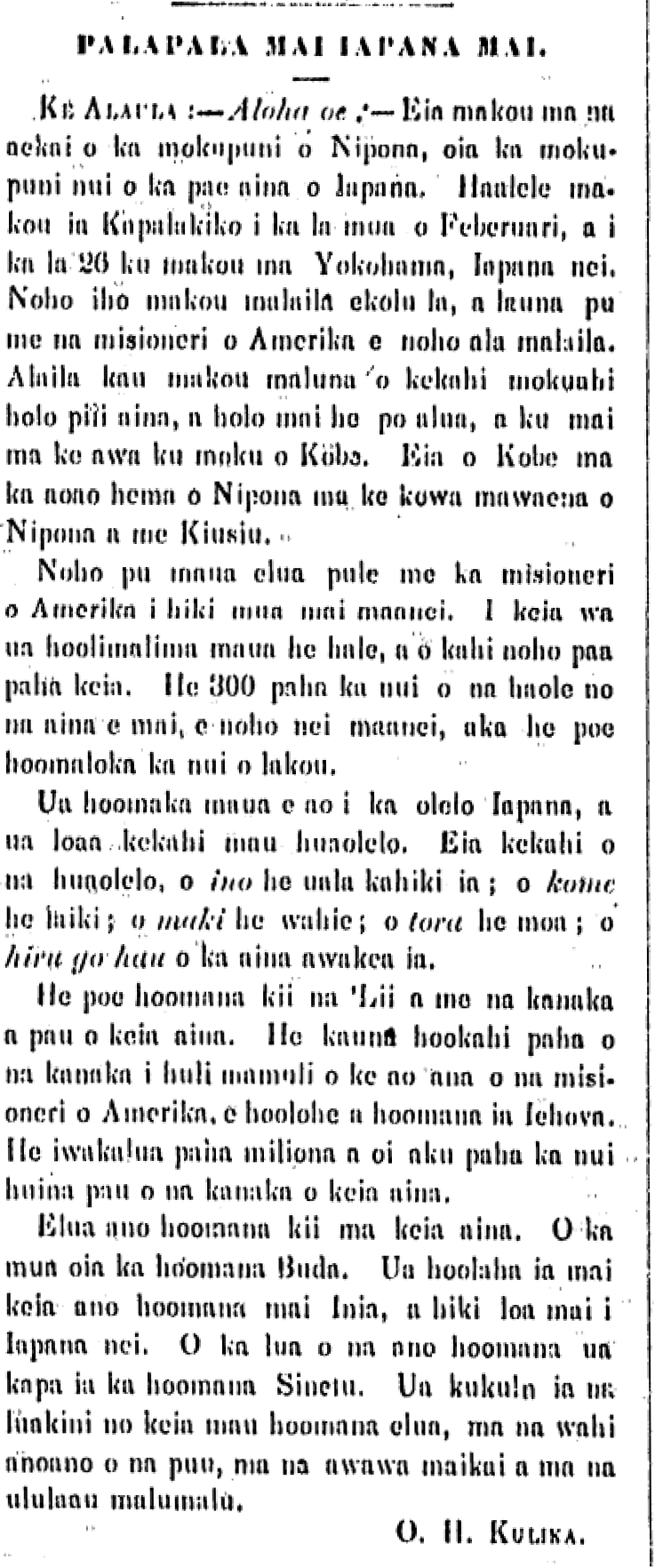
Ke Alaula:—Aloha to you:—Here we are on the shores of the island called Nipona,* the large island of the archipelago of Japan. We left San Francisco on the first day of February and on the 26th, we landed here at Yokohama, Japan. We stayed there for three days and met with the American missionaries who live there. Then we boarded a steam coaster and travelled for two nights and landed at the port of Kōbe. Kōbe is on the south side of Nipona, in the space between Nipona and Kyūshū.

The two of us spent two weeks with the American missionary who arrived here earlier. Currently we are renting a house, and perhaps this is where we will stay permanently. There are about 300 haole from abroad living here, but most of them are unbelievers.

We started to learn Japanese, and know some words. Here are some of them, ino [imo] is potato; kome is rice; maki is firewood; tora [tori] is chicken; hiru go hau [hiru gohan] is lunch.

The Rulers and all people of the land are idol worshipers. There are perhaps forty people who have followed after the teachings of the American missionaries, listening to and worshiping Jehovah. There are maybe twenty million or more people in total in this land.

There are two types of idolatry here. The first one is Buddhism. This religion was spread from India until it reached Japan. The second type is called Sinetu [Shintō]. The religious buildings for both of these religions are built in serene places on hills, in beautiful valleys and sheltered forests.

O. H. Gulick.

*This seems to be a misunderstanding, whereas “Nippon” is the name for Japan as a whole, and the island that Gulick speaks of is named Honshū.

(Alaula, 5/1871, p. 8)

PALAPALA MAI IAPANA MAI.

Ke Alaula, Buke VI, Helu 2, Aoao 8. Mei, 1871.

Early Thanksgiving in Hawaii, 1862

Thanksgiving Day.

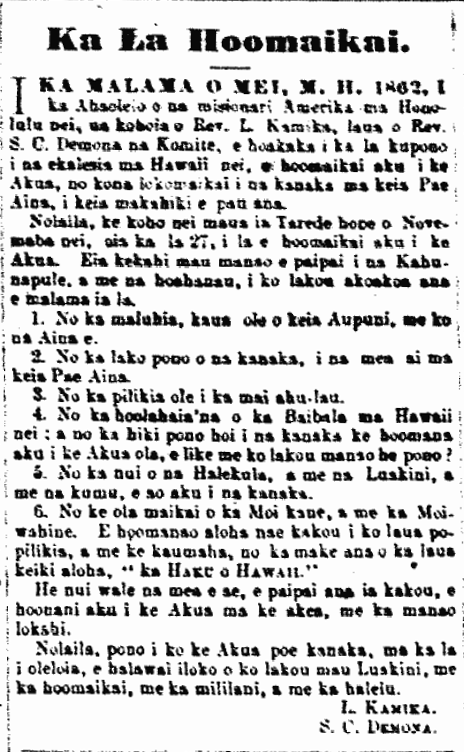
In the month of Mei, 1862, at the Conference of American missionaries here in Honolulu, Rev. L. Smith, and Rev. S. C. Damon were chosen as the Committee to clarify the appropriate day for the churches of Hawaii to give thanks to God for his blessing the people of this Archipelago in this year which is coming to an end.

Therefore, we select the last Thursday of this November, that being the 27th, as the day to give thanks to God. Here are some reasons to encourage the gathering of pastors and church members to celebrate this day.

1. For this Nation’s peace, and lack of war with other Countries.

2. For the availability of food for the people of this Archipelago.

3. For the lack of trouble from pestilence.

4. For the spread of the Bible here in Hawaii; and for the ability of the people to worship the living God as they wish?

5. For the abundance of Schools, and Churches, and teachers to teach the people.

6. For the good health of the King, and the Queen. Yet we remember with aloha, their tragedy, and grief, for the passing of their beloved child, “Ka Haku o Hawaii”.

There are many other things to encourage us to glorify God in the open as one.

Therefore, God’s people should gather at their churches on the specified day, to give their appreciation, exaltation, and songs of praise.

L. Smith.

S. C. Damon.

(Nupepa Kuokoa, 11/22/1862, p. 3)

Ka La Hoomaikai.

Nupepa Kuokoa, Buke I, Helu 52, Aoao 3. Novemaba 22, 1862.

Yokohama Union Church.

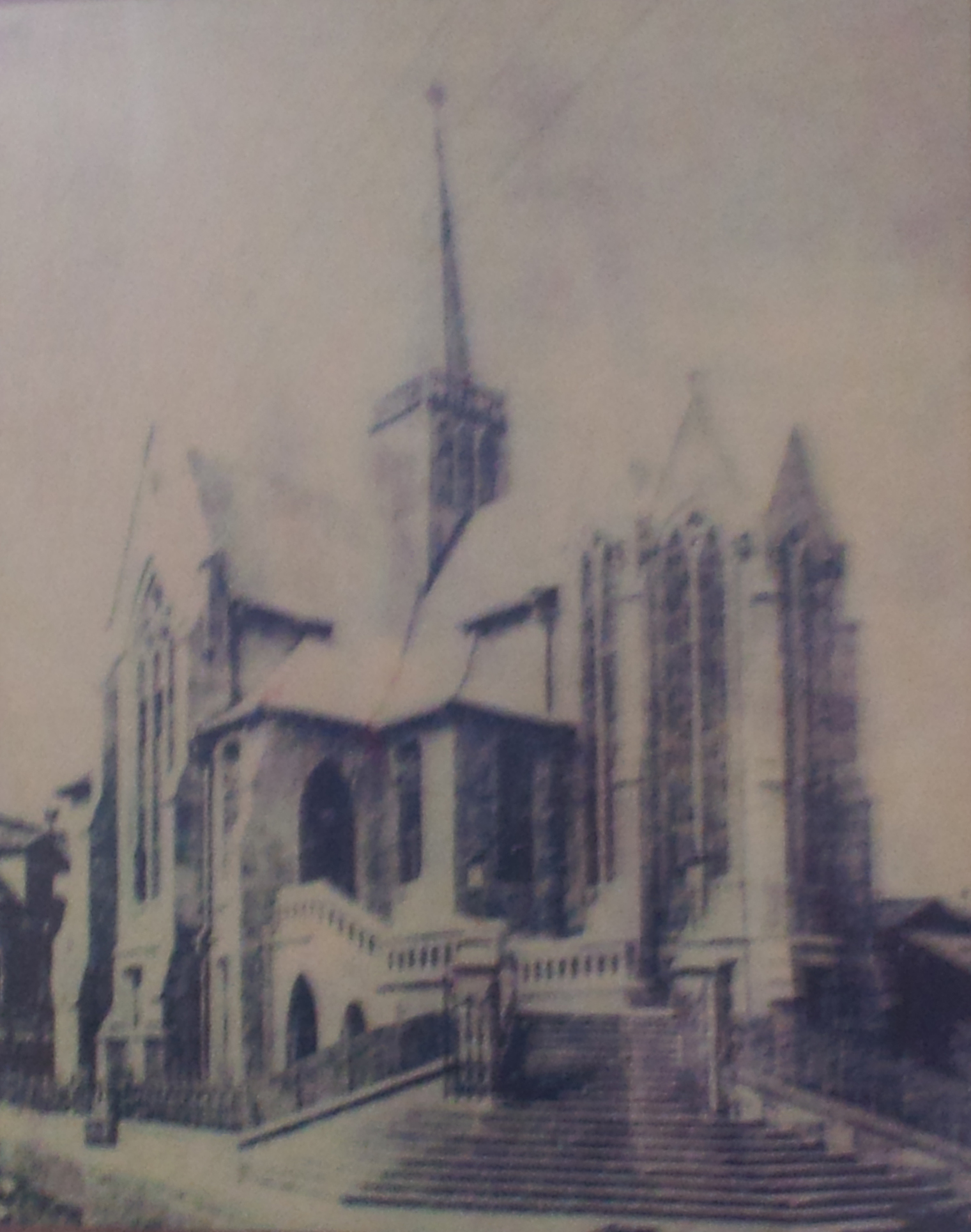
The church pastors did have this picture of the old church which was located on what is now a girl’s school nearby (Ferris). They do not believe that this is the church, because they hear it was built later (but there are no documentation to any of this)…

11/17/2011

Old Yokohama Union Church

…so I can’t say I stood where Kalakaua stood 130 years ago, but all I can say for sure is that it was close by…