This is an independent blog. Please note that I am nowhere near fluent, and that these are not translations, but merely works in progress. Please do comment if you come across misreads or anything else you think is important.
Just another place that posts random articles from the Hawaiian Newspapers! It would be awesome if this should become a space where open discussions happen on all topics written about in those papers!! And please note that these are definitely not polished translations, but are just drafts!!!
[This blog is not affiliated with any organization and receives no funding. Statements made here should in now way be seen as a reflection on other organizations or people. All errors in interpretation are my own.]
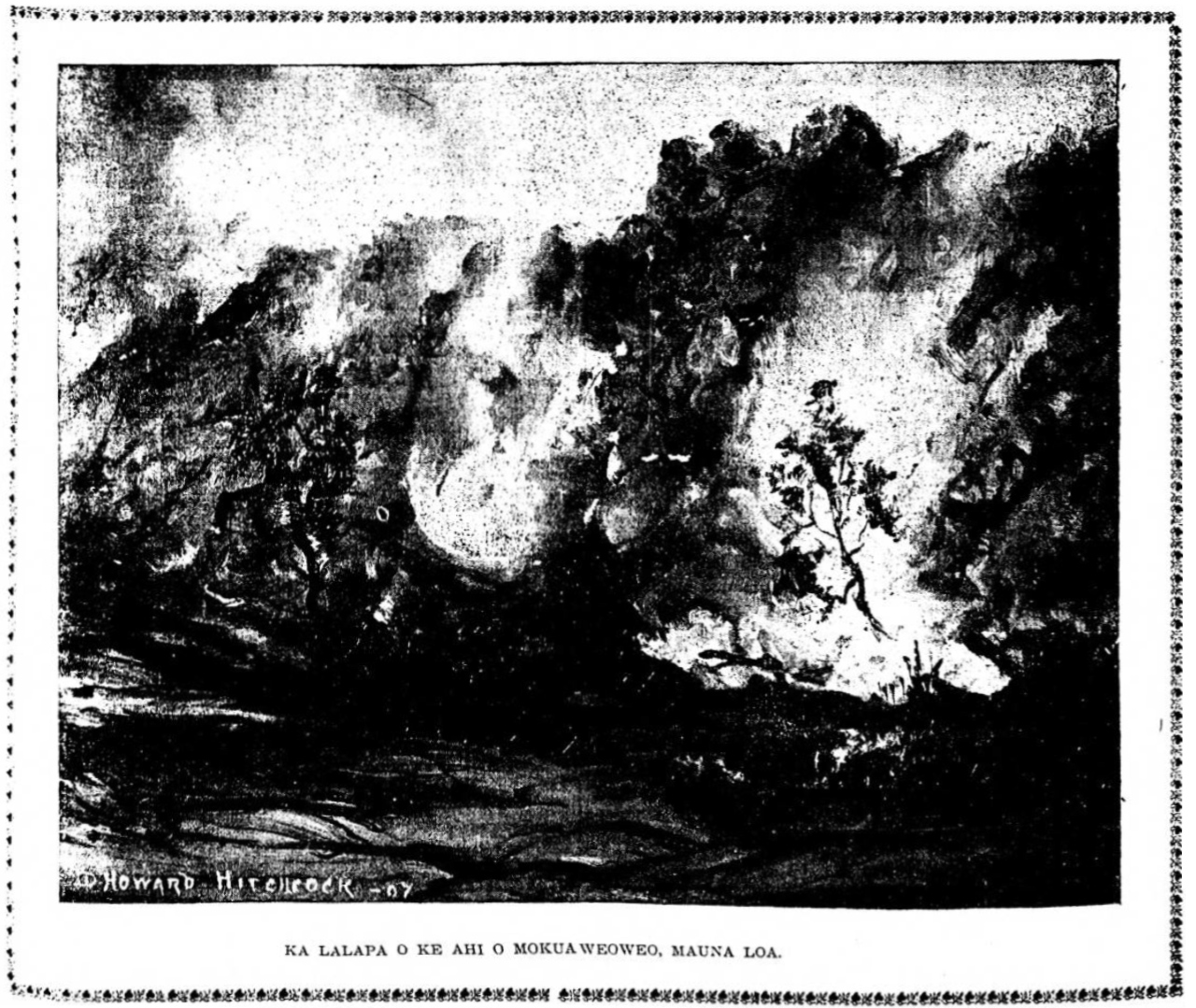
From our many friends living all over on the island of Keawe, we recieved news of sightings of lava blazing atop the summit of Mauna Loa, from the crater of Mokuaweoweo. And we are indebt to them for their kindness. These are each of the letters showing:
Kailua, North Kona, Hawaii, Dec. 5.–1 o’clock at late night on this past Wednesday, in the Alenuihaha Channel, on the deck of the Malulani, seen was the lava of Mokuaweoweo. The red glow of the fires were incomparably great.
[This image appears unrelated to the contents of the page, which is a serial of a foreign love story, “Ka Mana o ka Leka.” Does anyone recognize this painting by Hitchcock, and might it be on exhibit somewhere?]
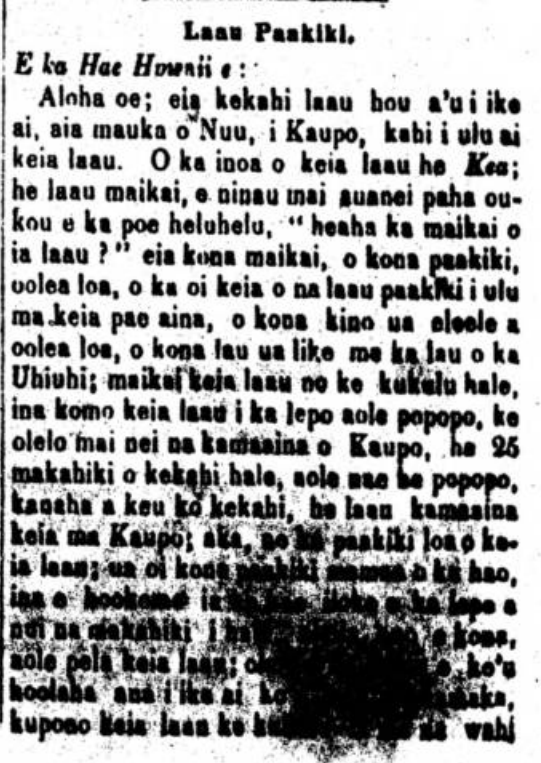
Aloha oe; here is a new tree that I have seen; this tree grows in the uplands of Nuu, in Kaupo. The name of this tree is Kea; it is a fine tree. You readers will perhaps ask, “What makes this tree a fine tree?” This is why, because of its strength; it is very solid. This is the strongest tree that grows in this archipelago. Its body is black and very rigid, and its leaves are like those of the Uhiuhi This is good wood for building houses; if the wood is placed in earth, it does not rot. The kamaaina of Kaupo say that some houses are 25 years old yet have no rot; some are forty years old or more. This is a familiar tree in Kaupo; and as for the strength of this wood, it is stronger than iron. Should iron have been placed in earth many years ago, its form will change, not so with this wood. That is why I am getting this out, so that my friends may know that this wood is good for standing in…
(Hae Hawaii, 11/18/1857, p. 133)
Ka Hae Hawaii, Buke 2, Ano Hou.—Helu 34, Aoao 133. Novemaba 18, 1857.
[The last few lines above were not legible online. It will be a great day when the images digitized from the originals are uploaded on Papakilo.]
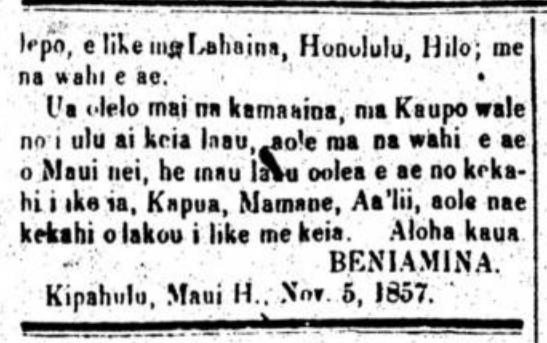
…dirt, like in Lahaina, Honolulu, Hilo, and other places.
The kamaaina say that this wood only grows in Kaupo, and not in other places here on Maui. There are other strong woods that are known: Kapua, Mamane, Aalii, but none are like this. Aloha kaua.
BENIAMINA. Kipahulu, Maui, H., Nov. 5, 1857.
[Might the Kea referred to here be talking about Uhiuhi?]
(Hae Hawaii, 11/18/1857, p. 134)
Ka Hae Hawaii, Buke 2, Ano Hou.—Helu 34, Aoao 134. Novemaba 18, 1857.
On this Saturday, that being tomorrow, appearing will be the newspaper that is bound as a book, Ke Au Hou, from the printing office of the Hawai Shinpo, and not on Wednesday as was said earlier.
[This is not the Ke Au Hou that was published in 1896 and edited by T. P. Spencer. This is the weekly Ke Au Hou owned and edited by John H. Wise, that runs from 5/4/1910 to 2/28/1912.]
(Kuokoa, 5/6/1910, p. 8)
Ka Nupepa Kuokoa, Buke XLVII, Helu 18, Aoao 8. Mei 6, 1910.
In the month of December, on the 15th and into the night, the moon will be dark [pouli ka mahina], but it will not be a fully darkened; it will just be lopsided. Two-thirds of the moon will disappear, then it will reappear, and then come out totally. This is when it will occur.
Aloha oe:–Please spread the word about this new thing at Ukumehame, that being Salt. This Salt is in the uplands of Papalaau; it is among the high cliffs, as if man gathered it in heaps.
The nature of this Salt: it is hard and expansive like the Salt of Alia at Moanalua on Oahu. The reason that this Salt spread among the cliffs is from water that trickled over the rocks and dirt and became salt.
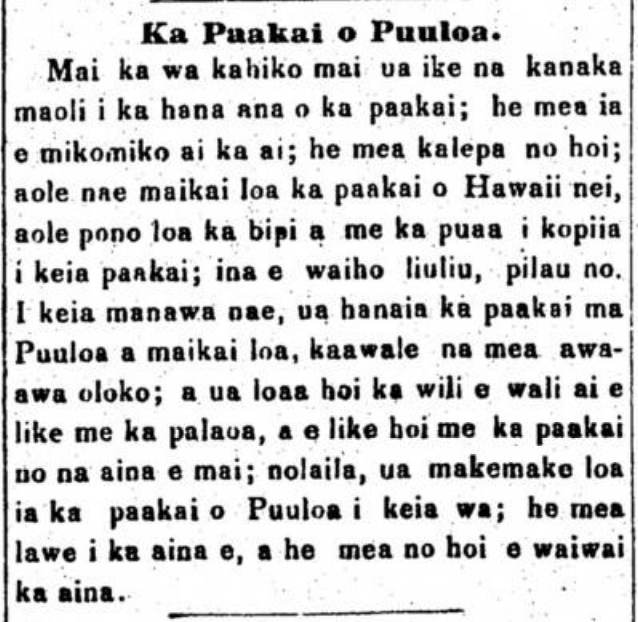
From old times, Hawaiians knew how to make salt. It was used to season food and to trade with, and yet the salt from Hawaii was not very good. Beef or pork salted with this salt was not so good. If it was left for a while, it would rot. Now however, the salt made at Puuloa is very good; the bitter contents are removed, and they have a mill that grinds it like flour, and like salt from foreign lands. Therefore, the salt from Puuloa is under great demand; it is exported and the land profits.
(Hae Hawaii, 7/25/1860, p. 70)
Ka Hae Hawaii, Buke 5, Ano Hou.—Helu 17, Aoao 70. Iulai 25, 1860.



 nupepa