More on Emalia Kaihumua out and about, 1901.

Sweet Emalia and Moanalua.

Their Problems Before the Court

Moanalua is a youth that we often see with a woman’s necklace all the time, and a women’s pocketbook. He is somewhat feeble-minded, and is always smiling. Moanalua is the name that people know him by, but his real name is something else.

He was arrested for stealing a suit and a pair of slacks from Keoki Woolsey’s place in Waikiki. He did not want a lawyer, and did not want to contest his guilt, and his case is left for the circuit court.

As for Sweet Emalia, she was enjoying the tasty water, swipe [suaipa], and after being filled with this intoxicating liquid, she went along with the two aikane, Kapahu and John Richard [?] on a car ride, in the evening of this past Sunday. The horse was exerted as they sped along King Street, and from the car came that song often heard from children on the streets, “There’ll be a hot time, in the old town, tonight.” This car was seen by a policeman as it sped on crazily, and he called out to stop, but the driver misheard and thought he was being told to speed up; and when the were caught, all the steam was exhausted from the horse resulting from it being run hard. Sweet Emalia and her riding companions were taken to jail [Halewai], and there she entertained the peace officers with her funny antics.

That Emalia was detained with another woman in a single room, and it wasn’t long when they began to display their skill in boxing. The rumbling of the earth was heard, and it was three large officers that separated the two women fighters.

Sweet Emalia was fined $12, and her fellow joy riders were each fined $2.00. Another suit was filed for injuring her companion, but it was dismissed.

(Kuokoa, 10/4/1901, p. 5)
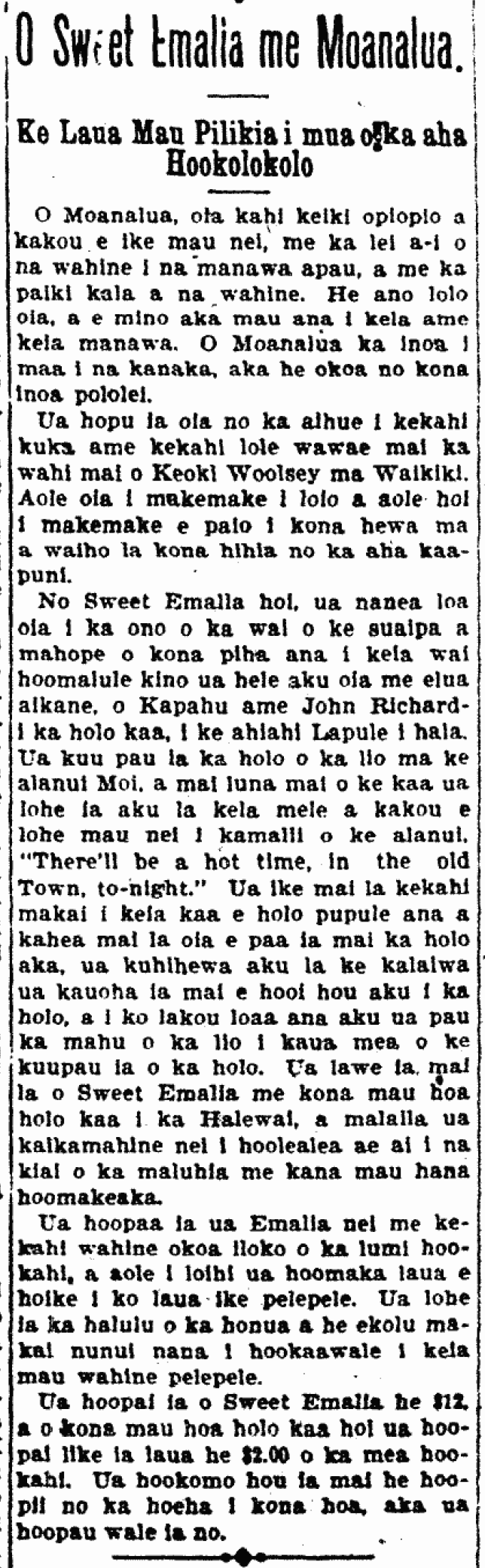
O Sweet Emalia me Moanalua.

Ka Nupepa Kuokoa, Buke XXXIX, Helu 14, Aoao 5. Okatoba 4, 1901.
Poi made from wheat flour in Kalawao and Kalaupapa, 1879.

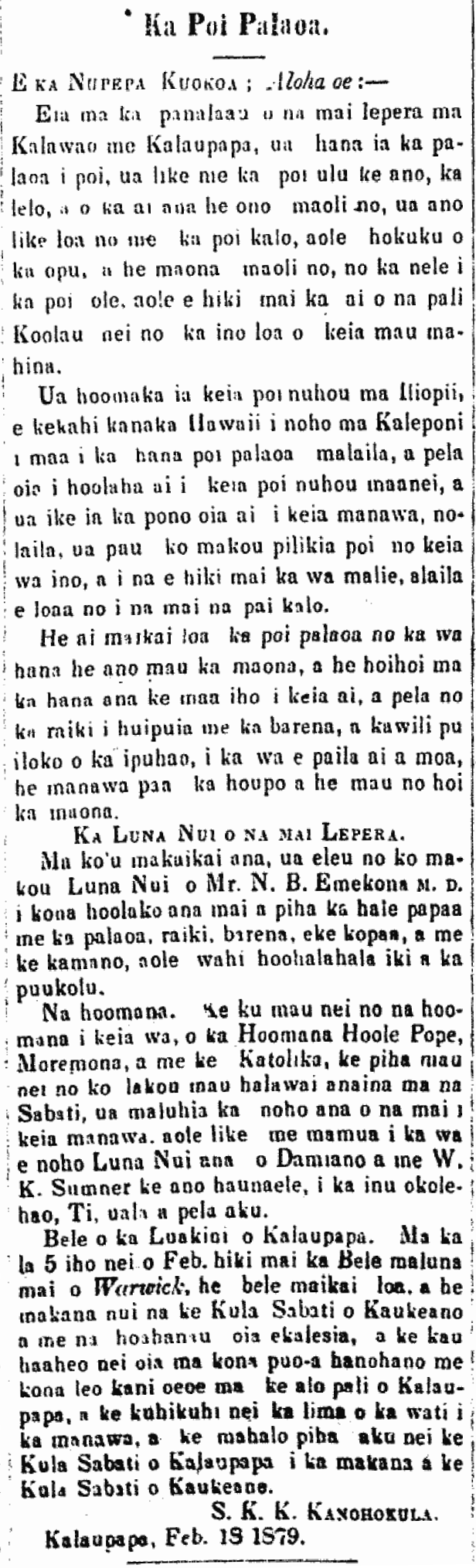
Poi Palaoa.

O Kuokoa Newspaper; Aloha oe:—

Here in the colony of the leprosy patients in Kalawao and Kalaupapa, flour is used to make poi [poi palaoa]; it is similar to poi made of breadfruit [poi ulu] in the yellow color, and it is truly delicious; it is a lot like taro poi [poi kalo]: your stomach doesn’t get sore, and you become full indeed; we have no poi because the taro won’t arrive to these Koolau cliffs because of the terrible weather during these months.

This new poi began at Iliopii, by a Hawaiian who lived in California who was used to making it there, and that is how he spread this new poi here; and the benefits of this poi is now known, and therefore, our poi problems are over during this stormy period, and should calm weather return, the patients will get their paʻi ʻai¹ [pai kalo].

Poi palaoa is very appropriate when working because you stay full, and it is fun to make when you get used to it, and so too with rice mixed with crackers and stirred up in a pot; when it boils and is cooked, it is time for to fill the stomach, and you will be always full.

The Superintendent of the Leprosy Patients.

In my observations, our Superintendent, Mr. N. B. Emerson [Emekona], M. D. is quick with filling the storehouse [hale papaa] with flour [palaoa], rice [raiki], crackers [barena], bags of sugar [eke kopaa], and salmon [kamano]; there is nothing to complain of Kapuukolu.²

Worship. Worship always happens now: Protestants [Hoole Pope], Mormons [Moremona], and Catholics [Katolika]; their meetings on Sundays are always full; life of the patients is peaceful now, not like before when Damien [Damiano] and when W. K. Sumner were Superintendent; there were uprisings from drinking okolehao and other alcoholic drinks made of ti, sweet potato [uala], and so forth.

Bell of the Church of Kalaupapa. On the 5th of Feb., the Bell arrived on the Warwick; a very fine bell which was a gift from the Sunday School of Kaukeano and the brethren of that church; and now it hangs proudly in its honored steeple with its ringing voice in the cliff faces of Kalaupapa, and it points out the movement of the hands of the clock, and the Sunday School of Kalaupapa fully appreciates the gift of the Sunday School of Kaukeano.

S. K. K. Kanohokula.

Kalaupapa, Feb. 18, 1879.

¹Although i tend not to use ʻokina and kahakō, i marked “pai ai” here for added clarity.

²Kapuukolu is a place on Kauai, figuratively used to represent abundance of good food.

(Kuokoa, 3/15/1879, p. 2)

Ka Poi Palaoa.

Ka Nupepa Kuokoa, Buke XVIII, Helu 11, Aoao 2. Maraki 15, 1879.