Patients released from Kalaupapa, 1917.

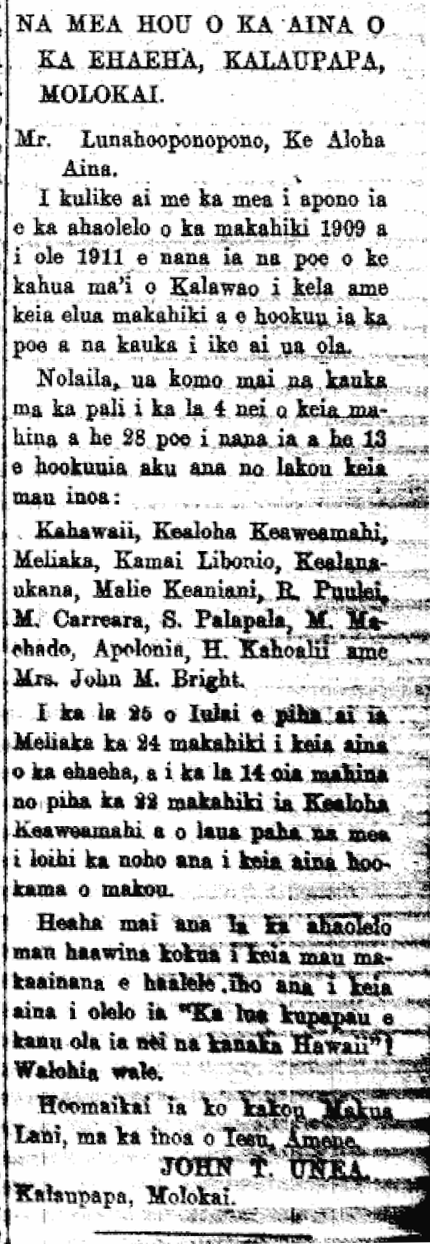
NEWS FROM THE LAND OF SUFFERING, KALAUPAPA, MOLOKAI.

Mr. Editor, Ke Aloha Aina.

In accordance with what was approved of by the legislature of 1909 or 1911, the people of the patient colony of Kalawao will be examined every two years and the people who are determined by the doctor to be cured will be released.

Therefore, the doctors entered the pali on the 4th of this month, and 28 people were examined and 13 will be released, whose names are:

Kahawaii, Kealoha Keaweamahi, Meliaka, Kamai Libonio, Kealanaukana, Malie Keaniani, R. Puulei, M. Carreara, S. Palapala, M. Machado, Apolonia, H. Kahoalii and Mrs. John M. Bright.

On the 25th of July, Meliaka will have spent 24 years in this land of suffering, and on the 14th of that very month, Kealoha Keaweamahi will have spent 22 years, and the two of them are perhaps the ones who have lived the longest in this land which we adopt.

How will the legislature assist these citizens who will leave this land called, “The grave where Hawaiians are being buried alive”? How heart wrenching.

Blessed be our Heavenly Father, in the name of Jesus, Amen.

JOHN T. UNEA.

Kalaupapa, Molokai.

(Aloha Aina, 4/13/1917, p. 1)
NA MEA HOU O KA AINA O KA EHAEHA, KALAUPAPA, MOLOKAI.

Ke Aloha Aina, Buke XXII, Helu 15, Aoao 1. Aperila 13, 1917.
Kalaupapa, almost twenty-five years later, 1891.

[found under “Letters from Our Friends.”]

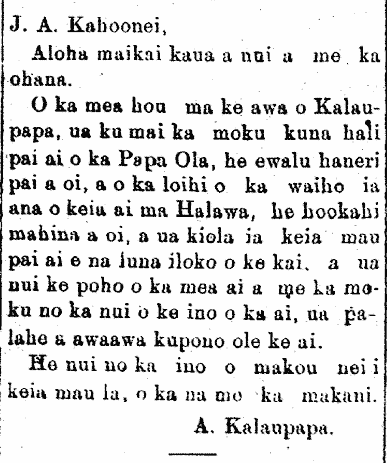
J. A. Kahoonei [of the newspaper “Nupepa Elele”],

Much aloha between us and the family.

The news from the port of Kalaupapa is that the rations-bearing schooner of the Board of Health arrived; there was eight-hundred pa‘i ‘ai or more which were left at Halawa for a whole month or more and then dumped into the ocean by the luna; a lot was wasted, being thrown into the sea [a me ka moku?] because of the great spoilage—it was rotten and too sour to eat.

It has been very stormy these past days with rain and wind.

A. Kalaupapa

(Nupepa Elele, 2/28/1891, p. 4)

J. A. Kahoonei, Aloha Maikai kaua a nui...

Nupepa Elele, Buke XII, Helu 29, Aoao 4. Feberuari 28, 1891.

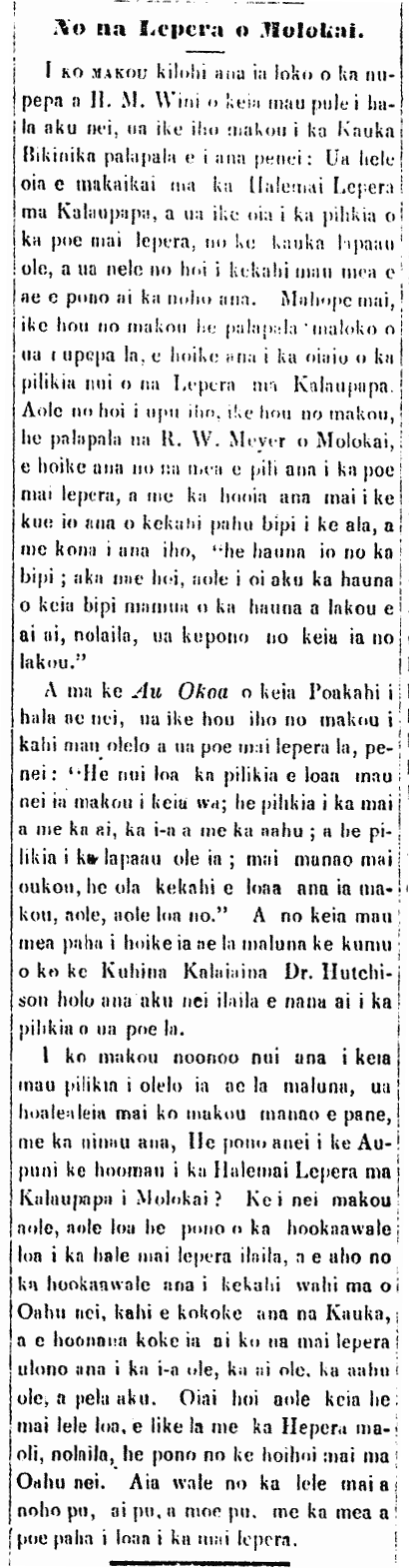
More from Kalaupapa—the early years of the leprosy settlement, 1867.

About the Leprosy Patients of Molokai.

Looking through H. M. Whitney’s newspaper [Pacific Commercial Advertiser? Nupepa Kuokoa?], of these past weeks, we came upon Dr. Bikinika [?]’s letter stating that he went to tour the Leprosy Hospital in Kalaupapa, and witnessed the plight of the leprosy patients—the lack of doctors and the lack of other living necessities. Later, we saw another letter in the same paper confirming the many difficulties of the patients in Kalaupapa. We did not imagine we’d see another letter, by R. W. Meyer of Molokai, speaking about things relating to the patients, and saying that there indeed was a crate of beef on the street, adding, “The beef was spoiled, but it was no more spoiled than what they eat, so it is fine for them.”

And in the Au Okoa of this past Monday, we again saw talk of the leprosy patients, as follows: “We are always facing many difficulties these days; there are problems with sickness, food (‘ai and i‘a), and clothing; we are troubled because we have no medical care—do not imagine that there is a life for us, for that is not at all the case, not at all.” And it is perhaps because of this statement above that the Minister of the Interior, Dr. Hutchison went there to see the difficulties of those people.

After much consideration of these problems shown above, we are stirred to respond with the question, “Is is right for the Government to continue the Leprosy Hospital in Kalaupapa, Molokai?” We say, “No, it is definitely not right to totally separate the leprosy housing there, and instead, to set aside a place here on Oahu, someplace close to Doctors; and the cries of the patients for lack of food, clothing, and so forth, can be immediately looked at. Being that this is not an extremely contagious disease like smallpox, they should be returned to Oahu. It can only be spread by living together, eating together, sleeping together with one or more of the people who have leprosy.

(Kuokoa, 2/23/1867, p. 2)

No na Lepera o Molokai

Nupepa Kuokoa, Buke VI, Helu 8, Aoao 2. Feberuari 23, 1867.

Film of Kalaupapa 4th of July celebration, 1915.

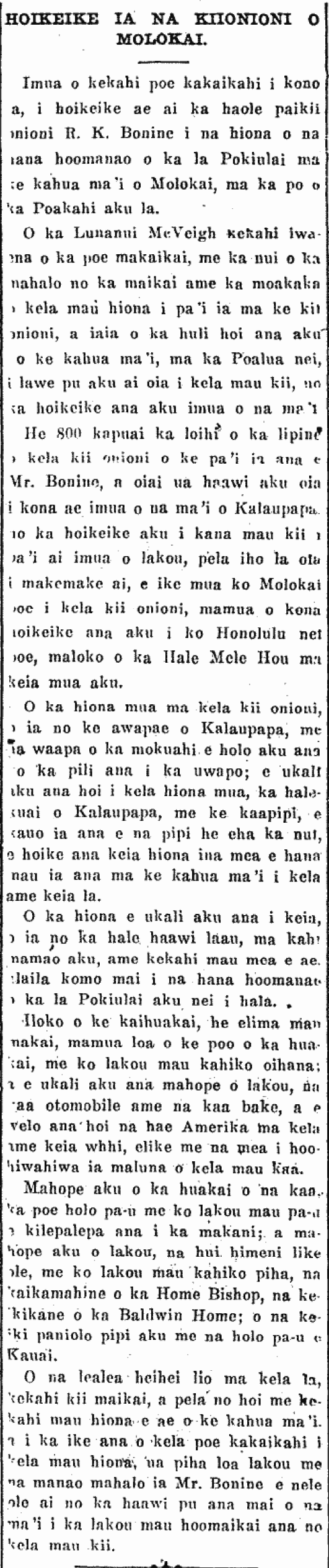
FILM OF MOLOKAI SHOWN.

Before a few invited people, the haole film maker, R. K. Bonine showed views of the celebration of the fourth of July at the land of the patients on Molokai, on the night of this past July 4th.

Superintendent McVeigh was amongst the audience, and was much appreciative of the quality and clarity of these views shot on film; and when he returned to the land of the patients this Tuesday, he took with him the movie to show before the patients.

The movie taken by Mr. Bonine was 800 feet in length, and as he agreed before the patients of Kalaupapa to show the movie he shot before them, therefore, he wanted Molokai’s people to see that movie first before him showing it to Honolulu’s people at the Opera House in the future.

The first scene in the movie is the port of Kalaupapa, with the skiffs of the steamship approaching the harbor; accompanying this first scene is the store of Kalaupapa, with a oxcart pulled by four oxen—this scene shows everyday life at the land of the patients.

The scene following this is the infirmary, which is far away, and some other things; and then it moves to the celebration of this past fourth of July.

In the parade are five police, all the way at the head of the parade, with their uniforms; following behind them are the automobiles and the Chinese carts [kaa bake?], and American flags wave everywhere like the ones decorating those vehicles.

After the parading cars were those pa-u riders with their skirts fluttering in the wind; and after them were the various singing groups all dressed up in their uniforms, the girls of Bishop Home, the boys of Baldwin Home; and following that was the cowboys and the pa-u riders of Kauai.

The entertaining horse races of the day is another good scene, along with some other views of the land of the patients; and when that small crowd saw these scenes, they were full of appreciation for Mr. Bonine, and the patients will certainly not fail to give their thanks for the movie.

(Kuokoa, 8/15/1915, p. 3)

HOIKEIKE IA NA KIIONIONI O MOLOKAI.

Nupepa Kuokoa, Buke LIII, Helu 33, Aoao 3. Augate 13, 1915.