Congratulations Waikiki Aquarium, 110 years old! 1904 / 2014.

HOME OF THE FISHES IS OPENED

A Place to Learn and Enjoy for the Visitors.

AN EFFORT BY HONOLULU’S WEALTHY FOR THE BENEFIT OF EVERYONE.

On the Saturday of this past week, the Aquarium of Hawaii, which stands in Waikiki, makai of Kapiolani Park opened for viewing. This opening was not an opening for the general public, but it was for just those who were invited to come see. This Sunday is when it will be open to the public.

Earlier, it was reported in the columns of the Kilohana¹ that a home will be built where Hawaii’s fishes will be kept, and in the end, the report has come true as the building was entered by the invited guests and will be entered by Honolulu’s people on Sunday.

Many years ago, there was a thought to build an aquarium in Honolulu nei, and Dr. Dorn was the one to come up with the idea; however, because the Government held back some of the resources, this idea by the doctor was dropped and it slept quietly until it was revived by the Rapid Transit Company [Hui Kaauwila]. This idea was considered seriously by this group, when Mr. James Castle [Kimo Kakela] and Mr. and Mrs. C. M. Cooke stepped in and encouraged the effort.

Mr. James Castle gave a portion of the land of Kapiolani Park, which he held in lease, as a place to build this home. When Mr. C. M. Cooke and his wife joined in this effort, that is when the Rapid Transit Company realized that their dream that they were dreaming would come true, and Mr. and Mrs. C. M. Cooke graciously gave the money for the construction. Therefore, the Rapid Transit Company was left to collect Hawaii’s fishes for the aquarium, and that is how the aquarium here on Oahu came to be.

This is seen in the great lands all over the world, and its importance is recognized. One of the benefits is that knowledge is gained by those studying the life of fish, and this is taught at universities. And some thousands of people graduate, being educated in where various ocean fishes live, like whales, sharks, the fishes of the ocean floor, and outside of those, the small fishes of the sea shore.

At the aquarium of Hawaii mentioned above are the many fishes of Hawaii; the ocean fishes are separated from the fresh-water fishes, and according to the visitors who went to see this new place and who have seen the displays of the Foreign Lands, …

¹From the subtitle of the Kuokoa Newspaper: “Ke Kilohana Pookela no ka Lahui Hawaii” [The Greatest Prize of the Hawaiian Nation]

[Go check out the Waikiki Aquarium today, Saturday, 3/22/2014! The 110th anniversary celebration continues with fun for the entire family! $1.10 admission to the Waikiki Aquarium all day! Activities include: the Great Marine Chalk Art Draw and Kids Doodle Zone, entertainment by the UH Rainbow Marching Band, Rainbow Dancers, and other guests groups, a special performance of the musical “Honu by the Sea,” free giveaways (while supplies last), LEGO build area, samples from Pepsi, educational and entertaining activities and much more!]

(Kuokoa, 3/25/1904, p. 1) Continue reading
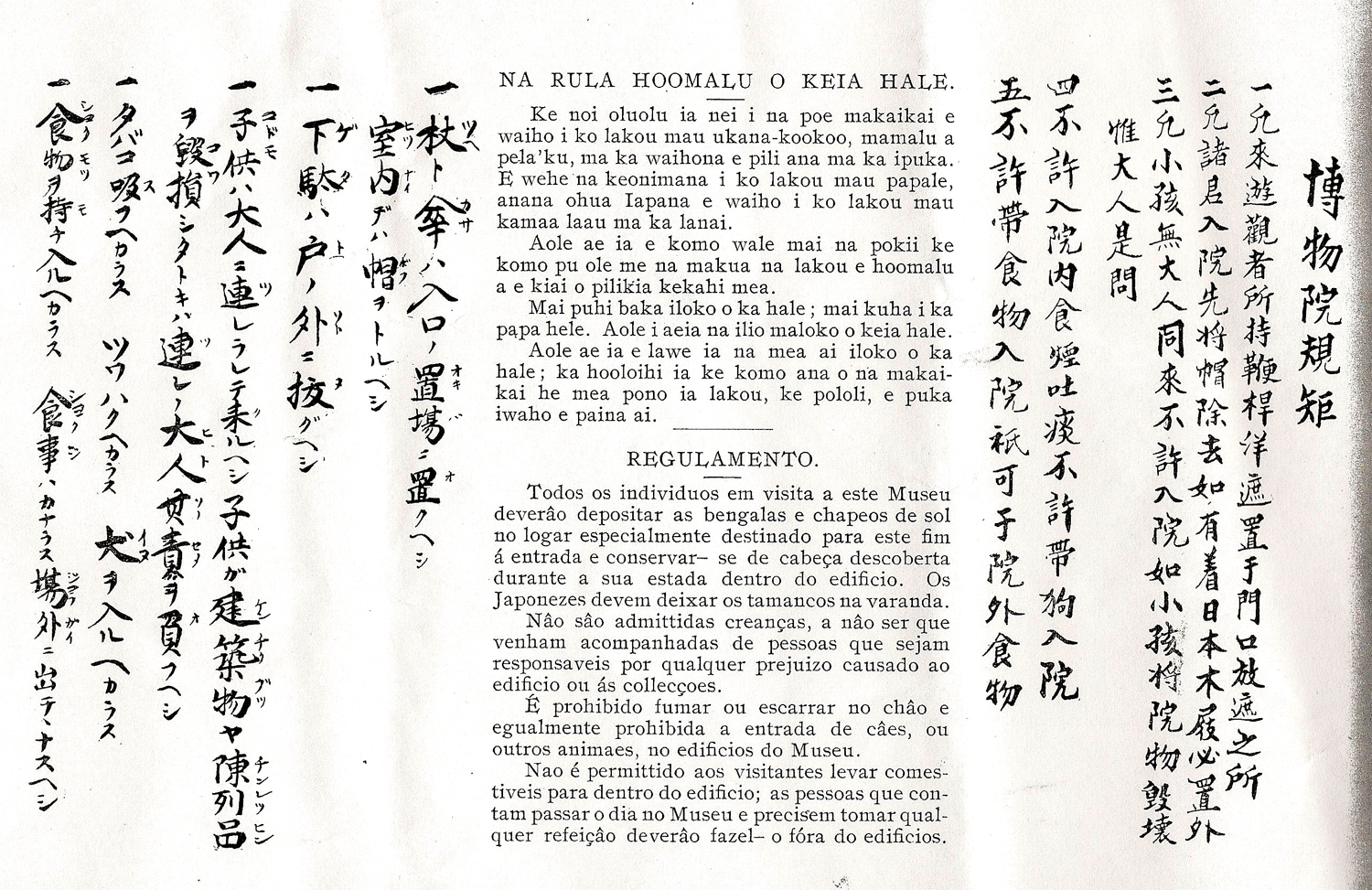
Bernice Pauahi Bishop Museum rules for patrons, 1903.

THE RULES OF ORDER OF THIS ESTABLISHMENT.

We kindly request of the visitors to leave their bags, canes, umbrellas, and so forth at the place to leave them by the entrance. Gentlemen are to remove their hats, and the Japanese guests are to leave their “wooden shoes” on the lanai.

Children are not allowed to enter unsupervised by adults who are to keep them in control and to watch them lest something gets damaged.

Do not smoke withing the building; do not spit on the floors. Dogs are not permitted in the building.

The bringing in of food into the building is not allowed; if here for an extended period, they must, if hungry, go outside to eat.

[This came from “A Handbook for Visitors to the Bernice Pauahi Bishop Museum of Polynesian Ethnography and Natural History” Honolulu 1903. I just came across this today and thought it was interesting.

In Japanese, the only big difference seems to be that it says if a child damages the building or one of the exhibits, then the accompanying adult must take responsibility. And those “wooden shoes” must have been troublesome, because it appears to be talked about in all four other languages as well!]

(“A Handbook for Visitors to the Bernice Pauahi Bishop Museum of Polynesian Ethnography and Natural History” Honolulu 1903.)

"A Handbook for Visitors to the Bernice Pauahi Bishop Museum of Polynesian Ethnography and Natural History" Honolulu 1903. Prepared by William T. Brigham, Director of the Museum.

“A Handbook for Visitors to the Bernice Pauahi Bishop Museum of Polynesian Ethnography and Natural History” Honolulu 1903. Prepared by William T. Brigham, Director of the Museum.

Aberahama Kaikioewa Palekaluhi and the malo of Kaumualii,

See this story about A. K. Palekaluhi’s description of a malo of Kaumualii’s, the king of Kauai, found in Additional Notes on Hawaiian Feather Work: a second supplement by William T. Brigham, in Memoirs of the Bernice Pauahi Bishop Museum of Polynesian Ethnology and Natural History, Vol VII.—No. 1, 1918. pp. 30–39.

I am not sure if this is what is described here at the Bishop Museum.