Translation of Edward Lilikalani’s response to the haole Memorial, 1876.

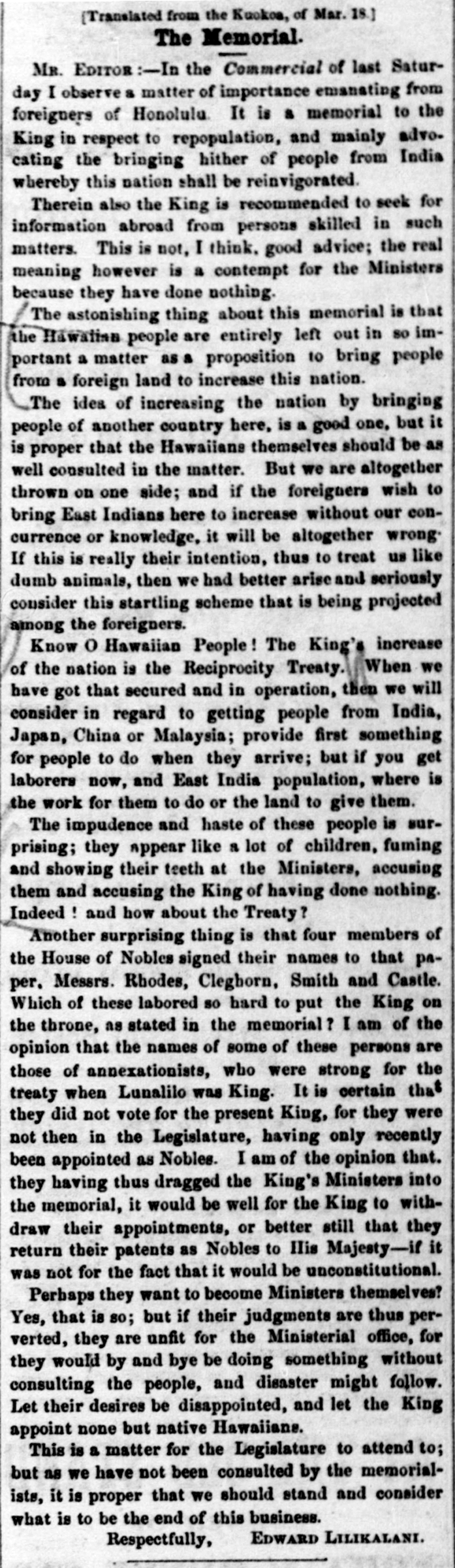
[Translated from the Kuokoa, of Mar. 18.]

The Memorial.

Mr. Editor:—In the Commercial of the last Saturday I observe a matter of importance emanating from foreigners of Honolulu. It is a memorial to the King in respect to repopulation, and mainly advocating the bringing hither of people from India whereby this nation shall be reinvigorated.

 Therein also the King is recommended to seek for information abroad from persons skilled in such matters. This is not, I think, good advice; the real meaning however is a contempt for the Ministers because they have done nothing.

The astonishing thing about this memorial is that the Hawaiian people are entirely left out in so important a matter as a proposition to bring people from a foreign land to increase this nation.

The idea of increasing the nation by bringing people of another country here, is a good one, but it is proper that the Hawaiians themselves should be as well consulted in the matter. But we are altogether thrown on one side; and if the foreigners wish to bring East Indians here to increase without our concurrence or knowledge, it will be altogether wrong. If this is really their intention, thus to treat us like dumb animals, then we had better arise and seriously consider this startling scheme that is being projected among the foreigners.

Know O Hawaiian People! The King’s increase of the nation is the Reciprocity Treaty. When we have got that secured and in operation, then we will consider in regard to getting people from India, Japan, China or Malaysia; provide first something for people to do when they arrive; but if you get laborers now, and East India population, where is the work for them to do or the land to give them.

The impudence and haste of these people is surprising; they appear like a lot of children, fuming and showing their teeth at the Ministers, accusing them and accusing the King of having done nothing. Indeed! and how about the Treaty?

Another surprising thing is that four members of the House of Nobles signed their names to that paper, Messrs. Rhodes, Cleghorn, Smith and Castle. Which of these labored so hard to put the King on the throne, as stated in the memorial? I am of the opinion that the names of some of these persons are those of annexationists, who were strong for the treaty when Lunalilo was King. It is certain that they did not vote for the present King, for they were not then in the Legislature, having only recently been appointed as Nobles. I am of the opinion that they having thus dragged the King’s Ministers into the memorial, it would be well for the King to withdraw their appointments, or better still that they return their patents as Nobles to His Majesty—if it was not for the fact that it would be unconstitutional.

Perhaps they want to become Ministers themselves? Yes, that is so; but if their judgments are thus perverted, they are unfit for the Ministerial office, for they would by and bye be doing something without consulting the people, and disaster might follow. Let their desires be disappointed, and let the King appoint none but native Hawaiians.

This is a matter for the Legislature to attend to; but as we have not been consulted by the memorialists, it is proper that we should stand and consider what is to be the end of this business.

Respectfully,  Edward Lilikalani.

[Here is a translation of Edward Kamakau Lilikalani’s response to the repopulation memorial that was printed in the Kuokoa on 3/18/1876.]

(Pacific Commercial Advertiser, 3/25/1876, p. 3)

The Memorial.

The Pacific Commercial Advertiser, Volume XX, Number 39, Page 3. March 25, 1876.

Edward Lilikalani responds to the Memorial by the haole, 1867.

Ka palapala Memoriala.

E ka Nupepa Kuokoa e; Aloha oe:—

Ua ike iho wau ma ka nupepa Kalepa o kela Poaono i hala ae nei, i kahi mau mea nui i hanaia e na haole o ke kulanakauhale nei o Honolulu, oia hoi he Palapala Memoriala maloko o laila, he mau kumu hoopii i ka Moi, e hooulu i ka lahui, a o ke ano nui o ka hooulu i oleloia ma ua palapala nei, oia no ke kii ana i ka Lahui Inia, a e hoopae mai i kumu e hoowelo hou aku ai i keia lahui kanaka.

A maloko no hoi oia palapala, he noi ana kekahi i ka Moi, e hele ae mawaho e kuka ai me kekahi poe akamai e ae. Ma keia ke manao nei au ua alakai hewa ka Memoriala i ka Moi; o ke ano maoli nae o keia o ka hoowahawaha i na Kuhina no ko lakou hana ole.

Eia ka mea kupaianaha o keia palapala Memoriala, o ke kapae loa ia ana o na kanaka Hawaii ma keia noi ano nui, e hoopae mai i ka lahui kanaka o ko na aina e ma ko kakou aina nei, e hooulu i keia lahui.

He manao maikai ka hooulu ana i ka lahui, mai ko na aina e mai, aka, e pono o kakou o na kanaka Hawaii kekahi e kuka pu no keia mea. Aka, ua kiloi loa ia kakou ma kahi e; ina paha ua makemake na haole e hoopae mai i keia lahui o Inia me ke kuka ole me kakou, ka poe a ua Inia nei e hele mai ana e hooulu, alaila, he mea hewa loa ko kakou ike e ole. A ina ua kiola loaia kakou a hooliloia me he mau holoholona’la, ka i ae no o ua poe haole nei e hoopae mai i ka Inia, na lakou no e onou okoa mai, me ko kakou ae ole; alaila, e pono no e ku kakou, a noonoo nui no keia hana i ulu kamahao ae iwaena o na haole.

E ike e ka Lahui Hawaii! O ka Hooulu Lahui a ka Moi ma ke kalaunu, oia no ke Kuikahi Panailike. A loaa mai ia a noho pu, a paa i ko kakou lima, alaila, noonoo ae, no ke kii ana’ku i na Inia, Iapana, Kina, a Malaea paha, i loaa mua na kumu hana a keia poe e hana ai, ke hiki mai, aka, ina e kii wale ia no na paahana, a me na Inia hooulu lahui, auhea ka hana, a me ka aina e haawi ai ia lakou.

He kupanaha ka mahaoi, a me ka lele e o lakou nei; ua hoolilo lakou ia lakou iho me he mau kamalii liilii’la, e hakaka ana, e hookeke wale ana no i na niho i na Kuhina o ka Moi, me ka olelo iho aole ka a lakou hana, aole ka a ka Moi hana. He kupaianaha, pehea ka ke Kuikahi?

Eia kekahi mea kupaianaha, he eha mau alii o ka Hale Ahaolelo alii i kakau i ko lakou mau inoa ma ia palapala. Oia o Kapena Loke, o Ake, Kamika, a me Kakela; owai o keia poe i hooikaika e hoonoho i ka Moi ma ka noho alii, e like me ka olelo o ua palapala la? Ke manao nei au o kekahi mau inoa o keia poe he mau hoohui aupuni lakou, i ikaika loa no ke kuikahi ia Lunalilo ka Moi, o ka mea i maopopo lea o ka Ahaolelo no, aole lakou nei ia wa, eia wale mai no mahope nei ko lakou lilo ana i mau alii no ka Hale Ahaolelo. A ke manao nei au, o ko lakou pakui ana aku i na Kuhina o ka Moi ma keia palapala noi, me ke kumu ole, e  pono e hoihoi mai ka Moi i ko lakou mau palapala hookohu, o ka pono loa no ko lakou hoihoi okoa aku i ko lakou mau hookohu alii i ka Moi, ina aole he paku nui nana e alai nei oia no ke kumukanawai.

E makemake ana paha e lilo lakou i mau kuhina ea. Ae! oia maoli no, aka, ina pela iho la ke kau kapakahi o ko lakou mau manao, alaila, aole lakou e pono e lilo i mau kuhina, mamuli hana lakou i na hana me ka ui ole mai ia kakou, a poino kakou. E pono no e hoohokaia ko lakou manao, a e koho ka Moi i poe kanaka Hawaii wale no.

He hana keia na ke kau Ahaolelo e hana ai, aka, no ko lakou ui ole ia mai e pono no e ku kakou a noonoo i ka hopena o keia hana. Me ka mahalo.

Edward Lilikalani.

[Find a translation of this rebuke by Edward Kamakau Lilikalani in the Advertiser of 3/25/1876.]

(Kuokoa, 3/18/1876, p. 4)

Ka palapala Memoriala.

Ka Nupepa Kuokoa, Buke XV, Helu 12, Aoao 4. Maraki 18, 1876.

Reply by the Ministers, 1876.

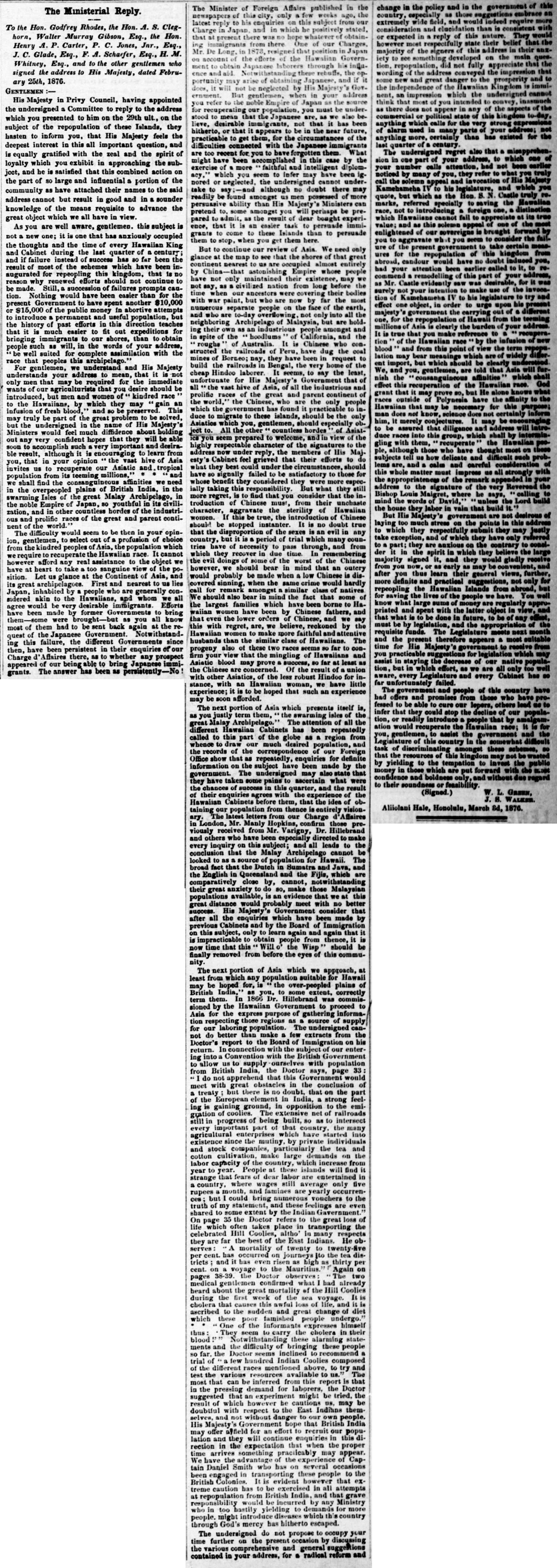
The Ministerial Reply.

To the Hon. Godfrey Rhodes, the Hon. A. S. Cleghorn, Walter Murray Gibson, Esq., the Hon. Henry A. P. Carter, P. C. Jones, Jnr., Esq., J. C. Glade, Esq., F. A. Schaefer, Esq., H. M. Whitney, Esq., and to the other gentlemen who signed the address to His Majesty, dated February 25th, 1876.

Gentlemen:—

His Majesty in Privy Council, having appointed the undersigned a Committee to reply to the address which you presented to him on the 29th ult., on the subject of the repopulation of these Islands, they hasten to inform you, that His Majesty feels the deepest interest in this all important question, and is equally gratified with the zeal and the spirit of loyalty which you exhibit in approaching the subject, and he is satisfied that this combined action on the part of so large and influential a portion of the community as have attached their names to the said address cannot but result in good and in a sounder knowledge of the means requisite to advance the great object which we all have in view.

As you are well aware, gentlemen, this subject is not a new one; it is one that has anxiously occupied the thoughts and the time of every Hawaiian King and Cabinet during the last quarter of a century; and if failure instead of success has so far been the result of most of the schemes which have been inaugurated for repeopling this kingdom, that is no reason why renewed efforts should not continue to be made. Nothing would have been easier than for the present Government to have spent another $10,000 or $15,000 of the public money in abortive attempts to introduce a permanent and useful population, but the history of past efforts in this direction teaches that it is much easier to fit out expeditions for bringing immigrants to our shores, than to obtain people such as will, in the words of your address, “be well suited for complete assimilation with the race that peoples this archipelago.”

For gentlemen, we understand and His Majesty understands your address to mean, that it is not only men that may be required for the immediate wants of our agriculturists that you desire should be introduced, but men and women of “kindred race” to the Hawaiians, by which they may “gain an infusion of fresh blood,” and so be preserved. This may truly be part of the great problem to be solved, but the undersigned in the name of His Majesty’s Ministers would feel much diffidence about holding out any very confident hopes that they will be able soon to accomplish such a very important and desirable result, although it is encouraging to learn from you, that in your opinion “the vast hive of Asia invites us to recuperate our Asiatic and tropical population from its teeming millions.” * * “and we shall find the consanguineous affinities we need in the overpeopled plains of British India, in the swarming Isles of the great Malay Archipelago, in the noble Empire of Japan, so youthful in its civilization, and in other countless hordes of the industrious and prolific races of the great and parent continent of the world.”

The difficulty would seem to be then in your opinion, gentlemen, to select out of a profusion of choice from the kindred people of Asia, the population which we require to recuperate the Hawaiian race. It cannot however afford any real assistance to the object we have at heart to take a too sanguine view of the position. Let us glance at the Continent of Asia, and its great archipelagoes. First and nearest to us lies Japan, inhabited by a people who are generally considered akin to the Hawaiians, and whom we all agree would be very desirable immigrants. Efforts have been made by former Governments to bring them—some were brought—but as you all know most of them had to be sent back again at the request of the Japanese Government. Notwithstanding this failure, the different Governments since then, have been persistent in their enquiries of our Charge d’Affaires there, as to whether any prospect appeared of our being able to bring Japanese immigrants. The answer has been as persistently—No! The Minister of Foreign Affairs published in the newspapers of this city, only a few weeks ago, the latest reply to his enquiries on this subject from our Charge in Japan, and in which he positively stated, that at present there was no hope whatever of obtaining immigrants from there. One of our Charges, Mr. De Long, in 1873, resigned that position in Japan on account of the efforts of the Hawaiian Government to obtain Japanese laborers through his influence and aid. Notwithstanding these rebuffs, the opportunity may arise of obtaining Japanese, and if it does, it will not be neglected by His Majesty’s Government. But gentlemen, when in our address you refer to the noble Empire of Japan as the source for recuperating our population, you must be understood to mean that the Japanese are, as we also believe, desirable immigrants, not that it has been hitherto, or that it appears to be in the near future, practicable to get them, for the circumstances of the difficulties connected with the Japanese immigrants are too recent for you to have forgotten them. What might have been accomplished in this case by the exercise of a more “faithful and intelligent diplomacy,” which you seem to infer may have been ignored or neglected, the undersigned cannot undertake to say;—and although no doubt there may readily be found amongst us men possessed of more persuasive ability than His Majesty’s Ministers can pretend to, some amongst you will perhaps be prepared to admit, as the result of dear bought experience, that is is an easier task to persuade immigrants to come to these Islands than to persuade them to stop, when you get them here.

But to continue our review of Asia. We need only glance at the map to see that the shores of that great continent nearest to us are occupied almost entirely by China—that astonishing Empire whose people have not only maintained their existence, may we not say, as a civilized nation from long before the time when our ancestors were covering their bodies with war paint, but who are now by far the most numerous separate people on the face of the earth, and who are to0day overflowing, not only into all the neighboring Archipelago of Malaysia, but are holding their own as an industrious people amongst and in spite of the “hoodlums” of California, and the “roughs” of Australia. It is Chinese who constructed the railroads of Peru, have dug the coal mines of Borneo; nay, they have been in request to build the railroads in Bengal, the very home of the cheap Hindoo [Hindu] laborer. It seems, to say the least, unfortunate for His Majesty’s Government that of all “the vast hive of Asia, of all the industrious and prolific races of the great and parent continent of the world,” the Chinese, who are the only people which the government has found it practicable to induce to migrate to these islands, should be the only Asiatics which you, gentlemen, should especially object to. All the other “countless hordes” of Asiatics you seem prepared to welcome, and in view of the highly respectable character of the signatures to the address now under reply, the members of His Majesty’s Cabinet feel grieved that their efforts to do what they best could under the circumstances, should have so signally failed to be satisfactory to those for whose benefit they considered they were more especially taking this responsibility. But what they still more regret, is to find that you consider that the introduction of Chinese must, from their unchaste character, aggravate the sterility of Hawaiian women. If this be true, the introduction of Chinese should be stopped instanter. It is no doubt true that the disproportion of the sexes is an evil in any country, but it is a period of trial which many countries have of necessity to pass through, and from which they recover in due time. In remembering the evil doings of some of the worst of the Chinese however, we should bear in mind that an outcry would probably be made when a low Chinese is discovered sinning, when the same crime would hardly call for a remark amongst a similar class of natives. We should also bear in mind the fact that some of the largest families which have been borne to Hawaiian women have been by Chinese fathers, and that even the lower orders of Chinese, and we say this with regret, are, we believe, reckoned by the Hawaiian women to make more faithful and attentive husbands than the similar class of Hawaiians. The progeny also of these two races seems so far to confirm your view that the mingling of Hawaiians and Asiatic blood may prove a success, so far at least as the Chinese are concerned. Of the result of a union with other Asiatics, of the less robust Hindoo for instance, with an Hawaiian woman, we have little experience; it is to be hoped that such an experience may be soon afforded.

The next portion of Asia which presents itself is, as you justly term them, “the swarming isles of the great Malay Archipelago.” The attention of all the different Hawaiian Cabinets has been repeatedly called to this part of the globe as a region from whence to draw our much desired population, and the records of the correspondence of our Foreign Office show that as repeatedly, enquiries for definite information on the subject have been made by the government. The undersigned may also state that they have taken some pains to ascertain what were the chances of success in this quarter, and the result of their enquiries agrees with the experience of the Hawaiian Cabinets before them, that the idea of obtaining our population from thence is entirely visionary. The latest letters from our Charge d’affaires in London, Mr. Manly Hopkins, confirm those previously received from Mr. Varigny, Dr. Hillebrand and other who have been especially directed to make evvery inquiry on this subject; and all leads to the conclusion that the Malay Archipelago cannot be looked to as a source of population for Hawaii. The broad fact that the Dutch in Sumatra and Java, and the English in Queensland and the Fijis, which are comparatively close by, cannot, notwithstanding their great anxiety to do so, make those Malaysian populations available, is an evidence that we at this great distance would probably meet with no better success. His Majesty’s Government consider that after all the enquiries which have been made by previous Cabinets and by the Board of Immigration on this subject, only to learn again and again that it is impracticable to obtain people from thence, it is now time that this “Will o’ the Wisp” should be finally removed from before the eyes of this community.

The next portion  of Asia which we approach, at least from which any population suitable for Hawaii may be hoped for, is “the over-peopled plains of British India,” as you, to some extent, correctly term them. In 1866 Dr. Hillebrand was commissioned by the Hawaiian Government to proceed to Asia for the express purpose of gathering information respecting those regions as a source of supply for our laboring population. The undersigned cannot do better than make a few extracts from the Doctor’s report to the Board of Immigration on his return. In connection with the subject of our entering into a Convention with the British Government to allow us to supply ourselves with population from British India, the Doctor says, page 33: “I do not apprehend that this Government would meet with great obstacles in the conclusion of a treaty; but there is no doubt, that on the part of the European element in India, a strong feeling is gaining ground, in opposition to the emigration of coolies. The extensive net of railroads still in progress of being built, so as to intersect every important part of that country, the many agricultural enterprises which have started into existence since the mutiny, by private individuals and stock companies, particularly the tea and cotton cultivation, make large demands on the labor capacity of the country, which increase from year to year. People at these islands will find it strange that fears of dear labor are entertained in a country, where wages still average only five rupees a month, and famines are yearly occurrences; but I could bring numerous vouchers to the truth of my statement, and these feelings are even shared to some extent by the Indian Government.” On page 35 the Doctor refers to the great loss of life which often takes place in transporting the celebrated Hill Coolies, altho’ in many respects they are far the best of the East Indians. He observes: “A mortality of twenty to twenty-five per cent has occurred on journeys to the tea districts; and it has even risen as high as thirty per cent, on a voyage to the Mauritius.” Again on pages 38–39, the Doctor observes: “The two medical gentlemen confirmed what I had already heard about the great mortality of the Hill Coolies during the first week of the sea voyage. It is cholera that causes this awful loss of life, and it is ascribed to the sudden and great change of diet which these poor famished people undergo.” * * “One of the informants expresses himself thus: ‘They seem to carry the cholera in their blood!'” Notwithstanding these alarming statements and the difficulty of bringing these people so far, the Doctor seems inclined to recommend a trial of “a few hundred Indian Coolies composed of the different races mentioned above, to try and test the various resources available to us.” The most that can be inferred from this report is that in the pressing deman for laborers, the Doctor suggested that an experiment might be tried, the result of which however he cautions us, may be doubtful with respect to the East Indians themselves, and not without danger to our own people. His Majesty’s Government hope that British India may offer a field for an effort to recruit our population and they will continue enquiries in this direction in the expectation that when the proper time arrives something practicably may appear. We have the advantage of the experienced Daniel Smith who has on several occasions been engaged in transporting these people to the British Colonies. It is evident however that extreme caution has to be exercised in all attempts at repopulation from British India, and that grave responsibility would be incurred by any Ministry who in too hastily yielding to demands for more people, might introduce diseases which this country through God’s mercy has hitherto escaped.

The undersigned do not propose to occupy your time further on the present occasion by discussing the various comprehensive and general suggestions contained in your address, for a radical reform and change in the policy and in the government of this country, especially as those suggestions embrace an extremely wide field, and would indeed require more consideration and elucidation than is consistent with or expected in a reply of this nature. They would however most respectfully state their belief that the majority of the signers of this address in their anxiety to see something developed on the main question, repopulation, did not fully appreciate that the wording of the address conveyed the impression that some new and great danger to the prosperity and to the independence of the Hawaiian Kingdom is imminent, an impression which the undersigned cannot think that most of you intended to convey, inasmuch as there does not appear in any of the aspects of the commercial or political state of this kingdom to-day, anything which calls for the very strong expressions of alarm used in many parts of your address; not anything more, certainly than has existed for the last quarter of a century.

The undersigned regret also that a misapprehension in one part of your address, to which one of your number calls attention, had not been earlier noticed by many of you, they refer to what you truly call the solemn appeal and invocation of His Majesty Kamehameha IV to his legislature, and which you quote, but which as the Hon. S. N. Castle truly remarks, referred specially to saving the Hawaiian race, not to introducing a foreign one, a distinction which Hawaiians cannot fail to appreciate at its true value; and as this solemn appeal of one of the most enlightened of our sovereigns is brought forward by you to aggravate what you seem to consider the failure of the present government to take certain measures for the repopulation of this kingdom from abroad, candour would have no doubt induced you, had your attention been earlier called to it, to recommend a remodelling of this part of your address, as Mr. Castle evidently saw was desirable for it was surely not your intention to make use of the invocation of Kamehameha IV to his legislature to try and effect one object, in order to urge upon his present majesty’s government the carrying out of a different one, for the repopulation of Hawaii from the teeming millions of Asia is clearly the burden of your address. It is true that you make references to a “recuperation” of the Hawaiian race “by the infusion of new blood” and from this point of view the term repopulation may bear meanings which are of widely different import, but which should be clearly understood. We, and you, gentlemen, are told that Asia will furnish the “consanguineous affinities” which shall effect this recuperation of the Hawaiian race. God grant that it may prove so, but He alone knows what races outside of Polynesia have the affinity to the Hawaiian that may be neccesary for this purpose! man does not know, science does not certainly inform him, it merely conjectures. It may be encouraging to be assured that dillegence and address will introduce races into this group, which shall by intermingling with them, “recuperate” the Hawaiian people although those who have though most on these subjects tell us how delicate and difficult such problems are, and a calm and careful consideration of this whole matter must impress us all strongly with the appropriateness of the remark appended in your address to the signature of the very Reverend the Bishop Louis Maigret, where he says, “calling to mind the words of David,” “unless the Lord build the house they labor in vain that build it.”

But His Majesty’s government are not desirous of laying too much stress on the points in this address to which they respectfully submit they may justly take exception, and of which they have only referred to a part; they are anxious on the contrary to consider it in the spirit in which they believe the large majority signed it, and they would gladly receive from you now, or as early as may be convenient, and after you thus learn their general views, further, more definite and practical suggestions, not only for repeopling the Hawaiian Islands from abroad, but for saving the lives of the people we have. You well know what large sums of money are regularly appropriated and spent with the latter object in view, and that what is to be done in future, to be of any effect, must be by legislation, and the appropriation of the requisite funds. The Legislature meets next month and the present therefore appears a most suitable time for His Majesty’s government to receivved from you practicable suggestions for legislation which may assist in staying the decrease of our native population, but in which effort, as we are all only too  well aware, every Legislature and every Cabinet has so far unfortunately failed.

The government and people of this country have had offers and promises from those who have professed to be able to cure our lepers, others lead us to infer that they could stop the decline of our population, or readily introduce a people that by amalgamation would recuperate the Hawaiian race; it is for you, gentlemen, to assist the government and the Legislature of this country in the somewhat difficult task of discriminating amongst these schemes, so that the resources of this kingdom may not be wasted by yielding to the tempation to invest the public money in those which are put forward with the most confidence and boldness only, and without dueregard to their soundness or feasibility.

(Signed.)  W. L. Green,

J. S. Walker.

Aliiolani Hale, Honolulu, March 3d, 1876.

(Pacific Commercial Advertiser, 3/4/1876, p. 3)

The Ministerial Reply.

The Pacific Commercial Advertiser, Volume XX, Number 6, Page 3. March 4, 1876.

A memorial on repopulation, 1876.

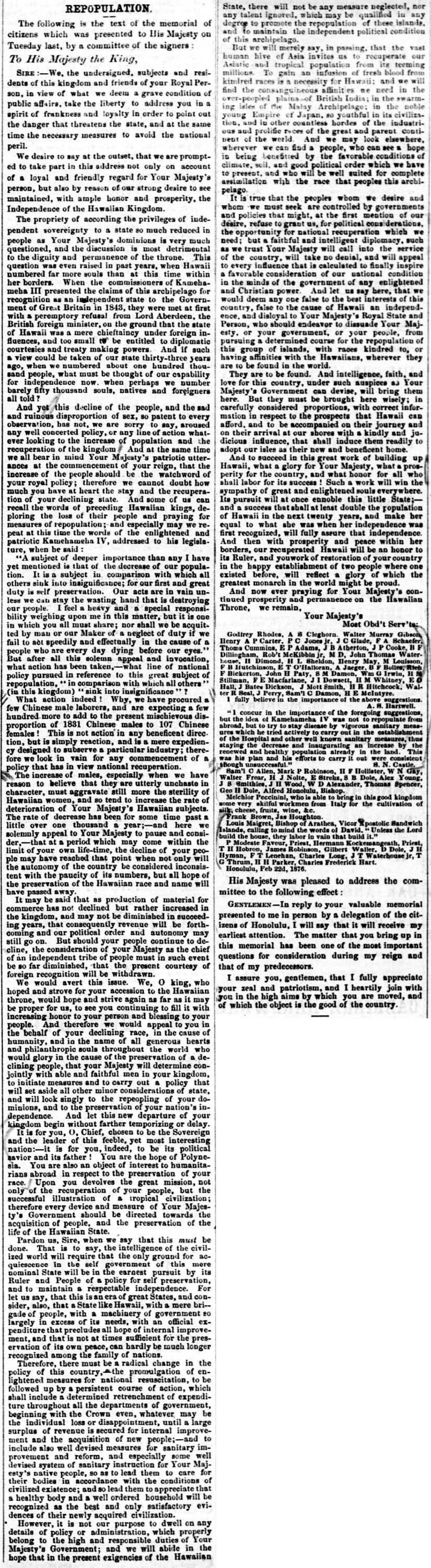
REPOPULATION.

The following is the text of the memorial of citizens which was presented to His Majesty on Tuesday last, by a committee of the signers:

To His Majesty the King,

Sire:—We, the undersigned, subjects and residents of this kingdom and friends of your Royal Person, in view of what we deem a grave condition of public affairs, take the liberty to address you in a spirit of frankness and loyalty in order to point out the danger that threatens the state, and at the same time the necessary measures to avoid the national peril.

We desire to say at the outset, that we are prompted to take part in this address not only on account of a loyal and friendly regard for Your Majesty’s person, but also by reason of our strong desire to see maintained, with ample honor and prosperity, the Independence of the Hawaiian Kingdom.

 The propriety of according the privileges of independent sovereignty to a state so much reduced in people as Your Majesty’s dominions is very much questioned, and the discussion is most detrimental to the dignity and permanence of the throne. This question was even raised in past years, when Hawaii numbered far more souls than at this time within her borders. When the commissioners of Kamehameha III presented the claims of this archipelago for recognition as an independent state to the Government of Great Britain in 1843, they were met at first with a peremptory refusal from Lord Aberdeen, the British foreign minister, on the ground that the state of Hawaii was a mere chieftaincy under foreign influences, and too small to be entitled to diplomatic courtesies and treaty making powers. And if such a view could be taken of our state thirty-three years ago, when we numbered about one hundred thousand people, what must be thought of our capability for independence now, when perhaps we number barely fifty thousand souls, natives and foreigners all told?

And yet this decline of the people, and the sad and ruinous disproportion of sex, so patent to every observation, has not, we are sorry to say, aroused any well concerted policy, or any line of action whatever looking to the increase of population and the recuperation of the kingdom. And at the same time we all bear in mind Your Majesty’s patriotic utterances at the commencement of your reign, that the increase of the people should be the watchword of your royal policy; therefore we cannot doubt how much you have at heart the stay and the recuperation of your declining state. And some of us can recall the words of preceding Hawaiian kings, deploring the loss of their people and praying for measures of repopulation; and especially may we repeat at this time the words of the enlightened and patriotic Kamehameha IV, addressed to this legislature, when he said:

“A subject of deeper importance than any I have yet mentioned is that of the decrease of our population. It is a subject in comparison with which all others sink into insignificance; for our first and great duty is self preservation. Our acts are in vain unless we can stay the wasting hand that is destroying our people. I feel a heavy and a special responsibility weighing upon me in this matter, but it is one in which you all must share; nor shall we be acquitted by man or our Maker of a neglect of duty if we fail to act speedily and effectually in the cause of a people who are every day dying before our eyes.” But after all this solemn appeal and invocation, what action has been taken,—what line of national policy pursued in reference to this great subject of repopulation, “in comparison with which all others” (in this kingdom) “sink into insignificance”?

What action indeed! Why, we have procured a few Chinese male laborers, and are expecting a few hundred more to add to the present mischievous disproportion of 1831 Chinese males to 107 Chinese females! This is not action in any beneficent direction, but is simply reaction, and is a mere expediency designed to subserve a particular industry; therefore we look in vain for any commencement of a policy that has in view national recuperation.

 The increase of males, especially when we have reason to believe that they are utterly unchaste in character, must aggravate still more the sterility of Hawaiian women, and so tend to increase the rate of deterioration of Your Majesty’s Hawaiian subjects. The rate of decrease has been for some time past a little over one thousand a year;—and here we solemnly appeal to Your Majesty to pause and consider,—that at a period which may come within the limit of your own life-time, the decline of your people may have reached that point when not only will the autonomy of the country be considered inconsistent with the paucity of its numbers, but all hope of the preservation of the Hawaiian race and name will have passed away.

 It may be said that as production of material for commerce has not declined but rather increased in the kingdom, and may not be diminished in succeeding years, that consequently revenue will be forthcoming and our political order and autonomy may still go on. But should your people continue to decline, the consideration of your Majesty as the chief of an independent tribe of people must in such event be so far diminished, that the present courtesy of foreign recognition will be withdrawn.

We would avert this issue. We. O king, who hoped and strove for your accession to the Hawaiian throne, would hope and strive again as far as it may be proper for us, to see you continuing to fill it with increasing honor to your person and blessing to your people. And therefore we would appeal to you in the behalf of your declining race, in the cause of humanity, and in the name of all generous hearts and philanthropic souls throughout the world who would glory in the cause of the preservation of a declining people, that your Majesty will determine conjointly with able and faithful men in your kingdom, to inititate measures and to carry out a policy that will set aside all other minor considerations of state, and will look singly to the repeopling of your dominions, and to the preservation of your nation’s independence. And let this new departure of your kingdom begin without farther temporizing or delay.

It is for you, O, Chief, chosen to be the Sovereign and the leader of this feeble, yet most interesting nation:—it is for you, indeed, to be its political savior and its father! You are the hope of Polynesia. You are also an object of interest to humanitarians abroad in respect to the preservation of your race. upon you devolves the great mission, not only of the recuperation of your people, but the successful illustration of a tropical civilization; therefore every device and measure of Your Majesty’s Government should be directed towards the acquisition of people, and the preservation of the life of the Hawaiian State.

 Pardon us, Sire, when we say that this must be done. That is to say, the intelligence of the civilized world will require that the only ground for acquiescence in the self government of this mere nominal State will be in the earnest pursuit by its Ruler and People of a policy for self preservation, and to maintain a respectable independence. For let us say, that this is an era of great States, and consider, also, that a State like Hawaii, with a mere brigade of people, with a machinery of government so largely in excess of its needs, with an official expenditure that precludes all hope of internal improvement, and that is not at times sufficient for the preservation of its own peace, can hardly be much longer recognized among the family of nations.

Therefore, there must be a radical change in the policy of this country,—the promulgation of enlightened measures for national resuscitation, to be followed up by a persistent course of action, which shall include a determined retrenchment of expenditure throughout all the departments of government, beginning with the Crown even, whatever may be the individual loss or disappointment, until a large surplus of revenue is secured for internal improvement and the acquisition of a new people;—and to include also well devised measures for sanitary improvement and reform, and especially some well devised system of sanitary instruction for Your Majesty’s native people, so as to lead them to appreciate that a healthy body and a well ordered household will be recognized as the best and only satisfactory evidences of their newly acquired civilization.

However, it is not our purpose to dwell on any details of policy or administration, which properly belong to the high and responsible duties of Your Majesty’s Government; and we will abide in the hope that in the present exigencies of the Hawaiian State, there will not be any measure neglected, nor any talent ignored, which may be qualified in any degree to promote the repopulation of these islands, and to maintain the independent political condition of this archipelago.

But we will merely say, in passing, that the vast human hive of Asia invites us to recuperate our Asiatic and tropical population from its teeming millions. To gain an infusion of fresh blood from kindred races is a necessity for Hawaii; and we will find the consanguineous affinities we need in the over-peopled plains—of British India; in the swarming isles of the Malay Archipelago; in the noble young Empire of Japan, so youthful in its civilization, and in other countless hordes of the industrious and prolific races of the great and parent continent of the world. And we may look elsewhere, wherever we can find a people, who can see a hope in being benefitted by the favorable conditions of climate, soil, and good political order which we have to present, and who will be well suited for complete assimilation with the race that peoples this archipelago.

It is true that the peoples whom we desire and whom we must seek are controlled by governments and policies that might, at the first mention of our desire, refuse to grant us, for political considerations, the opportunity for national recuperation which we need; but a faithful and intelligent diplomacy, such as we trust Your Majesty will call into the service of the country, will take no denial, and will appeal to every influence that is calculated to finally inspire a favorable consideration of our national condition in the minds of the government of any enlightened and Christian power. And let us say here, that we would deem any one false to the best interests of this country, false to the cause of Hawaii an independence, and disloyal to Your Majesty’s Royal State and Person, who should endeavor to dissuade Your Majesty, or your government, or your people, from pursuing a determined course for the repopulation of this group of islands, with races kindred to, or having affinities with the Hawaiians, wherever they are to be found in the world.

They are to be found. And intelligence, faith, and love for this country, under such auspices as Your Majesty’s Government can devise, will bring them here. But they must be brought here wisely; in carefully considered proportions, with correct information in respect to the prospects that Hawaii can afford, and to be accompanied on their journey and on their arrival at our shores with a kindly and judicious influence, that shall induce them readily to adopt our isles as their new and beneficent home.

And to succeed in this great work of building up Hawaii, what a glory for Your Majesty, what a prosperity for the country, and what honor for all who shall labor for its success! Such a work will win the sumpathy of great and enlightened souls everywhere. Its pursuit will at once ennoble this little State;—and a success that shall at least double the population of Hawaii in the next twenty years, and make her equal to what she was when her independence was first recognized, will fully assure that independence. And then with prosperity and peace within her borders, our recuperated Hawaii will be an honor to its Ruler, and youwork of restoration of your country in the happy establishment of two people where one existed before, will reflect a glory of which the greatest monarch in the world might be proud.

And now every praying for Your Majesty’s continued prosperity and permanence on the Hawaiian Throne, we remain,

Your Majesty’s

Most Obd’t Serv’ts:

Godfrey Rhodes, A. S. Cleghorn, Walter Murray Gibson, Henry A. P. Carter, P. C. Jones jr, J. C. Glade, F. A. Schaefer, Thomas Cummins, E. P. Adams, J. B. Atherton, J. P. Cooke, B. F. Dillingham, Robert McKibbin jr, M. D., John Thomas Waterhouse, H. Dimond, H. L. Sheldon, Henry May, M. Louisson, F. B. Hutchinson, E.T. O’Halloran, A. Jaeger, B. F. Bolles, Richard F. Bickerton, John H. Paty, S. M.Damon, William G. Irwin, H. M. Stillman, F. E. Macfarlane, J. I Dowsett, H. M. Whitney, E. O. Hall, J. Bates Dickson, J. Mott Smith, H. R. Hitchcock, Walter R. Seal, J. Perry, Samuel C. Damon, H. E. McIntyre.

I fully believe in the importance of the above suggestion.

A. S. Hartwell.

“I concur in the importance of the foregoing suggestions, but the idea of Kamehameha IV was not to repopulate from abroad, but to try to stay disease by vigorous sanitary measures which he tried actively to carry out in the establishment of the Hospital and other well known sanitary measures, thus staying the decrease and inaugurating an increase by the renewed and healthy population already in the land. This was his plan and his efforts to carry it out were consistent through unsuccessful.”  S. N.Castle.

Samuel C. Allen, Mark P. Robinson, H. F. Hollister, W. N. Gay, Walter Frear, H. J. Nolte, E. Strehz, S. B. Dole, Alex Young, J. S. Smithies, J. H. Wood, W. D Alexander, Thomas Spencer, George H. Dole, Alfred Honolulu, Bishop.

Melchior Peccinini, who is able to bring in this good kingdom some very skillful workmen from Italy for the cultivation of silk, cheese, fruits, wine, &c.

Frank Brown, James Houghton.

Louis Maigret, Bishop of Arathea, Vicor Apostollic Sandwich Islands, calling to mind the words of David, “Unless the Lord build the house, they labor in vain that builds it.”

P. Modeste Faveur, Priest, Hermann Kockemangeath, Priest, T. H. Hobron, James Robinson, Gilbert Waller, D. Dole, J.H. Hyman, F. T. Lenehan, Charles Long, J. T. Waterhouse jr, T. G. Thrum, H. H. Parker, Charles Frederick Hart.

Honolulu, Feb 22d, 1876.

His Majesty was pleased to address the committee to the following effect:

Gentlemen—In reply to your valuable memorial presented tome in person by a delegation of the citizens of Honolulu, I will say that it will receive my earliest attention. The matter that you bring up in this memorial has been one of the most important questions for consideration during my reign and that of my predecessors.

I assure you, gentlemen, that I fully appreciate your zeal and patriotism, and I heartily join with you in the high aims by which you are moved, and of which the object is the good of the country.

(Pacific Commercial Advertiser, 3/4/1876, p. 3)

REPOPULATION.

The Pacific Commercial Advertiser, Volume XX, Number 36, Page 3. March 4, 1876.