The Kawaiahao Choir:—We heard that tonight, this choir will go to the grounds of Iolani Palace [not the one standing today], where they will mourn for Kaimihaku who silently passed on: Continue reading
Mourning for Mataio Kekuanaoa, 1868.
1

The Kawaiahao Choir:—We heard that tonight, this choir will go to the grounds of Iolani Palace [not the one standing today], where they will mourn for Kaimihaku who silently passed on: Continue reading
Yesterday, the 28th of November, was a national holiday of Hawaii nei, and it was the Thirty-Sixth year as a nation because of the agreement of the great nations of Great Britain and France. It is a day that is cherished by every Hawaiian heart. Continue reading
Tomorrow, November 28, is the Independence Day of Hawaii nei, and it will be the fiftieth year of our living as an Independent Nation, and being recognized by the enlightened nations of the world. This is the jubilee year; however, the plunderers believe that they hold the steering paddle and that we will not have a joyful jubilee on that day. What of that; let us be patient, for there will come a day that the lahui will be joyful and be pleased to no end. Hold your breaths! It will come!
(Lei Momi, 11/27/1893, p. 4)
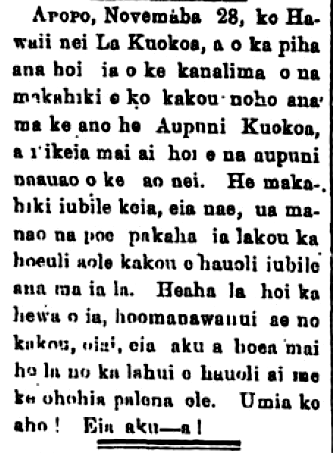
Ka Lei Momi, Buke I, Helu 17, Aoao 4. Novemaba 27, 1893.
To all citizens who have aloha for their Alii and patriots of Queen Liliuokalani, in the district of Honolulu;
Aloha to you all: Those whose names appear below are members of the Committee to invite all citizens for the YMCA [Ahahui Opiopio Imipono Karistiano] of Kawaiahao and Kaumakapili. Continue reading
Leo.—A Victory, Happy Hours. p 144.
1. Ke kani nei na pahu e,
Ma keia la maikai;
E ala mai a oli ae,
La Kuokoa nei.
Ke kani nei na mele e
Mauka, a makai;
Maanei, ma o, a ma na puu,
Nani ke kani mai.
Cho—Hooho pu na kini nei,
Huza, huza, e oli e,
Huza, huza, huza, e oli e,
Huza, huza, huza, e oli e. Continue reading
This coming Monday, the 28th of November, is the Independence Day of Hawaii nei, and on that day in the year 1844, recognition was received from the powers of England and France, and this is the 43rd year of our living with independence amongst the great powers of the entire world. Continue reading
He inoa Lani, he inoa Haku,
O Kumulipo o Kalakaua,
E lohe ko ke ao a puni,
O Kalakaua, oia ka Moi.
Cho.—E ola o ka Lani,
E ola ka Moi,
E lohe ko ke ao a puni,
O Kalakaua, oia ka Moi. Continue reading
Burning of the Ship Emerald.—At half-past two o’clock on Monday morning an alarm of fire was sounded by the watchmen in the bell-tower, which proved to be for the ship Emerald, at anchor in the roadstead. Fire brigades, about two hundred officers and men, were immediately dispatched from the Pensacola in port, which took off two or three of the patent fire extinguishers. The city firemen also turned out promptly, with their machines, hose carts and ladders, ready to assist whenever ordered. At early dawn, the ship was towed into the harbor alongside the steamboat wharf, where the firemen and engines could get access to her. The fire was first discovered soon after midnight, but when the naval force reached the ship the hole was so full of smoke that the fire extinguishers could could not be successfully applied, and little could be done towards checking the fire until the engines could be brought to bear on it. From six oʻclock, the firemen, mariners and citizens worked faithfully till after noon, when the fire was apparently subdued, and the firemen returned home. Continue reading
The ex-Queen has evidently been playing to the gallery and has enlisted in her broken cause some hysterical women. Among these is Julie de Rytiler. This may be a pseudonym, however, for the ever present Julius. He may have changed his sex in print. For mawkish sentiment the interview cannot be beat. When an interviewer writes such stuff as this she insults the lady she is interviewing. The ex-Queen is represented as having read “Aloha Oe” to this double distilled idiot and she writes “I do not know one word of Hawaiian, and yet so feelingly and expressively did this lovely woman read these songs that I felt sure I understoods it all.” It reminds one of the old lady in one of Marryat’s novels, who spoke of the extreme comfort of that “Blessed word Mesopotamia” was to her. The interviewer must be the kind of woman that can get a great deal of comfort out of “Mesopotamia,” or “Aloha Oe.” Hysterical persons like this do harm to the person they wish to do good to and certainly take away from the dignity of the ex-Queen.
(Hawaiian Star, 3/31/1897, p. 4)

The Hawaiian Star, Volume III, Number 1235, Page 4. March 31, 1897.
The Hawaiians are my people, and I am still their Queen. To the Hawaiians I shall always be Queen while I am alive, and after I am dead I shall still be their Queen—their dead Queen. But Hawaii is not in the hands of its people. From other countries all kinds of people have come—some wise, some foolish, some good, some very mean. They found fortunes in my county under the protection of my fathers, and then they robbed me of my throne.
[This quote is taken from an interview by Jule de Rytiler originally published in the American Woman’s Home Journal. For the entire interview as published by the Independent, see here.]
(Independent, 4/1/1897, p. 4)

The Independent, Volume IV, Number 547, Page 4. April 1, 1897.
 nupepa