This is an independent blog. Please note that I am nowhere near fluent, and that these are not translations, but merely works in progress. Please do comment if you come across misreads or anything else you think is important.
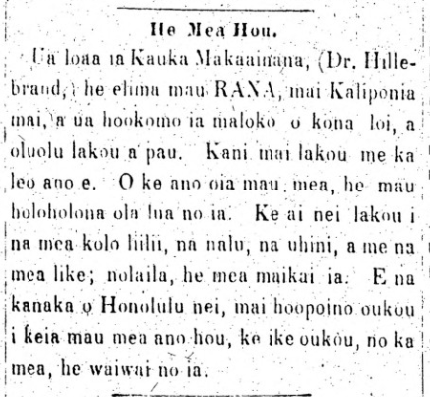
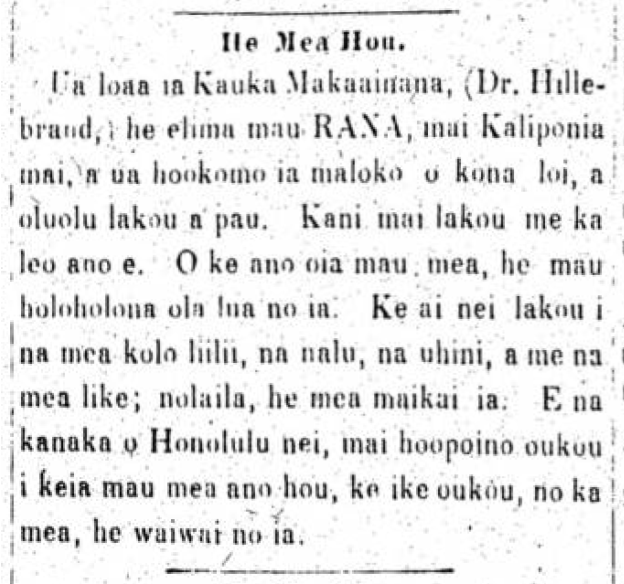
Kauka Makaainana (Dr. Hillebrand) has obtained five RANA (frogs) from California, and put them in his irrigated terrace, and they are all doing fine. They have a strange call. The nature of those animals is that they have two lives. They eat small creeping insects, flies, grasshoppers, and other things like that. Therefore it is a good thing. O People of Honolulu, do not harm these new things should you see them, because they are valuable.
Ka Hae Hawaii, Buke 2, Ano Hou—-Helu 27, Aoao 106. Sepetemaba 30, 1857.
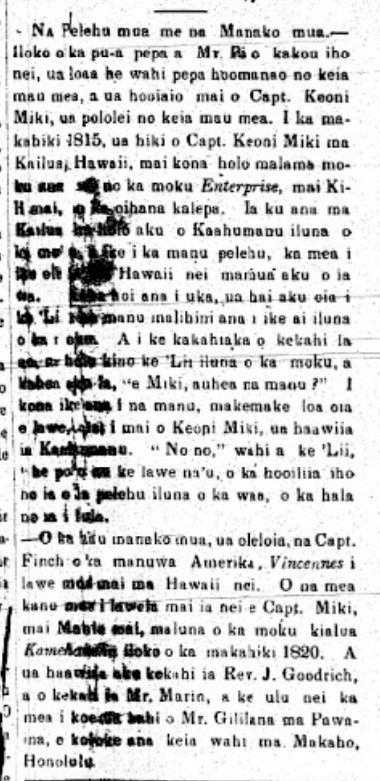
The first Turkeys and the first Mangoes.–In the sheaves of paper belonging to our Mr. ???, there was a memo pertaining to these things, and Captain John Meek [Capt. Keoni Miki] confirmed the information. In 1815, Capt. John Meek arrived in Kailua, Hawaii, as a mate of the ship Enterprise, from Chili, on a trading voyage. When he landed in Kailua, Kaahumanu boarded the ship and saw the turkeys, which were not seen here in Hawaii before that. She went back to shore and told the King about the unfamiliar birds she saw on the ship. In the morning of some following day, the King boarded the ship in person and called out, “O Miki, where are the birds?” When he saw the birds, he very much wanted to take them, but John Meek said that they were given to Kaahumanu. “No, no,” said the King, “I should take them for myself.[“] They were placed upon a canoe and taken ashore.
The first mango tree, it is said that it was Capt. Finch of the American warship Vincennes who first brought it to Hawaii nei. The first plants imported by Capt. Meek from Manila [Mania], were aboard the double-masted Kamehameha in 1820. Some were given to Rev. J. Goodrich, and some to Mr. Marin, and the others are growing at Mr. Gilliland’s place at Vineyard; this place is near Makaho, Honolulu.
(Ko Hawaii Ponoi, 6/18/1873, p. 2)
Ko Hawaii Pae Aina, Buke I, Helu 1, Aoao 2. Iune 18, 1873.
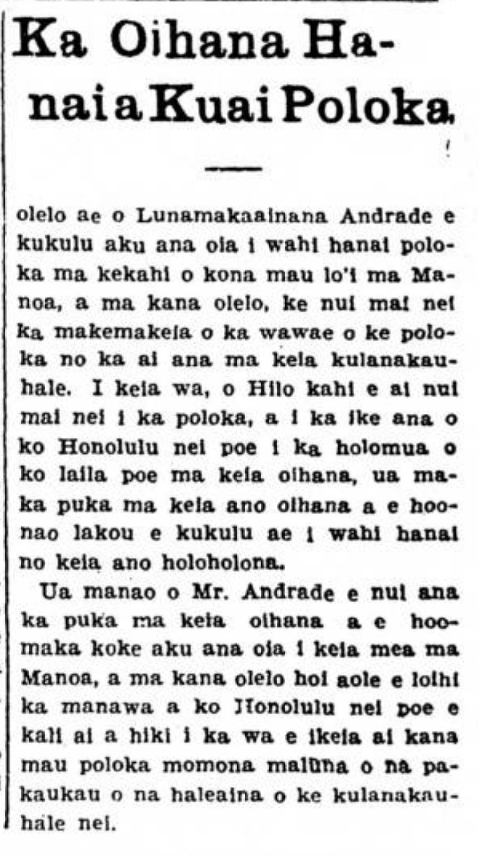
Representative Andrade said he will build a frog breeding grounds in some of his taro patches at Manoa, And according to him, the requests for frog legs for eating in this town is increasing. Currently, Hilo is where frog is eaten a lot, and when Honolulu people see the progress of those in this business, they will think of building a place to raise those animals.
Mr. Andrade believes that profits from this business will grow and he will start this venture in Manoa, and according to him, it will not be long for Honolulu people to wait before they will see his juicy frog on tables at restaurants in town.
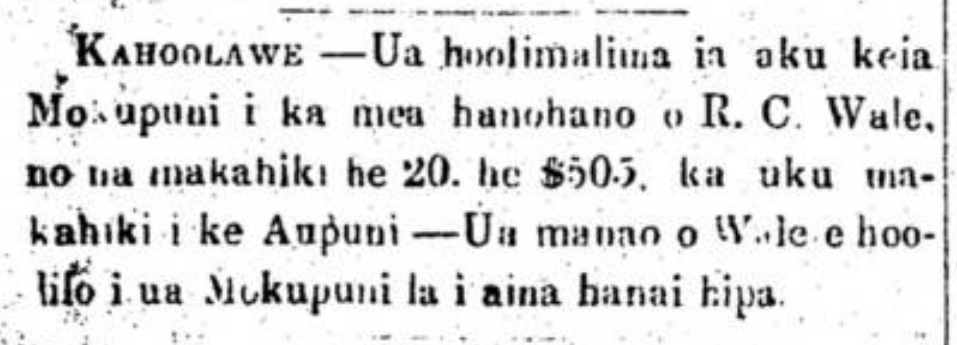
Kahoolawe–This island was leased to his Excellency R. C. Wyllie [ka mea hanohano R. C. Wale] for 20 years at $505 per year to the Government–Wyllie wants to turn the Island into a sheep ranch.
(Hae Hawaii, 4/14/1858, p. 6)
Ka Hae Hawaii, Buke 3, Ano Hou—Helu 2. Aperila 14, 1858.
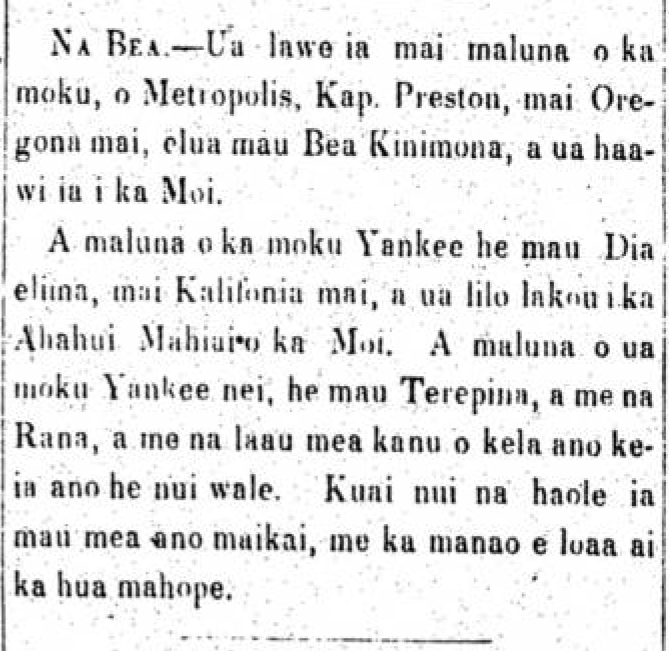
Aboard the ship the Yankee were five Deer, from California, and they went to the Royal Hawaiian Agriculture Society, of the King. And aboard that ship the Yankee, were some Terrapin and Frogs, and many types of plants. Haole buy those fine things with the thought they would have fruit in the future.
Bears.–Brought aboard the ship the Metropolis, Capt. Preston, from Oregon, were two Cinnamon Bears, and they were given to the King.
(Hae Hawaii, 12/2/1857, p. 142)
Ka Hae Hawaii, Buke 2, Ano Hou—Helu 2, Aoao 2. Dekemaba 2, 1857.
Kauka Makaainana (Dr. Hillebrand) has five FROGS [RANA] from California and he has put them in his taro patch. They are doing fine. They make strange noises. Their nature is that they are animals that have two lives. They eat small bugs: flies, grasshoppers, and other things like that. Therefore they are good. O People of Honolulu, do not harm these new things if you see them, because they are valuable.
(Hae Hawaii, 9/30/1857, p. 106)
Ka Hae Hawaii, Buke 2, Ano Hou—Helu 27, Aoao 106. Sepetemaba 30, 1857.
Who Brought the First Horses to the Islands?—In a valuable document presented by Stephen Reynolds, Esq., to the R. H. A. Society at its first meeting in 1850, the following passage occurs:—Horses.—I have not been able to find the name of him who introduced the first. It appears two were brought and presented to Kamehameha; the natives say Mr. Manine was in the vessel. Several were brought before 1823. From 1824 to 1838 many cargoes were brought from California. The horses born and reared on the islands are superior in all respects to those imported from California,—better limbs, better spirits, and tougher animals.” Continue reading →
“Old Oakum” was one of the odd characters of Honolulu u to about thirty years ago. He was a harmless creature whose one talent was that of collecting honey from bee trees without being stung. Where he came from or was born, or just what his nationality was, were matters not well known, for “Old Oakum” seemed to have forgotten all about himself long before coming to Honolulu which must have been in the early 50s. Continue reading →
It would be a difficult thing to fix the date of the beginning of the bee industry in the Hawaiian Islands. As far back as the “oldest inhabitant” can run his thoughts, honey has been gathered in the mountains. Back in the ’60s one of the characters of the city was Dwight Holcomb, known to the small boys and natives as “Old Oakum.” He was an eccentric individual and was the “bogie man” to the young boys of that time. Continue reading →
Honey of the forest.—There are a lot of honey bees in the forests of Oahu nei. We often see buckets filled with honey harvested by Dwight Holcomb [Okamu haole] in the uplands of Manoa and Kalihi. Continue reading →
 nupepa