NEWS.
O Hae Hawaii:
Aloha betwixt us.—I have some News I am sending to you, and it will be for you to spread it to all of the inhabited Islands of this Hawaiian archipelago. Continue reading

O Hae Hawaii:
Aloha betwixt us.—I have some News I am sending to you, and it will be for you to spread it to all of the inhabited Islands of this Hawaiian archipelago. Continue reading
Mr. Editor of the Greatest Prize of the Hawaiian People:
Aloha oe:—Please include this bit of news from here in North Hilo.
On the first of this month, Pakele, Iaukea, Laika, Kalei, and Lahapa went to go pick opihi on the shore of Waipunalei, and upon their return, they climbed up the pali. Lahapa was the first to climb up and the rest followed. When they reached the midpoint up the pali, a rocked dislodged and hit Lapaha square on the chest and he rolled down the pali, and because of the love of God, he was caught on a pandanus tree that was burned earlier in a fire. It was 40 feet high from where he tumbled from to where he was caught. Therefore, O my sisters and brothers and younger siblings, don’t go pick opihi again and return upland of the pali, lest you end up dying. Continue reading
O Kuokoa Newspaper, Aloha Oe. On the night of the 27th of February, 1883, at perhaps 10 o’clock, there rushed down the Halawa River on Molokai an astonishingly great amount of water. Continue reading
January 25. The was much water that covered over all of Olowalu, and the sugarcane acreage of the Olowalu Sugar Company, and nearly one hundred acres was covered with ʻaʻā lava and sand above; and the sleeping quarters of the workers was moved by the water, but it did not get washed away, and there were no injuries.
This is the news that I should tell you all; that is about all of the different fishes that came ashore; this did not happen in floods before; they were only a few fish; but during this flood, there were a lot of fishes that came on shore. These are the fishes that I saw, heepuloa, kala, aweoweo,
Continue reading
When the tsunami [kai hoee] hit, it reached all the large islands of this archipelago. It hit Kauai, Oahu, Molokai, Maui and Hawaii. But the island of Hawaii received the heaviest damages. The tsunami caused damages and took lives on the other islands, but the most severe was on Hawaii Island.
But from the death reports, of all the ethnicities, the Japanese made up most of deaths. On Hawaii Island, there were maybe four of five Hawaiians that died. On Kauai Island, there were many Hawaiians that died, and so too on Oahu and Maui.
A report from West Hawaii said the tsunami reached there as well. Hookena was reached by the tsunami but it probably lives nor houses were damaged. From what witnesses say, the ocean reached the level of the pier of Hookena, but it did not damage buildings. Continue reading
The wind and rain has returned during these past two weeks, from the 7th to the 20th, coming the strongest from the south side of Maui; collapsed were many homes, places of work, churches, schools, and bell towers. The name of this wind that acts without aloha is a Kona, but it is not something we should be astonished by, for God can do as he likes. Praised always be his name for his works.
At Nawaieha.
The number of buildings toppled by this wind was thirty or more. Some wooden buildings with new beams were turned over, but most important was the Church here in Wailuku; its windows were smashed, and the side makai on the top was torn off and the shingles were scattered by the force of the Kona wind. That is the biggest problem encountered by us here in Nawaieha. But we are hopeful that it will be rebuilt more beautiful than before, for all the members of this covenant gathered together to collect a sum of money sufficient to rebuild the church with great elegance, topping the beauty of the previous building. The wealthy haole are also joining in to help, that being Christopher H. Lewers [C. Lui] of Waihee and all of the wealthy people, and also J. D. Havekost [Kililika], who is a white kamaaina from Wailuku nei, as well as the youth of the shady valleys of Wailuku. A number of committees to ask for donations were set. I see these wealthy people with their aloha and their regret for the house of Jehovah. It is good; it is right that you build the house where the souls who are skeptical, godless, and so forth are widely taught. Continue reading
O Kuokoa Newspaper: Aloha oe.
On the night of February 27, 1883, at perhaps 10 o’clock, a shockingly huge amount of water rushed down the river of Halawa, Molokai.
Here is what was shocking:—On the 27th, the wind was perfectly calm, and there was no big rain. However, that night, the waters of the rivers of Moaula and Hipuapua came violently down and swept away 2 fishing canoes. One of these canoes was brought back on land but was broken up; the other is gone.
That is just some small news from here in Halawa, Molokai.
Aloha to the Editor and to the typesetting Boys of the press my delight.
Albert Kapaehaole
(Kuokoa, 3/10/1883, p. 3)
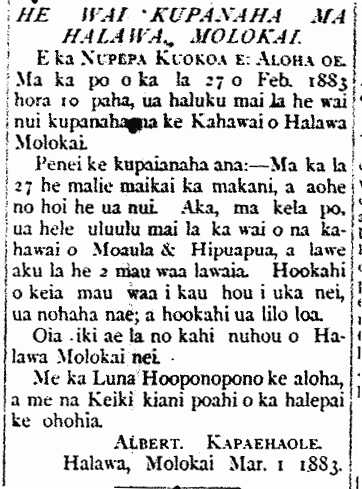
Ka Nupepa Kuokoa, Buke XXII, Helu 10, Aoao 3. Maraki 10, 1883.
Strong Winds.—M. W. Keale of Niihau told us that on the 3rd of this month, toppled over were nine buildings on Niihau, for there were two in Kamalino; two in Kiekie; one in Puuwai; and three in Kaumunui, one being a Protestant meeting house, one a Catholic meeting house, and one a private residence. And most of the other houses were tilted to the side by the dirt-stirring winds.
(Kuokoa, 10/24/1868, p. 3)
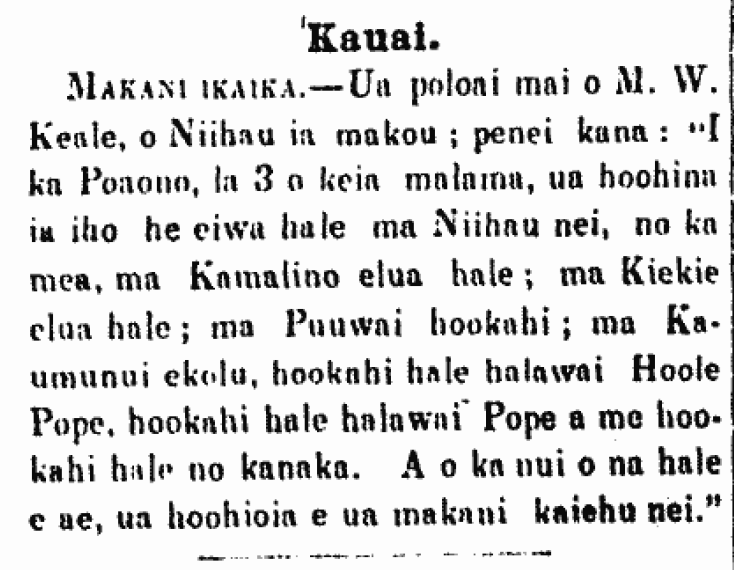
Ka Nupepa Kuokoa, Buke VII, Helu 43, Aoao 3. Okatoba 24, 1868.
O Kuokoa Newspaper; Aloha oe:—
On the Estate of J. Makee, the Mill, the bell house, and a portion of the Mill Boiling House, the trees, and the decorative flowers of the yard. All of these things were left barren. The grinders are standing exposed, and the quarters of the employees of J. Makee were turned over, door faced down. Some were moved; all of the houses were flooded. The sugarcane of J. Makee was pushed down by the water and the wind. The Roads and stone walls turned into nothing, for Makee and all the areas of this district. There was much damage, and the thatched houses of the Hawaiians were left scattered about. This wind on the 9th of this month began at 10 o’clock until 1/2 past 2. After the strength of the wind died down, there was a little rain. I will conclude my time with this news. It would be better if I leave the majority for another writer to talk of the majority of the news. With Aloha.
John Kaikiohua.
Ulupalakua, August 9, 1871.
[John Kaikiohua appears to have been the Head Foreman of James Makee’s sugar plantation. This account is just one of many about the great storm’s affects on Ulupalakua, Makawao, Wailuku, and Hana, appearing in this issue of the Kuokoa.
It is interesting to see that this storm occurred 143 years ago, just one day later from Iselle!]
(Kuokoa, 8/19/1871, p. 3)
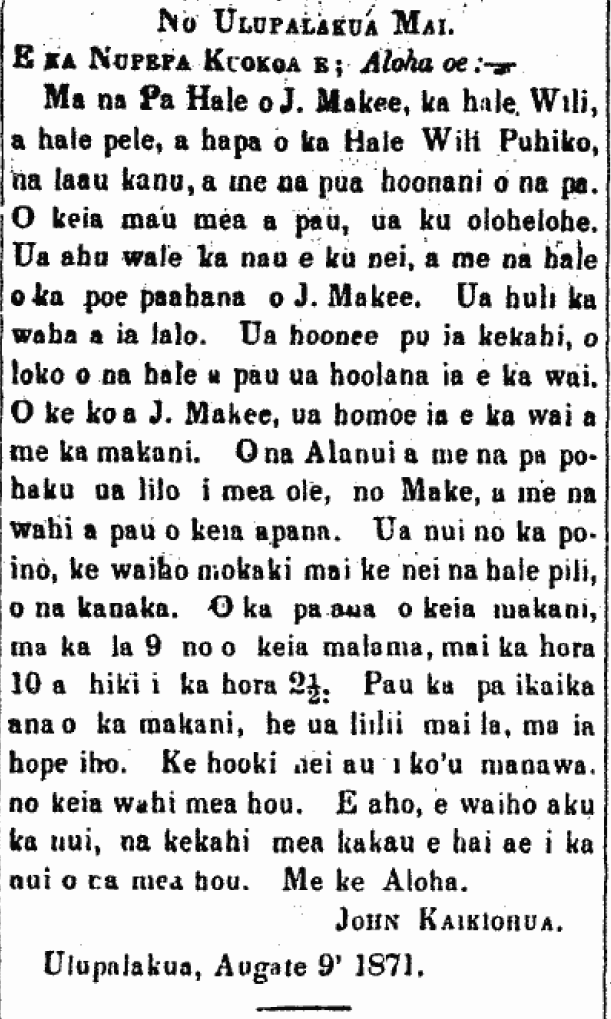
Ka Nupepa Kuokoa, Buke X, Helu 33, Aoao 3. Augate 19, 1871.
Please place this in some open area of your columns; the story of this huge earthquake mentioned above, in the District of Puna, and perhaps other places as well.
When I turned back with my travel companions on the road from Kapapala, we didn’t reach our home (Kahaualea), but between those places we were met with an earthquake, leaning this way and that as we groped around for something solid to hold on to, and one of my friends saw the ground before us splitting open, whereupon he cried out and stood elsewhere; as for me, I tipped over and heard up close the rumbling of the earth, and I said to my companions, “What is happening to us?” One of us answered, “Maybe this is an earthquake that is causing us this fright.” I then said, “How awesomely frightening; if the ground rumbles and splits open and we are swallowed up, then we are all dead, just like the Anak [Anaka] people who were swallowed in the earth.
The length of the earthquake upon us was like six minute, and when it was over, we headed back while constantly seeing at the places where the earth split open in the road; some were the size of a man’s foot, and were several inches wide at some places. And when we reached out houses, the ohana was there who experienced the same thing. I saw our eating house [hale paina] (a stone building) which collapsed; and the dishes were all broken.
It was as if the damage seen was from the earthquake, but it also came from the sea; we went down to the shore (where much of our houses were). When we looked, we saw the boats were smashed in little pieces, and inland, the earthquake made houses topple, the stone walls of the church collapse, house fences fall, fish ponds dry up; some survived. Toward the sea, five canoes were splintered, some house fences fell, and the water entered some houses where people lived. It was all messed up.
For those whose lives were in danger, when the water entered their houses, a man named Kapai got up with his two children and ran out, but they were taken by the sea and died, so too with some women and their children, they were beaten by the sea; some people with their daughter escaped by running and climbing a hala tree. Auwe! Auwe! in dire straits. Make haste O Ke Au Okoa, speed on the wings of the wind to report of this frightening news here in Puna and perhaps elsewhere as well. B. H. M. Kailiwahine.
Kaukeano, Puna, Hawaii, April 12, 1868.
P. S. It was on the 2nd of April, at maybe 5 in the evening that the tremors began, and it did not let up at all until the setting of the sun, and at dawn, the earthquakes were strong. B. H. M. K.
(Au Okoa, 4/16/1868, p. 3)
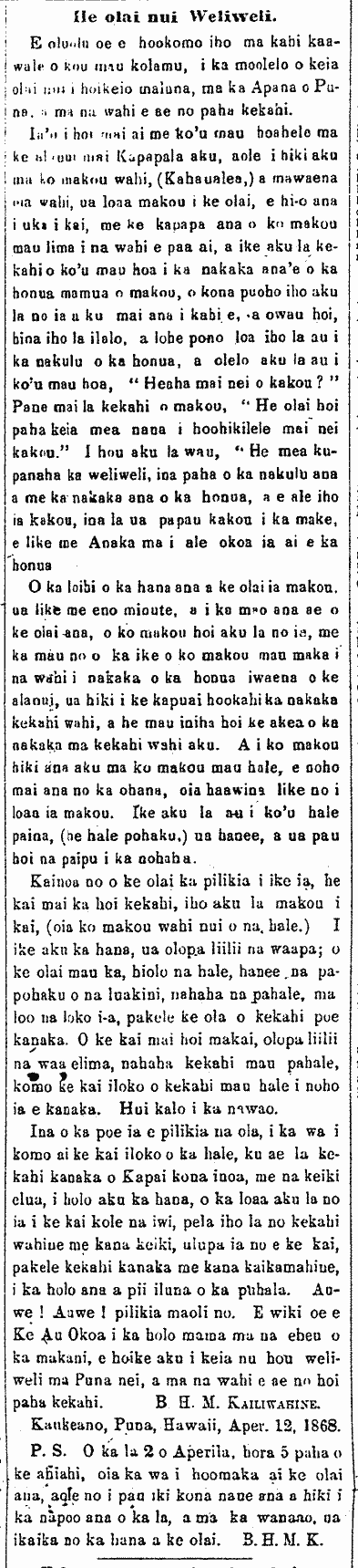
Ke Au Okoa, Buke III, Helu 52, Aoao 3. Aperila 16, 1868.
 nupepa