Mauna Loa eruption, 1873.

Lava erupts on Mauna Loa.

With the arrival of the schooner Nettie Merrill yesterday, heard from the captain was that they had seen the burning of Lava on top the summit of Mauna Loa this past Thursday. On the following Wednesday, seen was the spreading solid of the smoke. It is said that this is an exceptionally huge eruption. It is believed it will flow to Kau .

(Kuokoa 1/11/1873, p. 3)
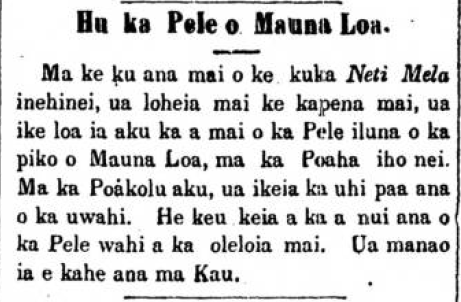
Ka Nupepa Kuokoa, Buke XII, Helu 2, Aoao 3. Ianuari 11, 1879.

Where will she go? No one knows, 1880.

[Found under: “He Waiwai.”]

Aboard the Likelike this past Sunday, we received the news, the fires of the woman Pele were emerging from atop Mokuaweoweo, and it is headed down toward the sea. It will turn toward and flatten out between Hilo and Laupahoehoe. We were told, it is not certain where it will appear; maybe in Hilo, maybe in Laupahoehoe. It is 15 miles away from the crater from where it heads down, and the skies above glow red, and lights up the land and the sea.

(Elele Poakolu, 11/10/1880, p. 1)

Ka Elele Poakolu, Buke I, Helu 10, Aoao 1. Novemaba, 10, 1880.

Pele Consumes Hawaii, 1880.

It is believed that the beauty and the terror of this eruption at Mauna Loa will be greater than that of the earlier eruptions witnessed by those who are living. The lava will perhaps flow for a number of month more. In a letter to the Gazette newspaper from H. M. Whitney, it was said that the lava first appeared in the evening on the fifth of this month. It is thought that the crater from which the lava erupted was a little to the north of Mokuaweoweo, and it is about six miles from it. At times the lava shot up two hundred feet and crackled a bit, falling like burning charcoal. It is something remarkable to see. The night is overcome by the light of the fires. The lava flowed on the side of Mauna Loa facing Mauna Kea, and the unobstructed land lying between the two mountains is fifteen full miles in circumference is like a lake of blazing fire. It is something incomparably fierce to see. From this great lake of fire there appeared two lava flows. One that went down to the Puna and Kau side, and the second down the eastern side. According to the latest news, it is said that the lava nearly reached Volcano House [ka hale hookipa ma Kilauea]; it is only 10 miles away; as for the flow headed east, it is 15 miles from Hilo. But it is not believed that Hilo will face disaster. The kamaaina from there perhaps will not have forgotten the lava flows in the years 1855, 1859, and 1868, when people were anxious that their lives were in danger. But according to the old saying, “Aole i haawi ia o Hilo no Pele.” [Hilo shall not be given to Pele.]

Continue reading

Ka Luahine Pele, 1942.

The Old Woman Returned

But She Is Gone Once More

Because the land has entered in the war, local news cannot be published in the newspapers without being permitted by the war department. One of these local news stories is the return of the Old Woman Pele to Hawaii nei, but not to her regular home at Halemaumau, but at Mokuaweoweo.

Continue reading

“Kilauea has vanished, obscured by smoke…” 1875.

[Found under: “Nu Hou Kuloko.”]

The fire of the woman.–We have heard, “Nalohia Kilauea po i ka uwahi, Po i ke awa ka uka o Puna,” [Kilauea has vanished, obscured by smoke, Obscured by the mist is the upland of Puna.] that risen is the red-heat of the fiery stone-melting oven of Madame Pele. The glow can be seen from very far off. Her activity at Mokuaweoweo has paused, and she is increasing her work at her own place. Perhaps that island of hers will recover.

(Kuokoa, 8/14/1875, p. 3)

Ka Nupepa Kuokoa, Buke XIV, Helu 33, Aoao 3. Augate 14, 1875.

Mauna Loa erupts, 1892.

EARTH-DEVOURING LAVA OF MOKUAWEOWEO.

From our many friends living all over on the island of Keawe, we recieved news of sightings of lava blazing atop the summit of Mauna Loa, from the crater of Mokuaweoweo. And we are indebt to them for their kindness. These are each of the letters showing:

Kailua, North Kona, Hawaii, Dec. 5.–1 o’clock at late night on this past Wednesday, in the Alenuihaha Channel, on the deck of the Malulani, seen was the lava of Mokuaweoweo. The red glow of the fires were incomparably great.

D. Makainai


Continue reading

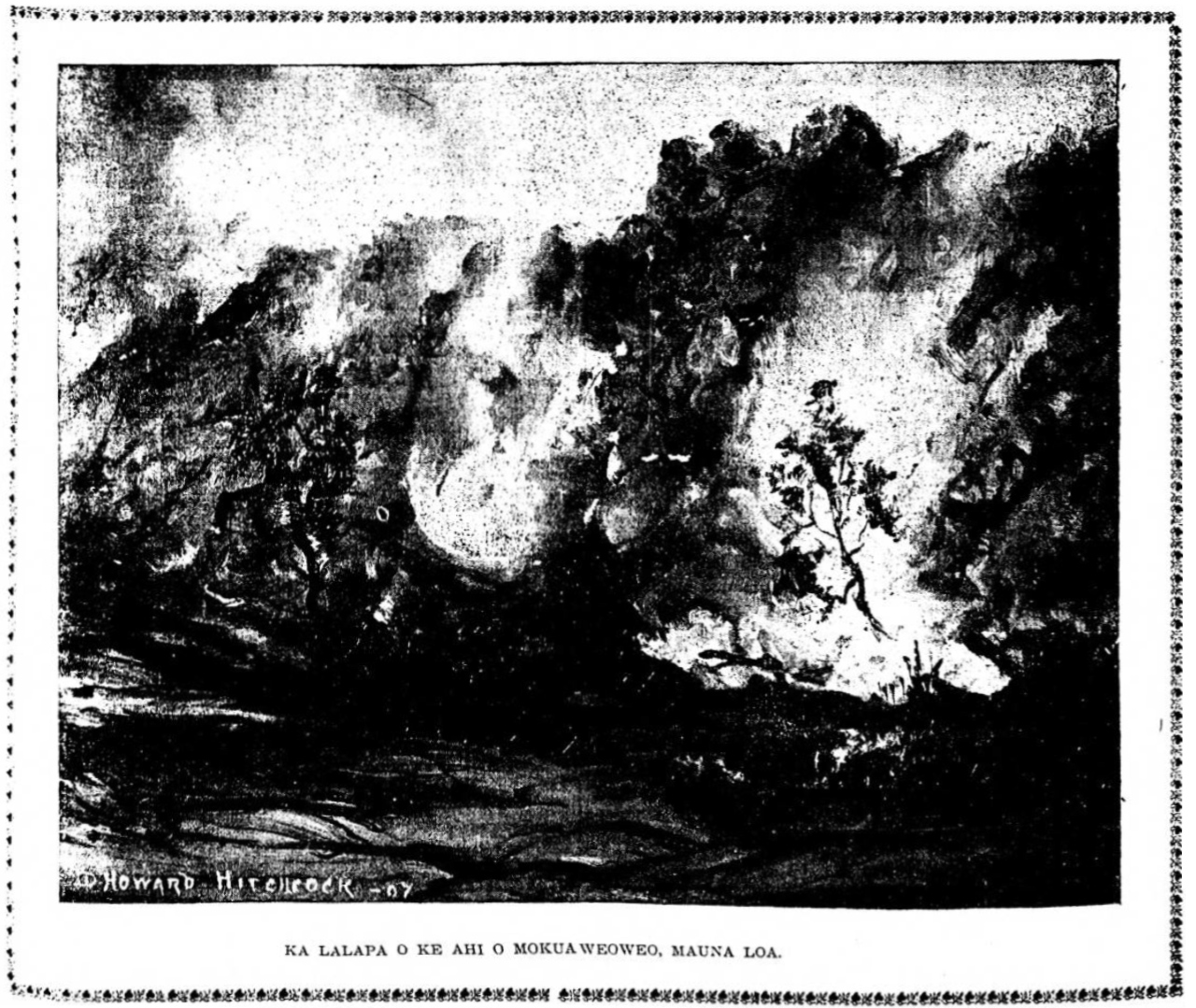
D. Howard Hitchcock Mokuaweoweo painting, 1907.

BLAZING FIRES OF MOKUAWEOWEO, MAUNA LOA.

[This image appears unrelated to the contents of the page, which is a serial of a foreign love story, “Ka Mana o ka Leka.” Does anyone recognize this painting by Hitchcock, and might it be on exhibit somewhere?]

Ka Nupepa Kuokoa, Buke XLII, Helu 5, Aoao 3. Feberuari 1, 1907.

Lilia Palapala, former student at Waialua Girls’ Boarding School, 1881.

LETTERS FROM THE STUDENTS OF HALEIWA, WAIALUA.

Keaiwa, Kau, Feb. 21, 1881.

Mrs. Mary E. Green. Teacher of the Boarding School of Haleiwa, Waialua,Oahu. Aloha to you and all of the students under your care.

I saw your announcement in the Kuokoa Newspaper of this year, pertaining to the students of Haleiwa the, fromthe time of O. H. Gulick until this time, and the pertaining questions.

Now, I am one of the students from the time of O. H. Gulick, and I am pleased to answer your questions. And here are the questions and answers.

Q 1 What is your name?

A Lilia Palapala Continue reading

Why do we ignore science? 1983.

Volcano alarm sounded, but nobody listened

Clark’s Big Isle

“You may bring a horse to the river, but he will drink when and what he pleaseth.”

—George Herbert, 1640.

HILO.—In early 1975, Drs. Donald Peterson and Donald Mullineaux, volcanologists, issued a report, “Volcanic Hazards on the Island of Hawaii.” If reaction had come in a theater, the audience would have booed.

Peterson was scoffed at by Big Island real estate agents and tourist industry leaders. Mayor Herbert Matayoshi jumped on the bandwagon and castigated the scientists for unduly alarming residents, potential visitors and prospective investors.

As a result, the report was largely ignored. Continue reading