This is an independent blog. Please note that I am nowhere near fluent, and that these are not translations, but merely works in progress. Please do comment if you come across misreads or anything else you think is important.
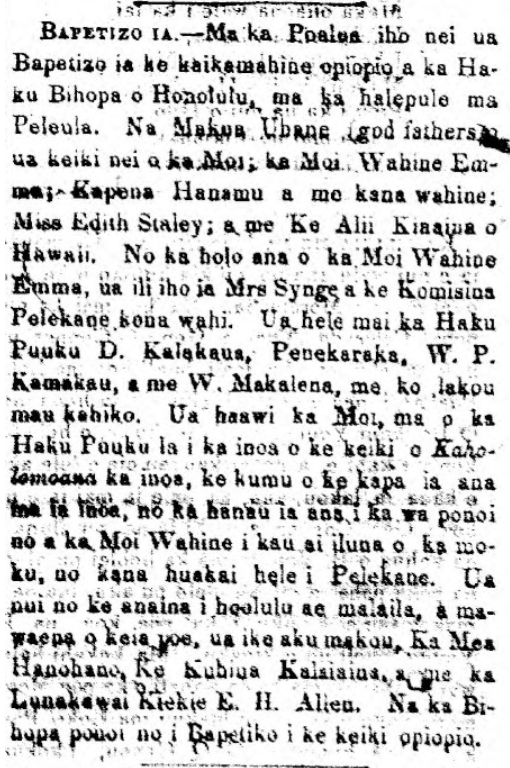
Baptized.–This past Tuesday, the young daughter of the Lord Bishop [Staley] of Honolulu was baptized at the church at Peleula. The god parents of the child are the King, Queen Emma, Captain Hanham [Kapena Hanamu], and his wife; Miss Edith Staley; and the Governess of Hawaii [Keelikolani]. Because Queen Emma was travelling, her part was assumed by the wife of the British Commissioner, Mrs. Synge. The Lord Chamberlain D. Kalakaua, Penekaraka [Prendergast], W. P. Kamakau, and W. Makalena attended in their finery. The King, through the Lord Chamberlain gave the child the name Kaholomoana. The reason she was given that name, because she was born at the exact time the Queen boarded the ship to go on her trip to Britain. There was a large crowd gathered there, and among them we saw His Excellency the Minister of the Interior [Hutchison], and Lord Chancellor E. H. Allen. The Bishop himself baptized the young child.
(Au Okoa, 6/19/1865, p. 2)
Ke Au Okoa, Buke I, Helu 9, Aoao 2. Iune 19, 1865.
Among the passengers aboard the bark Smyrniote that landed in the evening of this past Monday, Emma Meka [Emma Metcalf] was one who we saw; she returned with a heavy heart for the leaving of her father.
[Theophilus Sabin Metcalf died on August 6, 1866.]
Tomorrow (Tuesday), the 31st of July, is the twenty-third year that the Hawaiian Flag was returned. Therefore, it will be observed as a Holiday [La Nui], and the doors of the Government Buildings will be closed.
T. W. Hutchison, Minister of the Interior. Office of the Interior, July 27, 1866.
Ke Au Okoa, Buke II, Helu 15, Aoao 3. Iulai 30, 1866.
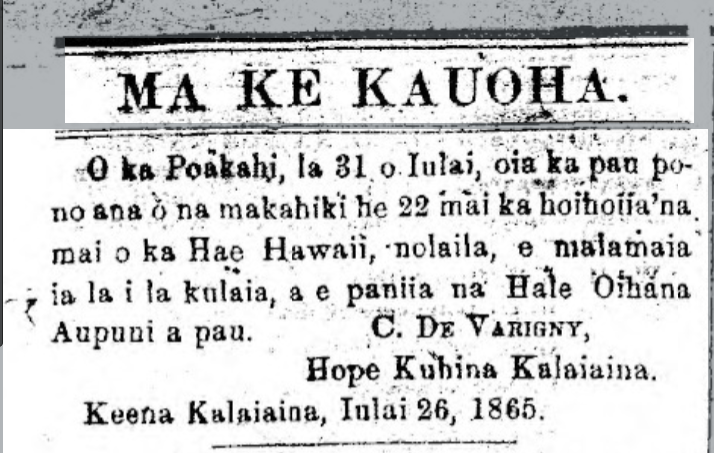
Monday, the 31st of July, is the conclusion of the 22nd year from when the Hawaiian Flag was returned. Therefore, that day will be observed as a holiday, and all Government Offices will be closed.
C. De Varigny, Acting Minister of the Interior, Office of the Interior, July 26, 1865.
Ke Au Okoa, Buke I, Helu 15, Aoao 3. Iulai 31, 1865.
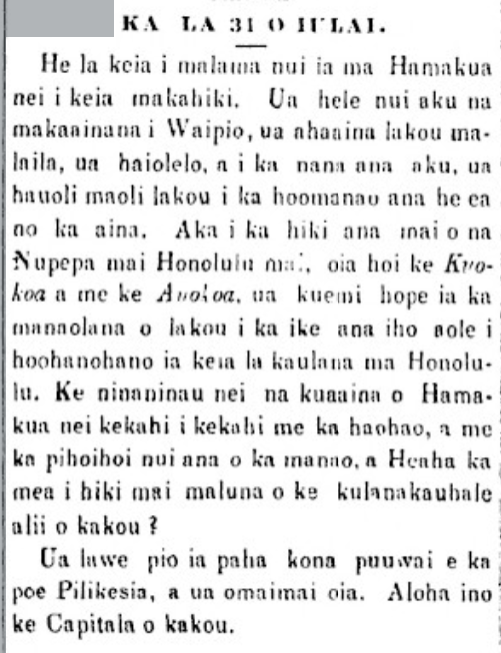
This was a day much celebrated here at Hamakua this year. Makaainana headed in droves to Waipio, and they feasted there, they had speeches, and they appeared to be happy indeed to commemorate the sovereignty of the land. But when the newspapers arrived from Honolulu, they being the Kuokoa and the Au Okoa, the makaainana’s enthusiasm for this celebrated day took a step back when they saw that this day was not honored in Honolulu. The country folk here in Hamakua question each other, astonished and highly disturbed, “What came upon the royal town of ours?
Perhaps their hearts were captured by the Philistines, and they are sickly. Alas for that Capitol of ours.
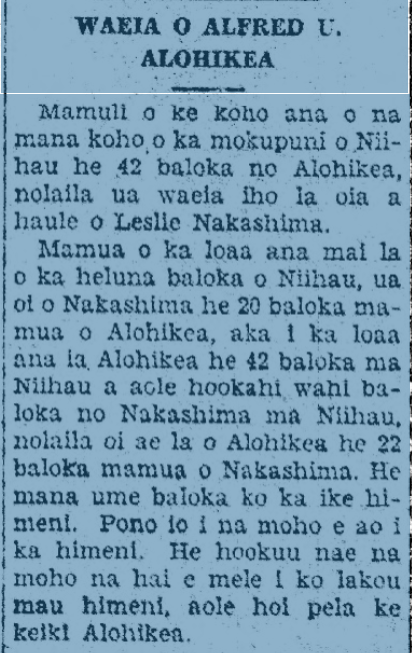
Because of the selection by the voters of the island of Niihau, 42 votes for Alohikea, therefore he was selected and Leslie Nakashima lost.
Before the number of Niihau votes were received, Nakashima lead by 20 votes over Alohikea, but when Alohikea received the 42 votes at Niihau, and no votes for Nakashima on Niihau, therefore Alohikea had 22 more votes than Nakashima. Knowing how to sing attracts ballots. Candidates need to learn to sing. The candidates let other do their singing; not so for that youth, Alohikea.
(Alakai o Hawaii, 10/18/1928, p. 3)
Ke Alakai o Hawaii, Buke 1, Helu 25, Aoao 3. Okatoba 18, 1928
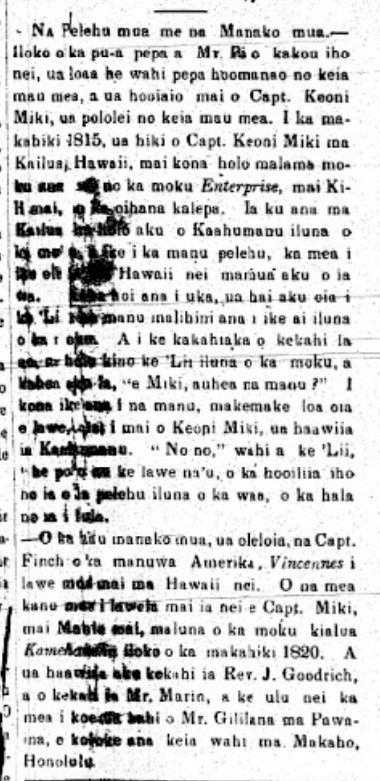
The first Turkeys and the first Mangoes.–In the sheaves of paper belonging to our Mr. ???, there was a memo pertaining to these things, and Captain John Meek [Capt. Keoni Miki] confirmed the information. In 1815, Capt. John Meek arrived in Kailua, Hawaii, as a mate of the ship Enterprise, from Chili, on a trading voyage. When he landed in Kailua, Kaahumanu boarded the ship and saw the turkeys, which were not seen here in Hawaii before that. She went back to shore and told the King about the unfamiliar birds she saw on the ship. In the morning of some following day, the King boarded the ship in person and called out, “O Miki, where are the birds?” When he saw the birds, he very much wanted to take them, but John Meek said that they were given to Kaahumanu. “No, no,” said the King, “I should take them for myself.[“] They were placed upon a canoe and taken ashore.
The first mango tree, it is said that it was Capt. Finch of the American warship Vincennes who first brought it to Hawaii nei. The first plants imported by Capt. Meek from Manila [Mania], were aboard the double-masted Kamehameha in 1820. Some were given to Rev. J. Goodrich, and some to Mr. Marin, and the others are growing at Mr. Gilliland’s place at Vineyard; this place is near Makaho, Honolulu.
(Ko Hawaii Ponoi, 6/18/1873, p. 2)
Ko Hawaii Pae Aina, Buke I, Helu 1, Aoao 2. Iune 18, 1873.
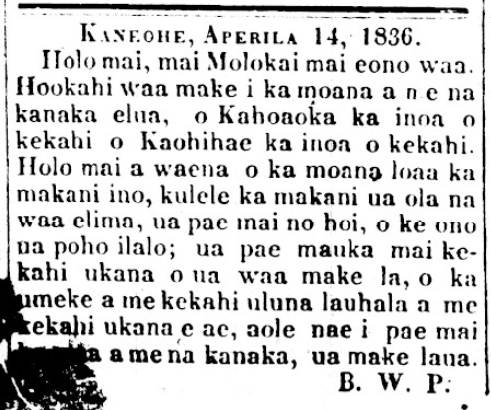
Six canoes sailed from Molokai. One sunk in the ocean with two people, Kahoaoka is the name of one of them, and Kaohihae is the name of the other. They sailed into the middle of the ocean where they came upon a tempest, the canoes were scattered by the wind, and five survived, they made it to land, while the sixth sank. Some of the cargo of the sunken canoe came ashore, an umeke and a lauhala pillow and some other belongings, but the canoe and the two men did not; the two of them died.
B. W. P.*
(Kumu Hawaii, 4/27/1836, p. 36)
*B. W. P. most likely stands for Benjamin Wyman Parker, also known as Pareka.
Ikaaka Heremona W. Kihe left this faint life; the famous writer seen in your newspaper, of the famous moolelo, “Kamiki.” He is one of the expert newspaper writers seen under the penname “Ka Ohu Haaheo iluna o na Kuahiwi Ekolu [Ka Ohu Haaheo o na Kuahiwi Ekolu].”
He left this life on the 17th of this month of February, and his path lead straight on the path of no return.
He died after being sick for a long number of years. His wife passed some months ago, and he followed after her in the same footsteps.
He was a familiar amongst your columns, O Hoku o Hawaii, in times past, and he was an expert writer of moolelo of Hawaii nei, and by his pen did he show your readers of Ka Hoku famous places of “Kekaha wai ole o na Kona nei [Waterless Kekaha of the Kona Districts].” He passed on with his family from Keei around his bed, and he put aside his burdens of this worldly life surrounded by his loved ones on this side of the river of death.
Aloha to that friend of our of this beloved land, “Kekaha wai ole o na Kona.”
Sincerely with aloha, SOLOMONA ALOHIKEA
He was a friend of ours in many years past, and seen indeed in the columns of Ka Hoku o Hawaii were new things from his pen. He was a familiar with politics for many years. And we recall him belonging to the Republican Party for the latter years of his life. Aloha for that kamaaina of the Kona Districts, where we visited many times. The editor of Ka Hoku o Hawaii thanks you, O Solomon Alohikea from whom came the news of the passing of this friend of ours in politics of our party. God shall give relief to his grieving family.
Leaving little by little Are our friends There is no rope that can restrain, It will sever indeed*
*This hymn was composed by Lorenzo Lyons (loosely based off the poem by James Montgomery):
Ke hele liilii nei Na hoa o kakou; Aohe kaula e paa ai, E moku ana no.
E hele liilii mau A pau loa’e kakou, Aohe hoa e kanikau, Ua make like no.
E ala hou no nae, A pii pu ae kakou, Ke noho pono a maikai, A komo i ke ao.
A hui pu ma o– Na hoaaloha nei, Aole e kaawale hou, Pau loa ho ka uwe.
(Hoku o Hawaii, March 4, 1930)
Ka Hoku o Hawaii, Buke XXIII, Helu 38, Aoao 3. Maraki 4, 1930.



 nupepa