Silk worms grown in Koloa, Kauai in 1836?

1836, the beginnings of sericulture on Kauai. 1843.

SILK. NUMBER 2.

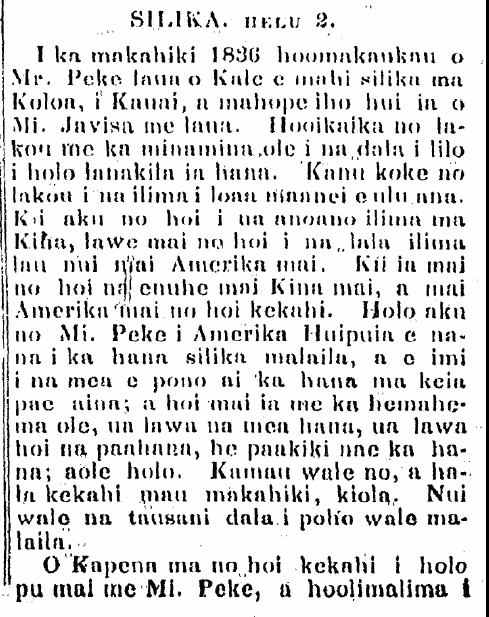
In the year 1836, Mr. Peke and Kale made ready to farm silk [silika] in Koloa, Kauai, and afterwards the two were joined by Mr. Jarvis [Mi. Javisa]. They put much effort into this without caring about money spent to make it a success. They immediately planted ilima found growing here. They went to get ilima [? mulberry] seeds from China and brought back branches of the ilima lau nui from America. Mr. Peke went to the United States of America to see silk production there, and to find what it took to raise them in this archipelago; he returned without anything lacking, with the necessary gear, and sufficient workers, but the work was difficult and did not move forward. They kept at it, and some years went by, and they gave up. Many thousands of dollars was wasted on it.

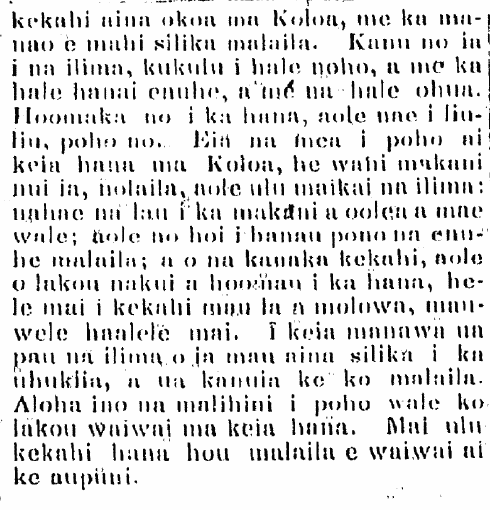
Kapena and others also came with Mr. Peke, and leased other lands in Koloa, with thoughts of raising silk there. He planted ilima, built a residence, a building to raise the worms, and a house for the workers. They began the work, but in not much time, it was a bust. Here are the reasons that it was a waste of time in Koloa: there is a strong wind so the ilima does not grow well as the leaves are torn in the strong wind and wilt, the worms don’t grow well there; and the people also, they are not eager and do not keep at the work; they come some days and slack off, are lazy and leave. Today, the ilima of those silk lands are all pulled out and sugar is planted there. So sad for those foreigners who wasted their money in this endeavor. A new enterprise almost started there to make the nation rich.

(Nonanona, 1/3/1843, p. 78)
SILIKA. HELU 2.

(Nonanona, 1/3/1843, p. 79)

...kekahi aina okoa ma Koloa...

Tobacco was not the only thing people have tried to grow here. A rubber plantation? 1907.

More on rubber cultivation in Hawaii nei. 1907.

A RUBBER ASSOCIATION TO BE ESTABLISHED ON MAUI.

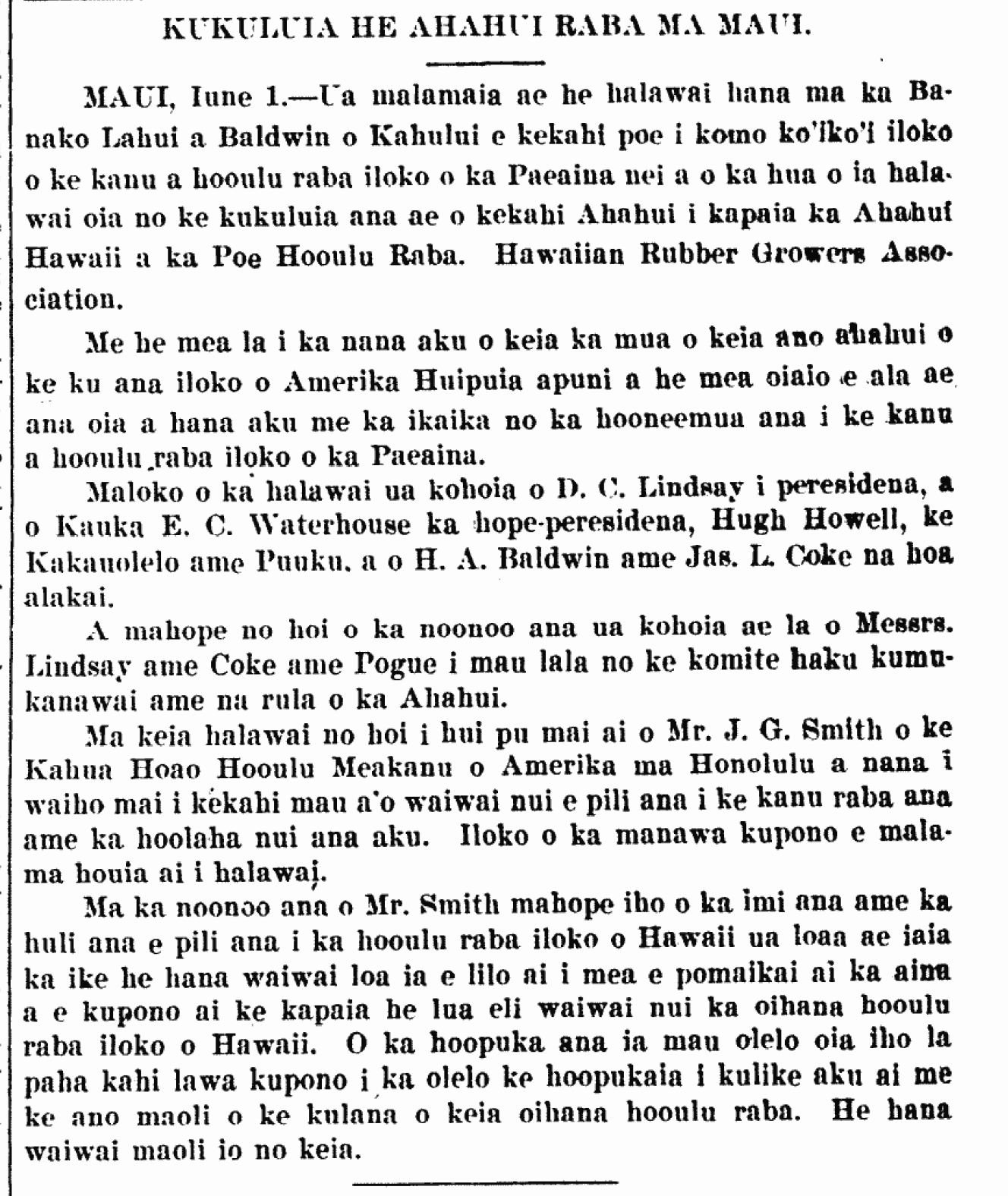
MAUI. June 1.—A business meeting was held at the Kahului Baldwin National Bank [Banako Lahui a Baldwin o Kahului] by people seriously planting and raising rubber [raba] in this Archipelago, and the outcome of the meeting was the establishment of an Association called “Ka Ahahui Hawaii a ka Poe Hooulu Raba [Hawaiian Rubber Growers’ Association]”.

It seems that when looking at this, this is the first association of its kind established in the whole of the United States of America, and it is a fact that it will start and strive to push forward the planting and growing of rubber in the Archipelago.

In the meeting, D. C. Lindsay was chosen as president, and Doctor E. C. Waterhouse as vice president, Hugh Howell, the Secretary and Treasurer, and H. A. Baldwin and James L. Coke as fellow advisors.

And after consideration, Messrs. Lindsay and Coke and Pogue were chosen as members of the committee to draft bylaws and rules for the Association.

Also at this meeting was Mr. J. G. Smith of the American Agricultural Experiment Station [Kahua Hoao Houlu Meakanu o Amerika] in Honolulu and he gave some valuable advice relating to the planting and the wide distribution of rubber. At a proper time, another meeting will be held.

In the thoughts of Mr. Smith, after he searched and investigated about growing rubber in Hawaii, he found that it is a very valuable endeavor that will bring good fortune to the land and it is well that the growing of rubber in Hawaii be called a rich mine. This declaration was perhaps enough of a statement befitting the importance of this effort to raise rubber. This is a truly lucrative endeavor.

(Kuokoa, 6/7/1907, p. 5)

KUKULUIA HE AHAHUI RABA MA MAUI.

Continue reading

Tobacco grown in Hawaii is similar to Cuban tobacco, 1905.

THE TOBACCO FROM HAWAII IS OF GOOD QUALITY.

This past Saturday Mr. Smith of the U.S. Experiment Station [Keena Hoao Meaulu o Amerika] here received a letter from an expert of Germany in plant research. Some time ago that Experimental Station of America tried planting tobacco in Hamakua. The first crop went to waste because of the ineptness of the the first person who was caring for it. Continue reading

On huli and planting and the ebook coming out from Bishop Museum Press, 1857/2020.

[Found under: “NO KA MAHIAI.”]

Not all kinds of huli are suitable for planting in wet patches. If the corm has been too closely cut off from the bottom of the huli and the huli itself is too small, it is not good for planting. If the taro has rotted and only a third remains good, Continue reading

Kalo planting and an ebook from Bishop Museum Press, 1922/2020.

[Found under: “KE ANO O KE KALAIAINA.”]

On  making loʻi if it was not done previously. I learned to make wet patches for four years at Lahainaluna. If it was desirable to convert a piece of dry land into a wet patch, they looked to see how water could be brought to it, because water was important. . . . If the patch was 20 fathoms long and 10 fathoms [anana, arm span] wide, we made them with shovels and the few pickaxes that we had. The soil near the banks was tossed up on them. The banks were made well, they were solid and thick. In digging with the shovel from the upper to the lower end and from one side to the other there was no part of the patch that was not dug. It looked level and even. Then the water was run into it and then the uneven places were seen, some deep, some high. The deep places were filled in. When it was seen that it was level then water was allowed to run in. We brought the oxen, that pulled the carts over the plains, and put them into the newly made patch and the oxen trampled on the earth up and down, to-and-fro. If we wanted some fun like the oxen, we increased the water in which to play. . . . Continue reading