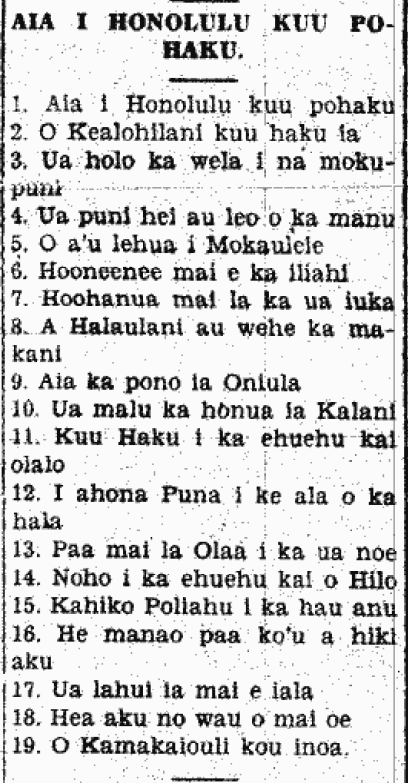
“Aia i Honolulu kuu pohaku,” name song for Kamehameha V., 1929.

AIA I HONOLULU KUU POHAKU.

1. Aia i Honolulu kuu pohaku

2. O Kealohilani kuu haku ia

3. Ua holo ka wela i na mokupuni

4. Ua puni hei au leo o ka manu

5. O a’u lehua i Mokaulele

6. Hooneenee mai e ka iliahi

7. Hoohanua mai la ka ua iuka

8. Aia ka pono ia Oniula

10. Ua malu ka honua ia Kalani

11. Kuu Haku i ka ehuehu kai olalo

12. I ahona Puna i ke ala o ka hala

13. Paa mai la Olaa i ka ua noe

14. Noho i ka ehuehu kai o Hilo

15. Kahiko Poliahu i ka hau anu

16. He manao paa ko’u a hiki aku

17. Ua lahui ia mai e iala

18. Hea aku no wau o mai oe

19. O Kamakaiouli kou inoa.

(Alakai o Hawaii, 12/5/1929, p. 2)

AIA I HONOLULU KUU POHAKU.
Ke Alakai o Hawaii, Buke 1, Helu 32, Aoao 2. Dekemapa 5, 1929.

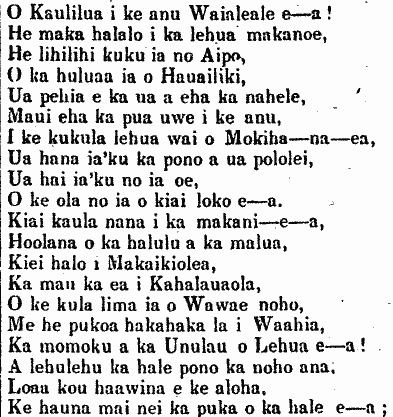
Kaulilua… Mele inoa for Kamehameha IV, 1864.

[Excerpt found under: “A DIRGE FOR KING Alexander Kalanikualiholiho, Maka o Iouli, Kunuiakea o Kukailimoku, KAMEHAMEHA IV!”]

O Kaulilua i ke anu Waialeale e—a!
He maka halalo i ka lehua makanoe,
He lihilihi kuku ia no Aipo,
O ka huluaa ia o Hauailiki,
Ua pehia e ka ua a eha ka nahele,
Maui eha ka pua uwe i ke anu,
I ke kukula lehua wai o Mokiha—na—ea,
Ua hana ia’ku ka pono a ua pololei,
Ua hai ia’ku no ia oe,
O ke ola no ia o kiai loko e—a.
Kiai kaula nana i ka makani—e—a,
Hoolana o ka halulu a ka malua,
Kiei halo i Makaikiolea,
Ka mau ka ea i Kahalauaola,
O ke kula lima ia o Wawae noho,
Me he pukoa hakahaka la i Waahia,
Ka momoku a ka Unulau o Lehua e—a!
A lehulehu ka hale pono ka noho ana,
Loaa kou haawina e ke aloha,
Ke hauna mai nei ka puka o ka hale e—a;

[So many interesting things about this. The first and foremost perhaps is that this appears as part of an unusual kanikau for Alexander Liholiho Kamehameha IV in the form of a conversation between Kamehameha III (K III.) and himself (K IV.). Another is that if you hula, you probably learned this as a mele inoa for Kalakaua and not as one for Kamehameha IV. Does anyone know who it is that is labeled as (M.) in the conversation? Click here for a PDF of the issue with the rest of the piece on page 4.]

(Kuokoa, 1/23/1864, p. 4)

O Kaulilua i ke anu Waialeale e—a!

Ka Nupepa Kuokoa, Buke III, Helu 4, Aoao 4. Ianuari 23, 1864.

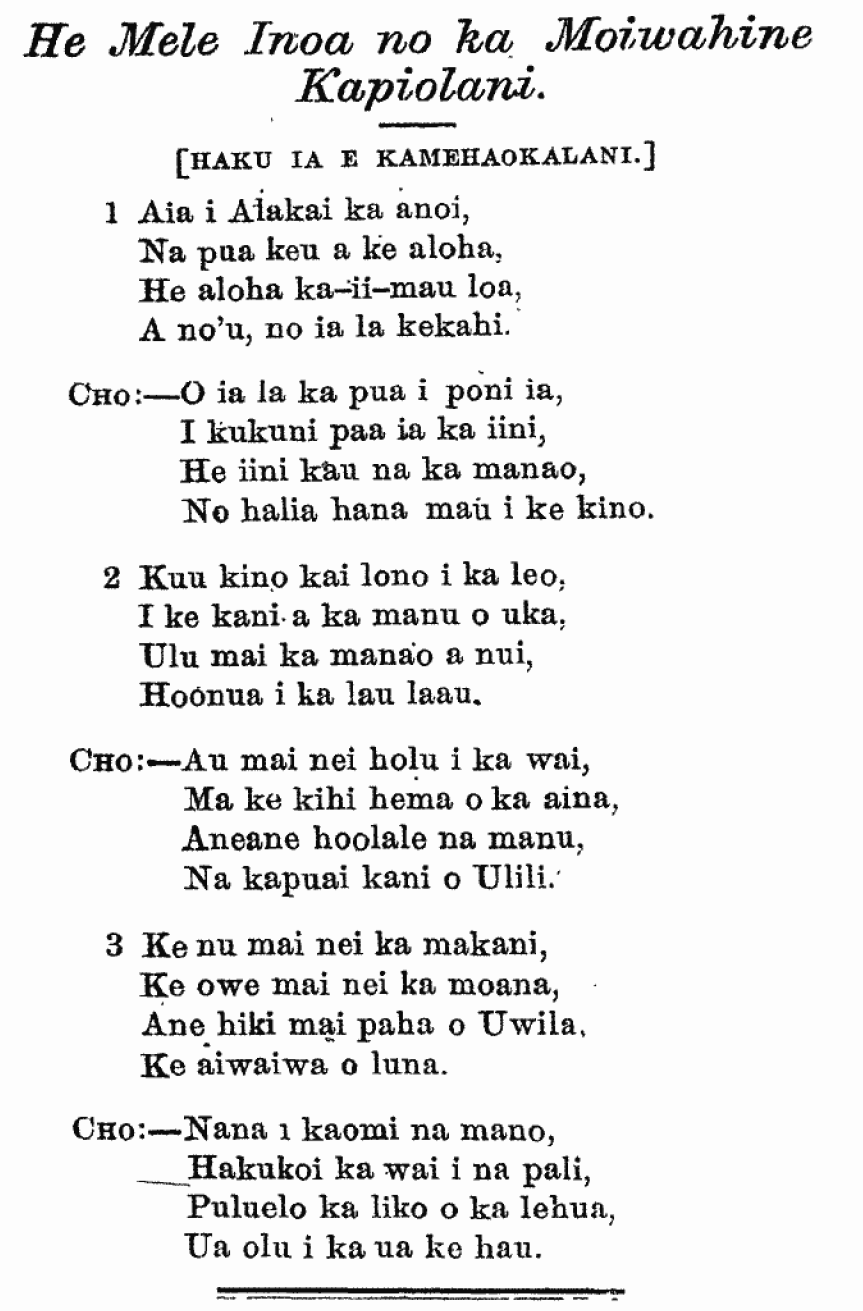
Another beautiful name song for Queen Kapiolani, still sung today, 1883.

He Mele Inoa no ka Moiwahine Kapiolani.

[HAKU IA E KAMEHAOKALANI.]

1 Aia i Alakai ka anoi,
Na pua keu a ke aloha,
He aloha ka—ii—mau loa,
A no’u, no ia la kekahi.

Cho:—O ia la ka pua i poni ia,
I kukuni paa ia ka iini,
He iini kau na ka manao,
No halia hana mau i ke kino.

2 Kuu kino kai lono i ka leo,
I ke kani a ka manu o uka,
Ulu mai ka manao a nui,
Hoonua i ka lau laau.

Cho:—Au mai nei holu i ka wai,
Ma ke kihi hema o ka aina,
Aneane hoolale na manu,
Na kapuai kani o Ulili.

3 Ke nu mai nei ka makani,
Ke owe mai nei ka moana,
Ane hiki mai paha o Uwila,
Ke aiwaiwa o luna.

Cho:—Nana i kaomi na mano,
Hakukoi ka wai i na pali,
Puluelo ka liko o ka lehua,
Ua olu i ka ua ke hau.

[The mele in the newspapers need to be studied. Here, this one is credited to Kamehaokalani. Later on in 1897, in Edward C. Holstein’s “Ka Buke Mele o na Himeni Hawaii,” it is credited to Kamealoha. This book is available as a reprint from the Bernice Pauahi Bishop Museum.]

(Koo o Hawaii, 8/29/1883, p. 8)

He Mele Inoa no ka Moiwahine Kapiolani.

Ke Koo o Hawaii, Buke 1, Helu 2, Aoao 8. Augate 29, 1883.

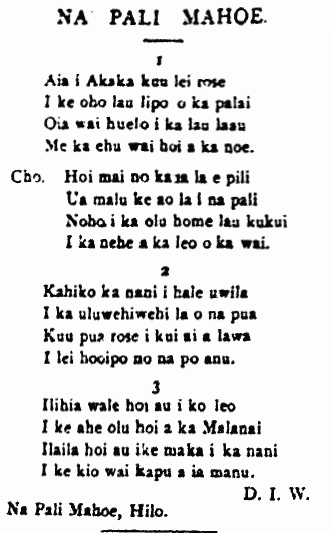
Mele about Na Pali Mahoe, 1888.

NA PALI MAHOE.

1

Aia i Akaka kuu lei rose
I ke oho lau lipo o ka palai
Oia wai huelo i ka lau laau
Me ka ehu wai hoi a ka noe.

Cho. Hoi mai no ka ia la e pili
Ua malu ke ao la i na pali
Noho i ka olu home lau kukui
I ka nehe a ka leo o ka wai.

2

Kahiko ka nani i hale uwila
I ka uluwehiwehi la o na pua
Kuu pua rose i kui ai a lawa
I lei hooipo no na po anu.

3

Ilihia wale hoi au i ko leo
I ke ahe olu hoi a ka Malanai
Ilaila hoi au ike maka i ka nani
I ke kio wai kapu a ia manu.

D. I. W.

Na Pali Mahoe, Hilo.

[There are so many beautiful songs held in the pages of the Hawaiian-Language Newspapers! Here is one written by someone living in the Na Pali Mahoe spoken of in the previous post. It would benefit modern composers greatly to look back at and to study these as they turn forward and compose their own mele.]

(Kuokoa, 5/5/1888, p. 1)

NA PALI MAHOE.

Ka Nupepa Kuokoa, Buke XXVII, Helu 18, Aoao 1. Mei 5, 1888.

Hei, cat’s cradle, Hawaiian style, 1916.

Some String Figures of Hawaii

There are many people studying the history of Hawaii nei and the lifestyle of its people, like what has been done with America, Europe and Asia. And through this studying of history, there has not been a lack of new information which brings benefits by its study. However Judge [Lyle Alexander] Dickey has come up with a new path to this study, not utilized before in Hawaii nei. He is learning string figures, and is collecting the old names and the mele that go with these string figures. He now has about a hundred or more of them.

String figures is something done all over the world. And most people know one or two. From what is known, there is not much of them in Europe and Asia; there are a bit more in Africa; and there is a lot with the Indians of America and the people of the islands of the Pacific. There are two books on string figures of the islands of Britain, the Indians of the Arctic, the Indians, and a few from the islands to the south of us. There is nothing written on the hei of Hawaii nei, even if Hawaii’s figures are most wonderful for the mele which accompany them. Some are not difficult, however some are very problematic because of the many transformations, with different lines of mele going along with each change. Some are very humorous without value, while some are for wooing, while others are riddles. Knowing the way of life of the people, its tales, its history, and the lay of its lands—this is the means of understanding the meanings and kaona (underlying meanings) of these hei. Perhaps the most widely memorized figure is called Hale Kumukaaha. However to this day, Judge Dickey has not gained clarity as to the true meaning and kaona of this hei.

Some figures done by the school children of Hawaii are perhaps not originating in Hawaii nei. The hei called “six eyes” is probably not from here [the first image]. Not a single old Hawaiian can make this figure. Maybe it is a new figure or maybe one from outside of Hawaii.

Some of the hei are associated with daily life, like the canoe, the net, the hammock, the imu, and the water gourd. Some are associated with animals and fish, like the turtle, the mo’o, the manini, the aweoweo, the hapuu, and the bird. Some hei are associated with the house like the kumukaaha structure, the loulu structure, and the paakai structure. There are a very little hei pertaining to body parts, like the piko of Kahoalii and the breasts of Ne. There are many dealing with land and famous fishing shrines as well as men with god-like bodies. Kauiki, for probably a good reason is the most widely known figure. One hei is for Wailua and it is seen in the attached illustration.

There is one famous hei, but it is only known by the oldsters of Hawaii nei, of which is accompanied by the chant starting with: “O Kuhaupio ka la, ka la i ke kula o Ahuena.”

A majority of the people who have the song or chant memorized along with the figures, have died without teaching them to their children. There are so many other things that entertain the new generation, but this entertainment of times long ago is something that the Hawaiian people are proud of. This skill shows intelligence in making the figures and associating it to this thing or that, and it is important that this ancient knowledge be kept. It would be good if someone reading this knows of some old Hawaiian who has a chant or mele memorized close at hand, one who is fond of mele and versed in string figures, or one who knows string figures, that he should Judge Dickey in Lihue, Kauai and tell him of what this person knows. There are many different hei of which the judge has heard, however, he has not found someone now living who can show them to him. There is one that is associated with the net of Makalii that J. S. Emerson saw in Hawaii many years ago; there are also some associated with the story of Pele and Kamapuaa, the paddle o Maui, “haehae ka manu e Kanealoha,” and so forth. These are great and very valuable, and it is important that they be preserved without regard to its simplicity or difficulty. And it is perhaps something that will bring joy when witnessing it being done, or perhaps something exceedingly appalling to consider.

(Kuokoa, 6/9/1916, p. 3)

KEKAHI MAU HEI A NA HAWAII

Ka Nupepa Kuokoa, Buke LIV, Helu 23, Aoao 3. Iune 9, 1913.

My Sweet Sweeting, 1908.

MY SWEET SWEETING.

Kuu ohu lei anuenue e,
Koiaweawe i ka pili.
I ka pai a ka makani kiu,
Ka iniki ana iho welawela,
Hoi mai kaua e pili.

Hui—My Sweet Sweeting
Aohe he pili hemo ole i ke kau.
My Sweet—Sweeting
Hoi mai kaua e pili,
My Sweet Sweeting.
Aohe pili hemo ole i ke kau,
My Sweet Sweeting.

[Mele are just waiting to be found again in the newspapers!]

(Kuokoa, 9/18/1908, p. 5)

MY SWEET SWEETING.

Ka Nupepa Kuokoa, Buke XLIII, Helu 38, Aoao 5. Sepatemaba 18, 1908.

Sheet music to “Sweet Sweeting” now available, 1908.

[Found under: “LOCAL NEWS”]

The song that is printed with the name Sweet Sweeting, the musical notes are available at the musical instrument store Bergstrom. That very nice mele was composed by native Hawaiian youths.

[A little shout out to Kamehameha Song Contest… There are so many priceless mele carefully stored away in the Hawaiian-Language Newspapers. It is time for us to look back; ua wela ka hao!]

(Kuokoa, 9/18/1908, p. 5)

O ka himeni e puka aku nei...

Ka Nupepa Kuokoa, Buke XLIII, Helu 38, Aoao 5. Sepatemaba 18, 1908.

Aua ia, 1862.

An ancient song.

O Kuokoa Newspaper; Aloha oe:

I just took a look within you, as well as the Hoku [o ka]  Pakipika; and I saw mele, and kanikau of all sorts. I however did not see this mele printed by the people who fancy publishing mele. Therefore, I ask you, Nupepa Kuokoa, to include this little mele in some available space.

E ke kama, kama—e,
Auaia e kona moku,
E ke kama kama,
Kama i ka huli nu,
E ke kama kama kama,
Kama i ka huli au,
Hulihia ke au,
Ka papa honua a ka moku,
Hulihia papioia ilalo ke alo,
E ui—e, a ui ia,
Hulihia i Manuakele,
I ka umu kaokoa a Ku,
I ka maka o Ku,
Kaaha mikii lohelohe,
Ka aha nana i hikii,
O hulahula Mea,
Ua kalakala ia,
Ua wekewekea.

Ua hemo aku la ka piko o ka aina,
Ua kala kaalihi pohakuku,
Me ka upena a Ku,
O ihu aniani,
Me kauluna o Nioalani,
O Keawe, o ka manu,
Ai kualaahia,
Keiki ehu kamaehu,
A Kanaloa,
Ua mokuhia kamakama,
A Kalino a ka moku,
Ua kalalia i ka ua lena a Lono,
Na Lono na ka mano nui,
Huki ai moku,
O Kalani o Kauila,
E a i Kahiki,
He ulunaio makawalu,
He ohia ako,
He hakoko i ka ua na ke’lii,
O Namakaeha e ku i ke kaua,
Nana i hoopehee ka honua,
O ka moku,
I haalaia i ke kiu e Loka,
Ka pua ka welohi a Kanaloa,
I ka puulele i ka hana oi a Hina,
E Hina, e une a hano, e una,
Unaia i mama,
I mama, mama,
I mamaia me he pule la.

Hooe io io Nana,
O nana ka hakui,
Io io Nana,
O nana ke au haku,
O kuu Haku ka’u aloha e uwe nei,
Uwe au—e, uwe au,
Uwe au ia oe e Lumialani,
O ka Lumialani o ka haku,
E kaa i ka honua,
O ke kaa i maukuku,
I ka maka o Lono,
O ke kauwahi aloha,
O Halakaina,
O Halakinau oe,
O Keala o Kolole,
No Kololehiwa ia ala,
Nona no ka Lukapewa,
Enaena Puna koele wahine i ka la,
Pua lohelau ka hala,
Ko ohia o Makuukeeu,
I ka papa o Papalauahi,
A Nanawale, ke hoolana no,
Keaiwa, ka e au—e,
I kaeu no a hopuhia loaa,
Loaa ka inoa ino,
He inoa hue—e,

This mele was composed for Namakaeha, an alii in the time of Kamehameha I. With appreciation. S. W. Kekalohe.

Kipahulu, Maui, H., Oct. 1, 1862.

(Kuokoa, 11/8/1862, p. 1)

He mele kahiko.

Ka Nupepa Kuokoa, Buke I, Helu 50, Aoao 1. Novemaba 8, 1862.

Hawaiian music and ukulele in Japan, 1933.

Returning Once Again to Hawaii Nei

A Japanese boy born here in Hawaii and who went back to Japan to enter into a College in Japan, and who is a child of Dr. Katsugoro Haida, came back to Hawaii after being away from Hawaii for 12 years.

The reason for his return to Hawaii was because of his desire to learn Hawaiian Mele and to learn how to sing them.

According to him, the Japanese of the Universities are enthralled by Hawaiian songs, and so too of the Ukulele.

That boy, Yoshitaku Haida [Yoshikatsu Haida, aka Haruhiko Haida, aka Yukihiko Haida] is his name, said that when he went to Japan, he sang some Hawaiian Songs that he had memorized while in Hawaii nei; so also with the ukulele, he was quite skillful in playing it; and it became something big with the Japanese youth going to that University [Keio University].

Because this boy saw the great interest the Japanese had for Hawaiian music, he decided to return to the land of his birth and increase his knowledge in Singing Hawaiian Music, and that was the reason for his coming back.

It is just he and his younger brother [Katsuhiko Haida] who are skilled at Hawaiian songs, to raise up Hawaii, and that is why he is learning Singing until he is proficient, at which point he will return to Japan where he will become a teacher of Hawaiian mele to the Japanese in Japan, and raise up the land of my [his] birth.

Upon arriving in Honolulu, he went to the Japanese Church on Fort Street to say a prayer for his father who has passed to the other world. He may be here in Hawaii for perhaps a year before turning back for Japan, to fulfill his desire to bring fame to his birth land.

(Hoku o Hawaii, 2/14/1933, p. 3)

Huli Hoi Hou I Hawaii Nei

Ka Hoku o Hawaii, Buke XXVI, Helu 37, Aoao 3. Feberuari 14, 1933.

Luke Kanakaole weds Edith Kanaele, 1933.

Luke Kanakaole was joined together in the sacred bond of marriage with Miss Edith Kanaele, of Keaukaha. Marriage is a splendid thing.

[After attending the awesome symposium this past week, Words in the World: Literatures, Oratures, and New Meeting Grounds, it was serendipity that I just came across this marriage announcement for the famous chanter and hula practitioner, as well as mother of one of the esteemed mele panel presenters, Pualani Kanakaole Kanahele!

There is so much available in the Hawaiian-Language Newspapers, if only we bothered to look. Although it wouldn’t hurt if there were clear images online and they were accurately word searchable.]

(Hoku o Hawaii, 2/14/1933, p. 3)

Ua hoohui ia ae nei o Luke Kanakaole...

Ka Hoku o Hawaii, Buke XXVI, Helu 37, Aoao 3. Feberuari 14, 1933.