This is an independent blog. Please note that I am nowhere near fluent, and that these are not translations, but merely works in progress. Please do comment if you come across misreads or anything else you think is important.
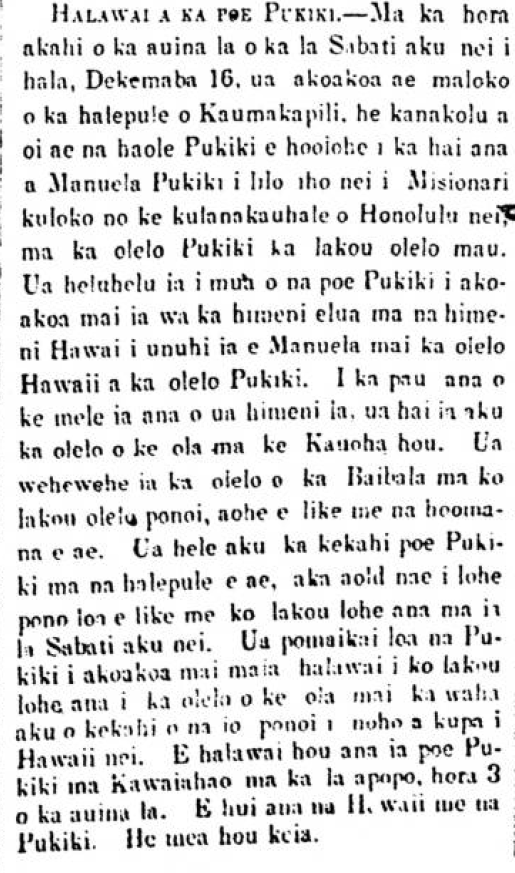
Meeting of the Portuguese.–At one in the afternoon of this past Sunday, December 16, thirty or more haole Pukiki gathered in Kaumakapili Church to hear the talk of Manuela Pukiki who just became a local missionary for the town of Honolulu. They generally speak in Portuguese. Read before the Portuguese gathered at that time were two hymns translated by Manuela from Hawaiian to Portuguese. When the hymns were done being sung, the word of life was told from the New Testament. The words of the Bible were explained to them in their own language, not like the other religions. Some of the Portuguese have gone to other churches, but they did not listen carefully like the did this past Sunday. The Portuguese who got together at that gathering were blessed to have heard the words of life from the mouth of one of their own flesh who have lived until familiar with Hawaii nei. The Portuguese will meet again at Kawaiahao tomorrow at 3 in the afternoon. The Hawaiians and the Portuguese are meeting together. This is something new.
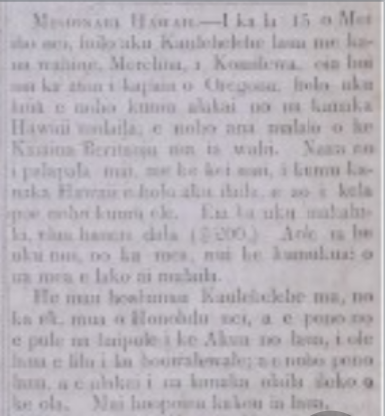
Hawaiian Missionaries.–On the 15th of May past, Kaulehelehe and his wife Merelina sailed for Komilewa, that being the land called Oregon; they went to live there as teachers for the Hawaiians there who live under the British Governor there. It was he who wrote requesting that Hawaiian teachers sail there to teach those people who are living without a teacher. This is the annual salary, two hundred dollars ($200). That is not a lot of money, because the cost of living there is high.
Kaulehelehe folk are members of the first church of Honolulu, and the devout must pray to God for them lest they be lost to temptation; and that they live properly and guide the people there in life. Let us not forget them.
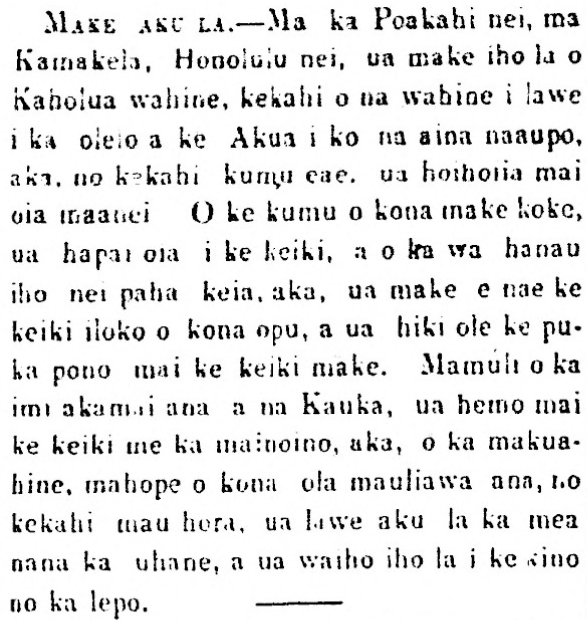
Died.–This past Monday, at Kamakela, here in Honolulu, Kaholua wahine, one of the women who took the word of God to the ignorant lands, but for other reasons she was returned here. The cause of her quick death was that she was pregnant, and perhaps it was while she was giving birth, the baby died within her belly, and the dead baby could not come out. Because the doctors’ skillful attempts, the child was expelled disfigured, but as for the mother, after she gasped for life for some hours, the one who belongs the soul took hit away, and left the body behind for the earth.
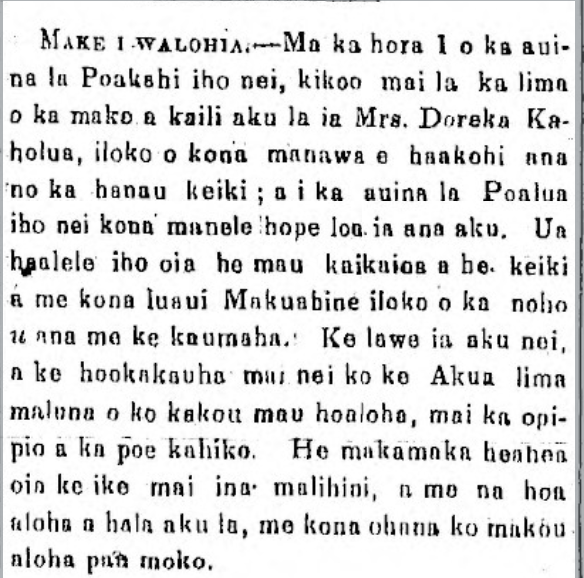
A Sorrowful Death.–At 1 o’clock in the afternoon, this past Monday, the hand of death reached out and snatched Mrs. Doreka Kaholua while she was bearing down giving birth; and on Tuesday afternoon she was carried away for all times. She left behind a number of younger siblings and a child, and her birth mother who grieve for her. God’s hand stretches out above our friends, from the young to the old. She was a welcoming host, should she see a stranger or friends, until she passed. With her family goes our sympathy.
(Au Okoa, 9/16/1869, p. 2)
Ke Au Okoa, Buke V, Helu 22, Aoao 2. Sepatemaba 16, 1869.
Did you see Bishop Museum’s He Aupuni Palapala blog the other week about Hawaiians in the Marshall Islands? See more about the Daniela and Doreka Opunui. Click here.
At the meeting of church leaders here in South Kona, on the 9th of this month, I was selected as the Committee to write to you about some opinions decided upon by that assembly, pertaining to the newspaper you are thinking to publish. And here are those opinions:
First. They discussed with much consideration words that are appropriate to publish in the Kuokoa Newspaper, and those that are improper. And they believe it is not proper to publish Hawaiian mele in the newspaper. They believe that by publishing mele in the newspaper, it will lead the young ones of the lahui toward its old ways. Being that some mele published in Whitney’s Kuokoa ; the extremities of this nation have much delight in those mele, and they are memorized by the youth; just like this mele:
“O Kilauea no ke aloha, O ka ihu lolilua i ka ale.”
Kilauea is beloved, Its prow unstable on the billows.”
And so forth, and there are many mele of that nature.
Second. The Assembly believes it is improper to publish certain local news of Hawaii nei, such at this. People start to hula on Kauai, and someone there sees this and announces it in the newspaper. That announcement to them is something inappropriate to print in the newspaper. It will give people living on the other islands the idea to imitate this behavior.
But they consider it is proper to print in the newspapers should hula practitioners from this location or that location be punished under the law.
Third. The Assembly believes that fighting words and filth should not be constantly printed in the newspaper–That is what they decided to report to you through me.
Aloha olua, J. W. Kupakee, Committee.
(Kuokoa, 12/24/1864, p. 5)
Ka Nupepa Kuokoa, Buke III, Helu 52, Aoao 5. Dekemaba 24, 1864.
Vague news has been received in Boston from Sydney [Kikane] simply explaining that the schooner Hiram Bingham was smashed and sunk in the deep along with the death of its captain, the Rev. A. C. Walkup with the ship. As for where the ship was smashed and sunk and the reason for it was not fully explained. This here below was published in the newspaper the San Francisco Call of the 27th of August [p. 13]:
“The missionary schooner Hiram Bingham, word of whose loss was received at Boston in a cablegram from Sydney, was built at Anderson’s shipyard near Hunters point and sailed from here November 10, 1908, on its maiden voyage. The message conveying the news of the loss of the vessel also told of the death of Captain Alfred C. Walkup, the mariner-missionary who commanded the gospel ship.
“Captain Walkup superintended the construction of the vessel and when he sailed from here took with him his son and daughter. The boy and girl, who were born in the Gilbert Islands, came home by way of Australia and are now in this country attending college.
“No details have been learned of the loss of the vessel, which was last reported March 2r5 at Ocean Island [Banaba].
“The Hiram Bingham was built by the American board of foreign missions for work among the Gilbert islanders and cost $7,000. The vessel was 63 feet long and was equipped with a 45 horsepower gasoline engine.”
In fall of the past year, the ship docked in Honolulu on its way to the islands of Kilibati. Its captain was welcomed with great care by the missionaries here, and before it set sail for the islands of the South, a prayer assembly was held at the pier of the Alameda.
That schooner the Hiram Bingham was the second schooner by that name built for the Mission in the Southern seas; it was built to take the place of the first vessel that rotted because it was put to use for so long. [The next two lines are set in the wrong order] It was named the Hiram Bingham in honor of Rev. Hiram Bingham the pioneer missionary teacher who lived for a long time in the islands of Kiribati.
When it stopped here, also aboard were copies of the Bible which was translated into the Kiribati language by Rev. Hiram, and that was the ballast used to sail here.
[Found under: “HE LETA MAI KO NA AINA E, KAKAUIA E REV. Z. S. K. PAALUHI.”]
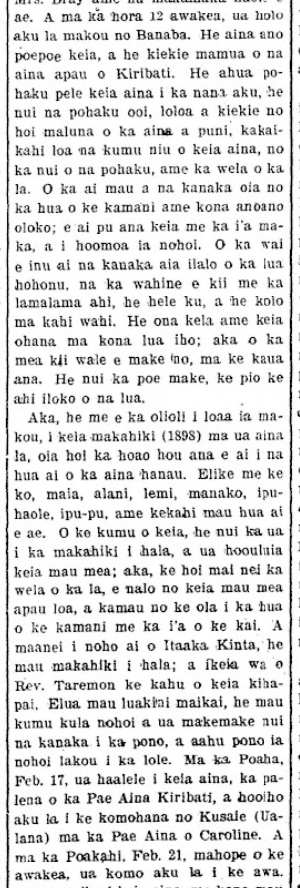
…And at 12 noon we sailed to Banaba. This is a land that is somewhat circular, and it is higher than all of the other lands of Kiribati. This land appears to be a heap of volcanic rock. There are a lot of sharp, long, and tall rocks all over on this land, and there are very few coconut trees, because of the many rocks and the heat of the sun. The fruit of the kamani and the seed within is the staple food of these people; this is eaten together with raw fish, and it is also cooked. Water that is drunk by the people is below in deep caves; the women fetch it with torches. You walk standing upright and some places you crawl. Each family are the owners of their own cave; and if someone just takes [without permission], they will die in war. There are many who die when the torch goes out in the cave.
But we are extremely joyful this year (1898) on that land, that is because we are trying once more to eat the fruits of our land of birth. Like sugarcane, banana, orange, lemon, mango, watermelon, pumpkin, and some other fruits. The reason for this is that there was a lot of rain this past year, and these things were grown; but the heat from the sun is returning and all of those things will disappear. Life is sustained with the fruit of the kamani and the fish of the sea. It was here that Itaaka Kinta used to live some years ago; and these days Rev. Taremon is the pastor of this parish. There are two fine churches, some school teachers, and the people greatly desire righteousness, and they wear clothes correctly. On Thursday, Feb. 17, we left this land, the edge of the Kiribati Archipelago, and went west for Kusaie (Ualana) in the Caroline Archipelago.
The Morning Star stopped at this land on midday Thursday, and today it sails for the islands Banaba and Nawaro and all the way to Ualana, Ponape, Ruk in the West.
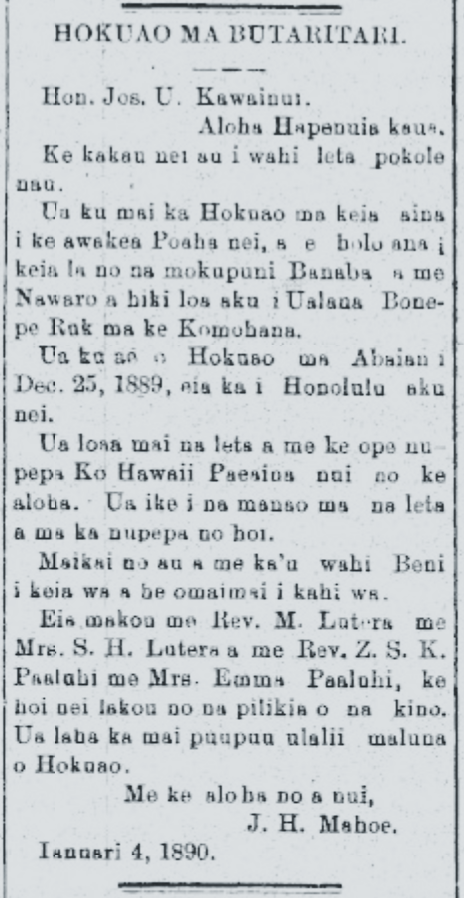
The Morning Star [Ka Hoku Ao] stopped at Abaiang on Dec. 25, 1889, and now is on its way to Honolulu.
We received the letters and the bundle of Ko Hawaii Paeaina newspapers; much aloha. We saw the ideas in the letters and the newspapers as well.
I and my Beni are fine now but sick sometimes.
We are with Rev. M. Lutera [Martina Lutera] and Mrs. S. H. Lutera and Rev. Z. S. K. Paaluhi [Zadaio Solomon Kalua Paaluhi] and Mrs. Emma Paaluhi; the are returning because of health issues. Smallpox has spread on the Morning Star.
With much aloha, J. H. Mahoe.[Joel Hulu Mahoe] January 4, 1890.
(Ko Hawaii Paeaina, 3/22/1890, p. 4)
Ko Hawaii Paeaina, Buke XIII, Helu 12, Aoao 4. Maraki 22, 1890.
From the latest news received last week we hear that Mrs. F. T. Gulika has died, the wife of Rev. J. P. Gulika, one of the old teachers who brought righteousness to this Archipelago. Our readers will perhaps not have forgotten the Gulick family in Hawaii nei, and the departure of the two in their old and weak days to go to Japan to live with their children. Continue reading →
In the evening of this past Monday, at the hour of 7:30, Mrs. Anna Maria Dimond let go of her breath, the aged companion of this life of Mr. Henry Dimond, at the age of 85.
She was born in the city of New York on the 19th of May, 1808. She married Henry Dimond on November 3, 1834, and landed in Honolulu in June [6,] 1835, along with Titus Coan [Koana] and Edwin Oscar Hall [Holo] folks. With the death of E. O. Hall, the Dimonds were the only ones left from those who came on the same journey here. Continue reading →
On the 27th of this past April, the wife of Mr. Dole, the teacher at the boarding school at Punahou. She had complication from childbirth; on Tuesday, she gave birth to a son, and on Saturday at one o’clock in the afternoon, the mother died. Continue reading →



 nupepa