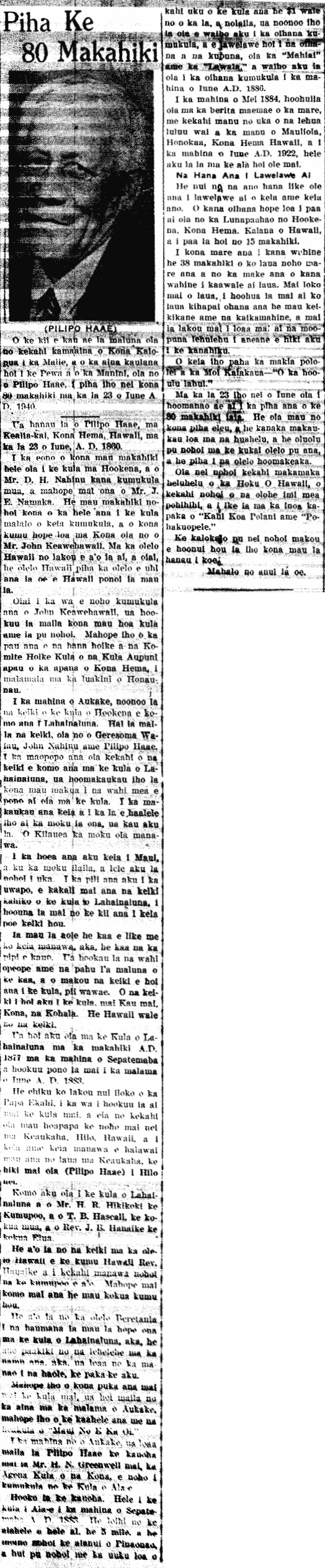
80 Years Old
(PILIPO HAAE)
The picture placed above is of one of the kamaaina of Kona of the horizon clouds in the calm, and the land famed for the Tail of the Manini [ke Pewa a o ka Manini],¹ that being Phillip Haae who just made 80 years old on the 23rd of June, A. D. 1940.
Pilipo Haae was born in Kealia Kai, South Kona, Hawaii, on the 23rd of June, A. D. 1860.
When he was six years old, he went to the school at Hookena, and Mr. D. H. Nahinu was his first teacher, and after him was Mr. J. E. Namaka. He went to school under this teacher for some years, and his last teacher in Kona was Mr. John Keawehawaii. They were taught in the Hawaiian language, being that during those days, O Hawaii’s Own, it was that the Hawaiian language which fully enveloped you.
While John Keawehawaii served as the teacher, Haae’s classmates and he as well were graduated. This was after the conclusion of the School Testing [Hoike Kula] of all of the Government Schools of South Kona which took place at the church of Honaunau.
In the month of August, the children of the Hookena school were considered for matriculation into Lahainaluna. The children were told, they being Geresoma Waiau, John Nahinu, and Phillip Haae. When he found out that he was one of the children to enter Lahainaluna School, his parents prepared what was necessary for him to go to school. When this was ready, and when the day came for his boat to leave, he got on. The Kilauea was the ship during those days.
When it reached Maui, and the ship stopped there, he got off on land. When the ship got to the dock, the upperclassmen from Lahainaluna were waiting, being sent to retrieve the new children.
In those days, there were no cars like today, but there were carts pulled by oxen. Their bundles and the fish boxes [? pahu I’a] were placed upon the cart, and we children who were headed to the school went up by foot. The children returning to the school came from Kau, Kona, and Kohala Loko and Kohala Waho. The children were all Hawaiian.
He entered into Lahainaluna School in 1877 in the month of September, and graduated in the month of June in 1883.
There were seven of them in the Senior Class [Papa Ekahi] the year that he graduated, and one of his classmates is still living here in Keaukaha, Hilo, Hawaii, and the two of them regularly get together at Keaukaha when Pilipo Haae comes to Hilo.
He entered into Lahainaluna School, and the Head Instructor [Kumupoo] was Mr. H. R. Hitchcock [H. R. Hikikoki], and T. B. Hascall was the first assistant, and Rev. J. B. Hanaike was the second assistant.
The children were taught in the Hawaiian language by the Hawaiian teacher, Rev. Hanaike, and sometimes they were instructed by the head teacher. Afterwards new assistant teachers came.
English was taught to the students during his later days at Lahainaluna School, but it was difficult for the lips to speak, and the haole understood what was being said when spoken all garbled [paka-ke].
After he graduated, he returned to his land in the month of August, after travelling about with his classmates of “Maui, The Greatest” [Maui No E Ka Oi].
In the month of August, Phillip was assigned by Mr. H. N. Greenwell, the School Agent of North and South Kona, to work as teacher at Ala-e School.
He carried out his assignment. He went to Ala’e School in September, 1883. The road to there was long; 5 miles, the roads of Pinaonao were bad; this along with the very meager pay from his school, just a $1 a day, therefore, he decided to leave the teaching job and to take on the occupation of his ancestors, that being “Farming” and “Fishing,” and so he left his teaching position in the month of May, 1886.
In the month of May, 1884, he was joined in holy matrimony with one of the birds from the uplands, of the lehua drooping with nectar of the birds of Mauliola, Honokaa, South Kona, Hawaii, and in the month of June, 1922, she left on the road of no return.²
The Work He Undertook
He did all sorts of jobs. His last position he held was the Head of the Prison of Hookena, South Kona, Hawaii County, which he held for 15 years.
In his marriage to his wife, they lived together for 38 years, and it was the death of his wife which separated the two of them. Betwixt them, their family garden bore fruit with boys and girls, and from them they have many grandchildren almost reaching seventy.
This perhaps is the true motto of King Kalakaua—”Increase the lahui.”
On this past 23rd of June, his 80th birthday was celebrated. He remains active as ever, and he is very good at numbers [makaukau loa ma na huahelu], and is pleasant to talk to, and is full of funny things to say.
He is one of our readers of the Hoku o Hawaii, and is an expert at seeking veiled information [as in riddles], and he is known by the pen names, “Kahi Koa Polani” and “Pohakuopele.”
We pray as well that he is given more birthdays to come.
¹A reference to the bay, Kapewaokamanini in Kona.
²Kahulaleaokeakealani, daughter of S. M. Paauhau was born on June 14, 1867 and died June 7, 1922.
[Just plain wow.]
(Hoku o Hawaii, 9/25/1940, p. 2)
Ka Hoku o Hawaii, Volume XXXV, Number 22, Aoao 2. Sepatemaba 25, 1940.

 nupepa