Death of Doreka Kaholua, aka Doreka Opunui, 1869.

Found under: “NU HOU KULOKO.: Oahu.”

Died.–This past Monday, at Kamakela, here in Honolulu, Kaholua wahine, one of the women who took the word of God to the ignorant lands, but for other reasons she was returned here. The cause of her quick death was that she was pregnant, and perhaps it was while she was giving birth, the baby died within her belly, and the dead baby could not come out. Because the doctors’ skillful attempts, the child was expelled disfigured, but as for the mother, after she gasped for life for some hours, the one who belongs the soul took hit away, and left the body behind for the earth.

(Kuokoa, 9/18/1869, p. 3)
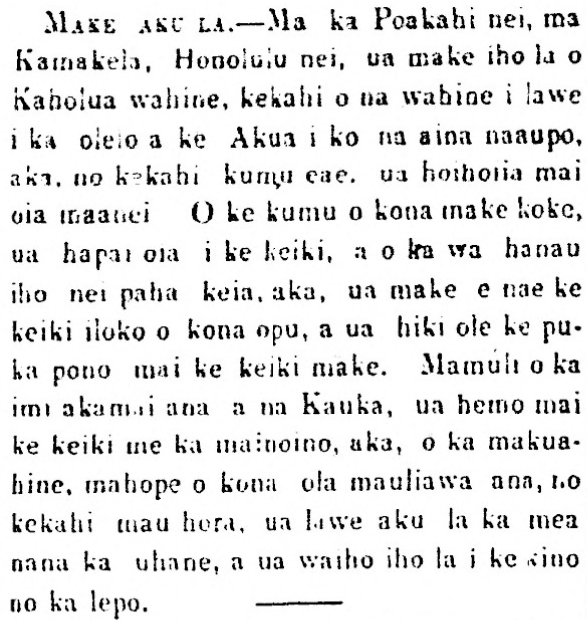
Ka Nupepa Kuokoa, Buke VIII, Helu 38, Aoao 3. Sepatemaba 18, 1869.

Another account:

A Sorrowful Death.–At 1 o’clock in the afternoon, this past Monday, the hand of death reached out and snatched Mrs. Doreka Kaholua while she was bearing down giving birth; and on Tuesday afternoon she was carried away for all times. She left behind a number of younger siblings and a child, and her birth mother who grieve for her. God’s hand stretches out above our friends, from the young to the old. She was a welcoming host, should she see a stranger or friends, until she passed. With her family goes our sympathy.

(Au Okoa, 9/16/1869, p. 2)
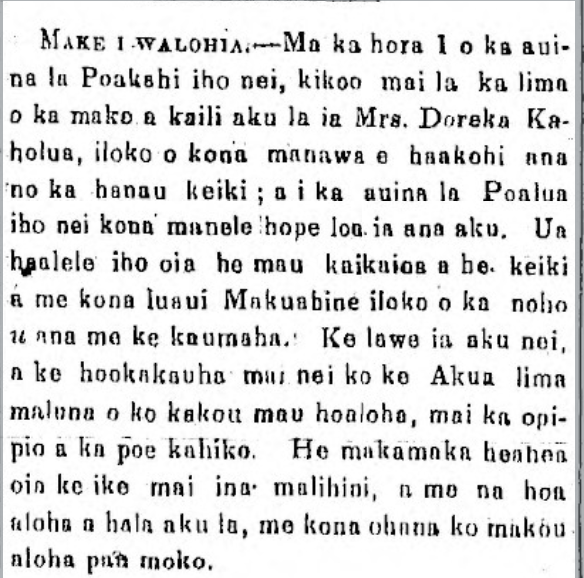
Ke Au Okoa, Buke V, Helu 22, Aoao 2. Sepatemaba 16, 1869.

Did you see Bishop Museum’s He Aupuni Palapala blog the other week about Hawaiians in the Marshall Islands? See more about the Daniela and Doreka Opunui. Click here.
On the first horses in Hawaii nei, 1852.

Who Brought the First Horses to the Islands?—In a valuable document presented by Stephen Reynolds, Esq., to the R. H. A. Society at its first meeting in 1850, the following passage occurs:—Horses.—I have not been able to find the name of him who introduced the first. It appears two were brought and presented to Kamehameha; the natives say Mr. Manine was in the vessel. Several were brought before 1823. From 1824 to 1838 many cargoes were brought from California. The horses born and reared on the islands are superior in all respects to those imported from California,—better limbs, better spirits, and tougher animals.” Continue reading

Animals introduced in Ka Lama Hawaii, 1834.

Pertaining to the Sloth [Hiamoe].

This strange animal is born and lives and dies amongst the branches of the trees. They are rare, and live in seclusion in the trees of the deep forests of South America. That is where it lives. Its front legs are long, somewhat like those of the arms of man, it does not reach a foot, its claws are long like fingers. Its hind legs are short. Therefore it cannot walk on land, it can only move by crawling. From that comes its name, the Sloth. Continue reading

Rev. William Kamau, oldest minister in the Hawaiian church, 1940.

[Found under “Aloha Pumehana”]

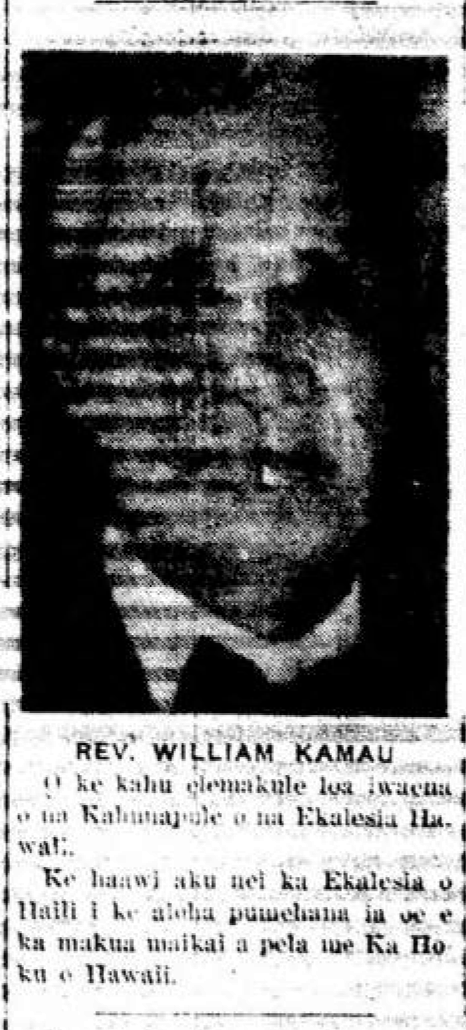
REV. WILLIAM KAMAU

He is the oldest amongst the ministers of Hawaii’s Churches.

The Haili Church gives its warm aloha to you, oh good father, and so too with Ka Hoku o Hawaii.

[Rev. William Kamau was one of the contributors to Bishop Museum’s Roberts Collection of mele. See this week’s He Aupuni Palapala blog for more information on a new exhibit about the collection and an better image of William Kamau!]

(Hoku o Hawaii, 6/19/1940, p. 1)

Ka Hoku o Hawaii, Volume XXXV, Number 8, Aoao 1. Iune 19, 1940.

Revealing what was lost, 2021.

La Hanau

EDWIN M. DESHA

O Edwin M. Desha, ka  Lunanui o Ka Hoku o Hawaii, ke hoomanao ana i kona la hanau ma keia Poalima iho, Okakoba 18.

Mawaho ae o kona kulana he boki nui no ka Hoku, he kakauolelo o Mr. Desha na Lunahoomalu Samuel M. Spencer of ke Kalana o Hawaii. He lala ku maikai oia no ka hui Liona o Hilo, a pela nohoi me kekahi mau ahahui e ae. Ma kekahi olelo ana ae, he kanaka paa loa oia i ka hana a aole he loaa iaia ka manawa no ka lawe ana i kona hoomaha, a pela nohoi ma kona la hanau.

Me na upu maikai ana no ka la hanau hauoli e Eddie, mai ka papa pa’i holookoa o ka Hoku.

[Did you check out the new “Nūhou Monday” post out from Bishop Museum’s He Aupuni Palapala group? It talks about you can actually see a picture of Edwin M. Desha in the original of this newspaper! Click here to get taken to the page.

P.S. I am amused with the phrase “he boki nui”.]

(Hoku o Hawaii, 10/16/1940, p. 1)

Ka Hoku o Hawaii, Volume XXXV, Number 25, Aoao 1. Okakoba 16, 1940.

Publishing a newspaper wasn’t easy! 1868.

KE ALAULA.

Have you not thought about, O People who frequently read this newspaper, with amazement at the beauty of your monthly paper, while asking yourself, “Who publishes this paper? and who puts in effort into writing down the ideas, and into the printing, and into the distributing?” Maybe you just thought they just appear; no, consider the amount of work and expense it takes to prepare this thing which gives you enjoyment, and be educated. Just grabbing it and quickly looking at the illustrations, reading quickly through the short ideas, and then discarding it in a corner, or perhaps tearing it apart at once as a wrapper for some fish, or to wrap something else. Maybe you have complaints about not receiving it more frequently, every week; and you call it a slow paper—one publication per month. Continue reading

He Aupuni Palapala project’s new blog page, 2021.

It seems the newspaper project He Aupuni Palapala: Preserving and Digitizing the Hawaiian Language Newspapers at Bishop Museum started a blog page. Let’s keep an eye out for future posts from them!

He Aupuni Palapala blog page can be found by clicking this image: