La Kuokoa information and more… 1700–1999.

For those of you interested, i came across this British Newspaper Archive site. It is unfortunately not free access. But if you want to know what their newspapers were saying about Haalilio and Richards and Paulet and Charlton as it all was going down (or other events that occurred between 1700–1999), it might be worth paying the subscription. Here for example there seem to be some four-thousand articles in the 1840s found using the search term “Sandwich Islands”:

http://www.britishnewspaperarchive.co.uk/search/results/1840-01-01/1849-12-31?basicsearch=sandwich%20islands&exactsearch=false&page=0

And for the same period, there are five hits for “Haalilio”:

http://www.britishnewspaperarchive.co.uk/search/results/1840-01-01/1849-12-31?basicsearch=haalilio&exactsearch=false

[Being that it is a pay for view site, i don’t believe that i would be able to repost articles found there even if i spent the money for a subscription myself…]

45th La Kuokoa celebration, 1888.

INDEPENDENCE DAY.

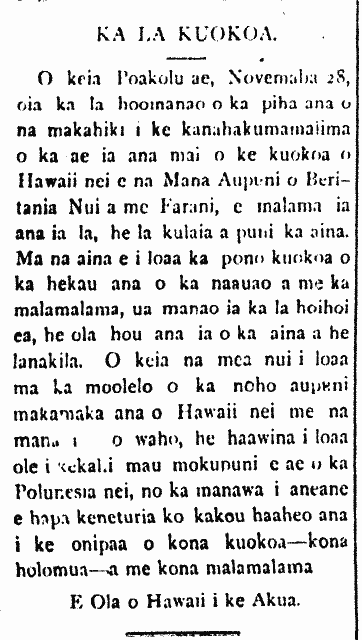
This coming Tuesday, November 28th, is the forty-fifth year celebration marking the recognition by the Heads of the Nations of Great Britain and France of Hawaiian independence; this day is set aside as a holiday all across the land. In other lands which enjoy independence through learning and enlightenment, independence day is seen as a day of rebirth for the nation and victory. These are great events found in the history of Hawaii’s friendly international relations; this is a distinction not received by any other island here in Polynesia; it has been nearly half a century that we remain proud of her unwavering  independence—progress—and enlightenment.

Long Live Hawaii Under God.

[On this the 170th anniversary of La Kuokoa, what are you doing to remember the great efforts taken by those like Timoteo Haalilio and William Richards to gain independence for the Nation?]

(Kuokoa, 11/24/1888, p. 2)

KA LA KUOKOA.

Ka Nupepa Kuokoa, Buke XXVII, Helu 47, Aoao 2. Novemaba 24, 1888.

More on Hawaiian Independence Day and Aloha Aina, 1843.

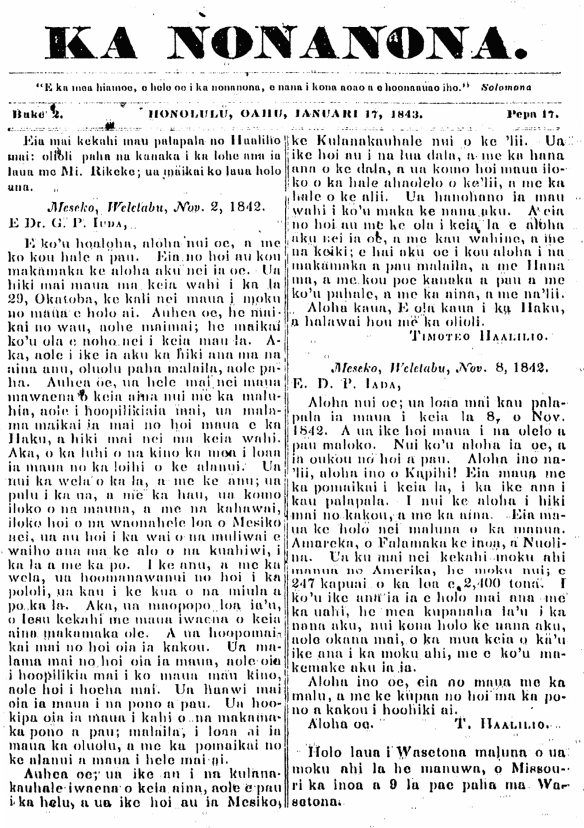
THE ANT [KA NONANONA].

“Go to the ant, thou sluggard; consider her ways, and be wise.” Proverbs [Solomona]

Book 2. HONOLULU, OAHU, JANUARY 17, 1843. Paper 17.

Here are some letters from Haalilio; people will surely be happy to hear from him and Mr. Richards that their travels are going well.

Weletabu [Vera Cruz ?], Mexico, Nov. 2, 1842.

Dr. G. P. Judd,

My dear friend, much aloha to you and your entire household. Here am I, your friend, with feeling aloha for you. The two of us [Haalilio and Richards] arrived here on the 29th of October, and we are awaiting a ship to ride. Hear me, I am doing fine, I have no illness; my health is fine now. However, I do not know how it will be when we get to the cold lands; perhaps it will be alright, and perhaps not. Hear me, we have travelled about this expansive land with peacefully, we were not troubled, we were cared for well by the Lord, until arriving here. But our bodies are spent after the long road. The days were extremely hot and extremely cold; we got drenched by the rain and snow, we passed through mountains, and rivers, and the wilds here in Mexico; we swam the water of rivers running by the face of the mountains, during the day and the night. In the cold and the heat, we endured hunger, riding on the backs of mules all day long. But I was certain that Jesus was with us in this friendless land. And that he blesses us. He takes care of the two of us, and our bodies are not troubled or hurt. He supplies us with all of our needs. He has welcomed us always amongst good friends; and there, we were given comfort and help on our path.

Listen to this, I’ve seen the towns of these lands; they are countless, and I have seen Mexico the great Town of the president [alii]. I’ve also seen the silver mines, and how they work silver; we’ve been to the legislature of the alii and his residence. Those places are grand to see. And today I am with health, giving my aloha to you and your wife and the children; give your [my?] aloha to all the friends there, and to Hana folks and to your people and to my household, and to the land and to the chiefs.

Aloha between us, Let us live through the Lord; until we meet in joy once more.

Timoteo Haalilio.

Mexico, Weletabu [Vera Cruz ?], Nov. 8, 1842.

O D. [G.] P. Judd,

Much Aloha to you; we received your letter on this day, the 8th of Nov., 1842. And we’ve understand all that was within. I have much aloha for you, and for all of you. How sad for all the alii, and how sad for Kapihi! We have been blessed this day in seeing your letter. There is much aloha for us all and our homeland. We are travelling aboard the American warships, Falmouth [Falamaka], to New Orleans [Nuolina]. A steam-powered American warship arrived, a huge vessel, 247 feet long and 2,400 tons. As I watch her sail by steam, it is a fantastic sight; she is so swift, with no comparison; this is the first time I’ve seen a steamer, and I am totally captivated by it.

Much aloha for you; here we are safe, steadfast in our duties we swore to.

Aloha to you.  T. Haalilio.

The two of them are headed to Washington aboard the steamer, a warship named Missouri, and perhaps they will land in Washington in 9 days.

[Does anyone know if Weletabu in Mexico is Vera Cruz, or if it is somewhere else?

Also, who is the Hana and the Kapihi mentioned here?]

(Nonanona, 1/17/1843, p. 81)

Eia mai kekahi mau palapala no Haalilio mai...

Ka Nonanona, Buke 2, Pepa 17, Aoao 81. Ianuari 17, 1843.

Use of tradition for propaganda, 1896.

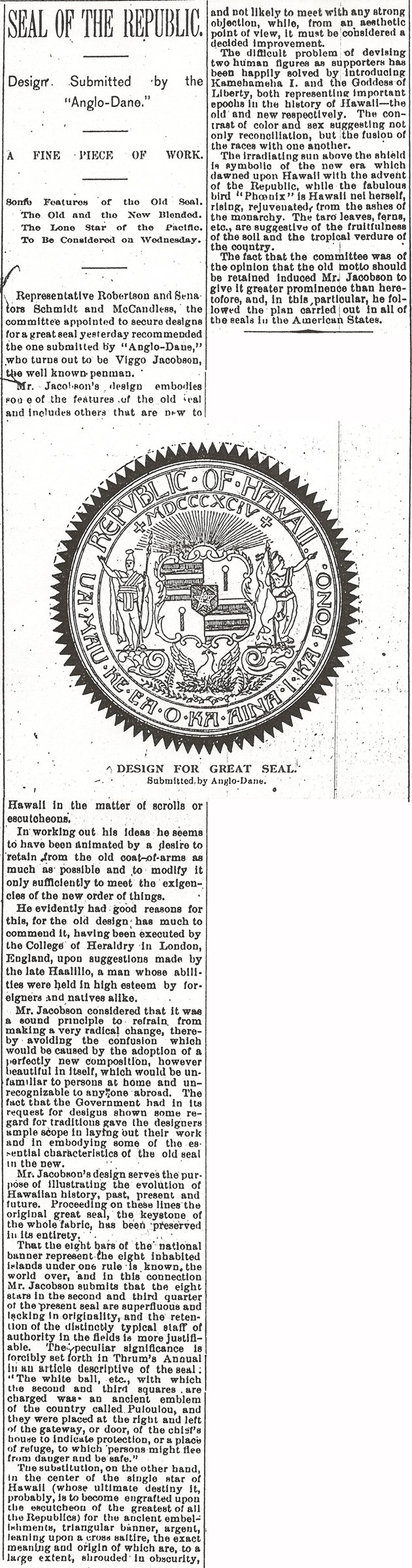
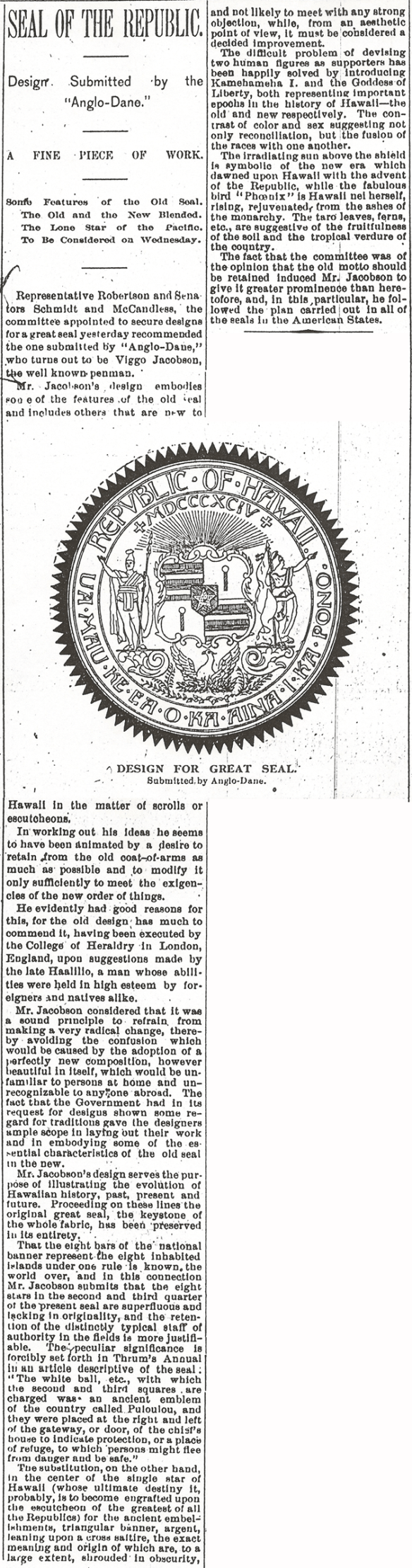
SEAL OF THE REPUBLIC.

Design Submitted by the “Anglo-Dane.”

A FINE PIECE OF WORK.

Some Features of the Old Seal. The Old and the New Blended. The Lone Star of the Pacific. To be Considered on Wednesday.

Representative Robertson and Senators Schmidt and McCandless, the committee appointed to secure designs for a great seal yesterday recommended the one submitted by “Anglo-Dane,” who turns out to be Viggo Jacobson, the well known penman.

Mr. Jacobson’s design embodies some of the features of the old seal and includes others that are new to Hawaii in the matter of scrolls or escutcheons.

In working out his ideas he seems to have been animated by a desire to retain from the old coat-of-arms as much as possible and to modify it only sufficiently to meet the exigencies of the new order of things.

He evidently had good reasons for this, for the old design has much to commend it, having been executed by the College of Heraldry in London, England, upon suggestions made by the late Haalilio, a man whose abilities were held in high esteem by foreigners and natives alike.

Mr. Jacobson considered that it was a sound principle to refrain from making a very radical change, thereby avoiding the confusion which would be caused by the adoption of a perfectly new composition, however beautiful in itself, which would be unfamiliar to persons at home and unrecognizable to anyone abroad. The fact that the Government had in its request for designs shown some regard for traditions gave the designers ample scope in laying out their work and in embodying some of the essential characteristics of the old seal in the new.

Mr. Jacobson’s design serves the purpose of illustrating the evolution of Hawaiian history, past, present and future. Proceeding on these lines the original great seal, the keystone of the whole fabric, has been preserved in its entirety.

That the eight bars of the national banner represent the eight inhabited islands under one rule is known, the world over, and in this connection Mr. Jacobson submits that the eight stars in the second and third quarter of the present seal are superfluous and lacking in originality, and the retention of the distinctly typical staff of authority in the fields is more justifiable. The peculiar significance is forcibly set forth in Thrum’s Annual in an article descriptive of the seal: “The white ball, etc., with which the second and third squares are charged was an ancient emblem of the country called Puloulou, and they were placed at the right and left of the gateway, or door, of the chief’s house to indicate protection, or a place of refuge, to which persons might flee from danger and be safe.”

The substitution, on the other hand, in the center of the single star of Hawaii (whose ultimate destiny it, probably, is to become engrafted upon the escutcheon of the greatest of all the Republics) for the ancient embellishments, triangular banner, argent, leaning upon a cross saltire, the exact meaning and origin of which are, to a large extent, shrouded in obscurity, and not likely to meet with any strong objection, while, from an aesthetic point of view, it must be considered a decided improvement.

The difficult problem of devising two human figures as supporters has been happily solved by introducing Kamehameha I. and the Goddess of Liberty, both representing important epochs in the history of Hawaii—the old and new respectively. The contrast of color and sex suggesting not only reconciliation, but the fusion of the races with one another.

The irradiating sun above the shield is symbolic of the new era which dawned upon Hawaii with the advent of the Republic, while the fabulous bird “Phœnix” is Hawaii nei herself, rising, rejuvenated, from the ashes of the monarchy. The taro leaves, ferns, etc., are suggestive of the fruitfulness of the soil and the tropical verdure of the country.

The fact that the committee was of the opinion that the old motto should be retained induced Mr. Jacobson to give it greater prominence than theretofore, and, in this particular, he followed the plan carried out in all of the seals in the American States.

(Pacific Commercial Advertiser, 2/25/1896, p. 1)
SEAL OF THE REPUBLIC.

The Pacific Commercial Advertiser, Volume XXIII, Number 4234, Page 1. February 25, 1896.