Hillebrand introduces frogs to Hawaii, 1857.

Something New.

Kauka Makaainana (Dr. Hillebrand) has obtained five RANA (frogs) from California, and put them in his irrigated terrace, and they are all doing fine. They have a strange call. The nature of those animals is that they have two lives. They eat small creeping insects, flies, grasshoppers, and other things like that. Therefore it is a good thing. O People of Honolulu, do not harm these new things should you see them, because they are valuable.
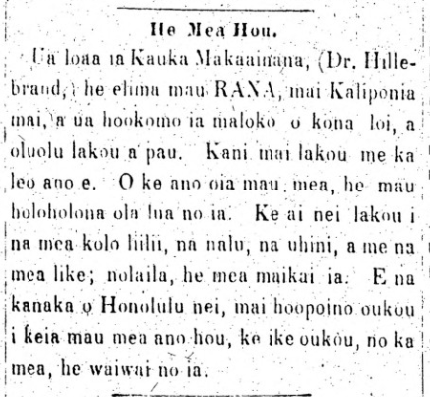
Ka Hae Hawaii, Buke 2, Ano Hou—-Helu 27, Aoao 106. Sepetemaba 30, 1857.

Fishing Tale, 1867.

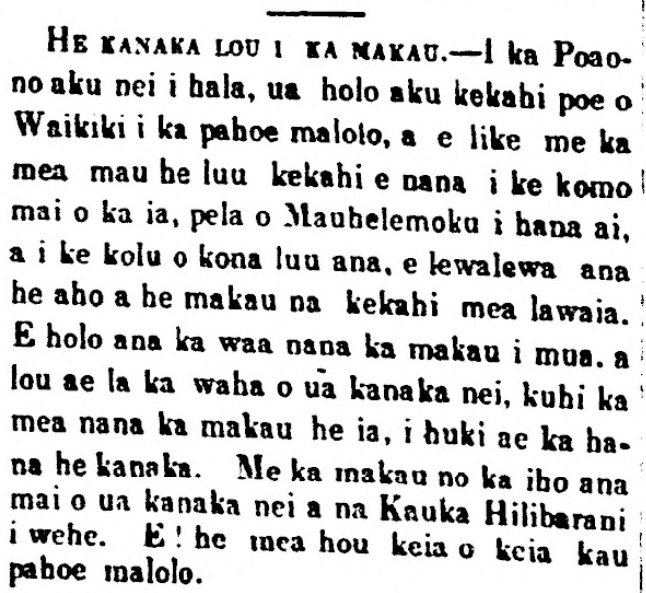
[Found under: “NU HOU KULOKO: Oahu.”]

A MAN SNAGGED BY A HOOK.–This past Saturday, some people went to Waikiki to catch flying fish by driving them into a net using their paddles [pahoe malolo]. And as usual, one of them dove down to watch the fish go in, that is what Mauhelemoku did. And the third time he dove down, there was dangling line and a hook of someone fishing. The canoe with the hook moved forward, and the mouth of that man was hooked. The one that the hook belonged to thought it was a fish and he yanked it up. The man along with the hook went came down and Dr. Hillebrand took it out. Eh! This is something new this flying fish fishing season.

(Kuokoa, 6/22/1867, p. 2)

Ka Nupepa Kuokoa, Buke VI, Helu 25, Aoao 2, Iune 22, 1867.

Hillebrand brings in frogs, 1857.

Something New.

Kauka Makaainana (Dr. Hillebrand) has five FROGS [RANA] from California and he has put them in his taro patch. They are doing fine. They make strange noises. Their nature is that they are animals that have two lives. They eat small bugs: flies, grasshoppers, and other things like that. Therefore they are good. O People of Honolulu, do not harm these new things if you see them, because they are valuable.
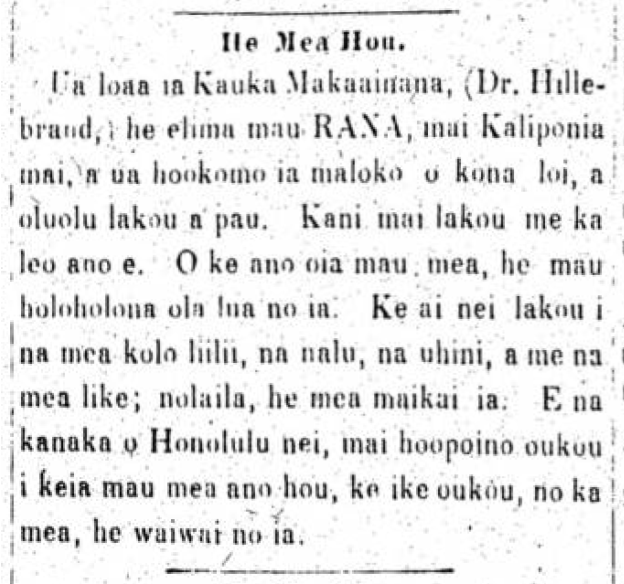
(Hae Hawaii, 9/30/1857, p. 106)

Ka Hae Hawaii, Buke 2, Ano Hou—Helu 27, Aoao 106. Sepetemaba 30, 1857.

More on bees and the man known to Hawaiians as Okamu haole, 1897.

An Industry That Has Made Rapid Strides.

It would be a difficult thing to fix the date of the beginning of the bee industry in the Hawaiian Islands. As far back as the “oldest inhabitant” can run his thoughts, honey has been gathered in the mountains. Back in the ’60s one of the characters of the city was Dwight Holcomb, known to the small boys and natives as “Old Oakum.” He was an eccentric individual and was the “bogie man” to the young boys of that time. Continue reading

More on the importing of birds and plants and laborers, 1865.

Planters’ Society.

A general meeting of the Society was held at the Court House on Saturday last, April 1st, 1865, pursuant to a call published by his Ex. R. C. Wyllie.

Mr. Montgomery was called to the Chair, and stated that the objects of the meeting were, first, to consider the amalgamation of the Planters’ Society with the Royal Hawaiian Agricultural Society.

Hon. G. M. Robertson, appointed at a former meeting to report on the proposed step, stated that the simplest way for attaining the object was for the members of the Planters’ Society to unite individually with the R. H. A. Society. Continue reading

Royal Hawaiian Agricultural Society and the importing of plants and animals, 1865.

[Communicated.]

Mr. Editor:—The eminent success which has attended Dr. Hillebrand’s first consignment of plants and birds per Alberto for the Royal Hawaiian Agricultural Society, ought certainly to operate as a stimulus to all who feel interested in the material progress of these islands, to lend a helping hand to enable him to avail freely of the facilities and opportunities he now possesses of procuring and forwarding here the vast number of plants, &c., suitable to our climate, Continue reading