Death of the translator of Twenty-Thousand Leagues Beneath the Sea, Oniula, George W. Kanuha, 1876.

A Solemness, an  Expression of Affection for G. W. Kanuha.

[Aia aku la paha oe i ka aina hanau,
Ia Kona kai opua i ka lai,
Opua hinano ua malie
Hiolo na wainaoa a ke kehau,
Aole—eia ka paha i na hono a Piilani,
I ka lai o Hauola,
I ka malu o ka Ulu o Lele
E holoholo kuaua paupili ana.
Auwe! Aloha ino.]

Perhaps you are at the land of your birth,
Kona of the billowing clouds on the sea in the calm,
The clouds white like hinano blossoms,
Where the chilling waters of the Kehau mists fall,
No—maybe you are here amongst the bays of Piilani,
In the calm of Hauola,
In the shade of the Breadfruit of Lele,
Travelling about like the Paupili showers.
Auwe! How sad.

George W. Kanuha was born in 1845 in the town of Kailua, North Kona, Hawaii, of the streaked sea, the peaceful sea at Kalaiaehu, ever moistened by the amazing rains of the land of his birth in the face of the clouds. And he passed on to the other side of the black river, that line before the animals life and plant life which forever moves toward the final Great Revelation in the City of heaven. On the 16th day of this month, G. W. Kanuha travelled one last time in the shade of the ulu trees of Lele [Lahaina] in the sparkling sun and the red dirt of his welcoming home, sinking into the eternal home, the belly of the earth following after papa and mama. Aloha ino.

Ahukinialaa Wahineiki was his father, a student of Lahainaluna College, from the very beginning of the school in 1831, he boarded at that school until he graduated with the fluttering flag upon his Diploma. Mrs. Kealoha Wahineiki was his mother. G. W. Kanuha was an only child. Continue reading
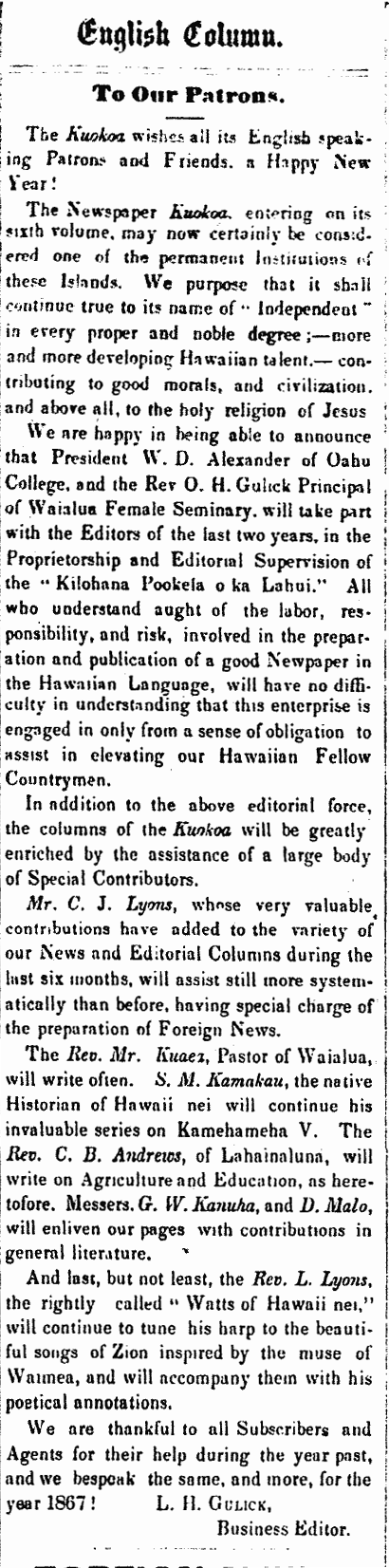
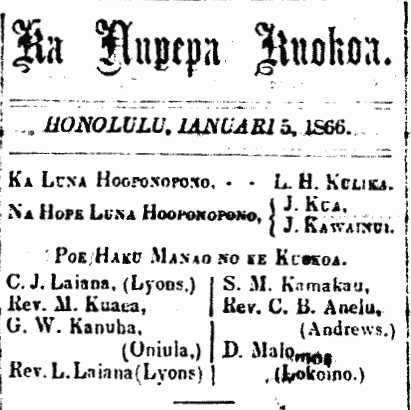
English announcement of officers and writers of the Kuokoa, 1867.

English Column.

To Our Patrons.

The Kuokoa wishes all its English speaking Patrons and Friends, a Happy New Year!

The Newspaper Kuokoa, entering on its sixth volume, may now certainly be considered one of the permanent Institutions of these Islands. We purpose that it shall continue true to its name of “Independent” in every proper and noble degree;—more and more developing Hawaiian talent—contributing to good morals, and civilization, and above all, to the holy religion of Jesus.

We are happy in being able to announce that President W. D. Alexander of Oahu College, and the Rev. O. H. Gulick Principal of Waialua Female Seminary, will take part with the Editors of the last two years, in the Proprietorship and Editorial Supervision of the “Kilohana Pookela o ka Lahui.” All who understand aught of the labor, responsibility, and risk, involved in the preparation and publication of a good Newpaper in the Hawaiian Language, will have no difficulty in understanding that this enterprise is engaged in only from a sense of obligation to assist in elevating our Hawaiian Fellow Countrymen.

In addition to the above editorial force, the columns of the Kuokoa will be greatly enriched by the assistance of a large body of Special Contributors.

Mr. C. J. Lyons, whose very valuable contributions have added to the variety of our News and editorial Columns during the last six months, will assist still more systematically than before, having special charge of the preparation of Foreign News.

The Rev. Mr. Kuaea, Pastor of Waialua will write often. S. M. Kamakau, the native Historian of Hawaii nei will continue his invaluable series on Kamehameha V. The Rev. C. B. Andrews, of Lahainaluna, will write on Agriculture and Education, as heretofore. Messers. G. W. Kanuha, and D. Malo, will enliven our pages with contributions in general literature.

And last, but not least, the Rev. L. Lyons, the rightly called “Watts of Hawaii nei,” will continue to tune his harp to the beautiful songs of Zion inspired by the muse of Waimea, and will accompany them with his poetical annotations.

We are thankful to all Subscribers and Agents for their help during the year past, and we bespeak the same, and more, for the year 1867!  L. H. Gulick,

Business Editor.

(Kuokoa, 1/5/1867, p. 3)

Kuokoa_1_5_1867_3.png

Ka Nupepa Kuokoa, Buke VI, Helu 1, Aoao 3. Ianuari 5, 1867.

Officers and Writers of the Kuokoa, 1867.

Ka Nupepa Kuokoa

HONOLULU, JANUARY 5, 1866 [1867].

Editor [Ka Luna Hooponopono] – – L. H. Gulick [L. H. Kulika].

Junior Editors [Na Hope Luna Hooponopono] – – J. Kua, J. Kawainui.

Writers for the Kuokoa.

C. J. Laiana [Lyons],
Rev. M. Kuaea,
G. W. Kanuha [Oniula],
Rev. L. Laiana [Lyons],
S. M. Kamakau,
Rev. C. B. Anelu [Andrews],
D. Malo [Lokoino].

[Here we see that G. W. Kanuha calls himself Oniula, but does anyone know more about this D. Malo who calls himself Lokoino?]

(Kuokoa, 1/5/1866, p. 2)

Kuokoa_1_5_1867_2.png

Ka Nupepa Kuokoa, Buke VI, Helu 1, Aoao 2. Ianuari 5, 1867.

Selection from Homer’s Iliad, 1868.

WRITING.

Greetings to you [E weli aku ana ia oe] O Maaa wind of my beloved land moistened by the light showers of Winter, and the fragrance-carrying Puulena wind of Mahamoku: O Honele Ihuanu of Albion,¹ aloha to you. It was many years ago when I was overcome by a sudden desire for the poems of the Iliad, the book of Homer of the Greeks, along with the Aeneid of Virgil of the Romans, as I assumed that these mele books were the greatest compositions of the world. I had a great desire to read wisely the lines which brought delight to my mind—however, I was held back by a great cliff from which I was not able to leap and dive to the other side where my mind desired, being that it was written in a superior foreign language reaching the very core of the tongue, which these lips could not mouth; the classical language of those poems. And because I saw these mele in English, translated by someone skilled in those classical languages, that is the reason I thought to bring it into our own language so that you as well may see some of those poems; and perhaps there will be some of you who will hold the past in high regard just as I do. The nature of this mele composed below is a conversation between Hector (a fearless Warrior of Troy) and his wife, Andromache, when they were being warred upon by Greece: The composition of this mele is near factual; and it is truly beautiful. Thus:

“A! e ke alii wiwo ole, i hea la oe e holo aku ai?
A hoopoina loa hoi i kau wahine a me kau keiki.
Aole anei ou manao i ka nui o ko maua pilikia?
Ia’u, he wahine kane ole, a me iala hoi he keiki makua ole? Continue reading