Death of John Waile Heremona Ikaaka Kihe

DARKENED IS THE MIST UPON THE THREE MOUNTAINS

Mr. Editor,

Ikaaka Heremona W. Kihe left this faint life; the famous writer seen in your newspaper, of the famous moolelo, “Kamiki.” He is one of the expert newspaper writers seen under the penname “Ka Ohu Haaheo iluna o na Kuahiwi Ekolu [Ka Ohu Haaheo o na Kuahiwi Ekolu].”

He left this life on the 17th of this month of February, and his path lead straight on the path of no return.

He died after being sick for a long number of years. His wife passed some months ago, and he followed after her in the same footsteps.

He was a familiar amongst your columns, O Hoku o Hawaii, in times past, and he was an expert writer of moolelo of Hawaii nei, and by his pen did he show your readers of Ka Hoku famous places of “Kekaha wai ole o na Kona nei [Waterless Kekaha of the Kona Districts].” He passed on with his family from Keei around his bed, and he put aside his burdens of this worldly life surrounded by his loved ones on this side of the river of death.

Aloha to that friend of our of this beloved land, “Kekaha wai ole o na Kona.”

Sincerely with aloha,
SOLOMONA ALOHIKEA

He was a friend of ours in many years past, and seen indeed in the columns of Ka Hoku o Hawaii were new things from his pen. He was a familiar with politics for many years. And we recall him belonging to the Republican Party for the latter years of his life. Aloha for that kamaaina of the Kona Districts, where we visited many times. The editor of Ka Hoku o Hawaii thanks you, O Solomon Alohikea from whom came the news of the passing of this friend of ours in politics of our party. God shall give relief to his grieving family.

Leaving little by little
Are our friends
There is no rope that can restrain,
It will sever indeed*

*This hymn was composed by Lorenzo Lyons (loosely based off the poem by James Montgomery):

Ke hele liilii nei
Na hoa o kakou;
Aohe kaula e paa ai,
E moku ana no.

E hele liilii mau
A pau loa’e kakou,
Aohe hoa e kanikau,
Ua make like no.

E ala hou no nae,
A pii pu ae kakou,
Ke noho pono a maikai,
A komo i ke ao.

A hui pu ma o–
Na hoaaloha nei,
Aole e kaawale hou,
Pau loa ho ka uwe.

(Hoku o Hawaii, March 4, 1930)

Ka Hoku o Hawaii, Buke XXIII, Helu 38, Aoao 3. Maraki 4, 1930.

It Seems People were Eating Apapane Still in 1890.

[Found under: “Kela a me Keia.”]

They say that there was much delicacies at that banquet held at the seaside of Waikiki last Sunday. The dish most treasured was the flesh of the Apapane bird.

(Ahailono o ka Lahui, 1/30/1890, p. 1)

Ka Ahailono o ka Lahui, Vol. 1, No. 18, p. 1. January 30, 1890.

Paʻiʻai Supply for Kalaupapa, 1898.

BITS OF NEWS FROM THE PATIENT SETTLEMENT

Mr. Editor,

Aloha oe:

Please insert this in an empty space of our beloved [newspaper], and it will whip about all the borders of the land so that the many friends will know who live from Kumukahi where the sun appears to the setting of the sun at surface of the sea at Lehua.

In the morning of Saturday, May 21, our Superintendent W. J. Feary along with a number of leprosy patient assistants left the Settlement. The end of their ocean path aboard their arc (canoe) were the valleys of Pelekunu and Wailau, in search of paʻiʻai for the patients living here in the Colony. It was for that reason that he was sent on this search; it was not his own idea, but because of all of the patients.

They visited Pelekunu and met with the kamaaina, and W. J. Feary talked with them about ʻai, and that it was difficult acquiring, but due to the grace of the Heavens, they met with good fortune, in that they received some ʻai, but by using W. J. Feary’s own money. They did not receive a lot there, so they left Pelekunu and sailed on for Wailau. They met with the kamaaina there to discuss ʻai. The kamaaina denied them. They would not receive ʻai, unless they paid in cash. W. J. Feary thrust his hand in his pocket and and paid for the ʻai that would be enough for the colony, that being 750 per week.

With the success of their mission, they turned back along with the Mokolii on their path to Waikolu with the paʻiʻai on board numbering 744, while 6 paʻiʻai was lost at sea, The ʻai was flung ashore at Waikolu. The patients were told to fetch them from Waikolu, and they did as they were told, and each received paʻiʻai. The patients were overjoyed at receiving paʻiʻai. Those weeks when they patiently ate haole food, without being satiated. Only now has their minds returned after their eyes saw their staple food. Much sthanks to W. J. Feary, our Superintendent.

On the 26th of May, 6 patients were taken from the Colony to the Kalihi Receiving Station for reexamination per the order of the Board of Health.

On the 29th of that month of May, caught in the burning grip of the law was the champion of the Koolau cliffs, the one whose name is famous, for going on Board of Health lands.

My appreciation goes to the Editor, and with the typesetting boys my salutations.

William N. Kuaana,
Puahi, Kalaupapa, Molokai, June 3, 1898.

(Aloha Aina 6/11/1898, p. 6)

Ke Aloha Aina, Buke IV, Helu 24, Aoao 6. Iune 11, 1898.

Fishing Tale, 1867.

[Found under: “NU HOU KULOKO: Oahu.”]

A MAN SNAGGED BY A HOOK.–This past Saturday, some people went to Waikiki to catch flying fish by driving them into a net using their paddles [pahoe malolo]. And as usual, one of them dove down to watch the fish go in, that is what Mauhelemoku did. And the third time he dove down, there was dangling line and a hook of someone fishing. The canoe with the hook moved forward, and the mouth of that man was hooked. The one that the hook belonged to thought it was a fish and he yanked it up. The man along with the hook went came down and Dr. Hillebrand took it out. Eh! This is something new this flying fish fishing season.

(Kuokoa, 6/22/1867, p. 2)

Ka Nupepa Kuokoa, Buke VI, Helu 25, Aoao 2, Iune 22, 1867.

Marriage of Mary Kaloa and Silaviaro Balamora, 5/18/1930.

JOINED IN THE PURE COVENANT OF MARRIAGE

Hon. Jonah Kumalae,
Honolulu, Hawaii.

Aloha nui kaua:–

Please allow me your patience with an open space in our precious, “KE ALAKAI O HAWAII” for this:

At 12:00 M of the 18th of May, 1930, Mary Kaloa of Pauwela, Maui was joined in the pure covenant of marriage with Mr. Silaviaro Balamora* of the American Cannery of Haiku, Maui.

Prescott Foo joined these young ones in the sacred covenant of marriage in the church of the Faith of the Latter Day located at Pauwela, Maui.

After the wedding, brought forth were light fare, that being desserts and cool ice.

After the foods were gone, the newly weds and their friends as well as us went to a luau prepared by Mrs. Cup Choy and Mrs. Po-ka.

We partook and were satiated by the very delicious meal.

Therefore, this was one of the awe-inspiring marriages held in Pauwela, Maui.

Present was your news sniffing sleuth of “Ke ALAKAI O HAWAII,” where he enjoyed those hours of happiness.

May the days of your marriage, O my grandchildren, be accompanied by the fortunes and blessings of the worldly life.

So too with your parents and family as well.

With you my dear Editor goes my great trust, and with your Linotype setters goes my farewell.

*Should the last name be Baylosis?

(Alakai o Hawaii, 6/19/1930, p. 2)

Ke Alakai o Hawaii, Buke 3, Helu 8, Aoao 2. Iune 19, 1930.

FIVE KAHILI WERE MADE FOR THE GOVERNOR

FIVE KAHILI FOR THE GOVERNOR

From the Workers Under Mokumaia

Yesterday afternoon, these kahili were shown in Waikiki.

These kahili will become property of the territory.

According to J. K. Mokumaia, the workers are showing their congratulations to the governor as did the makaainana to their alii in the days gone by.

The kahili were began on May 2 and were completed on May 17.

F. M. B. Kahea is who has knowledge of how to make a kahili.

J. K. Mokumaia is the great general of the alii.

Some Hawaiians have [made] five kahili to present to Governor Farrington on the 9th of June.

At the right of the picture is M. Keawe, J. Kapaiki, Mokumaia, Piko Kamahaa, Clara Kaaipua, Minnie Kakalia, Kahea and Makekehau. Each large kahili has 8000 feathers.

(Alakai o Hawaii, 5/24/1928, p. 1)

Ke Alakai o Hawaii, Buke I, Helu 4, Aoao 1. Mei 24, 1928.

Death of Hariaka Lolohi, 5/16/1862

Died.

Hariaka Lolohi died, a girl greatly loved by her friends. She is a familiar one amongst the serenity of this town, and she is well-acquainted inside of the church of the almighty God, she is a friend of the devout of the high god Sabaoth, that being the members of Kawaiahao. Blessed are those who die in Christ.

She died at 4 o’clock in the morning of the 27th of this month. She was born here in Honolulu on the 16th of May, 1840. And she was 22 years old and 11 days. This girl was never seen going astray. Her body has returned to her parents, and her elder sisters; she is the very last of this family, and she is the very last to return to the earth. I am one of her friends.

Pahukula, w.
Peleula, May 28, 1862.

(Hoku o ka Pakipika, 5/29/1862, p. 3)

Ka Hoku o ka Pakipika, Buke I, Helu 36, Aoao 3. Mei 29, 1862.

Kaulehelehe and his wife Merelina to Oregon, 1845.

Hawaiian Missionaries.–On the 15th of May past, Kaulehelehe and his wife Merelina sailed for Komilewa, that being the land called Oregon; they went to live there as teachers for the Hawaiians there who live under the British Governor there. It was he who wrote requesting that Hawaiian teachers sail there to teach those people who are living without a teacher. This is the annual salary, two hundred dollars ($200). That is not a lot of money, because the cost of living there is high.

Kaulehelehe folk are members of the first church of Honolulu, and the devout must pray to God for them lest they be lost to temptation; and that they live properly and guide the people there in life. Let us not forget them.

Ka Elele, Buke 1, Pepa 5, Iune 3, 1845, Aoao 35.

Accident at Sea, 1877.

[Found under: “Na Nu Hou Kuloko.”]

Lives Blessed by God–By the boundless generosity of Kalaiolele from the Bays of Piilani and P. N. Kahokuoluna from Olowalu, we received the sad news of an overturned canoe, as reported below: On the 4th of June, a single canoe left Kahoolawe and sailed for Lahaina. Aboard the canoe were five men and one woman along with 8,000 dried akule. Late that night, the canoe came upon a sudden gust of wind and was overturned. They tried hard to right the canoe but could not. In the afternoon of the 6th, they were spotted floating on the bottom of the canoe by the people of Olowalu. They were fetched at saved.

(Kuokoa, 6/16/1877, p. 2)

Ka Nupepa Kuokoa, Buke XVI, Helu 24, Aoao 2. Iune 16, 1877.

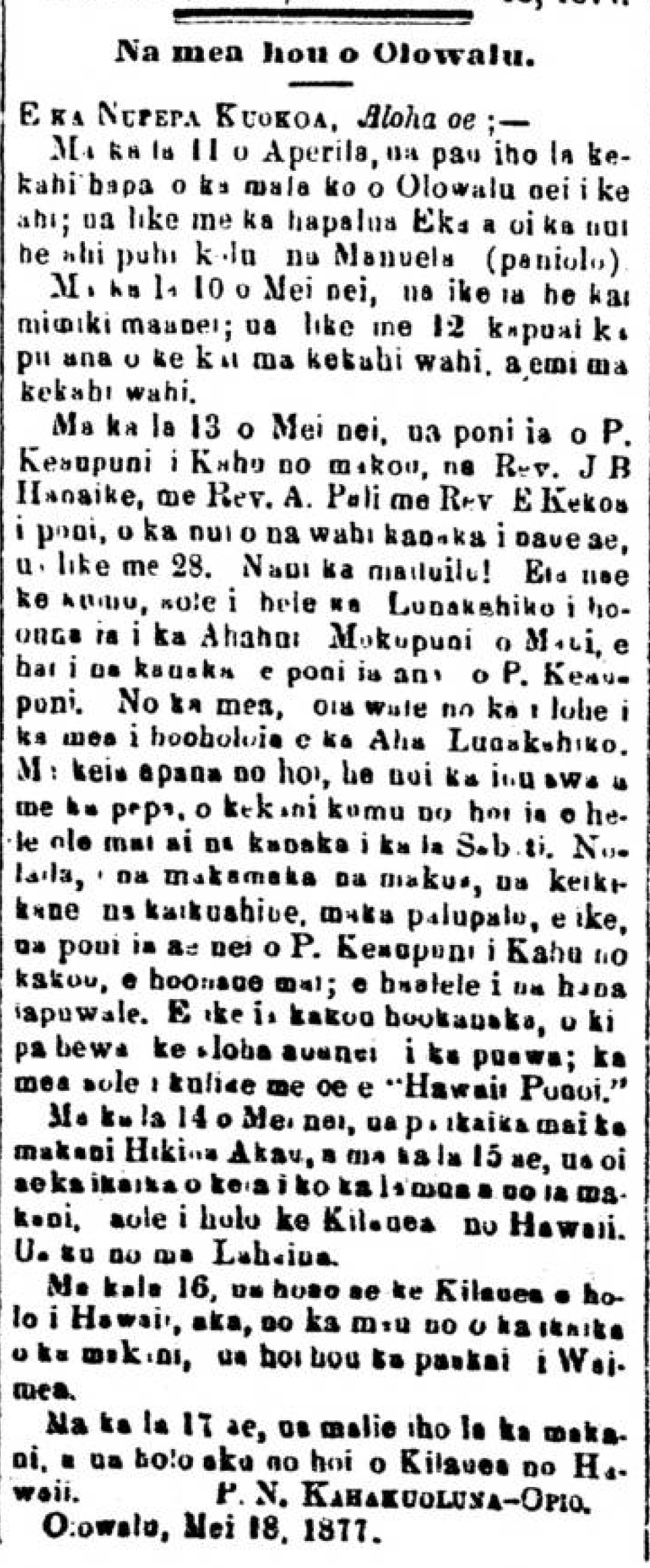
A Cane Fire, Tsunami, and a New Reverend in Olowalu, 1877.

News of Olowalu.

O Kuokoa Newspaper, Aloha oe:–

On the 11th of April, a portion of the cane field of Olowalu was destroyed by fire; it was about half an acre or more. It was a fire to burn kolu weed set by Manuela (Spanish).

On the 10th of May, a tsunami was seen; the sea rose 12 feet in some places and less in other places.

On the 13th of May, P. Keaupuni was ordained as a Kahu for us, the ordination was performed Rev. J. B. Hanaike, Rev. A. Pali, and Rev. E. Kekoa. The number of those who came was about 28. So few. This is the reason. The Elder who was sent by the Maui Island Conference to announce to the people that P. Keaupuni was getting ordained did not come. Because only he knew what was decided by the meeting of elders. In this district, there is much awa drinking and playing cards, which is some of the reasons why people do not come on the Sabbath. Therefore, friends, parents, boys, tender-eyed girls, let it be known that P. Keaupuni was ordained as a Kahu for us. Come, and give up worthless activities. Recognize your fellow man lest your love be wasted on an awa stock; that which is not like you, O Hawaii’s Own.

On the 14th of May, the North East wind was strong, and on the following 15th, it was stronger than the previous day. The Kilauea did not sail for Hawaii and remained in Lahaina.

On the 16th, the Kilauea attempted to sail for Hawaii, but because the strong winds continued, it returned.*

On the following 17th, the wind calmed down and the Kilauea sailed for Hawaii.

P. N. Kahokuoluna Jr. [Peter Noah Kahokuoluna Jr.]
Olowalu, May 18, 1877.

*”Hoi hou ka paakai i Waimea,” Said when someone starts out on a journey and then comes back again. ON 1028

(Kuokoa, 6/2/1877, p. 4)

Ka Nupepa Kuokoa, Buke .XVI, Helu 22, Aoao 4. Iune 2, 1877.