More on Liliuokalani’s Birthday Celebration, 1912.

THE BIRTHDAY OF LILIU ON HER 74th YEAR

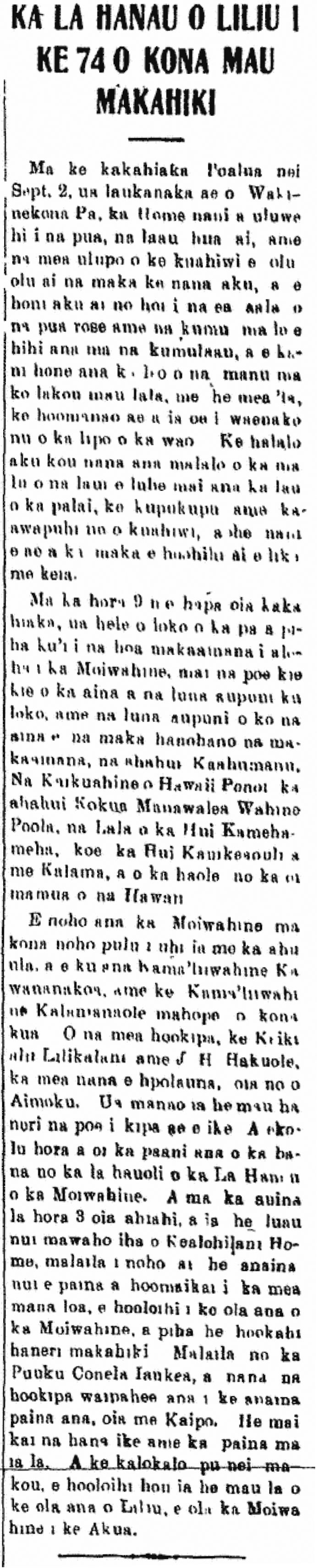
On this Tuesday morning, Sept. 2, the grounds of Washington Place was filled with people, the lovely Home verdant with flowers and fruit trees along with plants that grow densely in the mountains was wonderful to see; with the scent of rose blossoms and maile crawling on the trees as the birds called out sweetly on its branches—this all made you think that you were in the middle of the forest. Should your gaze fall below the shade of the ti leaves, it was lush with fronds of palai and kupukupu ferns and ginger from the mountains; there is no other beauty to entice the eyes equal to this.

At half past 9 on that morning, the estate was packed with the people who loved the Queen, from the high-ranking ones of the land; and the heads of local and foreign governments; dignitaries; citizens; the Kaahumanu Society [Ahahui Kaahumanu]; the Sisters of Hawaii Ponoi [Na Kaikuahine o Hawaii Ponoi]; the Charitable Association of Stevedore Wives [Ahahui Kokua Manawalea Wahine Poola ?]; the members of the Royal Order of Kamehameha [Hui Kamehameha], except for the Kauikeaouli Society and the Kalama; and the haole outnumbered the Hawaiians.

The Queen sat upon her cotton chair on which was draped a feather cloak [ahuula], and Princess Kawananakoa and Princess Kalanianaole stood behind her. The ones who did the welcoming were Prince Lilikalani and J. H. Hakuole, and the one who did introductions was Aimoku. It is believed that there were several hundreds that came to visit. And the band played for over three hours for this joyous day, the Birthday of the Queen. And in the afternoon at 3 o’clock, there was a great luau outside of Kealohilani Home, and there sat a large group who ate and gave thanks to the almighty, so that the Queen could live longer, reaching a hundred. Present indeed was the steward, Colonel Iaukea, and it was he that graciously welcomed the party guests along with Kaipo. The audience and the party that day went well. And we also pray that Liliu’s life may be increased more days; God save the Queen.

(Kuokoa Home Rula, 9/5/1912, p. 2)

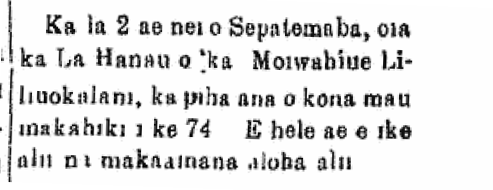
KA LA HANAU O LILIU I KE 74 O KONA MAU MAKAHIKI

Kuokoa Home Rula, Buke X, Helu 36, Aoao 2. Sepatemaba 5, 1912.

Queen Liliuokalani’s Birthday Celebration, 1912.

[Found under: “Various News”]

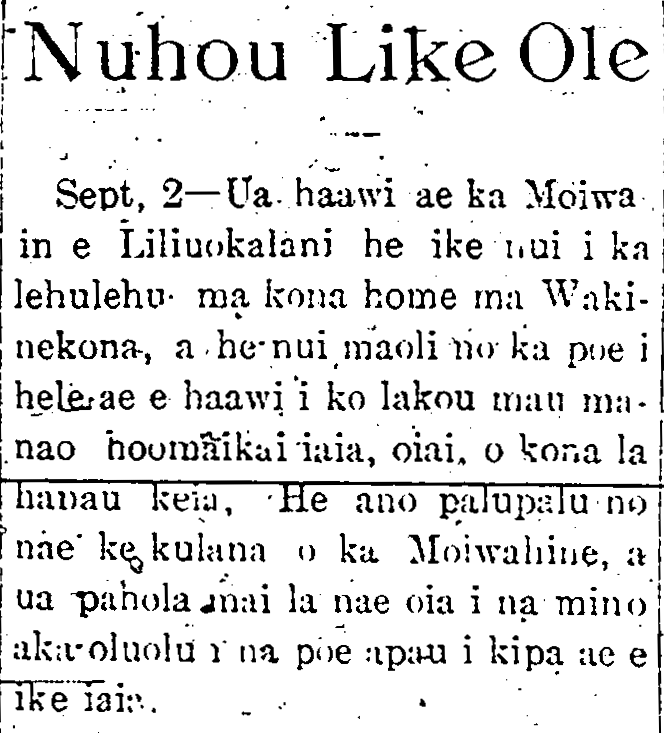
Sept. 2—Queen Liliuokalani held an audience with the public at her home, Washington Place, and there were a great many people who went to give their congratulations to her, being that this was her birthday. The Queen is somewhat frail, but she gave a kind smile to all who came to visit her.

(Hoku o Hawaii, 9/5/1912, p. 3)

Sept, 2—Ua haawi ae ka Moiwahin e...

Ka Hoku o Hawaii, Buke 7, Helu 14, Aoao 3. Sept. 5, 1912.

Liliuokalani’s “Aloha Oe,” 1929.

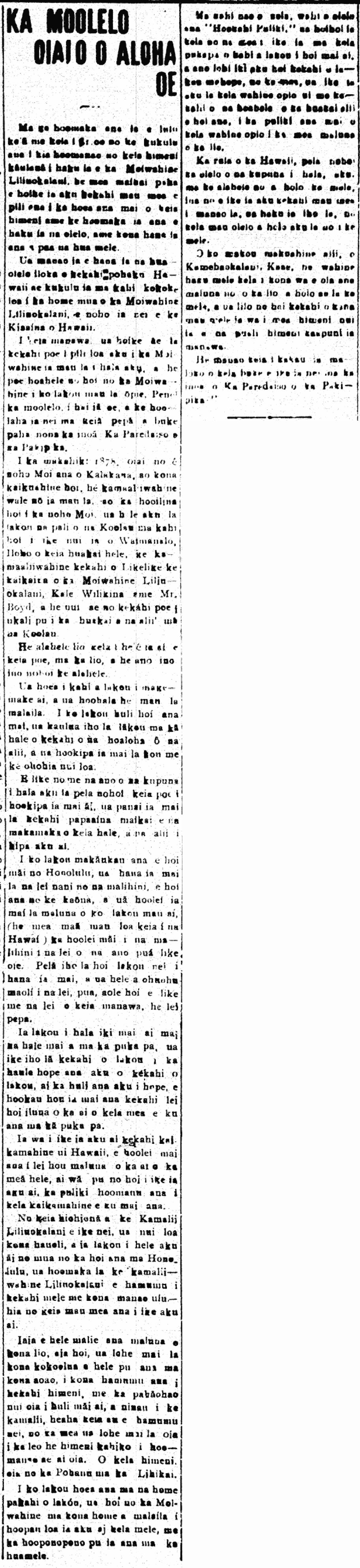
The True Story of “Aloha Oe”

As everyone starts to donate their dollar for the building of a memorial to this famous song composed by Queen Liliuokalani, perhaps it is well to speak about some of the information on the origins of this song, the beginnings of the penning of the lyrics, and it being set to music.

The monument was proposed to be the words in Hawaiian stone that would stand close to the first home of Queen Liliuokalani, now lived in by the Governor of Hawaii.

Now, some intimate with the Queen in days past, and travelling companions of the Queen when they were young, have spoken. This is the story that was told, and it was published in the paper or book called the “Paradise of the Pacific:

In 1878 [1877?], when Kalakaua reigned, and his sister was but a princess and heir to the throne, she travelled to the Koolau side, to well-known Waimanalo. With her was Likelike, Kale Wilikina, Mr. Boyd, and many attendants.

They travelled by horse on horse trail; this was a bad trail.

They arrived at their destination and spent several days there. They spent some days at some friends of the alii, and were welcomed with great gaiety.

Just as the with the kupuna of old, they were welcomed. A feast was laid out by the friends of this home which the alii were visiting.

When were making ready to return to Honolulu, lei of all kinds of flowers were placed about their necks, as was a custom amongst Hawaiians. They were adorned with flower lei, not like the paper lei popular during the time of this article.

When they all were going from the house to exit the estate, they saw one person fall back, and another lei was placed about the neck of the one at the entrance of the yard.

When this beautiful Hawaiian girl was seen giving a lei to the one leaving it also was seen her being embraced.

Because Princess Liliuokalani witnessed this scene, she was overjoyed. While they were headed back to Honolulu, she started to hum a melody, while being full of emotion over what she had seen.

The one next to Liliu heard her humming, and was curious, and asked what she was humming, as it reminded her of an old song. That song was “Rock Beside the Sea” [Pohaku ma ka Lihikai].

When they each returned to their homes, the Queen returned to hers, where she finished this song.
“One embrace” is charming for what was seen at the gateway–one person of their party tarrying as that beautiful young girl hugged the one on horseback.

As was said by the kupuna of yore, mele are composed while travelling, if something that catches ones eye is seen.

Our alii mother, Kamehaokalani Kane was a composer in her lifetime who made songs on horseback. Some of her compositions were well sung back in her time.

This is something written in the book known as the “Paradise of the Pacific.”

[As found in the “Paradise of the Pacific,” 42 (4): 31, 1929; 42 (10): 9, 1929.]

(Hoku o Hawaii, 4/23/1929, p. 2)

KA MOOLELO OIAIO O ALOHA OE

Ka Hoku o Hawaii, Buke XXII, Helu 45, Aoao 2. Aperila 23, 1929.

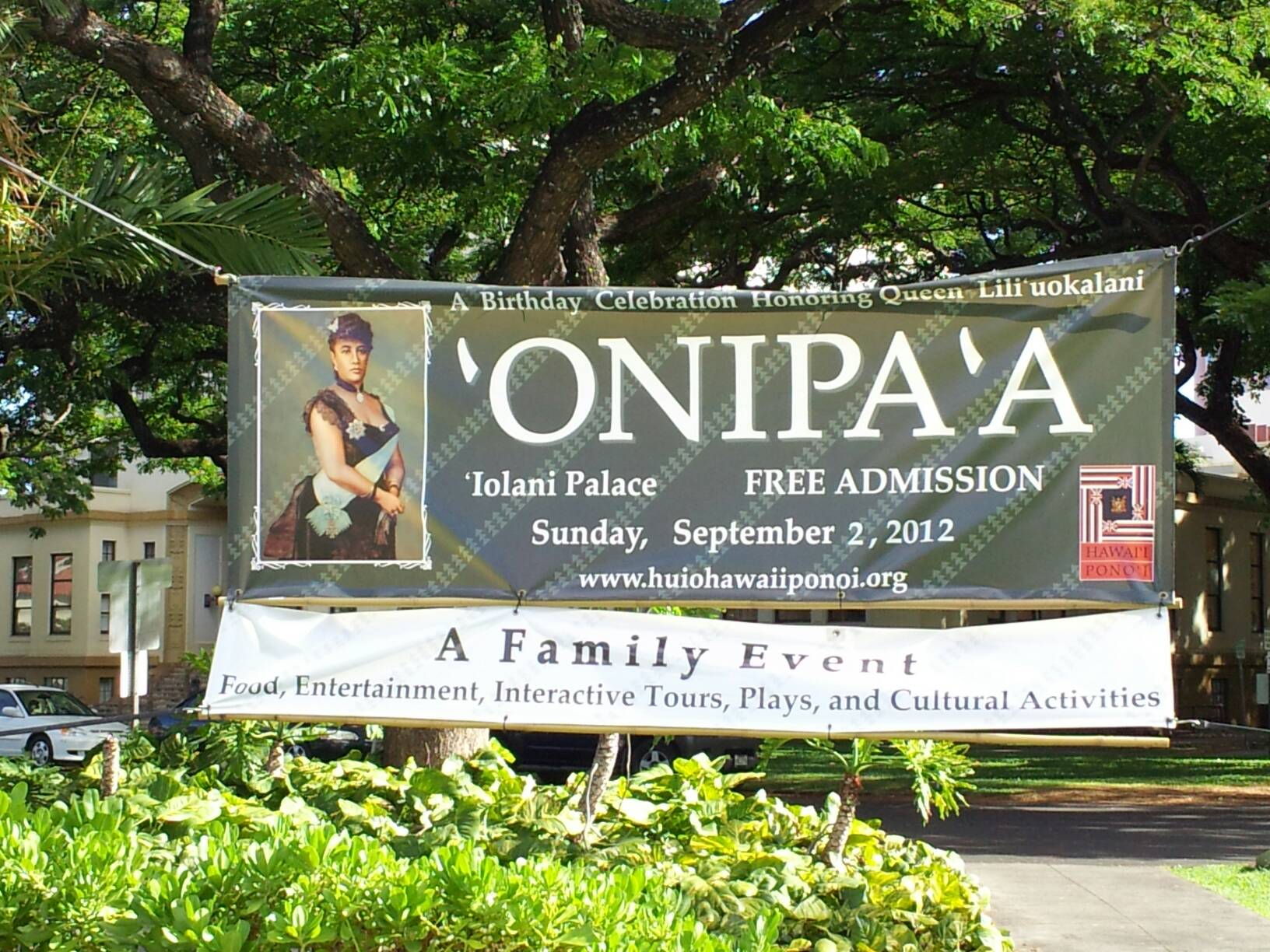
Celebrating the Queen’s Legacy, 2012.

I passed this before i got off the bus at Punchbowl today, and so i walked back and took a picture. Here is a nice description of some of the events taking place this Sunday, September, 2, 2012.

Also, one week later on the 8th, more celebration, Hilo style.

[How about everywhere else? Anybody have information on other celebrations?]

ONIPAA

ONIPAA

Set of mele composed in honor of King Kalakaua, 1881.

HE KAPA NO KALAKAUA.

O mai o Kalakaua nona ke Alii ke kapa hulu manu,
I hana ia mai e Halulu ka Manu Alii mai Kahiki,
Hiki i Hawaii nei i haku kapa hulu manu nou e Kalani Kalakaua,
Ke keiki makahiapo a Kapaakea ko makuakane,
A Keohokalole ko makuahine ke ola—la,
E kii ke kapa o ka hulu o ka Aeto,
A i kapa aahu no Kalani,
A e kii ko kapa o ka hulu o ka Iwa,
A i kapa aahu no Kalani,
A e kii ko kapa a ka hulu o ka Oo,
A i kapa aahu no Kalani,
A e kii ko kapa o ka hulu o ka Mamo,
A i kapa aahu no Kalani,
A e kii ko kapa o ka hlu o ka Iiwi,
A i kapa aahu no Kalani,
A e kii ko kapa o ka hulu o ka Pikake,
A i kapa aahu no Kalani,
A haina ke Alii nona ke kapa,
O Kalakaua kuu Lani.
Mrs. Kaleihiwahiwa.

HE OHU NO KALAKAUA.

Aia i ka Lani ko ohu e kohu ai,
Ua hana mua ia e ka Makua mana loa,
E kii ko lei ohu e Kalani,
O ke anuenue pio i ka lewa,
E kii ko lei ohu e Kalani,
O ka Waipuilani pio i ke kai,
Kinikohu oe e Kalani,
Ko ohu anuenue,
Kau mai oe i ka nuu,
Noho pono i ke Kalaunu,
He uwila kela—ua hiki mai nei,
He anapu keia maluna o Likelike,
He uila kela o ka papahi ohu,
He anapu keia Lehua o Hilo one,
He uwila kela—i ohu kahiko,
He anapu keia—no Kalakaua,
He uwila kela e o mai oe,
He anapu keia—e Kalakaua,
He uwila kela ko ohu kahiko,
He uwila kela,
Kohu i ke Kalaunu—He anapu keia,
He ohu no Kalakaua,
Mrs. Kaleihiwahiwa.

HE HANAU NO KALAKAUA.

Aia Iolani Kauikalani,
O ke Kini nui o Hawaii nei,
A o oe ka pua i oi loa ae,
Maluna o ke ao malamalama,
He uwila ka hoa e kaulike ai,
Ma na iliwai a o ka honua,
Hiki aku ka lohe la i ka hikina,
I ka la hanau o Kawaihau,
O ke aiwaiwa la o na lani,
A i hanau ia me ka opua,
Haina ke Alii i hanau ia,
O ka Wohikukahi la e—o mai.
Aia i Kauai o Kawaihau,
O ka Hui Mahi-ko o Kealia,
Alia oe la e Kapiolani,
E pulale e aku i ka hole ko,
Aia ike pono oe i ka nua,
Lawe ae oe a kau i ka nio,
Mai puni aku oe i ka puhikole,
I ka ili puakea oloko o Mareka,
A he mea hoopau poe-a-poe,
No ka mea Aupuni o Hawaii nei,
Ua ike maka iho no hoi oe,
A o oe ka heke i oi loa ae,
Haina ke Alii i hanau ia,
O ka Wohikukapu la e o mai.
Mrs. Kaleihiwahiwa.

HE INOA NO KALAKAUA.

Auhea wale oe e ka liko,
E ke koolua a o ka lehua,
Homai ke aloha ia nei;
A i honi kuwili ia aku,
Ke hoomau ae nei hoi,
I ke onaona la oia pua,
A’u i kui ai a lawa,
I lei no’u no ka Hikina,
No ka la hiki ma Kumukahi,
Kahiko ae la i Haehae,
O ka wela ka i kua o ka la,
Hulili i ka Pahoehoe,
Nonono ka pua o ka lehua,
Luhiehu i ke kula o Malama,
I ka hoope ia e ka ua,
Uluau kii wai o ka uka,
No uka ka wahine kia manu,
Aohe kepau pili ole,
O ke ani a Laukapalili,
Koe manu ole i ka wekiu,
E o e ka Wohikukahi,
O Kawaihau no he inoa.
Auhea oe Keonaona,
E ka hoapili o kuu kino,
A o oe a owau kai ike,
I ka hana hoi a ka makemake,
Kaua pu no ilaila,
I ka nahele lualai ke aloha,
Hiaai ka manao e ike,
I ka uka paoa i ke ala,
He ala o ka wai Iliahi,
Hoapili o Mailekaulahea,
Hea mai ke ahi a ka wahine,
O ke ala ia o ka malihini,
A e hiki ai i Kaauea,
I ka hale Kamala a ka noe,
Uhi wai anu o ka mauna,
I mehana i ke kono a loko,
Mea ole ke awa o ka uka,
Ka hanuna a ka ihu o ka lio,
I ke one aku o Kahualoa,
Loa wale ka noho’na o Kalani.
I Hiwahiwa no ke ao nei,
A i pua nani no Hawaii,
E o e ka Wohikukahi,
O Kawaihau he inoa.
Kaua i ka nani o Hilo,
I ka ua loku o Hanakahi,
Akahi no ko’u manene,
Ka me-eu hoi o ko’u oho,
He ula leo o Pahanakaiwi,
Ikuwa mai la i Haili,
Ilihia i ka leo o ka Mamo,
E wa mai la i Olaa,
Ua laa ia pua ia nei,
Eia i ko’u kiaha,
Ua hoolawa ia e Lia,
Me na lehua i Panaewa,
Kuhi no paha oe e Malio,
Hookahi halau i ao ai,
E like ai na mea hana,
O na mea hoonui ike,
He makau hala ole keia,
Ua lou ia e ka ia nui,
Ua moni ia ka’u maunu,
E Moananuikalehua,
Ua paa i ka lino pa-walu,
I malia i ke aho makalii,
Kuhi oe i ka Hilu-noenoe,
A he ia ia no ke kohola,
O ka lale au o Kaiona,
I noho i ka malu ohai,
Aohe hana a Malamanui,
Ua kau ke keha i Kaala,
O ka iki nioi pepa ia,
Holo ka wela i na aa koni,
Ka Upena nae mai keia,
Aohe ia koe ke hei mai,
He hului au no ia kai,
No ka moana kai hohonu,
E o e ka Wohikukapu,
O Kawaihau no he inoa,
Mrs. Kaleihiwahiwa
Ka-ua Paakea o Hale-kela.

(Elele Poakolu, 4/20/1881, p. 2)

HE KAPA NO KALAKAUA...

Ka Elele Poakolu, Buke II, Helu 7, Aoao 2. Aperila 20, 1881.

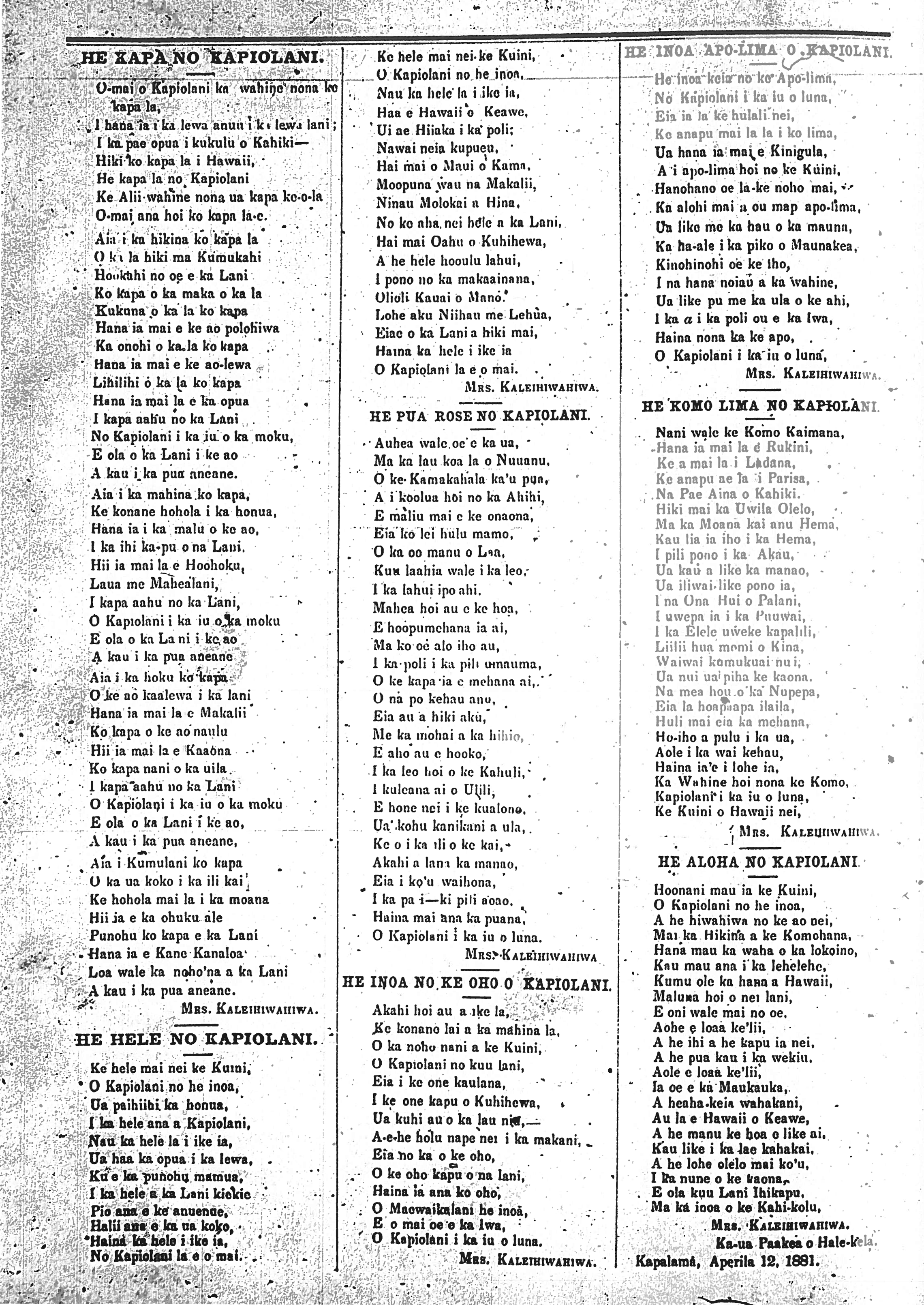
Speaking of Queen Kapiolani, here is a set of sweet mele composed in her honor! 1881.

HE KAPA NO KAPIOLANI.

O-mai o Kapiolani ka wahine nona ke kapa la,
I hana ia i ka lewa anuu i ka lewa lani;
I ka pae opua i kukulu o Kahiki—
Hiki ko kapa la i Hawaii,
He kapa la no Kapiolani
Ke Alii wahine nona ua kapa ke-o-la
O-mai ana hoi ko kapa la-e.
Aia i ka hikina ko kapa la
O ka la hiki ma Kumukahi
Hookahi no oe e ka Lani
Ko kapa o ka maka o ka la
Kukuna o ka la ko kapa
Hana ia mai e ke ao polohiwa
Ka onohi o ka la ko kapa
Hana ia mai e ke ao-lewa
Lihilihi o ka la ko kapa
Hana ia mai la e ka opua
I kapa aahu no ka Lani
No Kapiolani i ka iu o na moku,
E ola o ka Lani i ke ao
A kau i ka pua aneane.
Aia i ka mahina ko kapa,
Ke konane hohola i ka honua,
Hana ia i ka malu o ke ao,
I ka ihi ka-pu o na Lani,
Hii ia mai la e Hoohoku,
Laua me Mahealani,
I kapa aahu no ka Lani,
O Kapiolani i ka iu o ka moku
E ola o ka La ni i ke ao
A kau i ka pua aneane.
Aia i ka hoku ko kapa
O ke ao kaalewa i ka lani
Hana ia mai la e Makalii
Ko kapa o ke ao naulu
Hii ia mai la e Kaaona
Ko kapa nani o ka uila
I kapa aahu no ka Lani
O Kapiolani i ka iu o ka moku
E ola o ka Lani i ke ao,
A kau i ka pua aneane.
Aia i Kumulani ko kapa
O ka ua koko i ka ili kai
Ke hohola mai la i ka moana
Hii ia e ka ohuku ale
Punohu ko kapa e ka Lani
Hana ia e Kane Kanaloa
Loa wale ka noho’na a ka Lani
A kau i ka pua aneane.
Mrs. Kaleihiwahiwa.

HE HELE NO KAPIOLANI.

Ke hele mai nei ke Kuini,
O Kapiolani no he inoa,
Ua paihiihi ka honua,
I ka hele ana a Kapiolani,
Nau ka hele la i ike ia,
Ua haa ka opua i ka lewa,
Ku e ka punohu mamua,
I ka hele a ka Lani kiekie
Pio ana e ke anuenue,
Halii ana e ka ua koko,
Haina ka hele i ike ia,
No Kapiolani la e o mai.
Ke hele mai nei ke Kuini,
O Kapiolani no he inoa,
Nau ka hele la i ike ia,
Haa e Hawaii o Keawe,
Ui ae Hiiaka i ka poli;
Nawai neia kupueu,
Hai mai o Maui o Kama,
Moopuna wau na Makalii,
Ninau Molokai a Hina,
No ke aha nei hele a ka Lani,
Hai mai Oahu o Kuhihewa,
A he hele hooulu lahui,
I pono no ka makaainana,
Olioli Kauai o Mano,
Lohe aku Niihau me Lehua,
Eiae o ka Lani a hiki mai,
Haina ka hele i ike ia
O Kapiolani la e o mai.
Mrs. Kaleihiwahiwa.

HE PUA ROSE NO KAPIOLANI.

Auhea wale oe e ka ua,
Ma ka lau koa la o Nuuanu,
O ke Kamakahala ka’u pua,
A i koolua hoi no ka Ahihi,
E maliu mai e ke onaona,
Eia ko lei hulu mamo,
O ka oo manu o Lea,
Kuu laahia wale i ka leo,
I ka lahui ipo ahi
Mahea hoi au e ke hoa,
E hoopumehana ia ai,
Ma ko oealo iho au,
I ka poli i ka pili umauma,
O ke kapa ia e mehana ai,
O na po kehau anu,
Eia au a hiki aku,
Me ka mohai a ka hihio,
E aho au e hooko,
I ka leo  hoi o ke Kahuli,
I kuleana ai o Ulili,
E hone nei i ke kualono,
Ua kohu kanikani a ula,
Ke o i ka ili o ke kai,
Akahi a lana ka manao,
Eia i ko’u waihona,
I ka pa i—ki pili aoao,
Haina mai ana ka puana,
O Kapiolani i ka iu o luna.
Mrs. Kaleihiwahiwa.

HE INOA NO KE OHO O KAPIOLANI.

Akahi hoi au a ike la,
Ke konane lai a ka mahina la,
O ka noho nani a ke Kuini,
O Kapiolani no kuu lani,
Eia i ke one kaulana,
I ke one kapu o Kuhihewa,
Ua kuhi au o ka lau niu,—
A-e-he holu nape nei i ka makani,
Eia no ka o ke oho,
O ke oho kapu o na lani,
Haina ia ana ko oho,
O Maewaikalani he inoa,
E o mai oe e ka Iwa,
O Kapiolani i ka iu o luna.
Mrs. Kaleihiwahiwa.

HE INOA APO-LIMA O KAPIOLANI.

He inoa keia no ke Apo-lima,
No Kapiolani i ka iu o luna,
Eia ia la ke hulali nei,
Ke anapu mai la la i ko lima,
Ua hana ia mai e Kinigula,
A i apo-lima hoi no ke Kuini,
Hanohano oe la ke noho mai,
Ka alohi mai a ou map [mau] apo-lima,
Ua like me ka hau o ka mauna,
Ka ha-ale i ka piko o Maunakea,
Kinohinohi oe ke iho,
I na hana noiau a ka wahine,
Ua like pu me ka ula o ke ahi,
I ka a i ka poli ou e ka Iwa,
Haina nona ka ke apo,
O Kapiolani i ka iu o luna.
Mrs. Kaleihiwahiwa.

HE KOMO LIMA NO KAPIOLANI.

Nani wale ke Komo Kaimana,
Hana ia mai la e Rukini,
Ke a mai la i Ladana,
Ke anapu ae la i Parisa,
Na Pae Aina o Kahiki.
Hiki mai ka Uwila Olelo,
Ma ka Moana kai anu Hema,
Kau lia ia iho i ka Hema,
I pili pono i ka Akau,
Ua kau a like ka manao,
Ua iliwai like pono ia,
I na Ona Hui o Palani,
I uwepa ia i ka Puuwai,
I ka Elele uweke kapalili,
Liilii hua momi o Kina,
Waiwai kumukuai nu i,
Ua nui ua piha ke kaona,
Na mea hou o ka Nupepa,
Eia la hoapaapa ilaila,
Huli mai eia ka mehana,
Ho-iho a pulu i ka ua,
Aole i ka wai kehau,
Haina ia’e i lohe ia,
Ka Wahine hoi nona ke Komo,
Kapiolani i ka iu o luna,
Ke Kuini o Hawaii nei.
Mrs. Kaleihiwahiwa.

HE ALOHA NO KAPIOLANI.

Hoonani mau ia ke Kuini,
O Kapiolani no he inoa,
A he hiwahiwa no ke ao nei,
Mai ka Hikina a ke Komohana,
Hana mau ka waha o ka lokoino,
Kau mau ana i ka lehelehe,
Kumu ole ka hana a Hawaii,
Maluna hoi o nei lani,
E oni wale mai no oe,
Aohe e loaa ke’lii,
A he ihi a he kapu ia nei,
A he pua kau i ka wekiu,
Aole e loaa keʻlii,
Ia oe e ka Maukauka,
A heaha keia wahakani,
Au la e Hawaii o Keawe,
A he manu ke hoa e like ai,
Kau like i ka lae kahakai,
A he lohe olelo mai ko’u,
I ka nune o ke kaona,
E ola kuu Lani Ihikapu,
Ma ka inoa o ke Kahi-kolu.
Mrs. Kaleihiwahiwa.
Ka-ua Paakea o Hale-kela.
Kapalama, Aperila 12, 1881.

[This newspaper, Ka Elele Poakolu, is yet another one not available online even if it is microfilmed. I am not sure how ulukau.org missed digitizing this when they were under agreement many years ago to put up all of the available newspapers online… To view the pages, you have to find your way down to one of the institutions which have Hawaiian-Language Newspaper microfilms.

Might anyone have any biographical information on Mrs. Kaleihiwahiwa?]

(Elele Poakolu, 4/13/1881, p. 6)

HE KAPA NO KAPIOLANI...

Ka Elele Poakolu, Buke II, helu 6, Aoao 6. Aperila 13, 1881.

Rising food prices: Will politicians ever learn? 1923 / timeless.

REASONS FOR THE RISING COST OF FOOD.

There is perhaps no other more important question pertaining to the life of man than that of the cost of food. How many people have sat down and thought to themselves about the reasons for the rising costs and ways to lessen their living expenses.

If we consider that there is no man on earth that can live without food, then we can find a reason; and through thought and careful consideration, we can figure out the major reasons for the rise in food prices.

First of all, for nations who rely upon other nations or other lands to supply their food, their food will be expensive, and food price stability will not be realized. But for a land that produces its own food, and exports the excess to nations who are lacking, they will see a fall in their food costs.

With these facts, we can move forward. Here we are in Hawaii, growing two major crops, however these two things are not main dishes which give sustenance to the body, but they are just treats. They being sugar and pineapple. We are putting our efforts into these two things and this nation draws its income from it; however, at the same time, we are forgetting about the foods necessary for the body, and because we are so focused on chasing after money, we assume that these funds will supply us with food for nourishment.

The problem with our focus on the pursuit of money, is that we neglect looking after the actual things that are necessary for our bodies, the main staples. We are purchasing our food from foreign nations, while we are in pursuit of making money. When the nations which we rely upon to get our food have a small harvest, this is the time we will see an increase in the costs of food. It will rise because of the small amount of food growing in those countries in which we rely upon from where we get our food.

The second detriment to us in relying on the outside for feeding us is that when the shipping costs rise to ship in the food to us, there will be another set back, and that will be another reason the costs will rise. And should the occasion arise when there is war, or the lack of ships to bring our food, then the prices will shoot up; or there will be times when there is no food, because there will be no means to get the food.

And when the shipping costs rise, it will not be the sailors who will be in trouble, but it will be those who eat the food. For with the increase in the costs to the ship owners for pay for the sailors, or the ship builders perhaps, the ship owners will add on some pennies to the shipping charges, and when this comes to the hands of the consumer, he will understand that the expense to ship food here by boat resulted in an increase in the price of food; and the one paying the exorbitant prices for those foods is you, who eat them. And when the person is eating, he will see that the price of salmon here has risen.

And another factor in the rise of food costs is the number of people who eat the food, in a country that does not produce its own food. With the increase in population, the number of mouths will increase, so there will be less, or just doing without; and as a result of this lack, and to remedy it, the outside is relied upon to make up for this, and this is a problem bigger than all others. There may be a great amount of food brought in, but in comparison to the number of those who eat the food, that food is only a little, which is the main reason for the rise in food costs.

Therefore, we have come to where we can see where the problem lies. First, we do not grow staples. Second, although we have fertile land upon which we can grow food, we just grow things that bring in money and go without growing main foods.

What are staples? Vegetables and meat. These two things are staples. Other things are just treats, and man can live without them.

Here is Hawaii, a land where all foods can be grown which people eat here, along with the condiments. During the times of our ancestors, they had ample food so that they became big and strong. But these days, we are not planting staples. The Chinese and Japanese have come with their foods, with rice being the main food. This rice can be grown here in Hawaii nei. The haole came with their thing, the Irish potato and bread. Potatoes are being grown here now. As for flour, in the year 1849 or there about, Hawaii supplied California with flour. Wheat was grown in Kula, Maui, and on Molokai. Today, wheat can be grown should we desire. And if it is not possible, this is not a problem, because we are satisfied with other foods that can take its place.

And today, should we Hawaiians consider joining together in the growing of food, we will have the best food, and we will have produce that will help lessen the cost of food, as a result of this increase in the number of farmers.

The raising of livestock is also something needed, for that is a staple. Cows, pigs, goats, sheep, chicken, and the fishes of the sea. There is a lot of land now lived on by wild goats. If they were domesticated goats, then we’d have that meat, but because it is wild, and hard to get, it will not be enough for us; all the while the wild goats are feeding off of the fields which is for the sustenance of domesticated goats; some people are going into this profession.

The main thing that will lessen the costs of our food that we eat is the increasing of the growing of those foods; the joining into the growing of these things, because the quality of soil of this land is sufficient to grow these things. And let us look to making money through that, and not solely from treats.

We Hawaiians are supplied with land where we can enter into the occupation of growing food. There is probably no piece of land in Hawaii where staples cannot be grown. The land of Molokai has been opened up. The land of Kalamaula has enough water to grow food whenever it is desired. The lands upland of Palaau and Hoolehua will be opened up. These lands have soil good enough to grow Irish potatoes and corn.

Melons and other things can be grown which can support pig farming. With these staple foods, the farmer and those that raise livestock will receive good money from the mouths of those who live here, while being relied upon by those from outside to supply their food. Maybe the food won’t be cheaper, but you will have your food, O Farmer, with ease, and your family will be supplied, without it all being consumed; and the leftover, you can sent out to be purchased by those in pursuit of making money.

When foreign nations don’t have enough to send food to Hawaii, or when there are not enough ships, or if this nation enters into war, you and your family will have enough food, and you will get a higher price, because there will not be enough food imported. For these reasons, let us Hawaiians recognize these fields of gold stretched out before us, and let us grab it and harvest its many blessings. The seeking of one’s livelihood from the soil was the first way of life of the earliest men. And we know that there is no greater occupation than this. You are independent. You will have enough staple foods. You will have enough money, and with this money, you will have things that you do not grow. Clothes and things that make your life pleasant.

[I dedicate this to all the awesome farmers out there, both big and small (and fishermen and ranchers and dairy people for that matter). Also to the farmers’ markets, and establishments who support them. And to you, the people who try to buy local first. Conversely, I would like all of you politicians and others who think that agricultural lands and farmers are not important, to think about the big picture before another 89 years pass by. At this rate, we will be leaving the next generations with a very dismal way of life.]

(Kuokoa, 2/15/1923, p. 2)
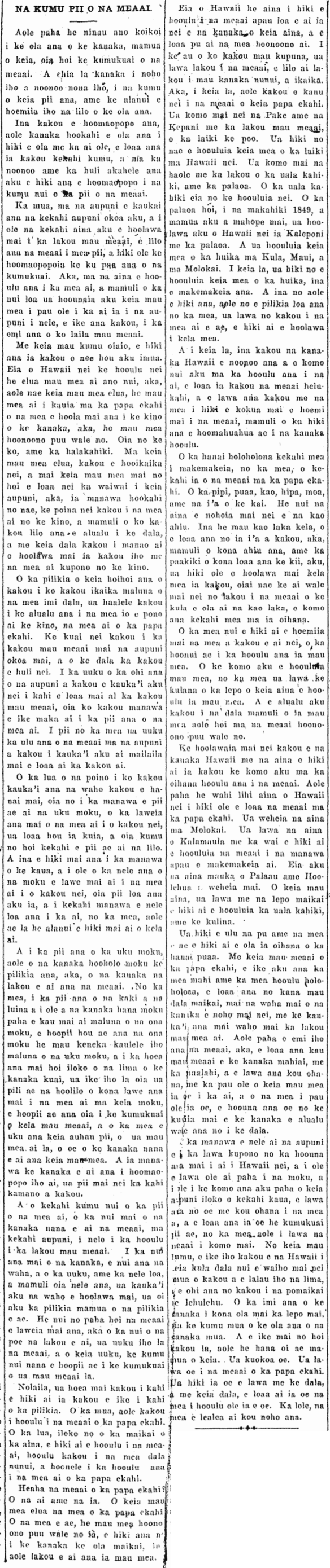
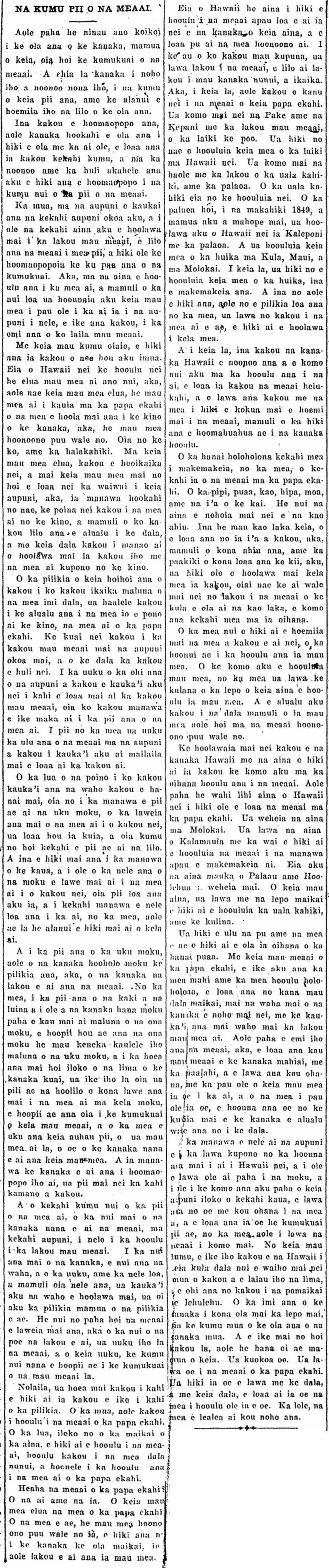
NA KUMU PII O NA MEAAI.

Ka Nupepa Kuokoa, Buke LXII, Helu 7, Aoao 2. Feberuari 15, 1923.