The Queen leaves Washington, D. C., 1900.

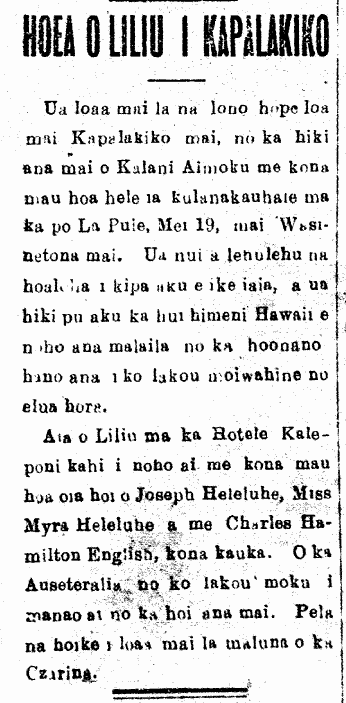
LILIU ARRIVES IN SAN FRANCISCO

We have received the latest news from San Francisco [Kapalakiko], about the arrival of the Queen and her travelling companions in that city on Sunday, May 19th from Washington. There are many friends who visit to see her, and the Hawaiian singing group living there came to honor their queen for two hours.

Liliu is at the California Hotel with her companions, Joseph Heleluhe; Miss Myra Heleluhe; and Charles Hamilton English, her doctor. They are planning to return home on the Australia. That is what we hear from the Czarina.

(Aloha Aina, 6/2/1900, p. 4)

HOEA O LILIU I KAPALAKIKO

Ke Aloha Aina, Buke VI, Helu 22, Aoao 4. Iune 2, 1900.

Joseph Heleluhe, 1900.

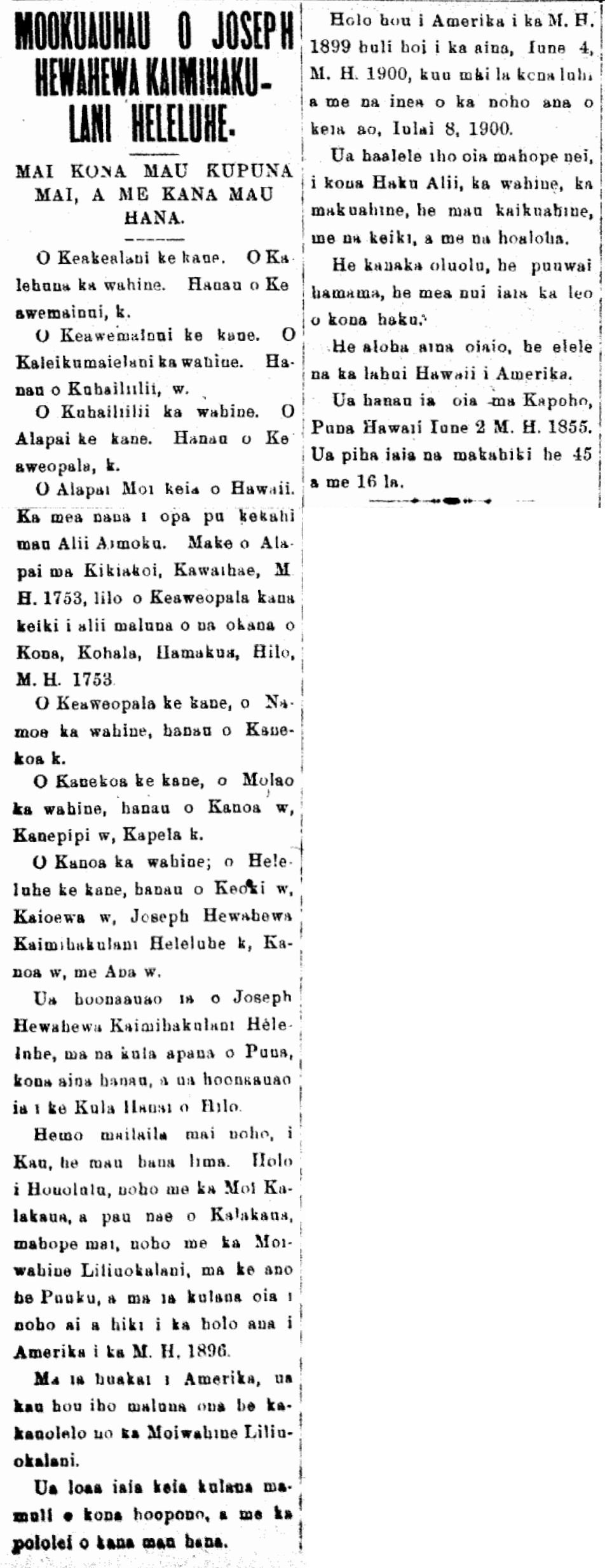
THE GENEALOGY OF JOSEPH HEWAHEWA KAIMIHAKULANI HELELUHE.

FROM HIS KUPUNA, ALONG WITH HIS ACCOMPLISHMENTS.

Keakealani was the man. Kalehuna was the woman. Born was Keawemainui (m).

Keawemainui was the man. Kaleikumaielani was the woman. Born was Kuhailiilii (f).

Kuhailiilii was the woman. Alapai was the man. Born was Keaweopala (m).

This was Alapai, the King of Hawaii. The one who crushed a number of Rulers [Alii Aimoku]. Alapai died at Kikiakoi, Kawaihae, in the year 1753, and Keaweopala his child became the ruler of the districts [okana] of Kona, Kohala, Hamakua, and Hilo, in 1753.

Keaweopala was the man. Namoe was the woman. Born was Kanekoa (m).

Kanekoa was the man. Molao was the woman. Born was Kanoa (f), Kanepipi (f), and Kapela (m).

Kanoa was the woman. Heleluhe was the man. Born was Keoki (f), Kaioewa (f), Joseph Hewahewa Kaimihakulani Heleluhe (m), Kanoa (f), and Ana (f).

Joseph Hewahewa Kaimihakulani Heleluhe was educated in the district schools of Puna, his land of birth, and educated at Hilo Boarding School [Kula Hanai o Hilo].

He graduated, and then lived in Kau, and did physical labor. He moved to Honolulu and lived with King Kalakaua, and after Kalakaua was done, he then lived with Queen Liliuokalani as her Steward [Puuku], and remained in that capacity until they went to America in 1896.

On that journey to America, upon him was also placed the duty of secretary to Queen Liliuokalani.

He received that position because of his propriety, and his meticulousness.

They went once again to America in 1899 and returned home to the aina on June 4, 1900; he left behind his labors and hardships of life in this world on July 8, 1900.

He left behind him, his Royal Mistress [Haku Alii], his wife, his mother, a number of sisters, his children, and his friends.

He was an amicable man with an open heart, and the voice of his Queen was important to him.

He was a true patriot, and he was an envoy from the Hawaiian nation to America.

He was born in Kapoho, Puna, Hawaii, on June 2, 1855. He made 45 years old and 16 days.

(Aloha Aina, 7/28/1900, p. 1)

MOOKUAUHAU O JOSEPH HEWAHEWA KAIMIHAKULANI HELELUHE.

Ke Aloha Aina, Buke VI, Helu 30, Aoao 1. Iulai 28, 1900.

Wakeke Heleluhe to take the place of Kia Kahele Nahaolelua, 1897.

Returning Home.

It is heard that Mrs. Kahele Nahaolelua is returning on the steamer Monowai this coming Thursday and left behind the Queen [Aliiaimoku]. The reason for this return is unclear to us, however, there are all sorts of rumors; some say she is sick, some say that she misses her family, some say that she has urgent business, and so forth; the truth will be known only when she returns. And because she is coming home, in her stead will be Mrs. Wakeke Heleluhe, who will leave on the steamship Australia of this coming Wednesday. Her departure is certain, for her wardrobe is being made for her trip to foreign lands. So this is a confirmation of the truth of Captain Palmer’s words that it is unclear when the Queen will return and her stay there is not limited.

[The Queen states:

In the early part of May it became necessary for my companion, Mrs. Kia Nahaolelua, to return to Honolulu. Three months was the length of time I had expected to be absent when I asked her to accompany me; but five months had passed away, and her husband and large family of children needed her. So I sent her to San Francisco under the charge of Captain Palmer, where he was to meet Mrs. Joseph Heleluhe, and conduct her to Washington.

See another article on Mrs. Heleluhe’s departure.]

(Makaainana, 5/3/1897, p. 8)

E Huli Hoi Mai Ana.

Ka Makaainana, Buke VII—-Ano Hou, Helu 18, Aoao 8. Mei 3, 1897.

King Kalakaua returns from trip around the world, 1881 / 1912.

KE KAENA A KA MOI KALAKAUA

Ua kaahele au maluna o ka ilihonua me na moana,
A Inia mamao, a me Kina kaulana;
Hoea i na aekai o Aferika, a me na palena o Europa,
A halawai me ka ikaika o na aina apau,
A ia’u i ku ai ma ka aoao o na Poo Aupuni,
Ka poe mana maluna o ka lakou, me ka hiehie Alii;
Hoomaopopo iho la au i ka ukuiki, a nawaliwali o ko’u,
Me ko’u Nohoalii hookahua ia maluna o kahi puu Pele,
A ma kahi he miliona i hooko i ka keia mau Moi,
He mau tausani wale iho no malalo o ko’u mau malu;
Aka, ke upu nei loko, na’u ke Kaena hiki,
Aia he mau nani maloko o na poai o ko’u mau aekai—
I oi aku ka makamae i ka o’u mau hoa Moi,
Aohe o’u kumu hopo maloko o ko’u Aupuni,
He hiki ke hui me ko’u lahui, me ka weli ole,
Aohe makau no’u iho, me ke kiai pilipaa ole ia,
A na’u ke Kaena, he momi i hoounaia mailuna mai na’u—
Eia me A’u ke Aloha pilipaa o Ko’u Lahuikanaka.

[See an English translation for this mele.]

(Au Hou, 2/14/1912, p. 25)

KE KAENA A KA MOI KALAKAUA

Ke Au Hou, Buke 3, Helu 6, Aoao 25. Feberuari 14, 1912.

From the suite of Queen Emma, Hoapili Kaauwai and Kiliwehi, 1866.

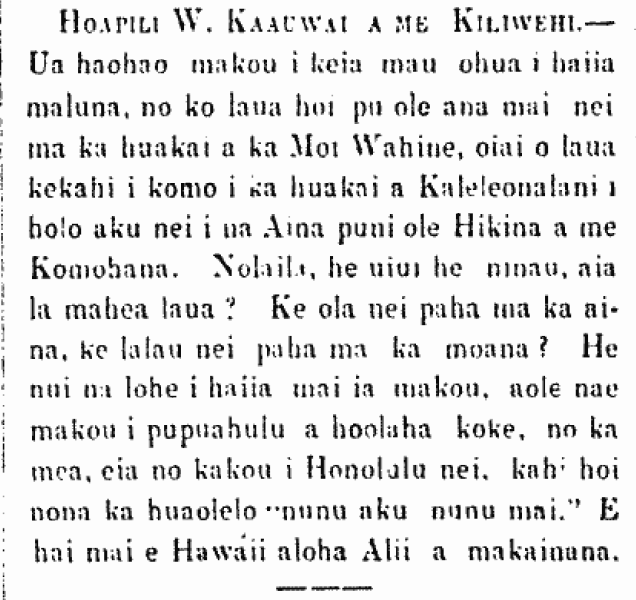
Hoapili W. Kaauwai and Kiliwehi.—We are curious about the attendants mentioned above, because they have not returned from the trip of the Queen, whereas they were two who joined in on the journey of Kaleleonalani when she set off for the continents of the East and the West. Therefore we question and ask, where are those two? Maybe they are staying on land or gone astray at sea? We hear a lot of stories, yet we will not lose our head and spread them at once, because here we are in Honolulu where it is said, “speculate this way, speculate that way”.¹ Tell us, O Alii and makaainana loving Hawaii.

¹”Nunu aku, nunu mai” perhaps is a variant of “Nune aku, nune mai”, and is a saying associated with busy Honolulu. Is there anyone with more information on this saying?

[There is much written about the happenings between Hoapili and Kiliwehi.]

(Kuokoa, 10/27/1866, p. 2)

Hoapili W. Kaauwai a me Kiliwehi.

Ka Nupepa Kuokoa, Buke V, Helu 43, Aoao 2. Okatoba 27, 1866.

Queen Emma returns to Hawaii, 1866.

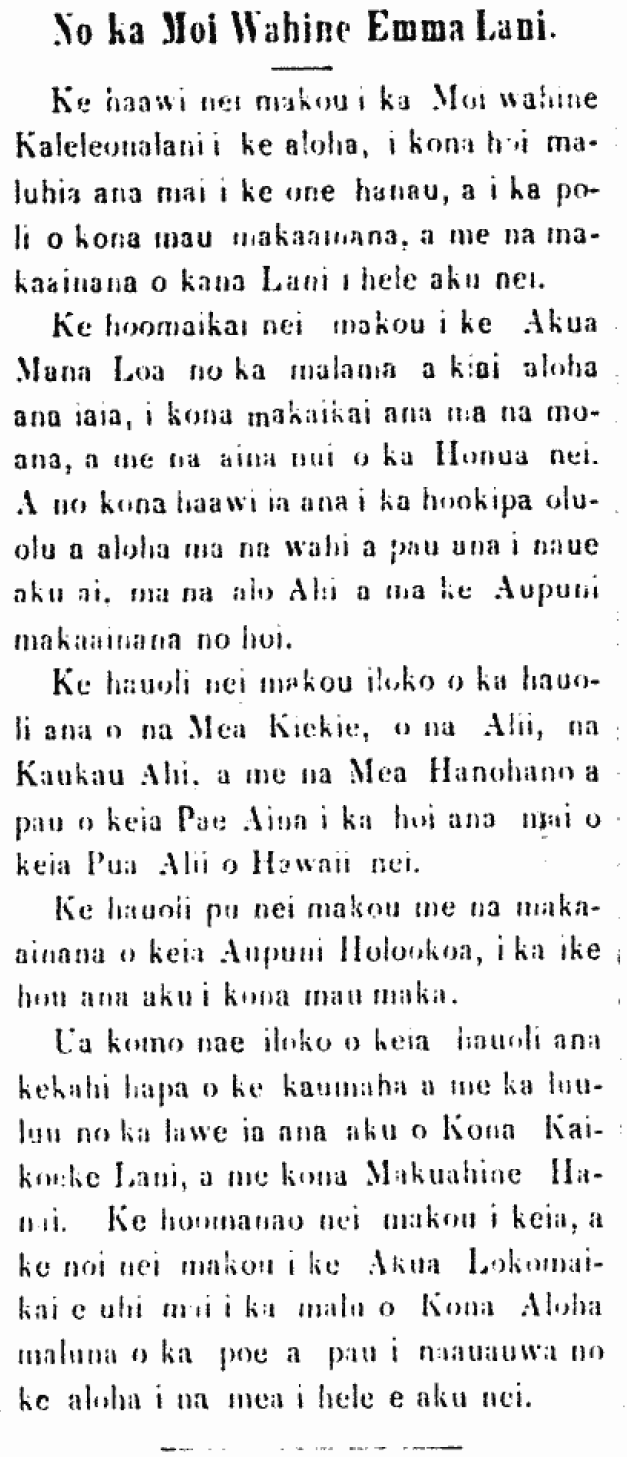
About Queen Emma Lani.

We extend aloha to Queen Kaleleonalani with her safe return to her birth sands, and to the bosoms of her makaainana and the makaainana of her Chief one who has departed.

We give our thanks to Almighty God for lovingly watching over and guiding her, on her voyage over the ocean and the great lands of the Earth. And for the giving of kind and loving receptions in all places she went, in Royal courts as well as amongst the commoners.

We are pleased with the joy of their Highnesses, the Alii, the Kaukau Alii, and all of the Honorable ones of this Archipelago at the return of this Royal Descendant of Hawaii nei.

We are pleased as well along with all the makaainana of the Entire Nation, at seeing once again her face.

Along with this joy is also some sadness and grief for the taking of Her Royal Sister-in-Law [Kaikoeke Lani],¹ and her Foster Mother [Makuahine Hanai].² We remember this, and we ask of the Benevolent God to envelope in the protection of His Aloha, all who are grieving because of their aloha for those who have departed.

¹Victoria Kalohelani Kamamalu Kaahumanu (11/1/1838–5/29/1866)

²Grace Kamaikui Ruka [Rooke] (1808–7/24/1866)

(Kuokoa, 10/27/1866, p. 2)

No ka Moi Wahine Emma Lani.

Ka Nupepa Kuokoa, Buke V, Helu 43, Aoao 2. Okatoba 27, 1866.

Queen Emma affronted, 1866.

We Do Not Approve.

As we read the words which President Johnson spoke at his audience with Queen Emma, we nearly ridicule them. Were he instead the greatly beloved Abraham Lincoln, were it perhaps during his time, then the words would have been splendid. He was a very humble man, whereas this President is arrogant. It is unfortunate that it was him, and that he is the head of the Nation which we love. Here are his good for nothing words:—

“I offer you my esteem as you enter the Nation’s capital, for a people of 30,000,000” [He knows that Hawaii is a tiny Nation, and is boasting of America’s greatness.] “It is not because you are Royalty that I give you my regard, but because you are a woman who has looked out for the interest of your people.” [What is wrong with showing aloha in her Royal status?] “I can say that in our country, we are all royalty, we are all Kings and Queens. Therefore, when you speak to one of our people, you are speaking Monarch to Monarch.” [Queen Emma is aware of how America is; what purpose does it serve to speak those words in a welcoming address? You’d imagine that he would have words of aloha for Hawaii. America couldn’t be more against their President [? Oi ole kue ko Amerika i ko lakou Peresidena].

[Johnson’s speech as quoted in Memphis, Tennessee’s Public Ledger of August 24, 1866, is as follows:

“I am most happy to renew to your Majesty the assurances of profound regard and esteem made to you by the Acting Secretary of State, and it affords me pleasure to offer you a cordial welcome to the capital of these United States, the seat of government for over thirty millions of people. And in according you this earnest welcome, permit me to assure you that it is not because you bear the title of Queen; it is induced solely by the prestige that has preceded you, that has assured us of your virtues as a woman, and especially of your efforts in the cause of Christianity, civilization and education among the people of your country. It is more on that account than of the rank or appellation that you bear. If I were disposed to be facetious on this occasion, I might say that while none of the people of these United States wear crowns, while no man is acknowledged as a king and no woman as a queen, yet while you are here in these United States, you will have none but queens to associate with.”]

(Kuokoa, 10/27/1866, p. 3)

Makemake ole.

Ka Nupepa Kuokoa, Buke V, Helu 43, Aoao 3. Okatoba 27, 1866.

Queen Emma in Washington D. C., 1866.

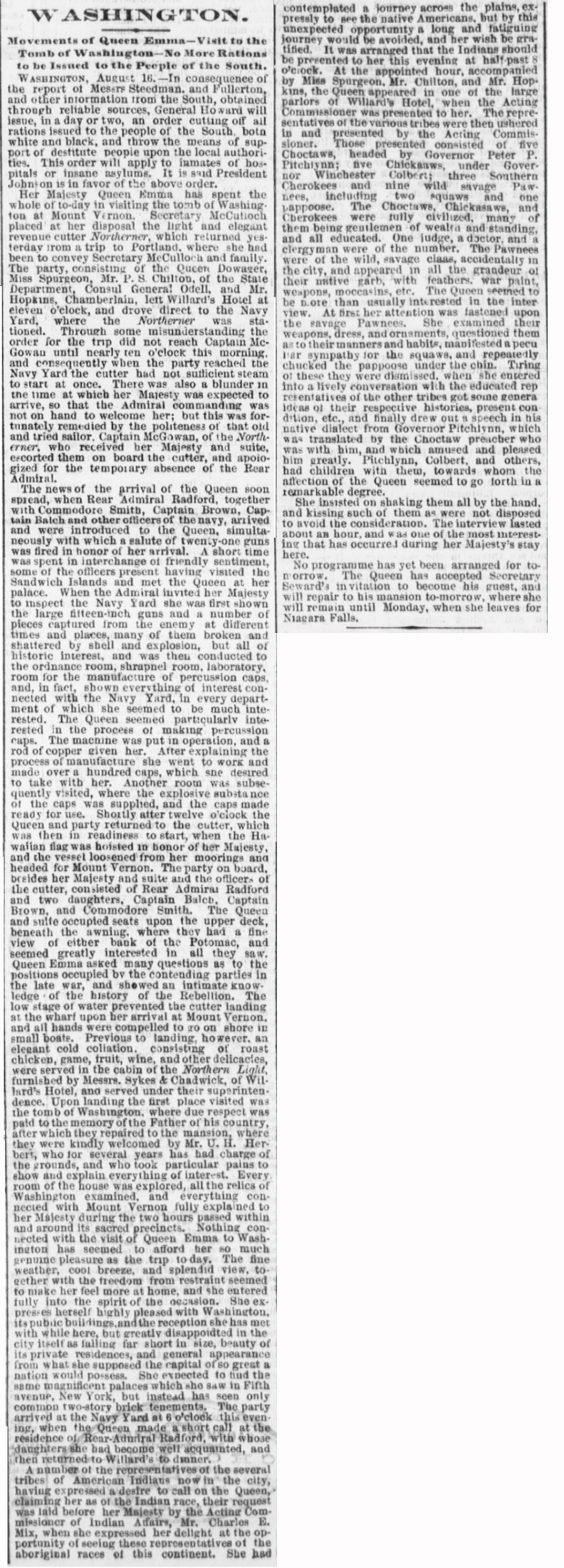
WASHINGTON.

Movements of Queen Emma—Visit to the Tomb of Washington—No More Rations to be Issued to the People of the South.

Washington, August 16.—In consequence of the report of Messrs Steedman, and Fullerton, and other information from the South, obtained through reliable sources, General Howard will issue, in a day or two, an order cutting off all rations issued to the people of the South, both white and black, and throw the means of support of destitute people upon the local authorities. This order will apply to inmates of hospitals or insane asylums. It is said President Johnson is in favor of the above order.

Her Majesty Queen Emma has spent the whole of to-day in visiting the tomb of Washington at Mount Vernon. Secretary McCullouch placed at her disposal the light and elegant revenue cutter Northerner, which returned yesterday from a trip to Portland, where she had been to convey Secretary McCulloch and family. The party, consisting of the Queen Dowager, Miss Spurgeon, Mr. P. S. Chilton, of the State Department, Consul General Odell, and Mr. Hopkins, Chamberlain, left Willard’s Hotel at eleven o’clock, and drove direct to the Navy Yard, where the Northerner was stationed. Through some misunderstanding the order for the trip did not reach Captain McGowan until nearly ten o’clock this morning, and consequently when the party reached the Navy Yard the cutter had not sufficient steam to start at once. There was also a blunder in the time at which her Majesty was expected to arrive, so that the Admiral commanding was not on hand to welcome her; but this was fortunately remedied by the politeness of that old and tried sailor, who received her Majesty and suite, escorted them on board the cutter, and apologized for the temporary absence of the Rear Admiral.

The news of the arrival of the Queen soon spread, when Read Admiral Radford, together with Commodore Smith, Captain Brown, Captain Balch and other officers of the navy, arrived and were introduced to the Queen, simultaneously with which a salute of twenty-one guns was fired in honor of her arrival. A short time was spent in interchange of friendly sentiment, some of the officers present having visited the Sandwich Islands and met the Queen at her palace. When the Admiral invited her Majesty to inspect the Navy Yard she was first shown the large fifteen-inch guns and a number of pieces captured from the enemy at different times and places, many of them broken and shattered by shell and explosion, but all of historic interest, and was then conducted to the ordinance room, shrapnel room, laboratory, room for the manufacture of percussion caps, and, in fact, shown everything of interest connected with the Navy Yard, in every department of which she seemed to be much interested. The Queen seemed particularly interested in the process of making percussion caps. The machine was put in operation, and a rod of copper given her. After explaining the process of manufacture she went to work and made over a hundred caps, which she desired to take with her. Another room was subsequently visited, where the explosive substance of the caps was supplied, and the caps made ready for use. Shortly after twelve o’clock the Queen and party returned to the cutter, which was then in readiness to start, when the Hawaiian flag was hoisted in honor of her Majesty, and the vessel loosened from her moorings and headed for Mount Vernon. The party on board, besides her Majesty and suite and the officers of the cutter, consisted of Rear Admiral Radford and two daughters, Captain Balch, Captain Brown, and Commodore Smith. The Queen and suite occupied seats upon the upper deck, beneath the awning, where they had a fine view of either bank of the Potomac, and seemed greatly interested in all they saw. Queen Emma asked many questions as to the positions occupied by the contending parties in the late war, and showed and intimate knowledge of the history of the Rebellion. The low stage of water prevented the cutter landing at the wharf upon her arrival at Mount Vernon, and all hands were compelled to go on shore in small boats. Previous to landing, however, an elegant cold collation, consisting of roast chicken, game, fruit, wine, and other delicacies, were served in the cabin of the Northern Light, furnished by Messrs. Sykes & Chadwick, of Willard’s Hotel, and served under their superintendence. Upon landing the first place visited was the tomb of Washington, where due respect was paid to the memory of the Father of this country, after which they repaired to the mansion, where they were kindly welcomed by Mr. U. H. Herbert, who for several years has had charge of the grounds, and who took particular pains to show and explain everything of interest. Every room of the house was explored, all the relics of Washington examined, and everything connected with Mount Vernon fully explained to her Majesty during the two hours passed within and around its sacred precincts. Nothing connected with the visit of Queen Emma to Washington has seemed to afford her so much genuine pleasure as the trip to-day. The fine weather, cool breeze, and splendid view, together with the freedom from restraint seemed to make her feel more at home, and she entered fully into the spirit of the occasion. She expresses herself highly pleased with Washington, its public buildings, and the reception she has met with while here, but greatly disappointed in the city itself as falling far short in size, beauty of its private residences, and general appearance from what she supposed the capital of so great a nation would possess. She expected to find the same magnificent palaces which she saw in Fifth avenue, New York, but instead has seen only common two-story brick tenements. The party arrived at the Navy Yard at 6 o’clock this evening, when the Queen made a short call at the residence of Rear-Admiral Radford, with whose daughters she had become well acquainted, and then returned to Willard’s to dinner.

A number of the representatives of the several tribes of American Indians now in the city, having expressed a desire to call on the Queen, claiming her as of the Indian race, their request was laid before her Majesty by the Acting Commissioner of Indian Affairs, Mr. Charles E. Mix, when she expressed her delight at the opportunity of seeing these representatives of the aboriginal races of this continent. She had contemplated a journey across the plains, expressly to see the native Americans, but by this unexpected opportunity a long and fatiguing journey would be avoided, and her wish be gratified. It was arranged that the Indians should be presented to her this evening at half-past 8 o’clock. At the appointed hour, accompanied by Miss Spurgeon, Mr. Chilton, and Mr. Hopkins, the Queen appeared in one of the large parlors of Willard’s Hotel, when the Acting Commissioner was presented to her. The representatives of the various tribes were then ushered in and presented by the Acting Commissioner. Those presented consisted of five Choctaws, headed by Governor Peter P. Pitchiynn; five Chickasaws, under Governor Winchester Colbert; three Southern Cherokees and nine wild savage Pawnees, including two squaws and one pappoose. The Choctaws, Chickasaws, and Cherokees were fully civilized, many of them being gentlemen of wealth and standing, and all educated. One judge, a doctor, and a clergyman were of the number. The Pawnees were of the wild, savage claas, accidentally in the city, and appeared in all the grandeur of their native garb, with feathers, war paint, weapons, moccasins, etc. The Queen seemed to be more than usually interested in their interview. At first her attention was fastened upon the savage Pawnees. She examined their weapons, dress, and ornaments, questioned them as to their manners and habits, manifested a peculiar sympathy for the squaws, and repeatedly chucked the pappoose under the chin. Tiring of these they were dismissed, when she entered into a lively conversation with the educated representatives of the other tribes got some general ideas of their respective histories, present condition, etc., and finally drew out a speech in his native dialect from Governor Pitchlynn, which was translated by the Choctaw preacher who was with him, and which amused and pleased him greatly. Pitchlynn, Colbert, and others, had children with them, towards whom the affection of the Queen seemed to go forth in a remarkable degree.

She insisted on shaking them all by the hand, and kissing such of them as were not disposed to avoid the consideration. The interview lasted about an hour, and was one of the most interesting that has occurred during her Majesty’s stay here. No programme has yet been arranged for tomorrow. The Queen has accepted Secretary Seward’s invitation to become his guest, and will repair to his mansion to-morrow, where she will remain until Monday, when she leaves for Niagara Falls.

(Evening Telegraph, 8/17/1866, p. 1)
WASHINGTON.

The Evening Telegraph, Volume VI, Number 40, Page 1. August 17, 1866.