English Song for the Restoration of the Kingdom, 1893.

[The Hawaiian Historical Society, on their Facebook page, posted this awesome image of the English lyrics of the “Restoration Anthem,” which it seems was sung at the luau given by Kamehameha III at Luakaha!]

Restoration Anthem.

Tune. God save the King

Hail! to our rightful king!
We joyful honor bring,
This day to thee!
Long live your Majesty!
Long reign thou dynasty!
And for posterity,
The sceptre be

Hail! to the worthy name!
Worthy his country’s fame!
Thomas, the brave!
Long shall they virtues be,
Shrined in our memory
Who came to set us free
Quick oe’r the wave!

Hail! to our Heavenly King!
To thee our thanks we bring,
Worthy of all.
Loud, we thine honors raise!
Loud, is our song of praise!
Smile on our future days,
Sovereign of all.

July 31, 1843

Sung at the great cold water luau given by H.H.M. Kamehameha III, in Nuuanu to several thousands of natives and all the Foreigners including the officers of 4 ships of war. For which Admiral Thomas thanked the ladies and gent who did him the honor.

[unclear phrase]  August 20, 1843

Song for the Restoration of the Kingdom, 1843.

MELE HOI HOU ANA.

(Leo, ‘E Ola ke Alii i ke Akua.’)

1.  E ko makou alii!
Mahalo ‘ka moi,
I keia la!
E mau kou ola nei!
E mau kou aupuni!
No na hanauna hoi,
I oni paa.

2.  Nani! ka inoa maikai!
Me kona aina nae!
Toma ke koa!
Mahalo ‘kou maikai,
Kou wikiwiki mai!
Maluna o ke kai,
E kuu ‘na pau!

3.  Hiilani i ke Lii!
Iehova ka Moi,
E hapai no;
Nui ke kupinai!
Nui ke mele nae!
I mau ka pomaikai
Ia oe no.

Honolulu, Oahu, Iulai 31, 1843.

(Nonanona, 9/5/1843, p. 44)

MELE HOI HOU ANA.

Ka Nonanona, Buke 3, Pepa 8, Aoao 44. Sepatemaba 5, 1843.

La Hoihoi Ea, 1843.

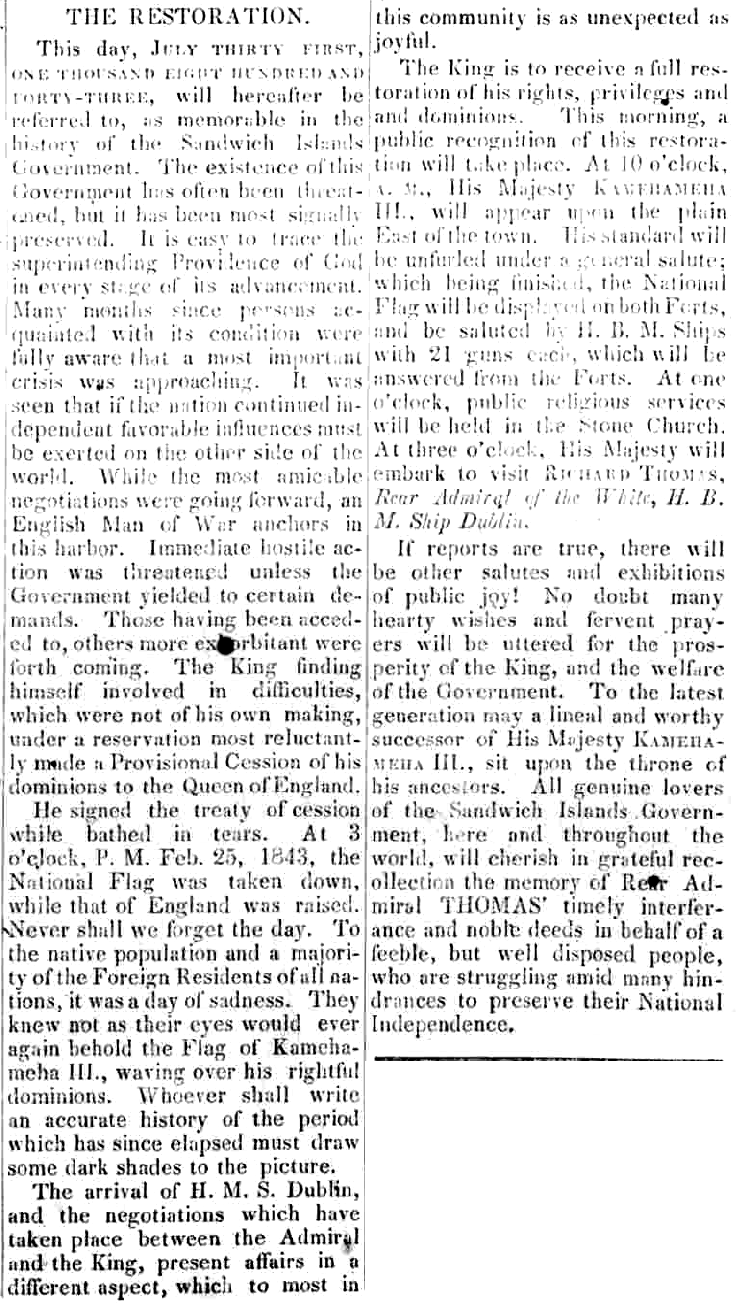
THE RESTORATION.

This day, July thirty first, one thousand eight hundred and forty-three, will hereafter be referred to, as memorable in the history of the Sandwich Islands Government. The existence of the Government has often been threatened, but it has been most signally preserved. It is easy to trace the superintending Providence of God in every stage of its advancement. Many months since persons acquainted with its condition were fully aware that a most important crisis was approaching. It was seen that if the nation continued independent favorable influences must be exerted on the other side of the world. While the most amicable negotiations were going forward, an English Man of War anchors in this harbor. Immediate hostile action was threatened unless the Government yielded to certain demands. Those having been acceded to, others more exhorbitant were forth coming. The King finding himself involved in difficulties, which were not of his own making, under a reservation most reluctantly made a Provisional Cession of his dominions to the Queen of England.

He signed the treaty of cession while bathed in tears. At 3 oʻclock, P. M. Feb. 25, 1843, the National Flag was taken down, while that of England was raised. Never shall we forget the day. To the native population and a majority of the Foreign Residents of all nations, it was a day of sadness. They knew not as their eyes would ever again behold the Flag of Kamehameha III., waving over his rightful dominions. Whoever shall write an accurate history of the period which has since elpased must draw some dark shades to the picture.

The arrival of H. M. S. Dublin, and the negotiations which have taken place between the Admiral and the King, present affairs in a different aspect, which to most in this community is as unexpected as joyful.

The King is to receive a full restoration of his rights, privileges and and dominions. This morning, a public recognition of this restoration will take place. At 10 oʻclock, A. M., His Majesty Kamehameha III., will appear upon the plain East of the town. His standard will be unfurled under a general salute; which being finished, the National Flag will be displayed on both Forts, and be saluted by H. B. M. Ships with 21 guns each, which will be answered from the Forts. At one oʻclock, public religious services will be held in the Stone Church. At three oʻclock, His Majesty will embark to visit Richard Thomas, Rear Admiral of the White, H. B. M. Ship Dublin.

If reports are true, there will be other salutes and exhibitions of public joy! No doubt many hearty wishes and fervent prayers will be uttered for the prosperity of the King, and the welfare of the Government. To the latest generation may a lineal and worthy successor of His Majesty Kamehameha III., sit upon the throne of his ancestors. All genuine lovers of the Sandwich Islands Government, here and throughout the world, will cherish in grateful recollection the memory of Rear Admiral THOMASʻ timely interferance and noble deeds in behalf of a feeble, but well disposed people, who are struggling amid many hindrances to preserve their National Independence.

[This is from a special edition of the Advocate and Friend published on the very day of the restoration. The rest of the coverage can be seen here on the Mission Houses Museum page! Mahalo to Dwight Baldwin (descendant of the Temperance Advocate, and Seamenʻs Friend editor Samuel C. Damon) via Nathan Napoka for reminding me that there are indeed Hawaii newspapers other than Hawaiian-Language Newspapers.]

(Advocate and Friend, 7/31/1843, p. 38)

THE RESTORATION.

Advocate and Friend. (Extra). July 31, 1843, p. 38.

The first Kamehameha Day out in the country, continued, continued, 1872.

At Kailua, Kona.

“Here is what is new here in the land of calm. The day of Kamehameha I was celebrated grandly in Kailua; this is the biggest day I’ve witnessed. The chiefess [probably Keelikolani, governess of Hawaii Island], prepared for the activities of the day as she saw fit. The grounds of Hulihee was filled with old men and women, and the sands were packed with visitors; and this is what was reenacted from the times of Kamehameha I:

The women wore white, with lei of whale ivory [palaoa] around their necks, and bracelets of palaoa on their wrists. There were two torches lit at 12 midnight and taken to where his body lay; and there they stood until daylight, until the procession began over the sands of Niumalu until where his body was placed; there were two torches of Hopili and Makainai who carried them before the procession, and following was the chiefess, and so forth. Makanoanoa gave a speech and after it was over, the procession returned to the lanai, and Makanoanoa spoke again assisted by Hopili. The chiefess was the last to speak.”

[This is the last part of the article describing the celebration of the first Kamehameha Day in Lahaina, Wailuku, and Kailua in Kona.]

The first Kamehameha Day out in the country, continued, 1872.

At Wailuku.

The children of the Hawaiian nation celebrated this day to commemorate the day believed to be the incorrect [? kupaewa] day of birth of the old chief who passed on, the one who joined Hawaii nei together to become one.

Here below are the activities done in celebration on that day. A crowd gathered at the protestant church in Wailuku; people were separated into those who were born during the time of Kamehameha I, who had a separate seating section, and so too of the people of Kamehameha IIʻs time, and all the way until those of Kamehameha Vʻs time; when looking about, a majority of the audience was born in the time of Kamehameha III.

The program was opened with the singing of a hymn to Almighty God; Hymn 33 and Mr. Napue gave a prayer; there was a second Hymn 196, and that came to an close. J. A. Napela [J. H. Napela] served as the Chairman, and spoke about things of Kamehameha Iʻs time and his deeds, his strength, and so forth. This was the first speech, and it was given for the commemoration, appropriately done by one who is well-immersed in the ways of those times.

Speech number two. C. P. Kealakai, teacher of Halehaku; his speech was about the one being commemorated; his main topic which he expounded upon was aloha for God.

Speech number three. D. H. Hakuole, teacher of Kauaula; his speech was about Opukahaia, and not about the remembrance of Kamehameha I.

Speech number four. Kamoku, a student of the theological seminary; this speech was on the mark [pilipono ka la i papaenaena] and did not go astray; it was the first delightful speech for the audience.

Speech number five. A. Keohokalole, audience member from the island of Maui; this was a speech suited for the learned; the items were woven skillfully together, and was fitting to the program.

Speech number six. I donʻt have the name; it was a speech that was not pertinent to the topic; he was made to sit down by the Chairman.

Speech number seven. Mr. Kaleohano; the speech was about electricity, but it was related to the topic. He spoke about these famous words before the audience, because the haole sugar farmers don’t recall the words of the alii, Kamehameha V, who said: “If I had a million dollars in my pocket, I would be able to demolish these sugar mills for their contempt of the royal proclamation.

Speech number eight. P. Kaluna, teacher of Papohaku, it was electric; it was apparent that his speech showed his great thought for the celebration of the day.

Speech number nine. Kawelau, teacher of the district of that famous rain, the Ukiukiu [of Makawao]; I will not say that he wasn’t electric, but it was somewhat like speech number four.

Speech number ten. Nahunahupu; this was a speech not appropriate for the person who was being commemorated that day.

Speech number eleven. D. Mamaki, teacher of Lahaina; this was a fine speech.

After this speech was over, that concluded the activities of the day. Everyone proceeded down to the place of N. Kepoikai, Esq. There, they were supplied with every type of Hawaiian food, along with haole food, all except liquor. This feast was appreciated for its peaceful nature and great pride, well-suited for gentlemen. The majority of those who partook in the food were government school teachers of the from all around Maui.

[This is a continuation of “Day Commemorating Kamehameha I.” There is one more section describing the celebration held at Kailua, Kona, with quite a display of whale ivory! I will try to get that up sometime in the future.]

The beginnings of Fathers’ Day, 1911.

THE DAY FOR FATHERS

Started by Mrs. John B. Dodd of Spokane, Washington, and observed in that city in the year 1910, was the first remembrance for fathers, the right hands of mothers, the ones who strive to look after the well being of their families.

The day for fathers is the third Sunday of June, like the one for mothers which is celebrated on the Second Sunday of May.

There is much criticism about the day for fathers, because there are many fathers who forget their homes on Saturday nights and throw their money at all sorts of worldly entertainments. But this is not true of all fathers; there are fathers who think first of their homes, their wife, and their children, and then after their entertainment; and for those fathers, and all fathers, Aloha for them should be given by the children who are living.

The symbol of remembrance for fathers is a Rose of any color; that is while the father is still living, this should be pinned on the chest, but for the father who has died, a White Rose should be pinned;  just as remembrances are held on the day for mothers, so too should the be for fathers. The theme on fathers’ will be announced at the Churches.

[Let Fathers’ Day be everyday while you can!]

(Aloha Aina, 5/13/1911, p. 1)

KA LA O NA MAKUAKANE.

Ke Aloha Aina, Buke XV, Helu 19, Aoao 1. Mei 13, 1911.

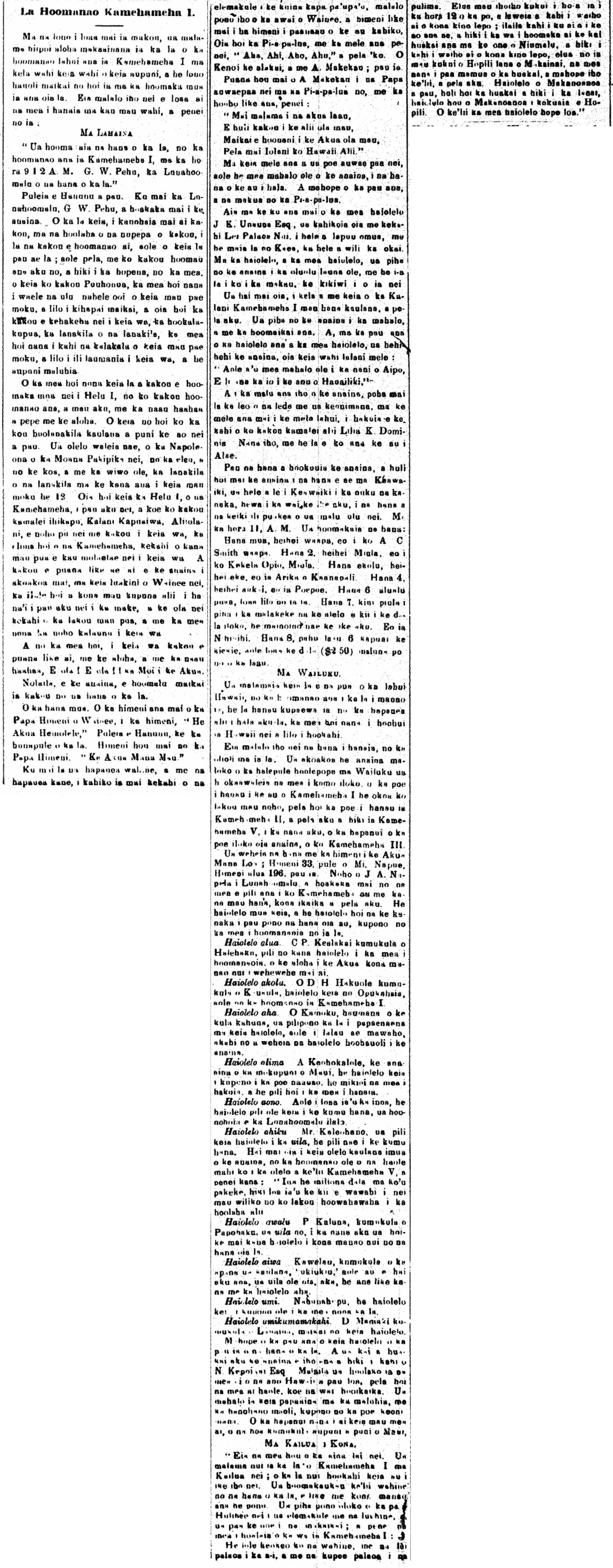
The first Kamehameha Day out in the country, 1872.

Day Commemorating Kamehameha I.

According to the news we received, the day the nation remembers Kamehameha I was preciously observed in different places of the nation, and this is good news for the very beginning of this day. Here below you will find what took place in various places, and here it is:

In Lahaina

“The activities of the day for the commemoration of Kamehameha I began at 9:12 A. M. with G. W. Pehu as the Chairman of the day’s events.”

A prayer was given by Hanunu. Chairman G. W. Pehu stood and explained to the crowd. This is the day that we were told in the announcements in our newspapers that this day is one that we are to commemorate, but not just on this day and that’s it; no, we are to continue this until the end, for he is the pillar of our world, the one who cleared away the thorny wilderness of this archipelago and made it into a fine garden, and it for him which we have pride: the wondrous one, the victor of victors, the one who shorn off the roughness  of these islands and smoothed it out making it a peaceful nation.

The one for whom we are starting off with this very first day, for whom we are celebrating for all times, with humble hearts, modesty, and aloha. He is our famed conqueror across the whole world. He is called the Napoleon of the Pacific Ocean, for his dexterity and his bravery and fearlessness; the victor of victors in battle for these 12 islands. He is the 1st of the Kamehamehas, who has gone, leaving our sacred offspring, King Kapuaiwa, Aliiolani, now living amongst us, the fifth of the Kamehamehas, one of his blossoms now appears clearly before us. And we proclaim together O Crowd gathered here at the church of Wainee, the House made by his royal ancestors who are passed on, while some of their descendants live on, along with the one who occupies the throne today.

For we now say in unison with aloha and humble hearts, May He Live! May the King Live in God!!

Therefore O People, let us keep the activities of the day well under control.

The first event. The singing of the Choir of Wainee, the hymn, “He Akua Hemolele.” There was a prayer by Hanunu, the pastor of the day. The Choir sang once more, “Ke Akua Mana Mau.”

The old ladies stood, along with the old men; some of the old men were right below the pulpit of Wainee, decked out in  layers of pa’upa’u kapa, and sang memorized songs of old. Like the Second Alphabet [Pi-a-pa-lua], sung like this: “Aha, Ahi, Aho, Ahu,” and so forth. Kenoi was the leader along with A. Makekau; this came to an end.

A. Makekau called out once more to this group of oldsters, with the Pi-a-pa-lua, exhorting in this manner:

“Don’t care after wooden idols,
Let us turn to the ever-living ruler,
It is good to glorify the ever-living God,
This, according to Iolani, the King of Hawaii.”

With this singing of the old ones, there was not a single one there who did not feel gratitude for the work done in times past. And after this was done, the makua then sang the Pi-a-pa-lua.

When the speaker, J. K. Unauna, stood, he was wearing a Large Whale Ivory Lei [Palaoa], which curved at the front like a banana of Kaea whose blossom containers [okai] are twisted. By the speech, of the speaker, the audience was immensely pleased, like a fish caught on the hook, weaving this way and that.

He spoke of the different famous feats of the Chief Kamehameha I. The audience was filled with thanks and appreciation. And, at the end of the speech of the speaker, the audience stomped their feet, like these lines of mele:

“I have nothing but praise for the beauty of Aipo,
Shuddering at the cold of Hauailiki”

[“Aole a’u mea mahalo ole i ka nani o Aipo,
E li ana ka io i ke anu o Hauailiki.”]

And when the audience calmed down, the voices of the men and women burst forth, singing the national anthem [mele lahui] composed by one of our chiefly children, Lilia K. Dominis. To witness this, it was as if the current was drawing to Alae [e ko ana ke au i Alae].

The program was over, and the audience was released, and the went to the other festivities at Keawaiki, which was teeming with people; there were so many people seen at the activities of the white ones of Lahaina nei. At the hour of 11 A. M., the games began:

First event, boat race, won by the boat of A. C. Smith. Event 2, Mule race, won by Castle Jr.’s mule. Event three, sack race, won by Arika of Kaanapali. Event 4, swimming race, won by Poepoe. Event 6, pig chase [alualu puaa], which was won by him. Event 7, tin can filled with molasses and you try to get the dollar inside using your tongue; it was miserable to watch. Won by [?Nahioihi]. Event 8, a wooden pole of 6 feet tall; the money ($2.50) atop the pole was not gotten.

[This article continues with scenes from Wailuku and Kailua, Kona. Look for the continuation at a later date. The image online is very hard to read. I can’t wait for the day when all the newspapers are rescanned clearly!]

(Au Okoa, 6/20/1872, p. 3)
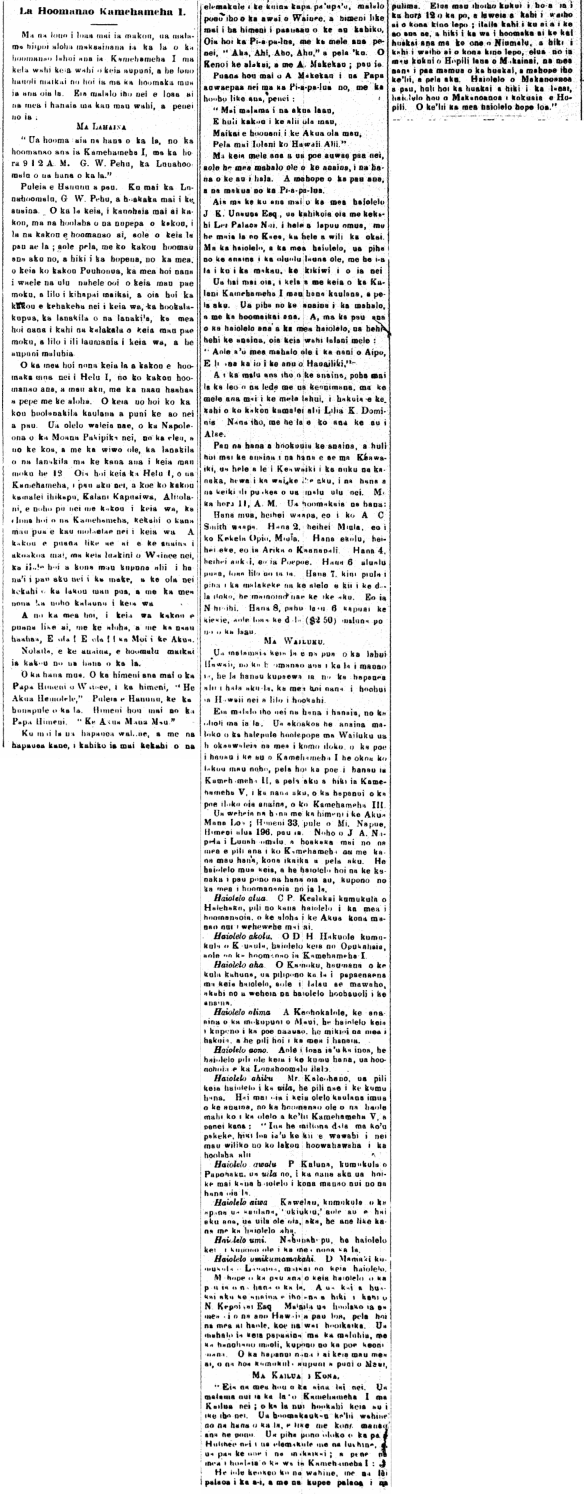
La Hoomanao Kamehameha I.

Ke Au Okoa, Buke VIII, Helu 10, Aoao 3. Iune 20, 1872.

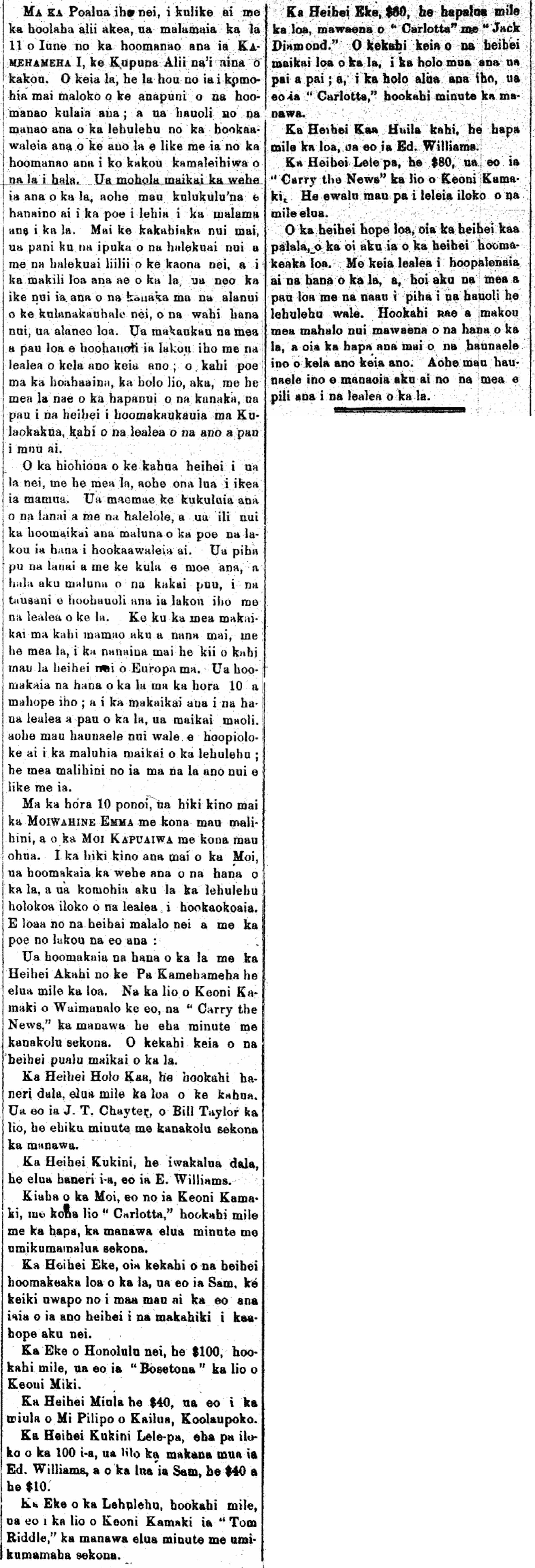
The First Kamehameha Day, 1872.

This past Tuesday, as per the Royal Proclamation, the 11th of June was observed as the day to commemorate Kamehameha I, our Royal Ancestor who conquered the land. This is a new day included in the realm of holidays; and the people were joyous at the designating of a day like this for the remembering of our precious beloved one of days gone by. The day opened beautifully, without any drops to bother the people who were well adept to celebrate the day. From early morning, the doors of the large and small shops of town were closed shut, and when the sun came out, nonexistent the sight of many people on the streets of this town, and the places of work were deserted. Everyone was ready to entertain themselves with pleasures of all sorts; some people with feasts or horse riding, but it seemed as if most of the people were at the races set up at Kulaokahua, where enjoyments of all sorts took place [? i muu ai].

The sight of the race track on that day, was as if like no other before. The lanai and tents were nicely built, and congratulations go to those responsible for that distinguished job. The lanai and grounds were filled all the way atop the hills with thousands enjoying themselves with the festivities of the day. Should a visitor stand far away and look forth, it was as if it was a scene from great racing days in Europe. The events of the day began at 10 o’clock or thereafter; and to take in all of the many fun activities of the day was great; there were no big uproars to disturb the peace; that is something unusual for big days like this.

At 10 o’clock sharp, Queen Emma made an appearance with her guests, and King Kapuaiwa with his suite. At the arrival of the King, the activities of the day were opened, and all the people joined in the festivities set aside. There are the races below as well as those who won.

The activities of the day began with the First Race for the Kamehameha Plate, which was two miles long. John A. Cummins [Keoni Kamaki] of Waimanalo won, with “Carry the News,” with a time of four minutes and thirty seconds. This was one of the fine open races [heihei pualu] of the day.

Trotting Race [Heihei Holo Kaa], for one hundred dollars, two mile long course. J. T. Chayter won with the horse Bill Taylor, with a time of seven minutes and thirty seconds.

Foot Race [Heihei Kukini], for twenty dollars, two hundred yards, won by E. Williams [Edward Williams].

King’s Cup, won by John A. Cummins [Keoni Kamaki], with his horse, “Carlotta,” one mile and  a half, with a time of two minutes and twelve seconds.

Sack Race [Heihei Eke], was one of the most humorous races of the day, won by Sam, the harbor boy who is used to winning that type of race in past years.

Honolulu Purse [Eke Honolulu nei], of $100, one mile, won by “Bosetona,” the horse of Keoni Miki [John Meek].

Mule Race [Heihei Miula], $40, won by the mule of Mr. Pilipo of Kailua, Koolaupoko.

Foot Hurdle Race [Heihei Kukini Lele-pa], four hurdles in a hundred yards; the first place went to Ed. Williams, and the second to Sam; $40 and $10.

Public Purse [Eke o ka Lehulehu], one mile, the horse of John A. Cummins [Keoni Kamaki], “Tom Riddle,” won, with a time of two minutes and fourteen seconds.

$60 Purse [Heihei Eke $60], half a mile long, between “Carlotta” and “Jack Diamond.” This was one of the best races of the day, in the first running, they were head to head; but on the second race, “Carlotta” won with a time of one minute.

Velocipede Race [Heihei Kaa Huila kahi], half a mile long, won by Edward Williams.

Hurdle Race [Heihei Lele pa], for $80, won by “Carry the News,” the horse of John A. Cummins [Keoni Kamaki]. Eight hurdles were jumped over in two miles.

The final race was the wheelbarrow race [heihei kaa palala], which was the most comical. With this race, the activities of the day came to a close, and everyone went home with hearts filled with much joy. There is one thing amongst all the activities which we appreciate greatly, that is the fraction of various sorts of commotions. There were no disturbances believed to have resulted from the gaiety of the day.

[This is quite a different type of celebration compared to today. Whatever you may have planned for today, let there be remembering of the one who unified the islands, Kamehameha Paiea.]

(Au Okoa, 6/13/1872, p. 2)

Ma ka Poalua iho nei...

Ke Au Okoa, Buke VIII, Helu 9, Aoao 2. Iune 13, 1872.

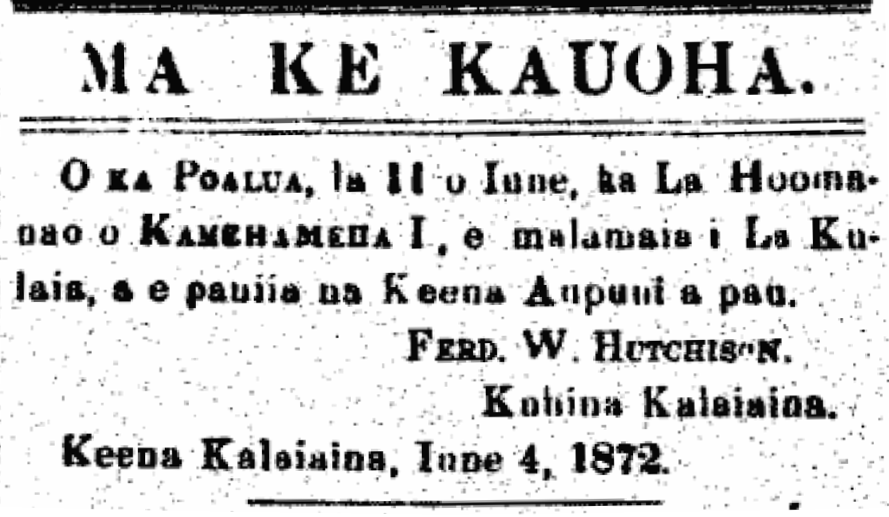
Announcing the first Kamehameha Day, 1872.

BY AUTHORITY.

Tuesday, the 11th of June, the Day of Commemoration of Kamehameha I, will be observed as a Holiday, and all Government Offices will be closed.

Ferd. W. Hutchison.

Minister of the Interior [Kuhina Kalaiaina].

Office of the Interior [Keena Kalaiaina], June 4, 1872.

(Au Okoa, 6/6/1872, p. 2)

MA KE KAUOHA.

Ke Au Okoa, Buke VIII, Helu 8, Aoao 2. Iune 6, 1872.