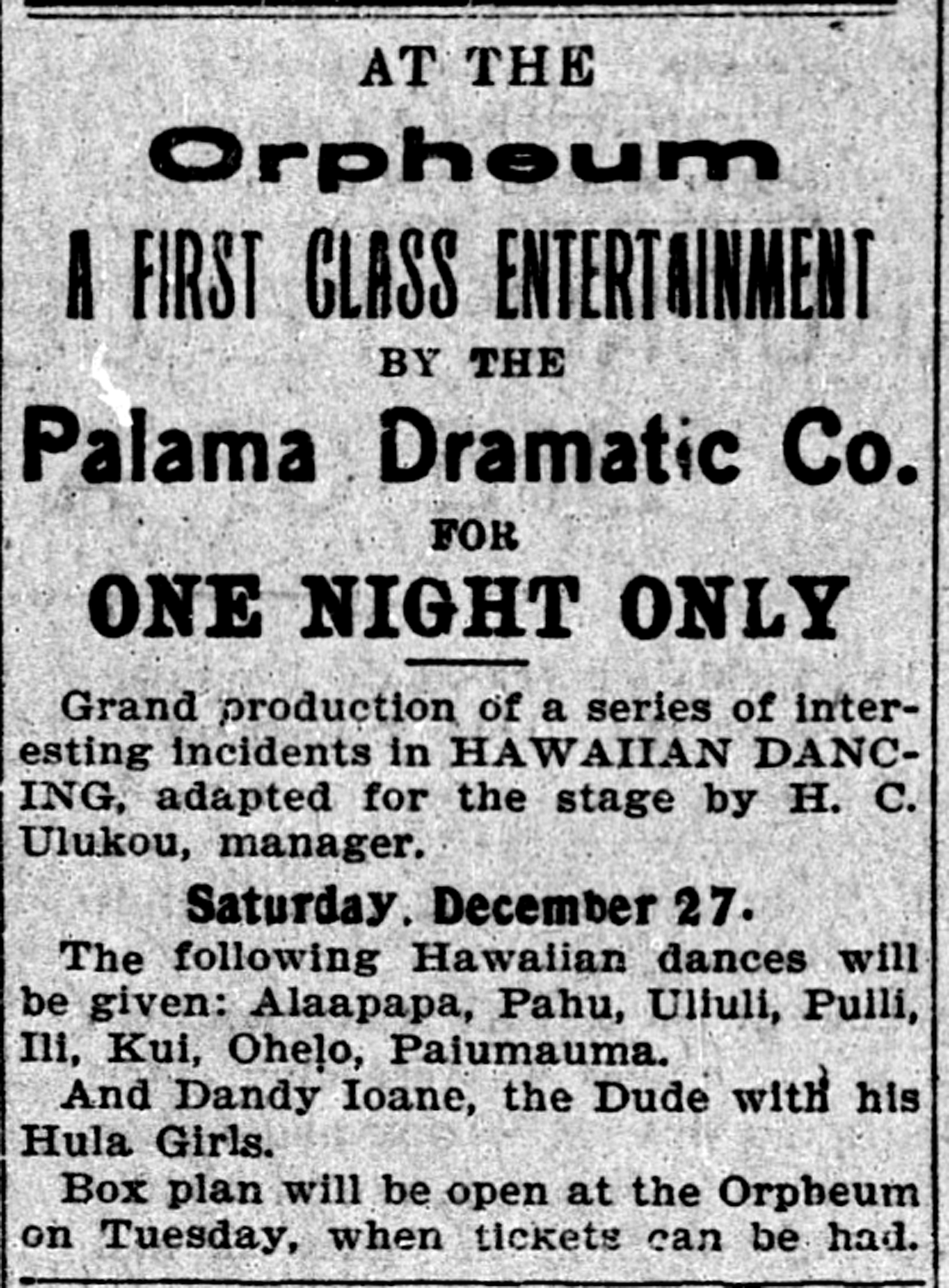
Ioane Ukeke at the Orpheum, 1902.

AT THE

Orpheum

A FIRST CLASS ENTERTAINMENT

BY THE

Palama Dramatic Co.

FOR

ONE NIGHT ONLY

Grand production of a series of interesting incidents in HAWAIIAN DANCING, adapted for the stage by H. C. Ulukou, manager.

Saturday, December 27.

The following Hawaiian dances will be given: Alaapapa, Pahu, Uliuli, Puili, Ili, Kui, Ohelo, Paiumauma.

And Dandy Ioane, the Dude with his Hula Girls.

Box plan will be open at the Orpheum on Tuesday, when tickets can be had.

[That Orpheum seems like it was the place to be back then!]

(Pacific Commercial Advertiser, 12/24/1902, p. 10)

AT THE Orpheum

The Pacific Commercial Advertiser, Volume XXXV, Number 6359, Page 10. December 24, 1902.

Traditional hula and play about the alii of old, 1902.

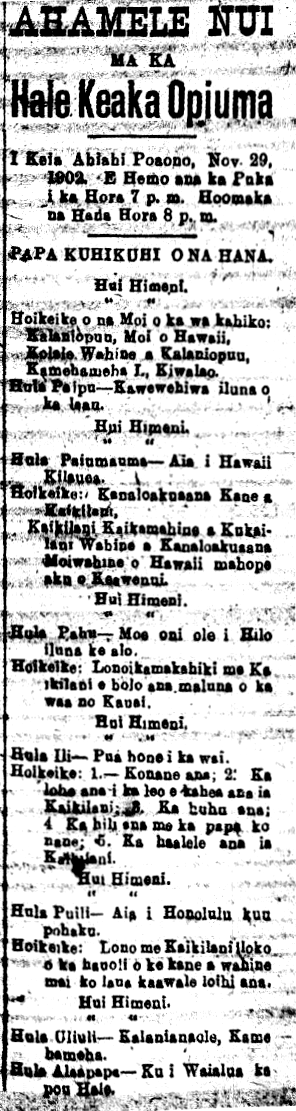
GREAT CONCERT

AT THE

Orpheum Theater

This Saturday Evening, Nov. 29, 1902. The Doors will Open at 7 p. m. The Activities to begin at 8 p. m.

PROGRAM OF EVENTS.

Singing Group.

 ” “

Show about the Kings of the olden days:

Kalaniopuu, King of Hawaii,

Kolale, Wife of Kalaniopuu,

Kamehameha I., Kiwalao.

Hula Paipu—Kawewehiwa iluna o ka laau.

Singing Group.

 ” “

Hula Paiumauma—Aia i Hawaii Kilauea

Show: Kanaloakuaana, Husband of Kaikilani.

Kaikilani, Daughter of Kukailani, Wife of Kanaloakuaana, Queen of Hawaii after Keawenui.

Singing Group.

 ” “

Hula Pahu—Moe oni ole i Hilo iluna ke alo.

Show: Lonoikamakahiki and Kaikilani travel aboard a canoe to Kauai.

Singing Group.

 ” “

Hula Ili—Pua hone i ka wai.

Show: 1.—Playing Konane; 2. Hearing the voice calling to Kaikilani; 3. The anger; 4. The beating with the konane board; 5. Leaving Kaikilani.

Singing Group.

 ” “

Hula Puili—Aia i Honolulu kuu pohaku.

Show: Lono and Kaikilani sharing the happiness between a man and a woman after a long separation.

Singing Group.

 ” “

Hula Uliuli—Kalanianaole, Kamehameha

Hula Alaapapa—Ku i Waialua ka pou Hale.

[Now this surely must have been something to see!]

(Aloha Aina, 11/29/1902, p. 8)

AHAMELE NUI

Ke Aloha Aina, Buke VIII, Helu 48, Aoao 8. Novemaba 29, 1902.


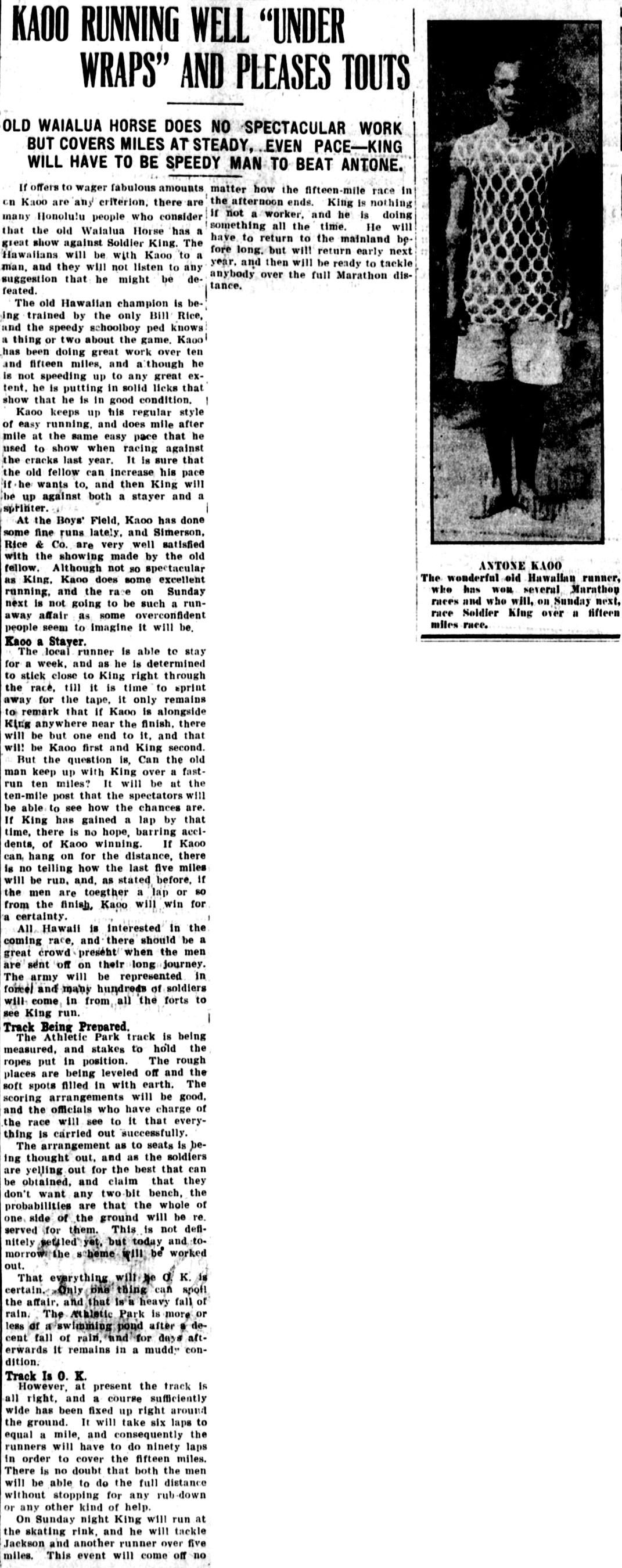
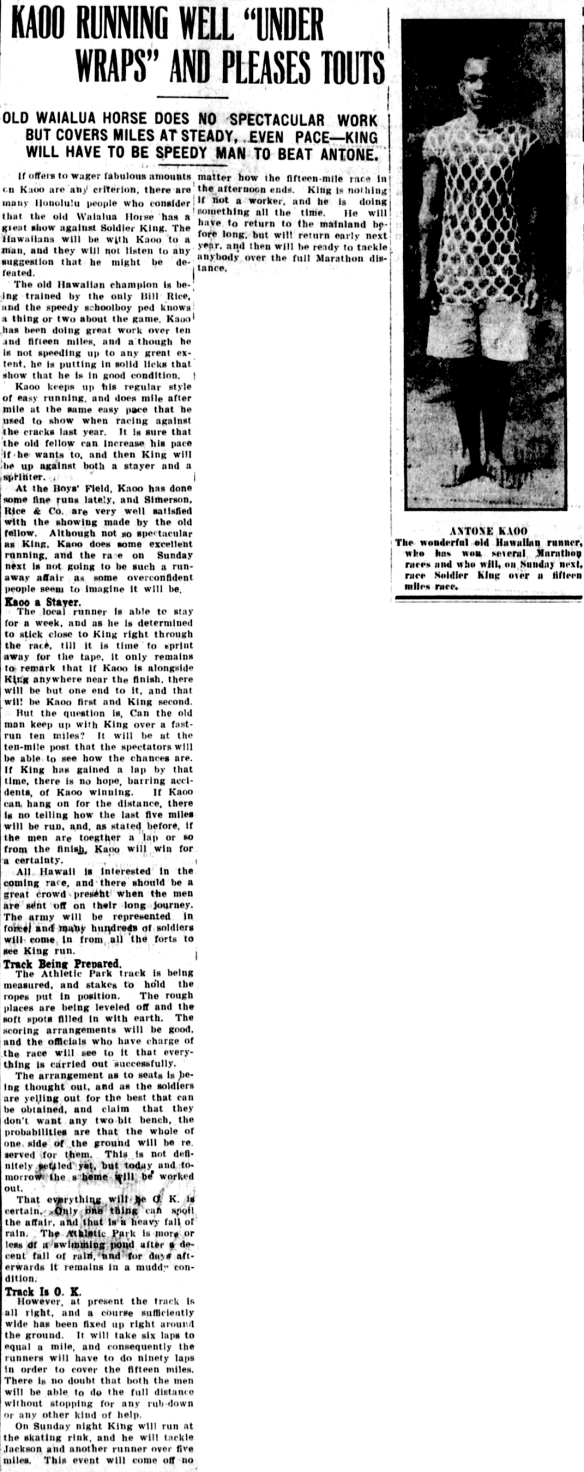
Antone Kaoo, the hula teacher and kukini, 1910.

KAOO RUNNING WELL “UNDER WRAPS” AND PLEASES TOUTS

OLD WAIALUA HORSE DOES NO SPECTACULAR WORK BUT COVERS MILES AT STEADY, EVEN PACE—KING WILL HAVE TO BE SPEEDY MAN TO BEAT ANTONE.

If offers to wager fabulous amounts on Kaoo are any criterion, there are many Honolulu people who consider that the old Waialua Horse has a great show against Soldier King. The Hawaiians will be with Kaoo to a man, and they will not listen to any suggestion that he might be defeated.

The old Hawaiian champion is being trained by the only Bill Rice, and the speedy schoolboy ped knows a thing or two about the game. Kaoo has been doing a great work over ten and fifteen miles, and although he is not speeding up to any great extent, he is putting in solid licks that show that he is in good condition.

Kaoo keeps up his regular style of easy running, and does mile after mile at the same easy pace that he used to show when racing against the cracks last year. It is sure that the old fellow can increase his pace if he wants to, and then King will be up against both a stayer and a sprinter.

At the Boys’ Field, Kaoo has done some fine runs lately, and Simerson, Rice & Co. are very well satisfied with the showing made by the old fellow. Although not so spectacular as King, Kaoo does some excellent running, and the race on Sunday next is not going to be such a runaway affair as some overconfident people seem to imagine it will be.

Kaoo a Stayer.

The local runner is able to stay for a week, and as he is determined to stick close to King right through the race, till it is time to sprint away for the tape, it only remains to remark that if Kaoo is alongside King anywhere near the finish, there will be but one end to it, and that will be Kaoo first and King second.

But the question is, Can the old man keep up with King over a fast-run ten miles? It will be at the ten-mile post that the spectators will be able to see how the chances are. If King has gained a lap by that time, there is no hope, barring accidents, of Kaoo winning. If Kaoo can hang on for the distance, there is no telling how the last five miles will be run, and, as stated before, if the men are together a lap or so from the finish, Kaoo will win for a certainty.

All Hawaii is interested in the coming race, and there should be a great crowd present when the men are sent off on their long journey. The army will be represented in force and many hundreds of soldiers will come in from all the forts to see King run.

Track Being Prepared.

The Athletic Park track is being measured, and stakes to hold the ropes put in position. The rough places are being leveled off and the soft spots filled in with earth. The scoring arrangements will be good, and the officials who have charge of the race will see to it that everything is carried out successfully.

The arrangement as to seats is being thought out, and as the soldiers are yelling out for the best that can be obtained, and claim that they don’t want any two-bit bench, the probabilities are that the whole of one side of the ground will be reserved for them. This is not definitely settled yet, but today and tomorrow the scheme will be worked out.

That everything will be O. K. is certain. Only one thing can spoil the affair, and that is a heavy fall of rain. The Athletic Park is more or less a swimming pond after a decent fall of rain, and for days afterwards it remains in a muddy condition.

Track is O. K.

However, at present the track is all right, and a course sufficiently wide has been fixed up right around the ground. It will take six laps to equal a mile, and consequently the runners will have to do ninety laps in order to cover the fifteen miles. There is no doubt that both the men will be able to do the full distance without stopping for any rub-down or any other kind of help.

On Sunday night King will run at the skating ring, and he will tackle Jackson and another runner over five miles. This event will come off no matter how the fifteen-mile race in the afternoon ends. King is nothing if not a worker, and he is doing something all the time. He will have to return to the mainland before long, but will return early next year, and then will be ready to tackle anybody over the full Marathon distance.

ANTONE KAOO

The wonderful old Hawaiian runner, who has won several Marathon races and who will, on Sunday next, race Soldier King over a fifteen miles race.

(Hawaiian Gazette, 10/27/1910, p. 10)
KAOO RUNNING WELL "UNDER WRAPS" AND PLEASES TOUTS

Evening Bulletin, Number 4760, Page 10. October 27, 1910.
 

Hula for Mayor Joseph Fern by Mary Robins, 1919.

HULA NO KA MEIA FERN.

Kaulana mai nei o Joe Fern,
O ka Meia hoi o Hawaii nei.
A nau no i nawelo aku,
Ikeia Hawaii he aina nani.
Pane mai e ka leo mailuna mai,
E lanakila ka inoa o Joe Fern.
Hiiia i ka poli hoi la o Pele,
O ka lau la-i kou kapa ia.
He mamo oe mai na kupuna mai,
He inoa kiekie kau i ka hano,
Hanohano e ke kama kau mai iluna.
O puu daimana i ko umauma.
E ku Hawaii me Kaleponi,
Haku oe i ko lei alawa pono.
Hae ana na manu o ke kupulau,
Na moho Meia waiwai ole,
O ka Lei Daimana kau umauma,
A i hoa kuka me Kaleponi.
Hooheno ke aloha me Pelekane,
A welo e ka hae o Hawaii nei.
Imua kaua a lanakila,
O ke Akua mana loa kou kokua.
Hea aku no au o mai oe,
O Joe Fern kou inoa.

Composed by MRS. MARY ROBINS,

Girl of the lighthouse.

[This is a political mele written for Joseph Fern, who was running for mayor of Honolulu. Mary Robins is referred to as the girl of the lighthouse because she is the wife Edward E. Robins, the keeper of Honolulu Harbor lighthouse.]

(Kuokoa, 6/6/1919, p. 3)

HULA NO KA MEIA FERN.

Ka Nupepa Kuokoa, Buke LVII, Helu 23, Aoao 3. Iune 6, 1919.

Hula for William Heen by Mary Robins, 1919.

HE HULA NO WILLIAM HEEN.

Kaulana mai nei o William Heen,
O ka loio hoi o ke Kalana,
Na ka nupepa i hai ae,
Loio Kaulana imi mea hou,
Nau no i nowelo aku,
Ahuwale Honolulu he aina nani,
He kulanakauhale ua ike ia,
Ki-pe dala o ke aupuni,
Uluhua i ke kani mai a ke Ao,
Ka moho loio waiwai ole,
E hui Hawaii me Kaleponi,
Haku ae i ko lei a lawa pono,
Moani ke ala o ka Miulana,
Pili paa o ka hana me oe ia.
O ka pine kaimana i ko umauma,
E hulali nei a mau loa aku,
Imua kaua a lanakila,
O ke Akua mana loa kou kokua,
Hea aku no au o mai oe,
O William Heen kou inoa.

Composed by MRS. MARY ROBINS,

Honolulu Harbor Lighthouse.

[Mary Robins is perhaps most well known for songs like “Royal Hawaiian Hotel,” “Lanai,” and “Honolulu Harbor.” This is a political song written for William Heen, running for City and County Attorney. Political mele like these were not uncommon during those days.]

(Kuokoa, 6/6/1919, p. 3)

HE HULA NO WILLIAM HEEN.

Ka Nupepa Kuokoa, Buke LVII, Helu 23, Aoao 3. Iune 6, 1919.

The performance of famous story of Hiiakaikapoliopele, 1880.

HAWAIIAN THEATER!

—AT THE—

TEMPERANCE HALL

—TONIGHT—

SATURDAY, JULY 31, 1880.

Shown will be the Famous Story of

HIIAKAIKAPOLIOPELE

and Lohiau on this night, like this below:

PROGRAM.

Hula Muumuu, Mokoi, Kilu, Pahu, Ka-laau, Pili, Alaapapa, Keawenuiaumi, Himeni, Uliuli and Hula Kii.

The doors will open at 7 o’clock, and begins at 8 o’clock sharp.

ENTRANCE FEE.

Front seats .. .. $1.50

Back seats .. .. $1.00

(Kuokoa, 7/31/1880, p. 2)

KEAKA HAWAII!

Ka Nupepa Kuokoa, Buke XIX, Helu 31, Aoao 2. Iulai 31, 1880.

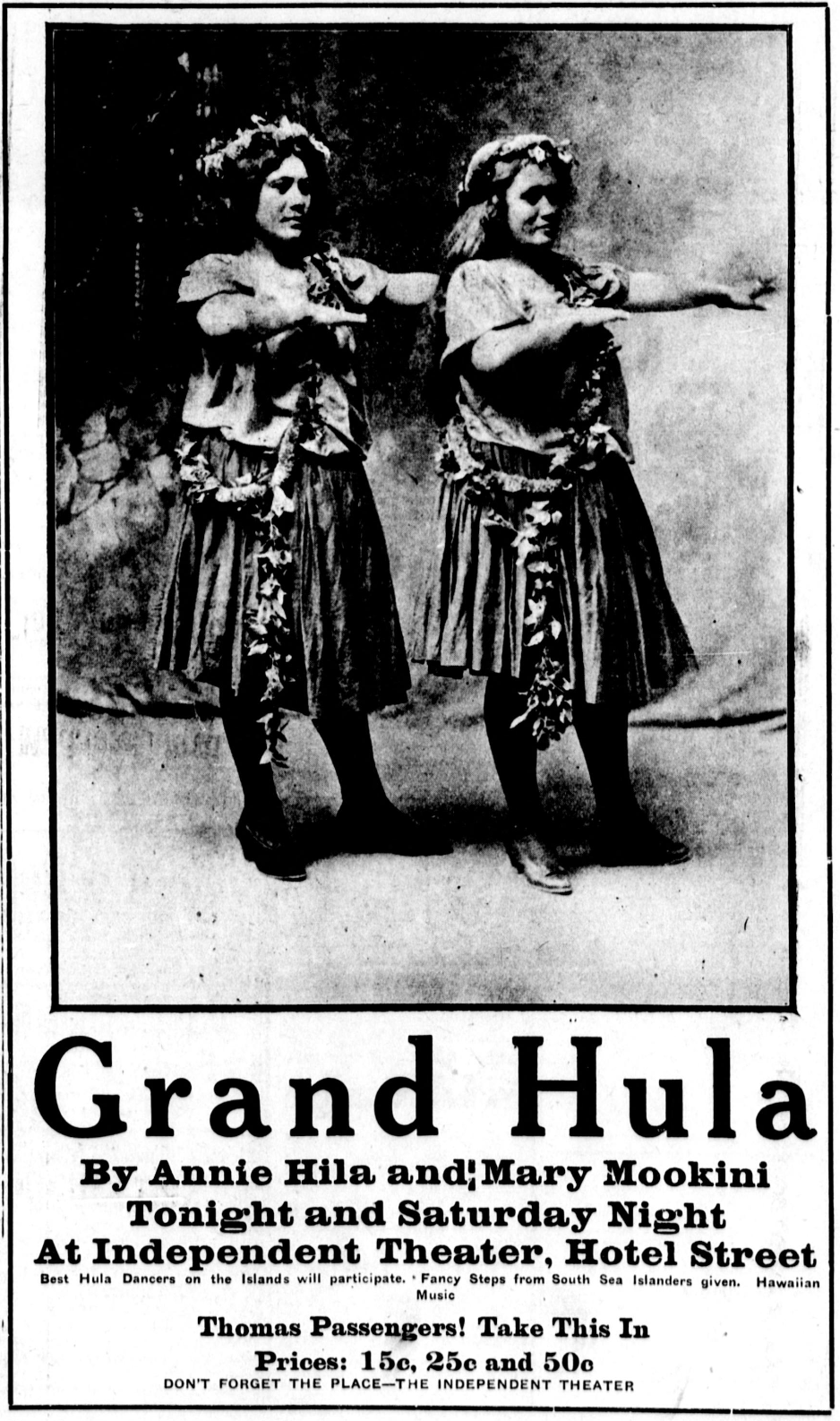
Hula performance, 1911.

Grand Hula

By Annie Hila and Mary Mookini

Tonight and Saturday Night

At Independent Theater, Hotel Street

Best Hula Dancers on the Islands will participate. Fancy Steps from South Se Islanders given. Hawaiian Music

Thomas Passengers! Take This In

Prices: 15c, 25c and 50c

DON’T FORGET THE PLACE—THE INDEPENDENT THEATER

(Evening Bulletin, 11/14/1911, p. 6)

Grand Hula

Evening Bulletin, Established 1882, Number 5083, Page 6. November 14, 1911.

Hula and the play “Umi-a-Liloa,” 1917.

TRULY HAWAIIAN IS ‘UMI-A-LILOA’

The hula alaapapa will be one of the special entre act features of the performance of “Umi-a-Liloa” at the opera house next Thursday evening. This hula is danced standing in contradiction to the older hulas which is called for a sitting position. It will be interpreted by a band of four young girls, who are experts in the art of the real Hawaiian dance. They are assisted by a man who beats the hula drum in old-time style. It is only in recent years that the hula has been accompanied by the music of instruments.

The second act contains an elaborate representation of the court of the king of Hawaii in the year 1640 and during the scene of the royal festivity some of the very ancient dances are introduced. They are danced, if one may call it so, sitting cross-legged upon the floor and the beauty of the performance lies in the grace and graphic intensity of the gestures of the body and arms of the dancers. Continue reading

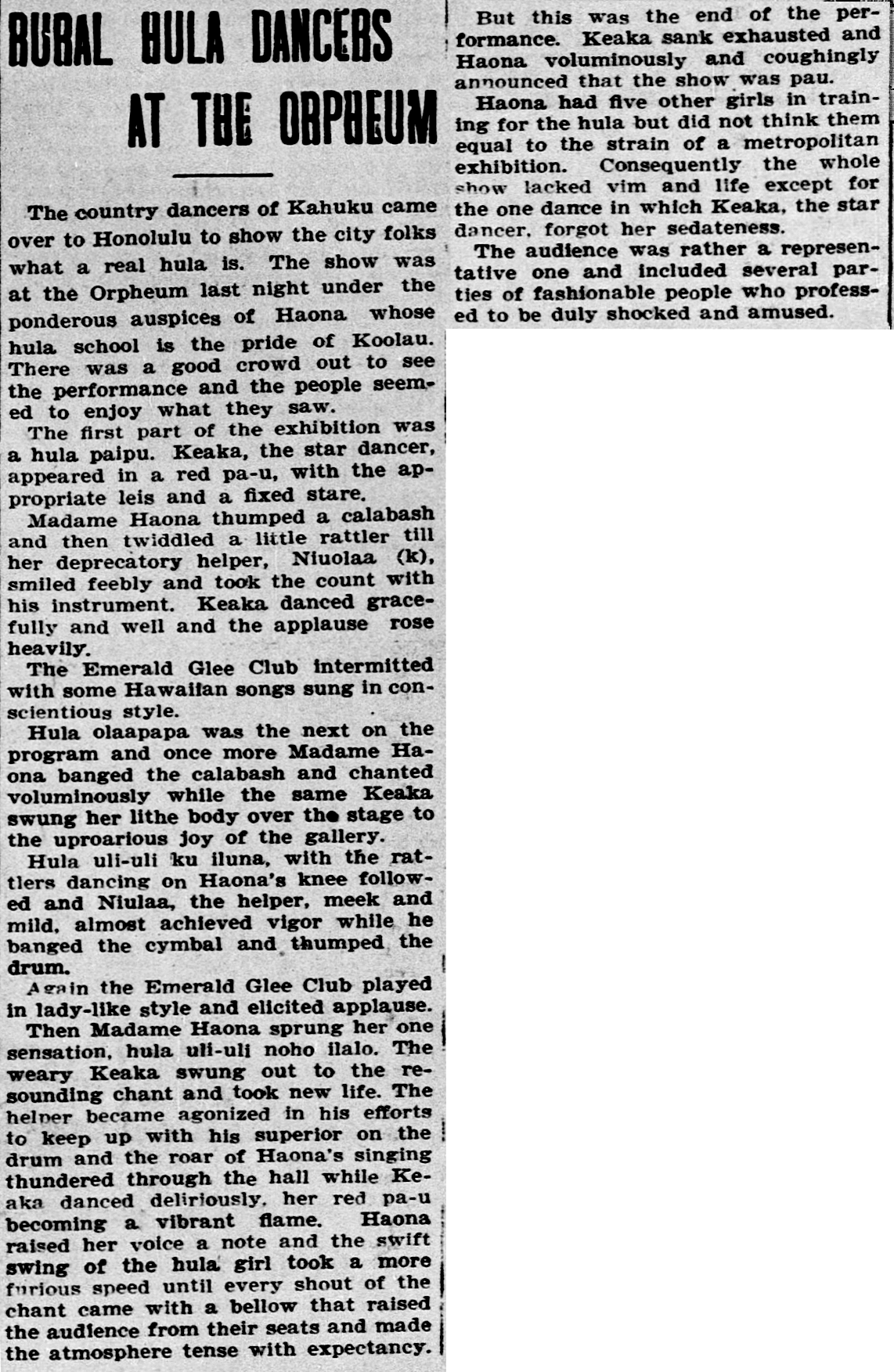
Hula from Kahuku at the Orpheum, 1905.

RURAL HULA DANCERS AT THE ORPHEUM

The country dancers of Kahuku came over to Honolulu to show the city folks what a real hula is. The show was at the Orpheum last night under the ponderous auspices of Haona whose hula school is the pride of Koolau. There was a good crowd out to see the performance and the people seemed to enjoy what they saw.

The first part of the exhibition was a hula paipu. Keaka, the star dancer, appeared in a red pa-u, with the appropriate leis and a fixed stare.

Madame Haona thumped a calabash and then twiddled a little rattler till her deprecatory helper, Niuolaa (k), smiled feebly and took the count with his instrument. Keaka danced gracefully and well and the applause rose heavily.

The Emerald Glee Club intermitted with some Hawaiian songs sung in conscientious style.

Hula olaapapa was the next on the program and once more Madame Haona banged the calabash and chanted voluminously while the same Keaka swung her lithe body over the stage to the uproarious joy of the gallery.

Hula uli-uli ku iluna, with the rattlers dancing on Haona’s knee followed and Niulaa, the helper, meek and mild, almost achieved vigor while he banged the cymbal and thumbed the drum.

Again the Emerald Glee Club played in lady-like style and elicited applause.

Then Madame Haona sprung her one sensation, hula uli-uli noho ilalo. The weary Keaka swung out to the resounding chant and took new life. The helper became agonized in his efforts to keep up with his superior on the drum and the roar of Haona’s singing thundered through the hall while Keaka danced deliriously, her red pa-u becoming a vibrant flame. Haona raised her voice a note and the swift swing of the hula girl took a more furious speed until every shout of the chant came with a bellow that raised the audience from their seats and made the atmosphere tense with expectancy.

But this was the end of the performance. Keaka sank exhausted and Haona voluminously and coughingly announced that the show was pau.

Haona had five other girls in training for the hula but did not think them equal to the strain of a metropolitan exhibition. Consequently the whole show lacked vim and life except for the one dance in which Keaka, the star dancer, forgot her sedateness.

The audience was rather a representative one and included several parties of fashionable people who professed to be duly shocked and amused.

(Pacific Commercial Advertiser, 10/15/1905, p. 1)

RURAL HULA DANCERS AT THE ORPHEUM

The Pacific Commercial Advertiser, Volume III, Number 146, Page 1. October 15, 1905.