Sheet music to “Sweet Sweeting” now available, 1908.

[Found under: “LOCAL NEWS”]

The song that is printed with the name Sweet Sweeting, the musical notes are available at the musical instrument store Bergstrom. That very nice mele was composed by native Hawaiian youths.

[A little shout out to Kamehameha Song Contest… There are so many priceless mele carefully stored away in the Hawaiian-Language Newspapers. It is time for us to look back; ua wela ka hao!]

(Kuokoa, 9/18/1908, p. 5)

O ka himeni e puka aku nei...

Ka Nupepa Kuokoa, Buke XLIII, Helu 38, Aoao 5. Sepatemaba 18, 1908.

Nice follow up on Louis [Lui] Thompson Keouli.

In response to an earlier post “More Hawaiians playing music afar, 1908,” from March 1, 2012.

https://nupepa-hawaii.com/2012/03/01/more-hawaiians-playing-music-afar-1908/#comment-2266

Keith James says:

I wrote a Wikipedia article on Lu Thompson Keouli (aka as Louis Keouli Thompson), who was my great-grandfather. He graduated from Kamehameha, class of 1900. (http://en.wikipedia.org/wiki/Louis_Keouli_Thompson)

Hawaiian Music and Musicians, Revised and Updated, 2013.

If you are free at 12:00 noon tomorrow, the Center for Biographical Research’s Brown Bag tomorrow is on the updated classic, “Hawaiian Music and Musicians”!

“Hawaiian Music and Musicians, Revised and Updated.”
by John Berger, Author and Editor
Thursday, March 14th
12 noon to 1:15 pm
Kuykendall 410

For more information, please contact biograph@hawaii.edu, 956-3774, or www.facebook.com/CBRHawaii

George S. Kanahele published his monumental Hawaiian Music and Musicians: An Illustrated History in 1979. Compiled with the assistance of a hundred contributors and the research of many more, it was immediately recognized as the most ambitious book ever written about Hawaiian music.

The book is arranged alphabetically, with entries on Hawaiian music from its roots in ancient chants to the flowering of the musical renaissance in Hawai’i. It describes leading personalities and groups, organizations, songs and publications, and discusses the extraordinary popularity of Hawaiian music round the world. There are biographies of musicians from every period of Hawaiian musical history—from Henry Berger, David Kālakaua, Queen Lili‘uokalani, and others of their time, to the great names of the 20th century.

In 2000 Dr. Kanahele asked veteran music critic John Berger to work with him on a second edition; Dr. Kanahele passed away a few months later. It took John Berger another dozen years to complete this Revised and Updated Hawaiian Music and Musicians: An Encyclopedic History (Mutual Publishing, 2012). The book is now more than doubled in length, with almost every entry revised and updated, and with almost 100 new entries. In this talk, John Berger will be discussing the process of revising and editing this immense musical history.

Speaker Bio:

John Berger has covered entertainment in Honolulu for 40 years. He has been writing about music, theatre and social events of all kinds for the Honolulu Star-Advertiser (formerly the Honolulu Star-Bulletin) since 1988.

[From University of Hawaii’s Center for Biographical Research Facebook page: https://www.facebook.com/events/423747624386459/ ]

More on Jane Loeau, 1867.

[Found under: “LOCAL NEWS: Hawaii.”]

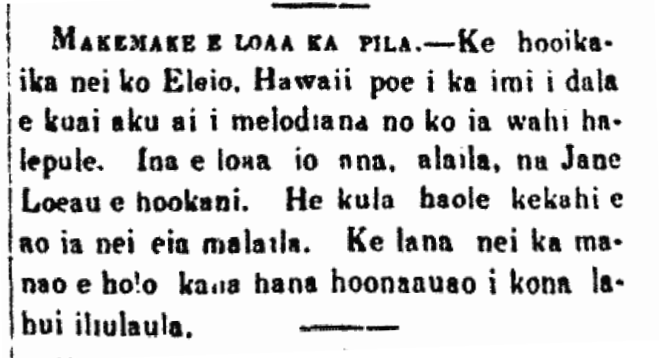
Instrument is sought after.—Eleio, Hawaii is putting effort into raising money to purchase a melodeon [melodiana] for its church house. If they should obtain one, then it will be Jane Loeau who will play it. An English school is also being taught by her there. It is hoped that her education effort for her dark-skinned [iliulaula] race will progress

(Kuokoa, 1/12/1867, p. 2)

Makemake e loaa ka pila.

Ka Nupepa Kuokoa, Buke VI, Helu 2, Aoao 2. Ianuari 12, 1867.

Hawaiian music and ukulele in Japan, 1933.

Returning Once Again to Hawaii Nei

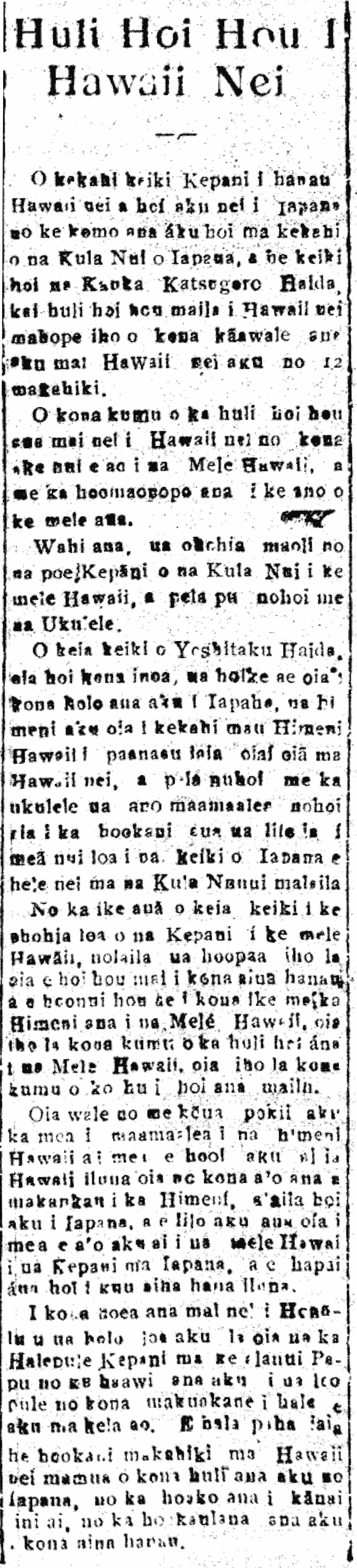
A Japanese boy born here in Hawaii and who went back to Japan to enter into a College in Japan, and who is a child of Dr. Katsugoro Haida, came back to Hawaii after being away from Hawaii for 12 years.

The reason for his return to Hawaii was because of his desire to learn Hawaiian Mele and to learn how to sing them.

According to him, the Japanese of the Universities are enthralled by Hawaiian songs, and so too of the Ukulele.

That boy, Yoshitaku Haida [Yoshikatsu Haida, aka Haruhiko Haida, aka Yukihiko Haida] is his name, said that when he went to Japan, he sang some Hawaiian Songs that he had memorized while in Hawaii nei; so also with the ukulele, he was quite skillful in playing it; and it became something big with the Japanese youth going to that University [Keio University].

Because this boy saw the great interest the Japanese had for Hawaiian music, he decided to return to the land of his birth and increase his knowledge in Singing Hawaiian Music, and that was the reason for his coming back.

It is just he and his younger brother [Katsuhiko Haida] who are skilled at Hawaiian songs, to raise up Hawaii, and that is why he is learning Singing until he is proficient, at which point he will return to Japan where he will become a teacher of Hawaiian mele to the Japanese in Japan, and raise up the land of my [his] birth.

Upon arriving in Honolulu, he went to the Japanese Church on Fort Street to say a prayer for his father who has passed to the other world. He may be here in Hawaii for perhaps a year before turning back for Japan, to fulfill his desire to bring fame to his birth land.

(Hoku o Hawaii, 2/14/1933, p. 3)

Huli Hoi Hou I Hawaii Nei

Ka Hoku o Hawaii, Buke XXVI, Helu 37, Aoao 3. Feberuari 14, 1933.

Another cool picture from Hawaii’s musical past. 1923.

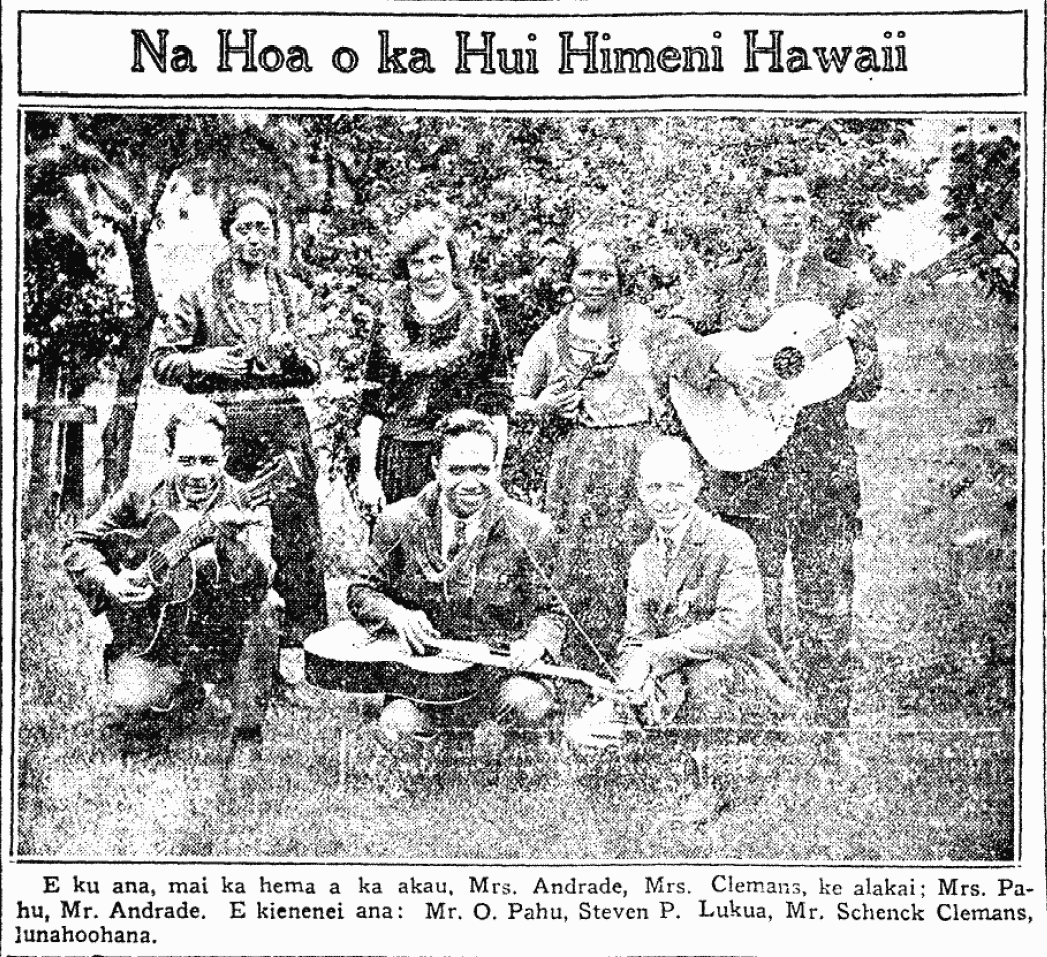
Members of the Hui Himeni Hawaii¹

Standing from the left to right: Mrs. Andrade; Mrs. Clemans, the leader; Mrs. Pahu; Mr. Andrade. Crouching:² Mr. O. Pahu; Steven P. Lukua; Mr. Schenck Clemans, business manager.

¹Hawaiian Glee Club?

²I wonder what the difference is between kīʻenenei (kīʻelelei) and ʻōkuʻu is.

(Kuokoa, 5/24/1923, p. 3)

Na Hoa o ka Hui Himeni Hawaii

Ka Nupepa Kuokoa, Buke LXII, Helu 21, Aoao 3. Mei 24, 1923.

More coverage of Hui Nalu Singing Group, 1912.

THE HUI HIMENI HUI NALU IS HEADED TO CHINA

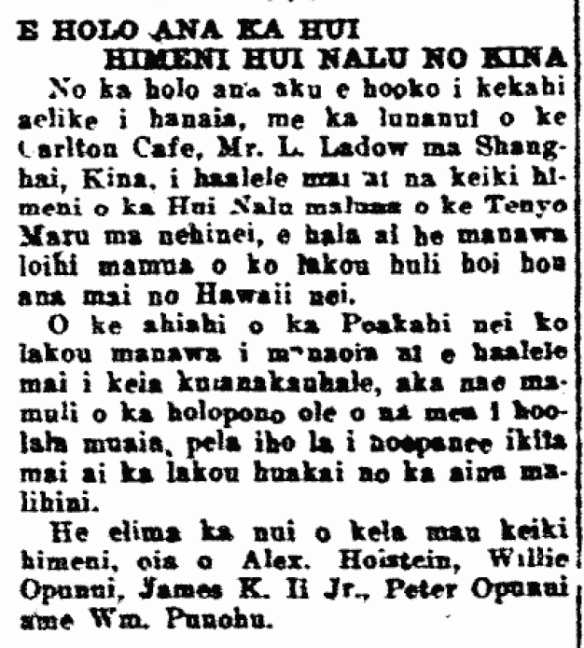
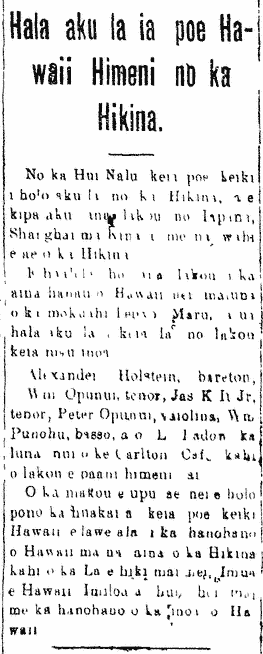
To fulfill their contract with the head of the Carlton Cafe, Mr. L. Ladow, in Shanghai, China, the singing boys of the Hui Nalu will leave aboard the Tenyo Maru yesterday, and they will spend a long period of time there before returning to Hawaii nei.

They were supposed to leave this town on Monday, however because what was planned earlier did not go well, their trip to foreign lands has been postponed for a bit.

There are five of these singers, they being: Alex. Holstein, Willie Opunui, James K. Ii, Jr., Peter Opunui, and William Punohu.

(Kuokoa, 12/20/1912, p. 4)

E HOLO ANA KA HUI HIMENI HUI NALU NO KINA

Ka Nupepa Kuokoa, Buke XLVIII, Helu 51, Aoao 4. Dekemaba 20, 1912.

Musicians travel to Japan and China, 1912.

Those Hawaiian Singers Leave for the East.

These youths are from the Hui Nalu [Singing Club] who left for the East; and they will visit Japan and Shanghai in China and other locations in the East.

They will leave the land of their birth aboard the steamship Tenyo Maru [?], and they left this day, their names being:

Alexander Holstein, baritone,

William Opunui, tenor, James K. Ii, Jr., tenor, Peter Opunui, violin, William Punohu, bass, and L. Ladon [Louis Ladow] the head of the Carlton Cafe, where they are to perform.

Our hope is that the journey of these Hawaii boys carrying with them the pride of Hawaii to East, to the land of the rising Sun, goes well. Go forward, go forward O Great-Travelling Hawaiians and return with glory in the name of Hawaii.

(Kuokoa Home Rula, 12/19/1912, p. 1)

Hala aku la ia poe Hawaii Himeni no ka Hikina

Kuokoa Home Rula, Buke X, Helu 51, Aoao 1. Dekemaba 19, 1912.

More on “Prince,” 1924.

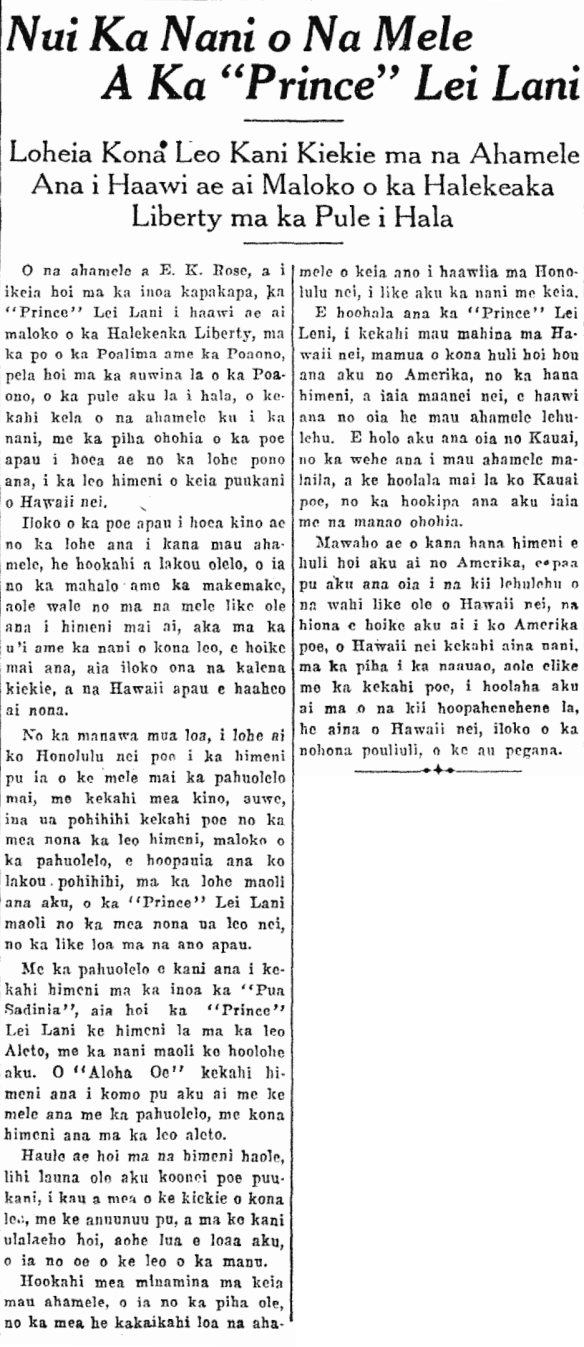
The Songs of “Prince” Lei Lani Were Just Beautiful

His Falsetto Voice Was Heard at the Concerts He Gave in the Liberty Theater Last Week.

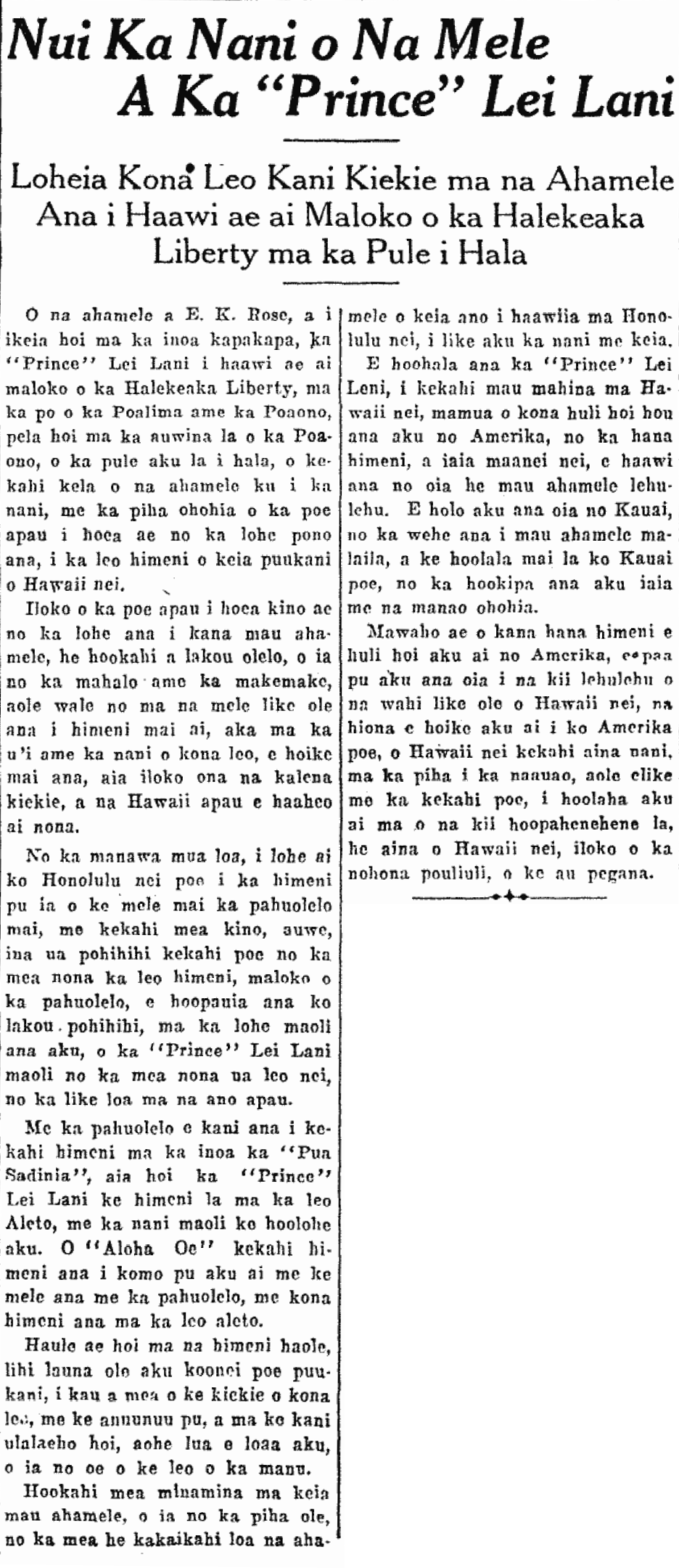
The concerts given by E. K. Rose, known by the stage name “Prince” Lei Lani [Leilani], in the Liberty Theater on the nights of Friday and Saturday, and the afternoon of Saturday of this past week, those were some of the most beautiful concerts, filling all those who attended with delight at hearing in person, the singing voice of this musician of Hawaii nei.

Amongst all of the people who attended to hear his concerts, they said but one thing; that being of their appreciation and desire, not just for all of the different mele sung, but for the loveliness and beauty of his voice, showing that within him are the high talents for which all Hawaiians have pride in him.

For the first time, Honolulu’s people heard singing live along with a phonograph [pahuolelo], auwe, if people weren’t clear about who the singer was on the phonograph, this lack of clarity was put to an end by them hearing the real “Prince” Lei Lani’s voice, being that they were the same in every way.

While the phonograph was playing a song called “Pua Sadinia,” “Prince” Lei Lani sang it in Alto, and it sounded beautiful. “Aloha Oe” was another number played on the phonograph while he sang in alto.

The local singers pale in haole songs, and cannot match the high range of his voice along with the modulation, and yodeling; there is no match, like the voice of a bird.

There was one unfortunate thing in the concert, that was that it was not filled, for there are not many concerts of this sort put on here in Honolulu that are as beautiful.

“Prince” Lei Lani will spend a number of months here in Hawaii nei before turning back to return to America to sing, and while he is here, he will be giving many concerts. He’ll be going to Kauai to perform concerts there, and Kauai’s people are planning a reception for him with excitement.

Other than to sing, he is returning to America, taking with him many photographs of all sorts of places here in Hawaii nei, scenes showing the people of America that Hawaii is a lovely place full of intelligence; not as was shown by some people using ridiculing pictures, saying that Hawaii is in the dark of pagan times.

[I wonder where the pictures ridiculing Hawaii were printed, and who it was that did it.

The internet is pretty amazing. Some ninety years later, we can hear Prince Lei Lani singing “Pua Sadinia” and “Aloha Oe”! Mahalo to cdbpdx for putting it up on youtube!!]

(Kuokoa, 4/10/1924, p. 1)
Nui Ka Nani o Na Mele A Ka "Prince" Lei Lani

Ka Nupepa Kuokoa, Buke LXIII, Helu 15, Aoao 1. Aperila 10, 1924.

Voice from the past, 1924.

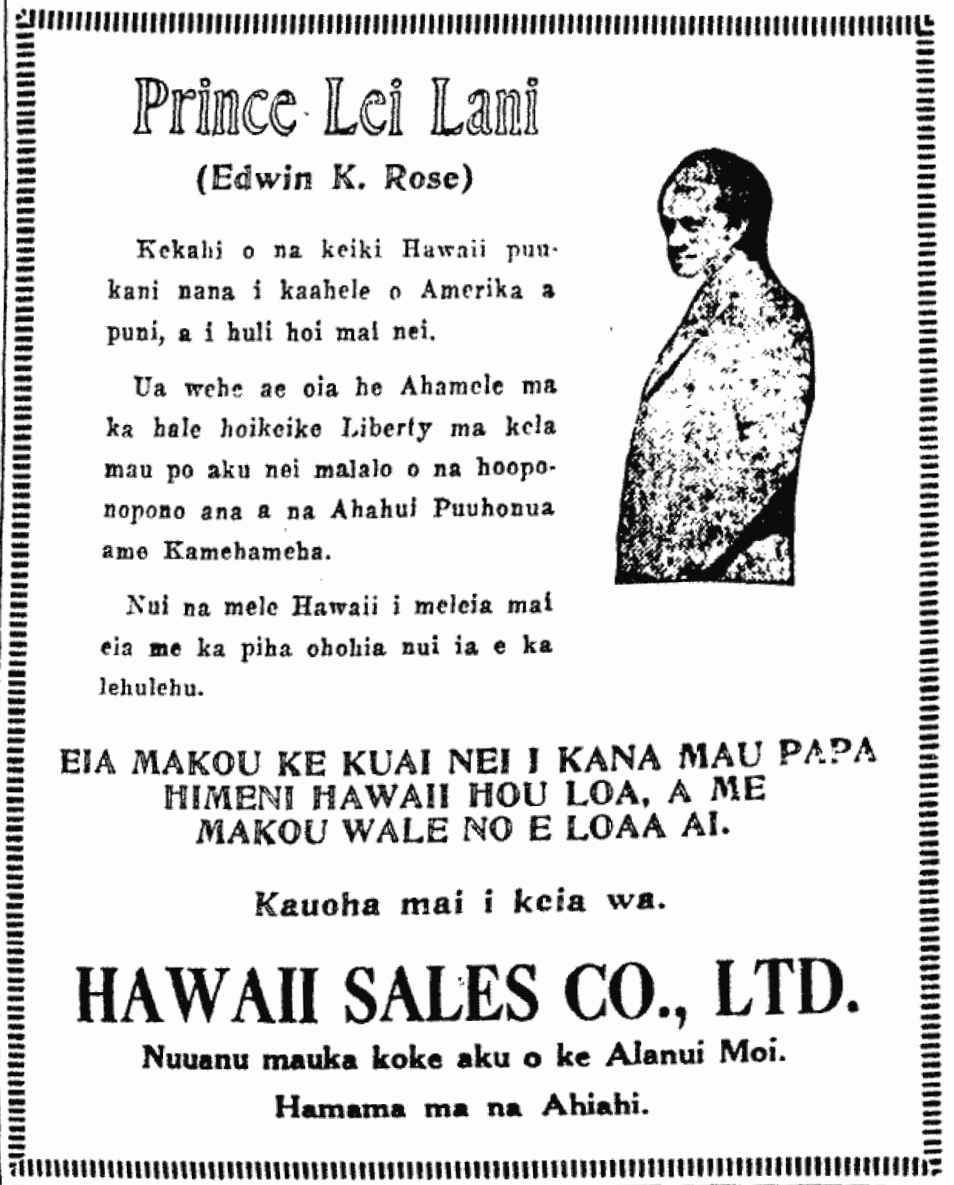
Prince Lei Lani

(Edwin K. Rose)

One of the Hawaiian singers who is touring all over America, and returned home.

He held a Concert at the Liberty Theater the other night organized by the Hawaiian Protective Association [Ahahui Puuhonua] and the Royal Order of Kamehameha [Ahahui Kamehameha].

There were many Hawaiian songs sung by him which were highly acclaimed by the crowd.

WE ARE SELLING HIS BRAND NEW HAWAIIAN RECORDS, AND WE ARE THE ONLY ONES WHO HAVE THEM.

Put in your orders now.

HAWAII SALES CO., LTD.

Nuuanu mauka near King Street.

Open in the Evenings.

(Kuokoa, 4/10/1926, p. 6)

Prince Lei Lani

Ka Nupepa Kuokoa, Buke LXIII, Helu 15, Aoao 6. Aperila 10, 1924.