This is an independent blog. Please note that I am nowhere near fluent, and that these are not translations, but merely works in progress. Please do comment if you come across misreads or anything else you think is important.
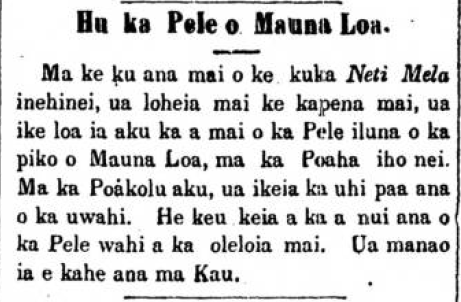
With the arrival of the schooner Nettie Merrill yesterday, heard from the captain was that they had seen the burning of Lava on top the summit of Mauna Loa this past Thursday. On the following Wednesday, seen was the spreading solid of the smoke. It is said that this is an exceptionally huge eruption. It is believed it will flow to Kau .
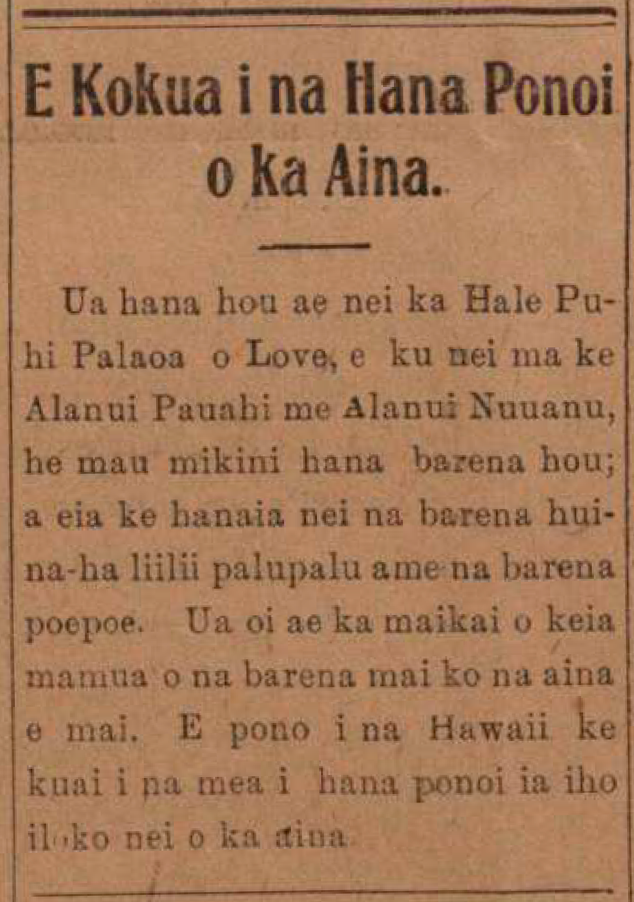
Rebuilt was Love’s Bakery, located at Pauahi and Nuuanu Streets. They have new cracker making machines, and they are baking soft soda crackers and saloon pilot crackers. These are better than the crackers from other lands. Hawaiians should buy items made locally.
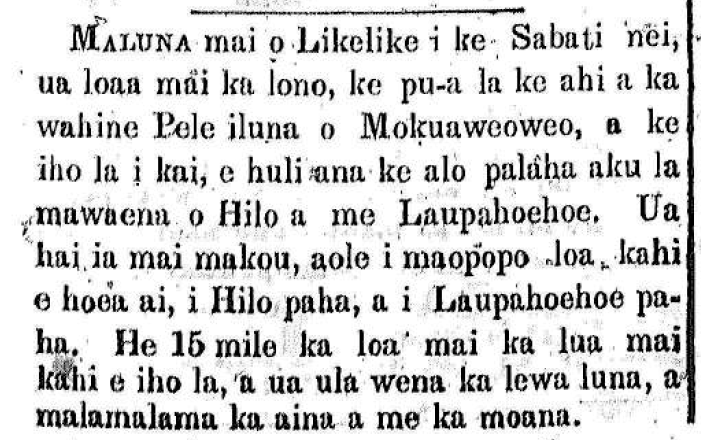
Aboard the Likelike this past Sunday, we received the news, the fires of the woman Pele were emerging from atop Mokuaweoweo, and it is headed down toward the sea. It will turn toward and flatten out between Hilo and Laupahoehoe. We were told, it is not certain where it will appear; maybe in Hilo, maybe in Laupahoehoe. It is 15 miles away from the crater from where it heads down, and the skies above glow red, and lights up the land and the sea.
(Elele Poakolu, 11/10/1880, p. 1)
Ka Elele Poakolu, Buke I, Helu 10, Aoao 1. Novemaba, 10, 1880.
It is believed that the beauty and the terror of this eruption at Mauna Loa will be greater than that of the earlier eruptions witnessed by those who are living. The lava will perhaps flow for a number of month more. In a letter to the Gazette newspaper from H. M. Whitney, it was said that the lava first appeared in the evening on the fifth of this month. It is thought that the crater from which the lava erupted was a little to the north of Mokuaweoweo, and it is about six miles from it. At times the lava shot up two hundred feet and crackled a bit, falling like burning charcoal. It is something remarkable to see. The night is overcome by the light of the fires. The lava flowed on the side of Mauna Loa facing Mauna Kea, and the unobstructed land lying between the two mountains is fifteen full miles in circumference is like a lake of blazing fire. It is something incomparably fierce to see. From this great lake of fire there appeared two lava flows. One that went down to the Puna and Kau side, and the second down the eastern side. According to the latest news, it is said that the lava nearly reached Volcano House [ka hale hookipa ma Kilauea]; it is only 10 miles away; as for the flow headed east, it is 15 miles from Hilo. But it is not believed that Hilo will face disaster. The kamaaina from there perhaps will not have forgotten the lava flows in the years 1855, 1859, and 1868, when people were anxious that their lives were in danger. But according to the old saying, “Aole i haawi ia o Hilo no Pele.” [Hilo shall not be given to Pele.]
Because the land has entered in the war, local news cannot be published in the newspapers without being permitted by the war department. One of these local news stories is the return of the Old Woman Pele to Hawaii nei, but not to her regular home at Halemaumau, but at Mokuaweoweo.
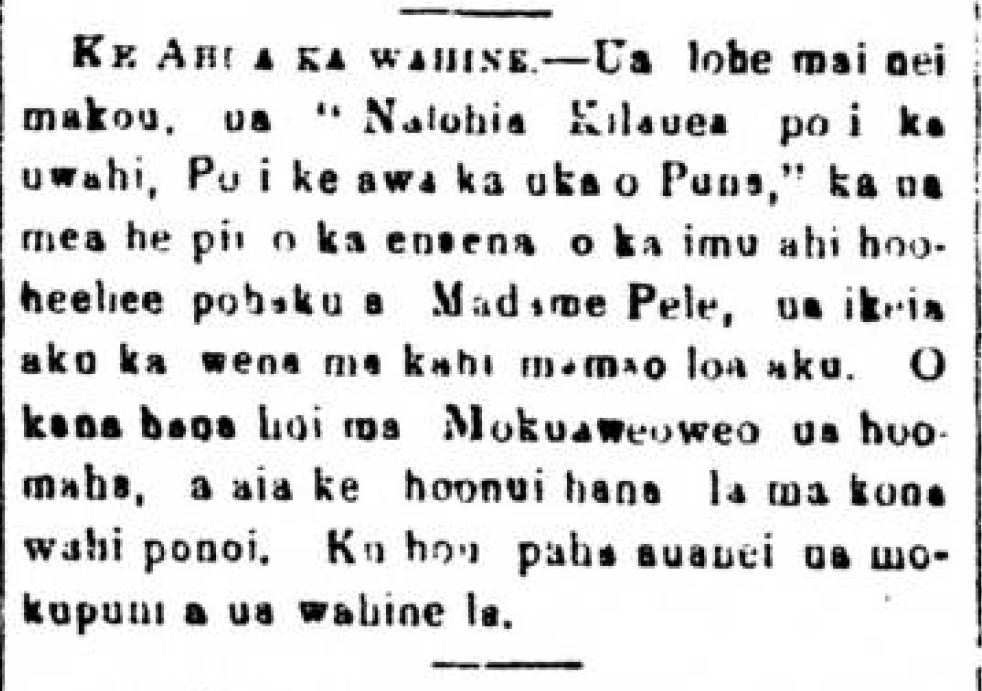
The fire of the woman.–We have heard, “Nalohia Kilauea po i ka uwahi, Po i ke awa ka uka o Puna,” [Kilauea has vanished, obscured by smoke, Obscured by the mist is the upland of Puna.] that risen is the red-heat of the fiery stone-melting oven of Madame Pele. The glow can be seen from very far off. Her activity at Mokuaweoweo has paused, and she is increasing her work at her own place. Perhaps that island of hers will recover.
From our many friends living all over on the island of Keawe, we recieved news of sightings of lava blazing atop the summit of Mauna Loa, from the crater of Mokuaweoweo. And we are indebt to them for their kindness. These are each of the letters showing:
Kailua, North Kona, Hawaii, Dec. 5.–1 o’clock at late night on this past Wednesday, in the Alenuihaha Channel, on the deck of the Malulani, seen was the lava of Mokuaweoweo. The red glow of the fires were incomparably great.
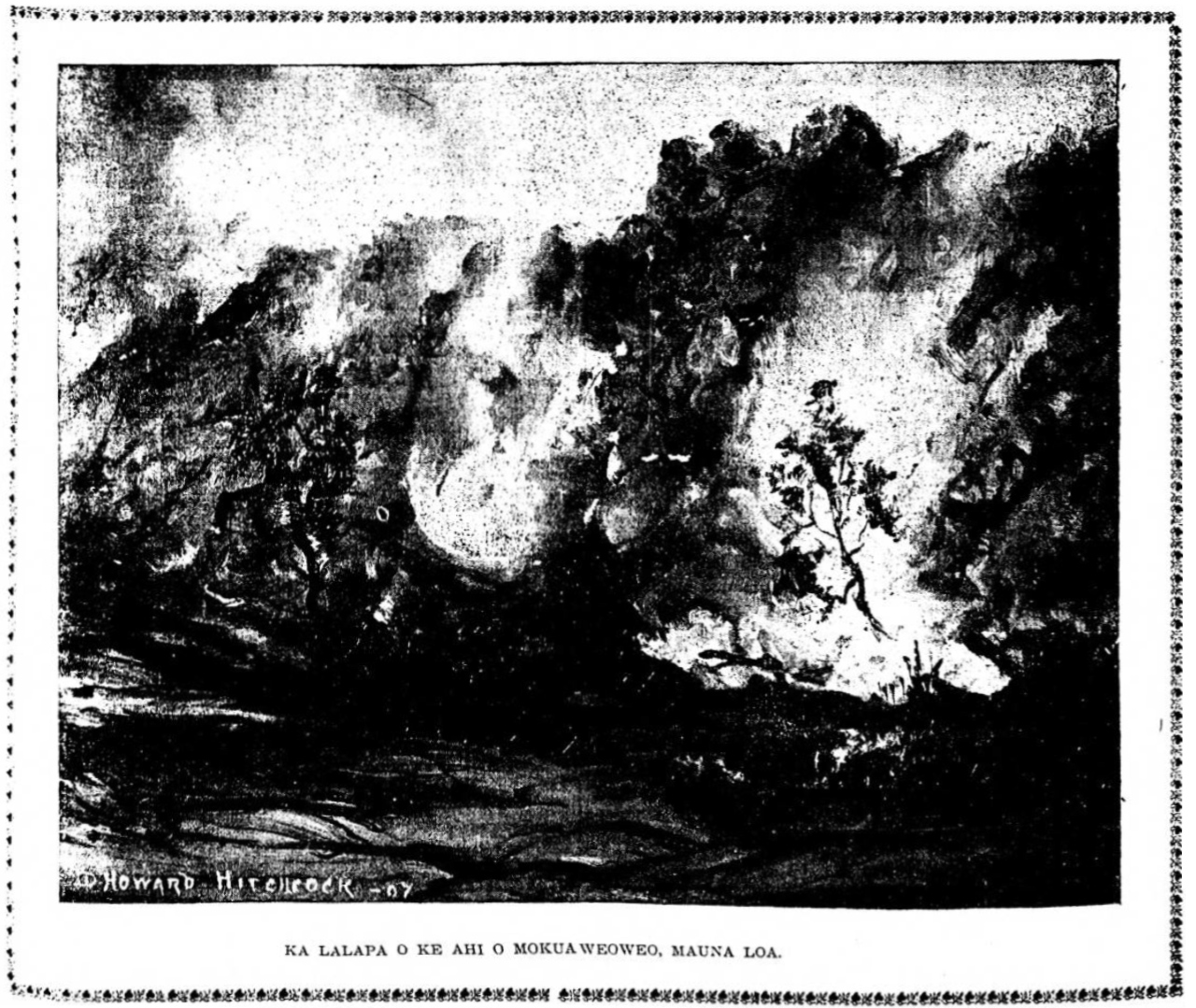
[This image appears unrelated to the contents of the page, which is a serial of a foreign love story, “Ka Mana o ka Leka.” Does anyone recognize this painting by Hitchcock, and might it be on exhibit somewhere?]
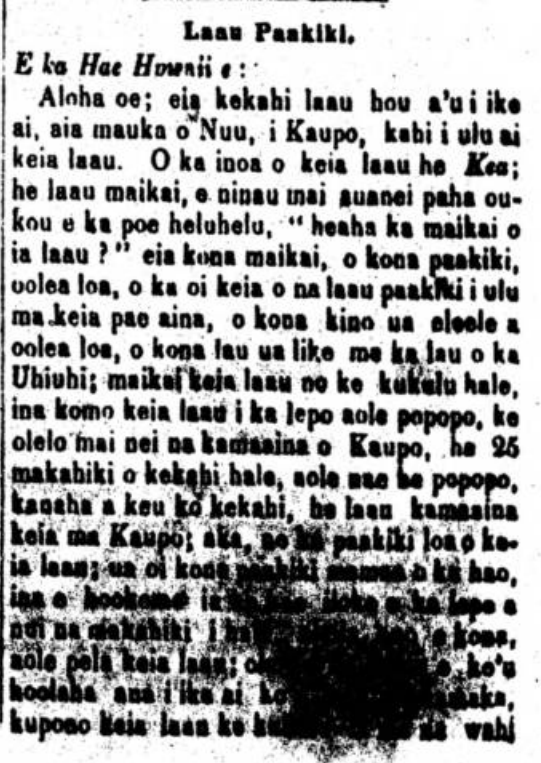
Aloha oe; here is a new tree that I have seen; this tree grows in the uplands of Nuu, in Kaupo. The name of this tree is Kea; it is a fine tree. You readers will perhaps ask, “What makes this tree a fine tree?” This is why, because of its strength; it is very solid. This is the strongest tree that grows in this archipelago. Its body is black and very rigid, and its leaves are like those of the Uhiuhi This is good wood for building houses; if the wood is placed in earth, it does not rot. The kamaaina of Kaupo say that some houses are 25 years old yet have no rot; some are forty years old or more. This is a familiar tree in Kaupo; and as for the strength of this wood, it is stronger than iron. Should iron have been placed in earth many years ago, its form will change, not so with this wood. That is why I am getting this out, so that my friends may know that this wood is good for standing in…
(Hae Hawaii, 11/18/1857, p. 133)
Ka Hae Hawaii, Buke 2, Ano Hou.—Helu 34, Aoao 133. Novemaba 18, 1857.
[The last few lines above were not legible online. It will be a great day when the images digitized from the originals are uploaded on Papakilo.]
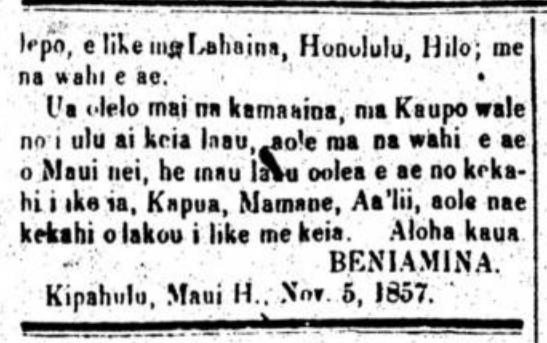
…dirt, like in Lahaina, Honolulu, Hilo, and other places.
The kamaaina say that this wood only grows in Kaupo, and not in other places here on Maui. There are other strong woods that are known: Kapua, Mamane, Aalii, but none are like this. Aloha kaua.
BENIAMINA. Kipahulu, Maui, H., Nov. 5, 1857.
[Might the Kea referred to here be talking about Uhiuhi?]
(Hae Hawaii, 11/18/1857, p. 134)
Ka Hae Hawaii, Buke 2, Ano Hou.—Helu 34, Aoao 134. Novemaba 18, 1857.

 nupepa