Salt, 1860.

Salt from Puuloa.

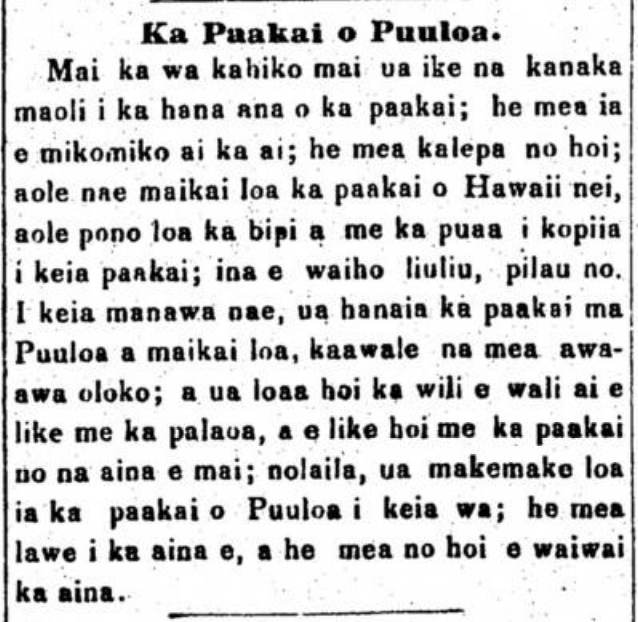
From old times, Hawaiians knew how to make salt. It was used to season food and to trade with, and yet the salt from Hawaii was not very good. Beef or pork salted with this salt was not so good. If it was left for a while, it would rot. Now however, the salt made at Puuloa is very good; the bitter contents are removed, and they have a mill that grinds it like flour, and like salt from foreign lands. Therefore, the salt from Puuloa is under great demand; it is exported and the land profits.

(Hae Hawaii, 7/25/1860, p. 70)
Ka Hae Hawaii, Buke 5, Ano Hou.—Helu 17, Aoao 70. Iulai 25, 1860.

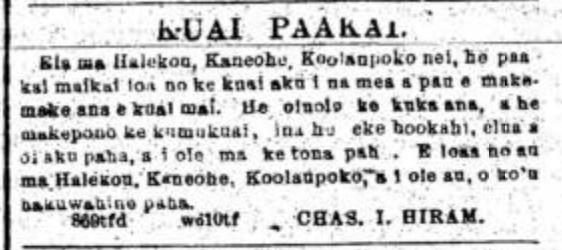
Salt from Halekou, Kaneohe, 1890.

SALT FOR SALE.

Here at Halekou, Kaneohe, Koolaupoko, is very nice salt for sale to anyone who wants to buy. Consultation is pleasant, and prices are reasonable, whether it be for a bag, or two, or more, or a ton. I can be found at Halekou, Kaneohe, Koolaupoko, or if not me, my wife.

CHARLES I. HIRAM.

(Ko Hawaii Paeaina, 2/8/1890, p. 3)

Ko Hawaii Paeaina, Buke XIII, Helu 6, Aoao 3. Feberuari 8, 1890.

Salt from Kealia, Maui, 1856.

PERTAINING TO SALT AT KEALIA IN MAUI.

I want to tell you about the abundance of salt at Kealia here in Maui.

This year, the salt here in Kealia is very good; and there is a lot.

There has not been a year like this one where there has been so much salt, and so fine; and it appears these days when looking at the salt like there are 4,000 tents in Kealia.

Continue reading

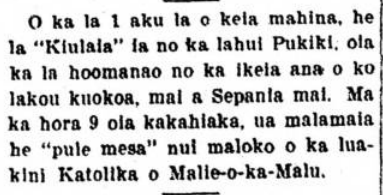
Portuguese holiday, 1897.

[Found under: “NU HOU HAWAII”]

The first of this month [December] was a “Kiulaia” [Holiday] for the Portuguese, that being the day commemorating the recognition of their independence from Spain. From 9 o’clock in the morning, a great mass was held in the Catholic church Malieokamalu.[Maliaokamalu / Our Lady of Peace].

[Kiulaia seems to be interchangeable with Kulaia, but for some reason, Kiulaia is often found in quotes as seen in this article.]

(Kuokoa, 12/3/1897, p. 3)

Ka Nupepa Kuokoa, Buke XXXVI, Helu 49, Aoao 3. Dekemaba 3, 1897.

Frogs, 1903.

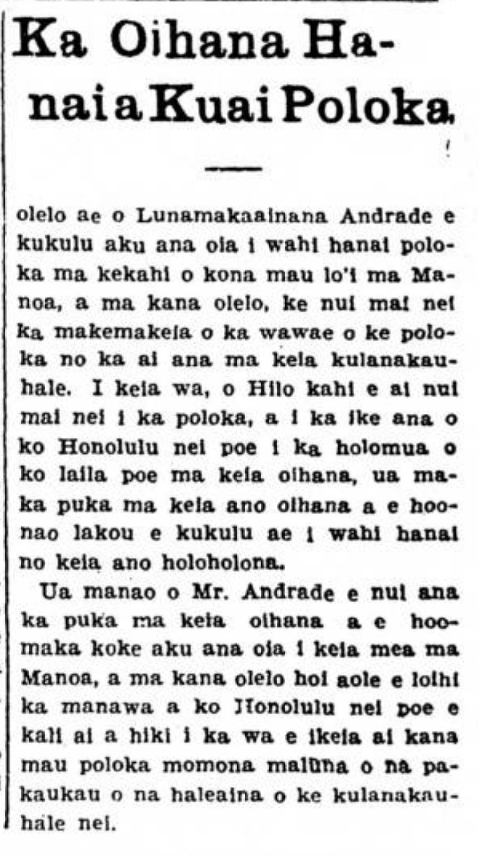
The Business of Raising and Selling Frogs.

Representative Andrade said he will build a frog breeding grounds in some of his taro patches at Manoa, And according to him, the requests for frog legs for eating in this town is increasing. Currently, Hilo is where frog is eaten a lot, and when Honolulu people see the progress of those in this business, they will think of building a place to raise those animals.

Mr. Andrade believes that profits from this business will grow and he will start this venture in Manoa, and according to him, it will not be long for Honolulu people to wait before they will see his juicy frog on tables at restaurants in town.

(Kuokoa, 7/17/1903, p. 5)

Ka Nupepa Kuokoa, Buke XLI, Helu 29, Aoao 5. Iulai 17, 1903.

Did Kamehameha IV Have Bears? Oh my! 1857,

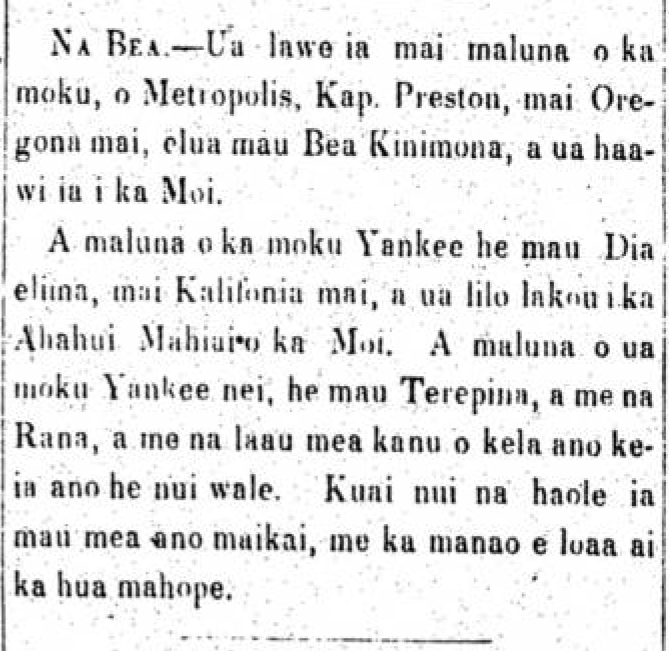
Aboard the ship the Yankee were five Deer, from California, and they went to the Royal Hawaiian Agriculture Society, of the King. And aboard that ship the Yankee, were some Terrapin and Frogs, and many types of plants. Haole buy those fine things with the thought they would have fruit in the future.

Bears.–Brought aboard the ship the Metropolis, Capt. Preston, from Oregon, were two Cinnamon Bears, and they were given to the King.

(Hae Hawaii, 12/2/1857, p. 142)

Ka Hae Hawaii, Buke 2, Ano Hou—Helu 2, Aoao 2. Dekemaba 2, 1857.

Hillebrand brings in frogs, 1857.

Something New.

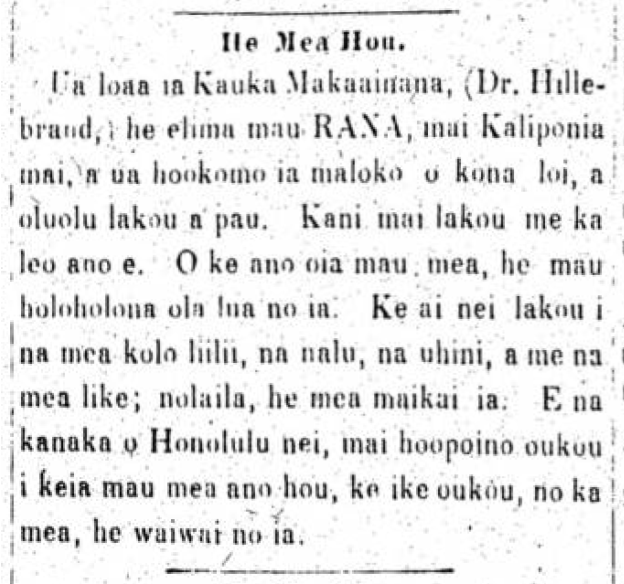
Kauka Makaainana (Dr. Hillebrand) has five FROGS [RANA] from California and he has put them in his taro patch. They are doing fine. They make strange noises. Their nature is that they are animals that have two lives. They eat small bugs: flies, grasshoppers, and other things like that. Therefore they are good. O People of Honolulu, do not harm these new things if you see them, because they are valuable.

(Hae Hawaii, 9/30/1857, p. 106)

Ka Hae Hawaii, Buke 2, Ano Hou—Helu 27, Aoao 106. Sepetemaba 30, 1857.

Altercation at the Chinese Times, 1896.

[Found under: “NU HOU HAWAII”]

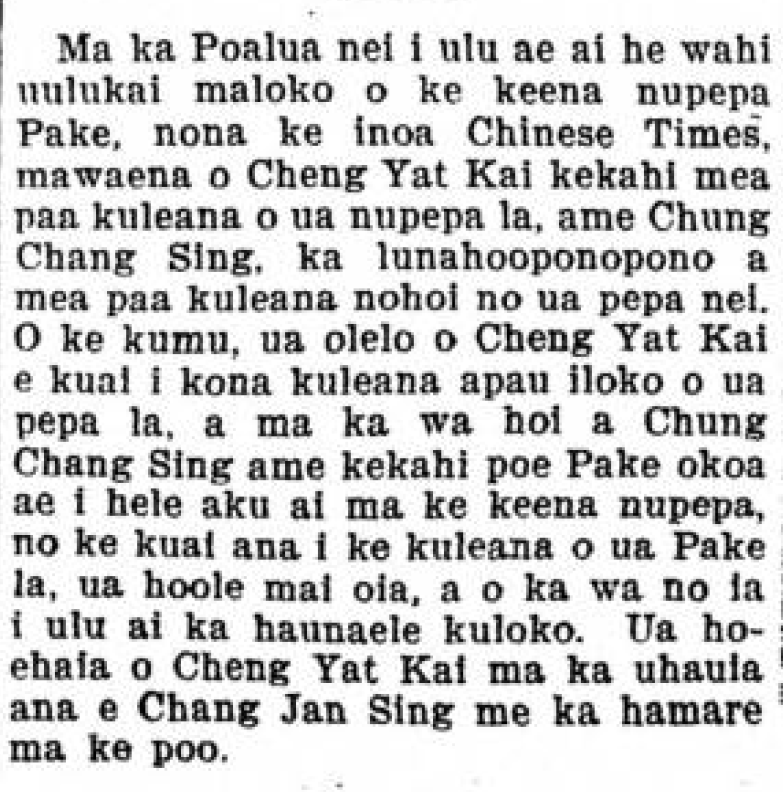
This past Tuesday, an altercation [uulukai] arose in the Chinese newspaper office by the name of Chinese Times [Wah Ha Bo] [華夏報], between Cheng Yat Kai, one of those who holds ownership in that newspaper, and Chung Chang Sing, the editor and also an owner in the paper. The cause was Cheng Yat Kai saying that he would sell all of his interests in the paper, and when Chung Chang Sing and some other Chinese got to the newspaper office to purchase the interests of that Chinese, he refused, and that was when the internal riot began. Cheng Yat Kai was injured by Chang Jan Sing hitting him in the head with a hammer.

(Kuokoa, 8/21/1896, p. 3)

Ka Nupepa Kuokoa, Buke XXXV, Helu 34, Aoao 3. Augate 21, 1896.