Another mele by Emalia Kaihumua, 1894.

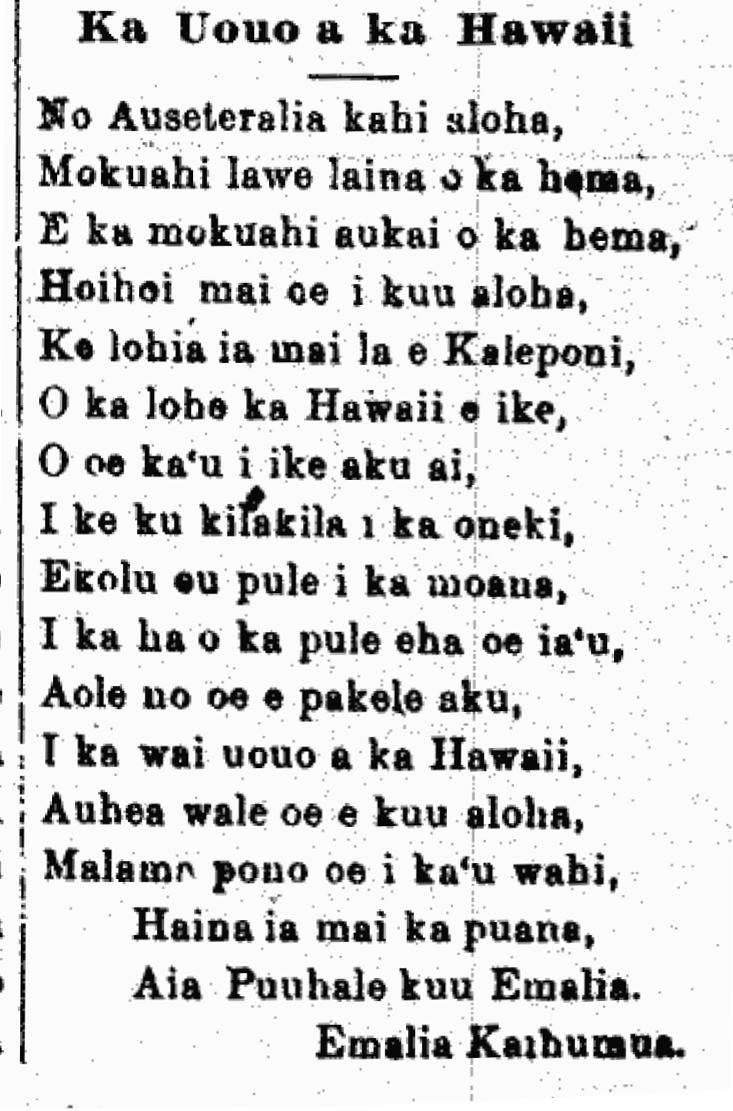
Ka Uouo a ka Hawaii

No Auseteralia kahi aloha,
Mokuahi lawe laina o ka hema,
E ka mokuahi aukai o ka hema,
Hoihoi mai oe i kuu aloha,
Ke lohia ia mai la e Kaleponi,
O ka lohe ka Hawaii e ike,
O oe ka’u i ike aku ai,
I ke ku kilakila i ka oneki,
Ekolu ou pule i ka moana,
I ka ha o ka pule eha oe ia’u,
Aole no oe e pakele aku,
I ka wai uouo a ka Hawaii,
Auhea wale oe e kuu aloha,
Malama pono oe i ka’u wahi,
Haina ia mai ka puana,
Aia i Puuhale kuu Emalia.

Emalia Kaihumua.

(Makaainana, 1/8/1894, p. 3)

Ka Uouo a ka Hawaii

Ka Makaainana, Buke I—-Ano Hou, Helu 2, Aoao 3. Ianuari 8, 1894.

Probably the earliest known version of a song well known today, 1894.

ALOHA O HAWAII.

He aloha Hawaii moku o Keawe
Aina a ka nani me ka maluhia
Hookuku au me Kaleponi
Hawaii ka oi o na Ailana
Na Ausekulia i kono mai ia’u
E naue i ka aina malihini
Aina kamahao i ka’u ike
Ua uhi paapu ia e ka noe
Ike i ka hau hookuakea i ka ili
Hoopumehana i ke ahi kapuahi
Ka iniki a ke anu me he ipo ala
E koi mai ana ia’u e hoi
Ilaila hoi hope ko’u manao
He kaukani mile ko’u mamao
Hu mai ke aloha no ka aina
No ka poi uouo kaohi puu
Haina ia mai ana ka puana
Ke aloha aina ko’u lei ia

Emalia Kaihumua.

Hale Hoikeike Hawaii. Kapalakiko

[This was written while Emalia Kaihumua was performing at the Hawaiian Exhibit [Hale Hoikeike Hawaii] at the California Midwinter International Exposition held in San Francisco. Looking back at was happening at the time in her homeland while she was “a thousand miles away”, it is very heart wrenching to see the many references to home and returning and finally the haina: “Let the refrain be told, Patriotism is my lei.”]

(Leo o ka Lahui, 4/27/1894, p. 3)

ALOHA O HAWAII.

Ka Leo o ka Lahui, Buke II, Helu 929, Aoao 3. Aperila 27, 1894.

Honolulu lighted up, 1888.

ELECTRIC LIGHTS OF HONOLULU NEI.

As for the long awaited electric lights to illuminate this town of Honolulu, the work of the carpenters is progressing, and the electric wires are projecting out in every direction on the streets all about town. It was believed that the turbine wheel for the machine would arrive on this landing of the Australia, however, it did not arrive from the Eastern states when the steamship left San Francisco.

Should it arrive aboard the next steamship, then it will be perhaps two or three weeks after that when everything will be ready to put it to work, and that will be when the presses here in Honolulu will be lit up by modern electric lights; it is something which we all have not seen before and have greatly desired, like of what we’ve heard of the electric lights in foreign lands.

[Honolulu Magazine this month has done a feature where it gives us a glimpse into what it was like here in 1888 (when Paradise of the Pacific, the forefather of the current magazine, began). I thought i might try to add to that in the upcoming weeks, randomly putting up 1888 articles while as always, posting news from other periods as well.]

(Kuokoa, 2/11/1888, p. 2)
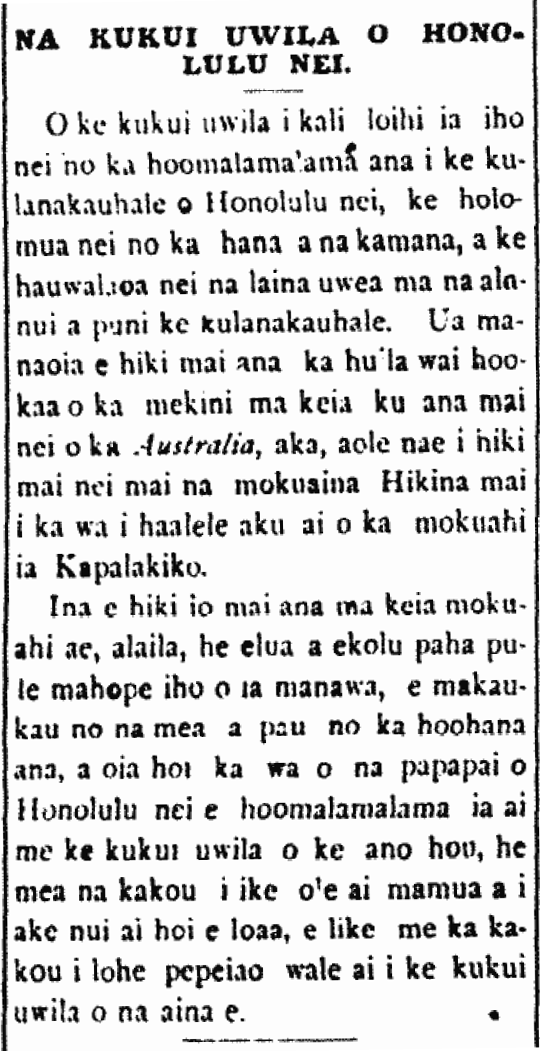
NA KUKUI UWILA O HONOLULU NEI.

Ka Nupepa Kuokoa, Buke XXVII, Helu 6, Aoao 2. Feberuari 11, 1888.

Excerpts of “Strangling Hands…” appearing in the Hawaiian-Language Newspaper. 1897.

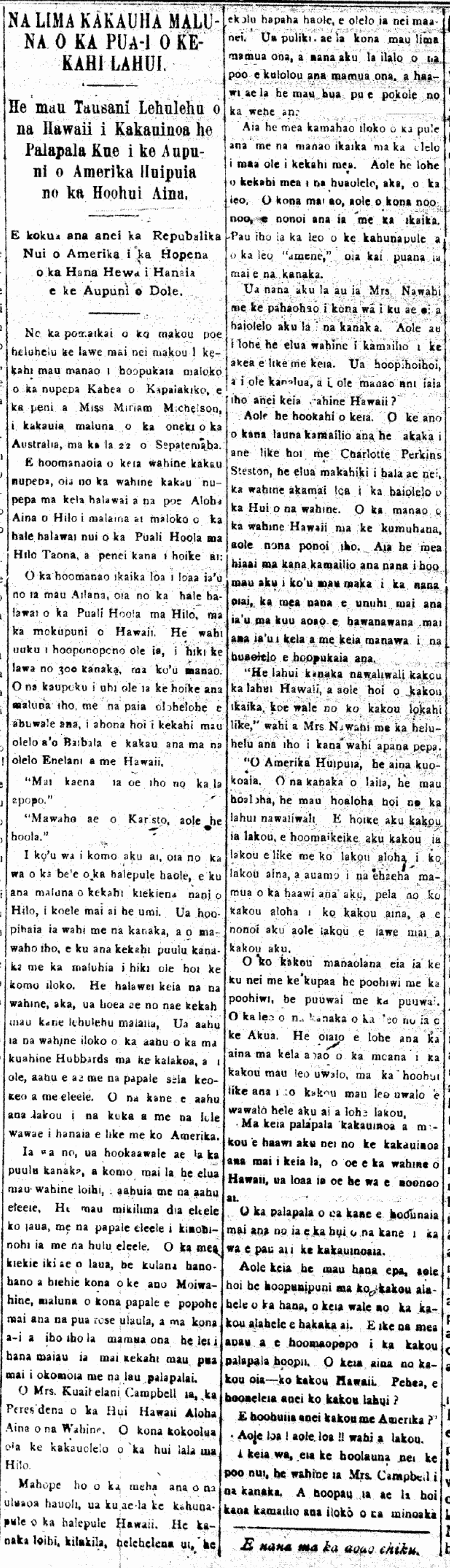
NA LIMA KAKAUHA MALUNA O KA PUA-I O KEKAHI LAHUI.

[This article is taken from the famed “Strangling Hands upon a Nation’s Throat” article by Miriam Michelson, which appears in the San Francisco Call, 9/30/1897, pp. 1–3. The introductory paragraphs go:]

For the benefit of our readers, we are taking some ideas printed in the newspaper San Francisco Call, written by the pen of Miss Miriam Michelson, on the deck of the ship, Australia, on the 22nd of September.

Remember that this woman newspaper reporter was the woman reporter present at the meeting of the Patriotic League of Hilo held at the meeting house of the Salvation Army in Hilo Town, and this is what she reported: . . .

(Aloha Aina, 10/16/1897, pp. 6 & 7.)

NA LIMA KAKAUHA MALUNA O KA PUA-I O KEKAHI LAHUI.

Ke Aloha Aina, Buke III, Helu 42, Aoao 6. Okatoba 16, 1897.

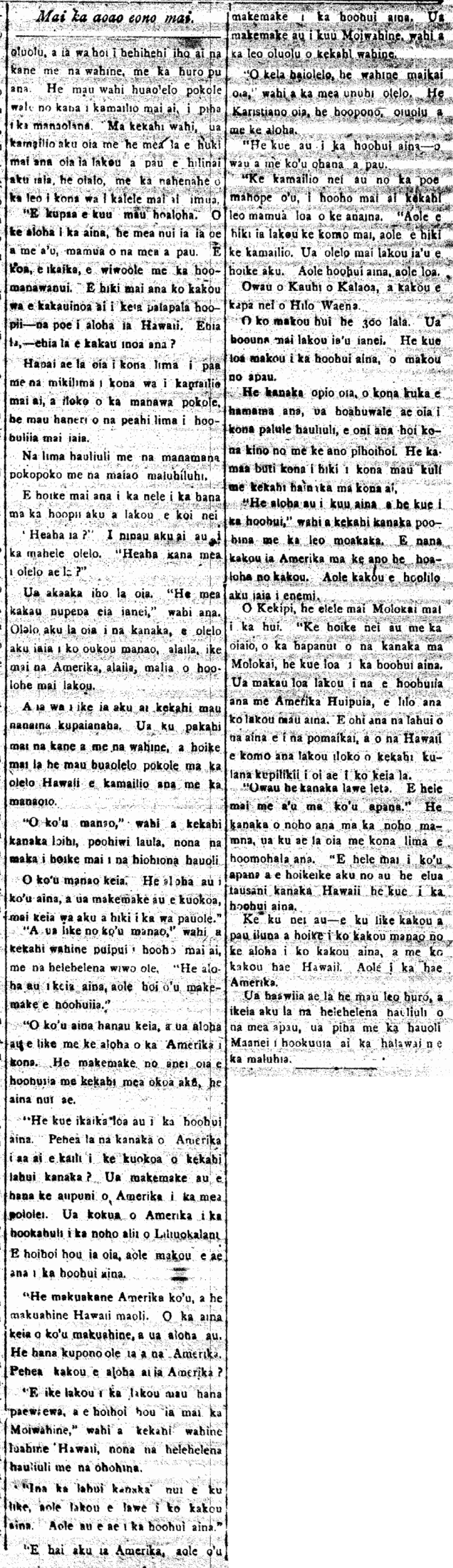
Mai ka aoao eono mai.

Ke Aloha Aina, Buke III, Helu 42, Aoao 7. Okatoba 16, 1897.