Queen Liliuokalani’s birthday celebrated at Washington Place, 1912.

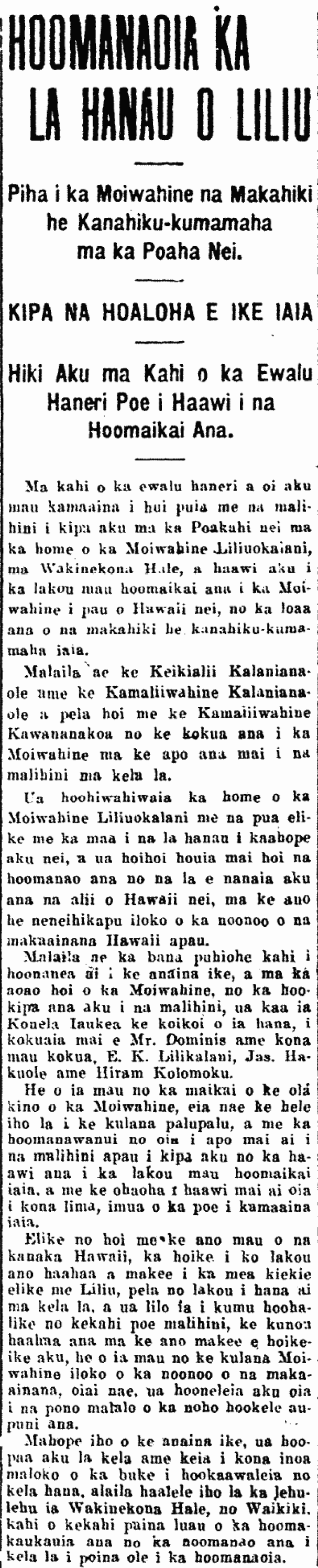
LILIU’S BIRTHDAY CELEBRATED

The Queen Made Seventy-Four This Thursday.

FRIENDS CAME TO SEE HER

Those Who Extended Their Congratulations Were About Eight Hundred.

About eight-hundred or more kamaaina and malihini went on Monday to the home of Queen Liliuokalani, Washington Place [Wakinekona Hale], and gave their congratulations to the former Queen of Hawaii nei, for her reaching seventy-four years in age.

Present was Prince Kalanianaole and Princess Kalanianaole and also Princess Kawananakoa, who were there to assist the Queen in welcoming the visitors on that day.

The Queen’s home was decorated in flowers as was customary on her birthdays in the past and memories were stirred up of days when the alii of Hawaii nei were viewed with majesty in the minds of all Hawaii’s people.

The band was there entertaining the visitors; and from the Queen’s side, to welcome the guests, the responsibility went to Colonel Iaukea, assisted by Mr. Dominis and his aids, E. K. Lilikalani, James Hakuole, and Hiram Kolomoku.

The Queen is still in good health, however she is becoming frail, yet with patience she welcomed all the guests who visited her to extend their congratulations, and delightedly she extended her hand before those with whom she was familiar.

Just as it is with Hawaiians, who show their deference and affection for their royalty, like Liliu; so they did on this day, and this was followed as an example by some of the malihini, who bowed deeply and with affection, showing that the Queen’s position remained the same in the minds of the people even if she is left without her rights in ruling the nation.

Following the audience, each person signed their name in the book set aside for this occasion, and then the crowd left Washington Place for Waikiki where a luau was prepared to celebrate that unforgettable day.

(Kuokoa, 9/6/1912, p. 1)
HOOMANAOIA KA LA HANAU O LILIU

Ka Nupepa Kuokoa, Buke XLVIII, Helu 36, Aoao 1. Sepatemaba 6, 1912.
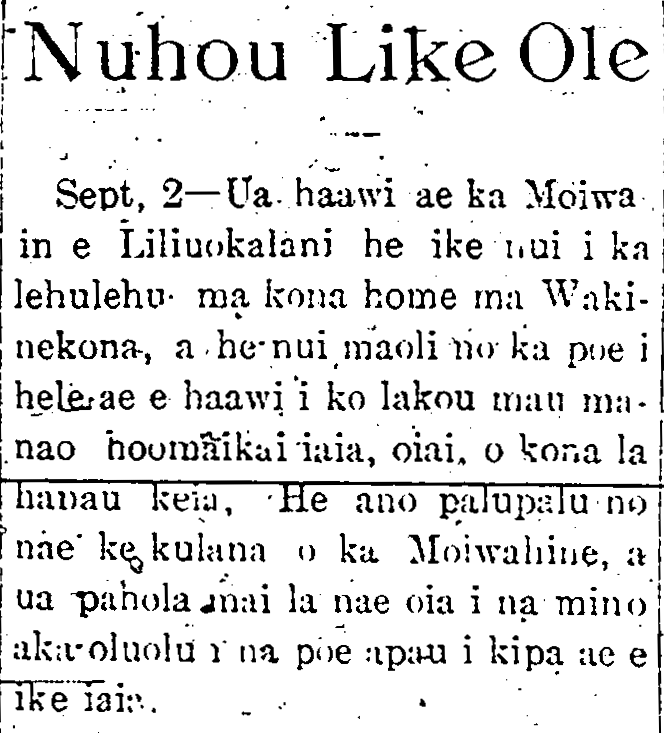
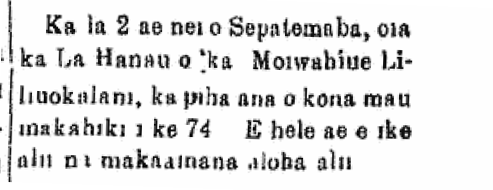
Queen Liliuokalani’s Birthday Celebration, 1912.

[Found under: “Various News”]

Sept. 2—Queen Liliuokalani held an audience with the public at her home, Washington Place, and there were a great many people who went to give their congratulations to her, being that this was her birthday. The Queen is somewhat frail, but she gave a kind smile to all who came to visit her.

(Hoku o Hawaii, 9/5/1912, p. 3)

Sept, 2—Ua haawi ae ka Moiwahin e...

Ka Hoku o Hawaii, Buke 7, Helu 14, Aoao 3. Sept. 5, 1912.

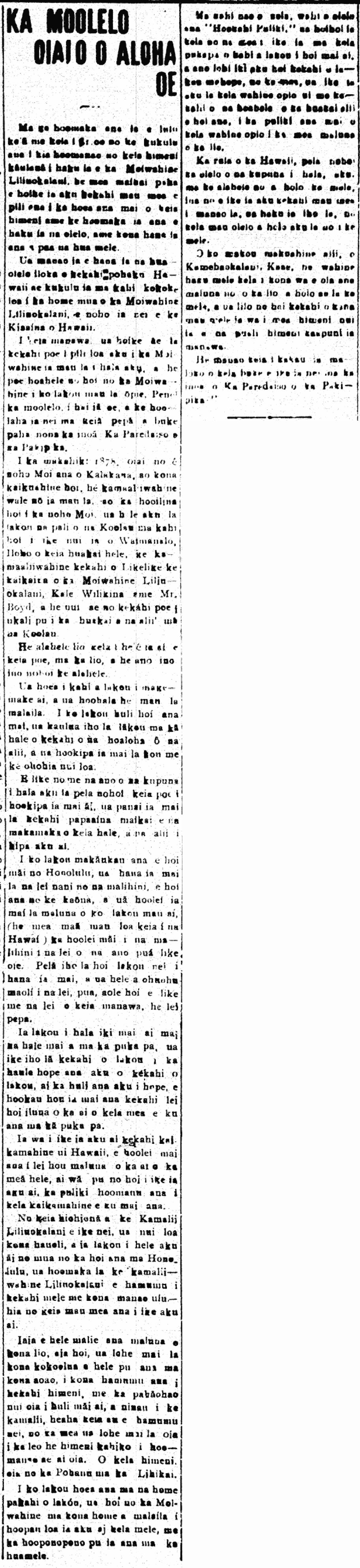
Liliuokalani’s “Aloha Oe,” 1929.

The True Story of “Aloha Oe”

As everyone starts to donate their dollar for the building of a memorial to this famous song composed by Queen Liliuokalani, perhaps it is well to speak about some of the information on the origins of this song, the beginnings of the penning of the lyrics, and it being set to music.

The monument was proposed to be the words in Hawaiian stone that would stand close to the first home of Queen Liliuokalani, now lived in by the Governor of Hawaii.

Now, some intimate with the Queen in days past, and travelling companions of the Queen when they were young, have spoken. This is the story that was told, and it was published in the paper or book called the “Paradise of the Pacific:

In 1878 [1877?], when Kalakaua reigned, and his sister was but a princess and heir to the throne, she travelled to the Koolau side, to well-known Waimanalo. With her was Likelike, Kale Wilikina, Mr. Boyd, and many attendants.

They travelled by horse on horse trail; this was a bad trail.

They arrived at their destination and spent several days there. They spent some days at some friends of the alii, and were welcomed with great gaiety.

Just as the with the kupuna of old, they were welcomed. A feast was laid out by the friends of this home which the alii were visiting.

When were making ready to return to Honolulu, lei of all kinds of flowers were placed about their necks, as was a custom amongst Hawaiians. They were adorned with flower lei, not like the paper lei popular during the time of this article.

When they all were going from the house to exit the estate, they saw one person fall back, and another lei was placed about the neck of the one at the entrance of the yard.

When this beautiful Hawaiian girl was seen giving a lei to the one leaving it also was seen her being embraced.

Because Princess Liliuokalani witnessed this scene, she was overjoyed. While they were headed back to Honolulu, she started to hum a melody, while being full of emotion over what she had seen.

The one next to Liliu heard her humming, and was curious, and asked what she was humming, as it reminded her of an old song. That song was “Rock Beside the Sea” [Pohaku ma ka Lihikai].

When they each returned to their homes, the Queen returned to hers, where she finished this song.
“One embrace” is charming for what was seen at the gateway–one person of their party tarrying as that beautiful young girl hugged the one on horseback.

As was said by the kupuna of yore, mele are composed while travelling, if something that catches ones eye is seen.

Our alii mother, Kamehaokalani Kane was a composer in her lifetime who made songs on horseback. Some of her compositions were well sung back in her time.

This is something written in the book known as the “Paradise of the Pacific.”

[As found in the “Paradise of the Pacific,” 42 (4): 31, 1929; 42 (10): 9, 1929.]

(Hoku o Hawaii, 4/23/1929, p. 2)

KA MOOLELO OIAIO O ALOHA OE

Ka Hoku o Hawaii, Buke XXII, Helu 45, Aoao 2. Aperila 23, 1929.

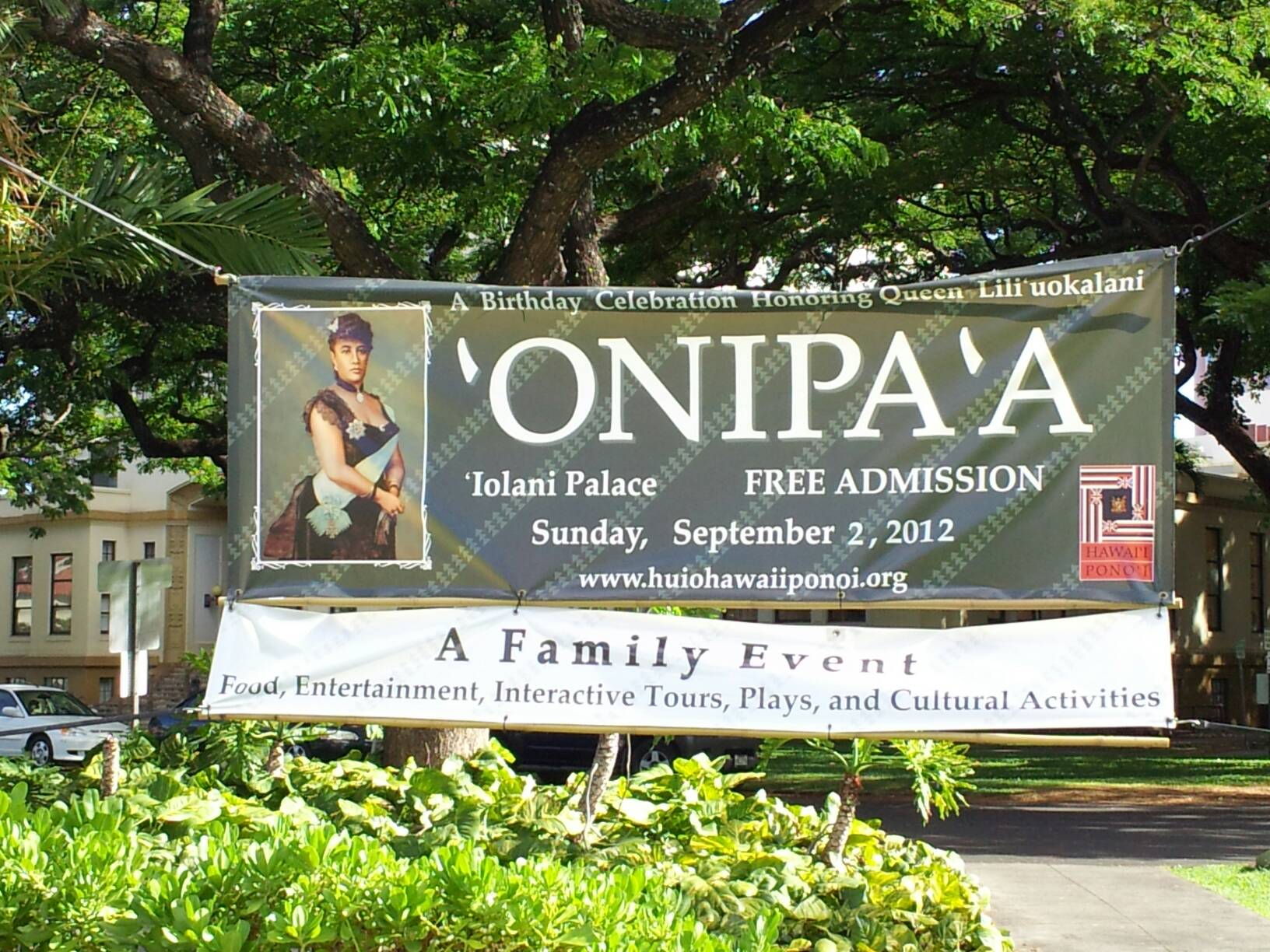
Celebrating the Queen’s Legacy, 2012.

I passed this before i got off the bus at Punchbowl today, and so i walked back and took a picture. Here is a nice description of some of the events taking place this Sunday, September, 2, 2012.

Also, one week later on the 8th, more celebration, Hilo style.

[How about everywhere else? Anybody have information on other celebrations?]

ONIPAA

ONIPAA

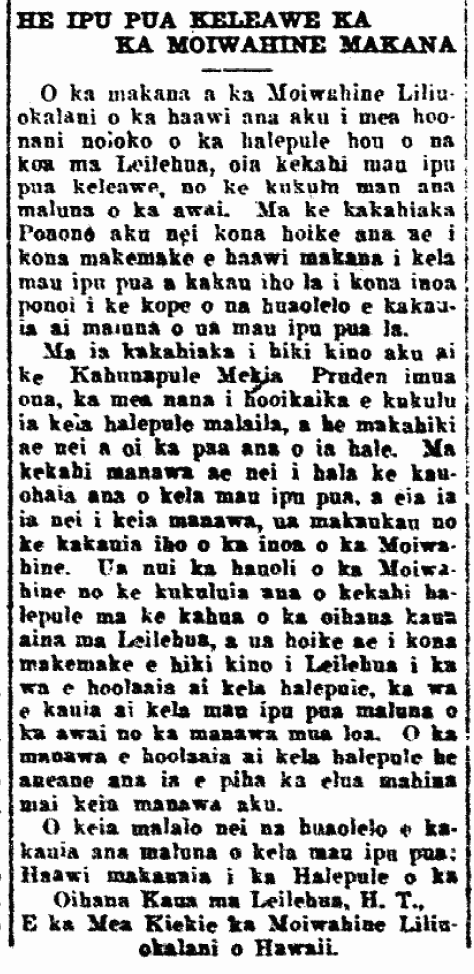
Gift from Liliuokalani to the soldiers of Leilehua, 1912.

BRONZE VASE, A GIFT BY THE QUEEN

The gift of Queen Liliuokalani, given to decorate the interior of the new church of the soldiers of Leilehua, were some bronze flower vases to be always stood upon the pulpit. On the morning of this past Saturday, she told of her interest in presenting the vases, and signed her own name on the paper with the words to be inscribed upon those vases.

On that morning the Chaplain, Major Pruden came before her, the one who worked at getting a church built there, and it took over a year to build. Sometime earlier, they vases were ordered, and here they now are ready to inscribe the name of the Queen. The Queen is overjoyed at the building of a chapel at the military base at Leilehua, and she expressed her desire to go in person to Leilehua when the church is consecrated, when the vases shall be placed upon the pulpit for all times. The date of the consecration of the church is almost two months from now.

Here below are the words inscribed upon the flower vases:

The Armed Forces at Leilehua, H. T.,
By Her Highness, Queen Liliuokalani of Hawaii.

[I wonder where these are today!]

(Kuokoa, 8/9/1912, p. 6)

HE IPU PUA KELEAWE KA KA MOIWAHINE MAKANA

Ka Nupepa Kuokoa, Buke XLVIII, Helu 32, Aoao 6. Augate 9, 1912.

Liliuokalani’s personal adornments sold, 1924.

Liliu’s Gold Necklaces are Auctioned Off.

In accordance with the wishes of the deceased Queen Liliuokalani, the board of trustees of the estate of the the deceased announced the auctioning off of the gold adornments of the deceased queen. In one of the rooms on the bottom of the Young Hotel in Honolulu, on this Tuesday, March 25, the auction began of the adornments: the diamond rings, the diamond bracelets, the diamond necklaces, the earrings, the stickpins, and many other items. Colonel C. Piehu Iaukea made known the wishes of Liliuokalani to build a house to care for orphaned girls of all ethnicities, in Honolulu, and the Hawaiian girls were the first in her heart.

On the first day, this Tuesday, $11,360.50 was made. The auction was continued on another day. It is not known what the total is at this time.

The houses intended for these orphaned children probably cannot be built with just the funds from these jewels, because these valuables were sold in Honolulu at a place where it was believed that they would go for cheap, and the gold craftsmen of Honolulu said that the prices bid on these treasures of Hawaii nei were just like throwing them away. If it was held in a town of ten million people or more, like London, New York, or Paris, where millionaires reside, then proper prices might have been gotten, however, here in Hawaii, where there are no millionaires, high prices are not attained.

Perhaps if it is included with the rest of Liliuokalani’s estate, then it will be enough to build this type of facility, for it will need over a hundred thousand more dollars for that kind of place. On top of that is the expenses for the care taking and for the executives, which would be some hundreds of thousands of dollars more, and where would this all come from? The treasures from the tomb of King Tutankhamen, Pharaoh of Egypt, who died over 3,000 years ago, is estimated at over a billion dollars today.

(Kuokoa, 3/27/1924, p. 2)

Na lei gula o Liliu ua kudala ia

Ka Hoku o Hawaii, Buke XVII, Helu 44, Aoao 2. Maraki 27, 1924.

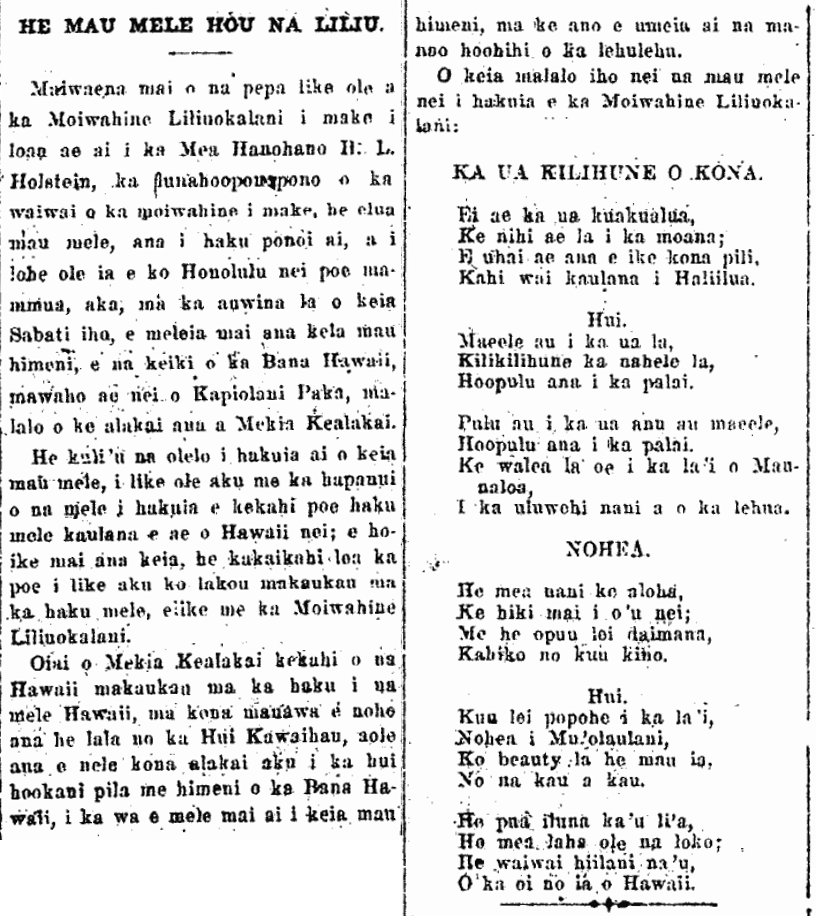
More mele, this time from Liliuokalani! 1920.

NEW MELE BY LILIU.

From within the various papers of the deceased Queen Liliuokalani, the Honorable H. L. Holstein, the executor of the deceased queen’s estate, found two mele which she composed herself, and which Honolulu’s people have not heard before; however, on the evening of this Sunday, the mele will be sung by the Royal Hawaiian Band [Bana Hawaii] outside of Kapiolani Park, under the direction of Mekia Kealakai.

The words of these compositions are profound, unlike most of the mele composed by other famous composers of Hawaii nei; this shows that there are but few people who are adept at composing mele like Queen Liliuokalani.

Being that Mekia Kealakai is one of those skilled at composing Hawaiian mele while he was a member of the Hui Kawaihau [Kawaihau Glee Club], there will be nothing lacking in his directing of the playing and singing of the Royal Hawaiian Band, when the mele are sung, drawing forth feelings of admiration from the audience.

Here below are the mele composed by Queen Liliuokalani:

KA UA KILIHUNE O KONA.

Ei ae ka ua kuakualua
Ke nihi ae la i ka moana;
E uhai ae ana e ike kona pili,
Kahi wai kaulana i Haliilua.

Hui.

Maeele au i ka ua la,
Kilikilihune ka nahele la,
Hoopulu ana i ka palai.

Pulu au i ka ua anu au maeele,
Hoopulu ana i ka palai.
Ke walea la oe i ka la’i o Maunaloa,
I ka uluwehi nani a o ka lehua.

NOHEA.

He mea nani ke aloha,
Ke hiki mai i o’u nei;
Me he opuu lei daimana,
Kahiko no kuu kino.

Hui.

Kuu lei popohe i ka la’i,
Nohea i Mu’olaulani,
Ko beauty la he mau ia,
No na kau a kau.

He pua iluna ka’u li’a,
He mea laha ole na loko;
He waiwai hiilani na’u,
O ka oi no ia o Hawaii.

[This must have been some performance! “Nohea” is also known as “Nohea i Mu’olaulani” and as just “Mu’olaulani.” I am not sure why this song is referred to as an unknown composition in 1920. But does anyone know if there are any recordings of “Ka Ua Kilihune o Kona”?]

(Kuokoa, 12/10/1920, p. 3)

HE MAU MELE HOU NA LILIU.

Ka Nupepa Kuokoa, Buke LVIII, Helu 50, Aoao 3. Dekemaba 10, 1920.

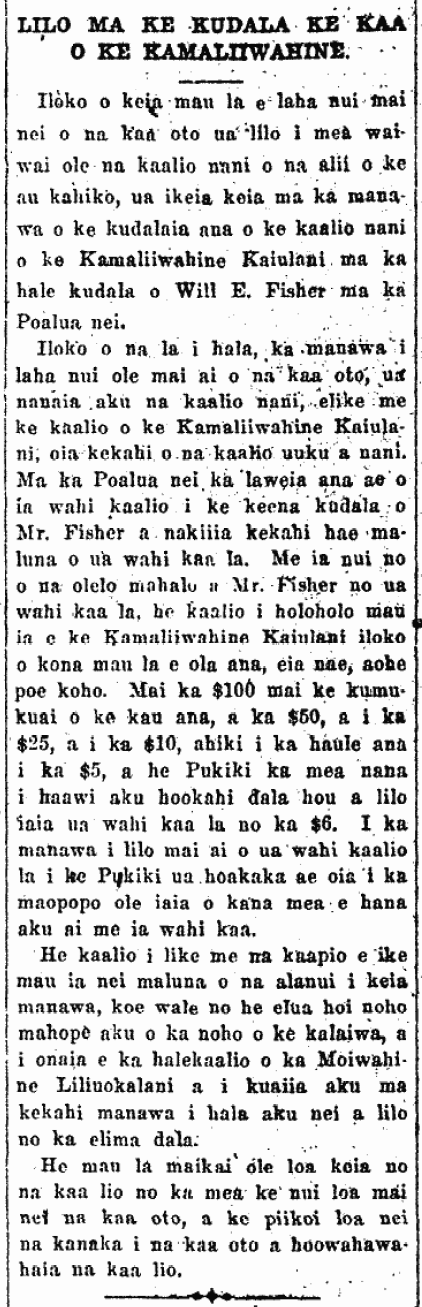
Sad fate of Kaiulani’s carriage. 1921.

THE CARRIAGE OF THE PRINCESS WAS AUCTIONED OFF.

During these days when automobiles [kaa oto] are very wide spread, the beautiful horse-drawn carriages [kaalio] of the alii of times past are obsolete, and this was seen when the lovely carriage of Princess Kaiulani was put up for auction at the auction house of Will E. Fisher this past Tuesday.

During times past, when automobiles were not so widespread, beautiful carriages were watched, like the horse-drawn carriage of Princess Kaiulani, which was one of the small and beautiful carriages around. On Tuesday, the carriage was taken to the auction house of Mr. Fisher and a flag was tied on to that vehicle. With much words of appreciation for the car by Mr. Fisher, the carriage in which Princess Kaiulani rode around in while she was living; there however were no bidders. The asking price went from $100 to $50, to $25, and to $10, until it fell to $5, and a Portuguese man added a dollar to that, and the car went to him for $6. When the carriage was won by that Portuguese man, he explained that he had no idea what he was going to do with it.

A carriage like the hacks [kaa pio] always seen on the roads today, but with two seats behind the seat of the driver, and owned by the carriage house of Queen Liliuokalani, was sold some time ago, and it went for five dollars.

These are terribly not good days for the horse-drawn carriage, because there is an abundance of automobiles, and people prefer autos while carriages are being ridiculed.

[Does anyone know what happened to Kaiulani’s carriage or the one that belonged to Liliuokalani, after they were sold, and where they are now, if they are still in existence? I have seen Keelikolani’s carriage at the Bishop Museum.]

(Kuokoa, 9/23/1921, p. 2)

LILO MA KE KUDALA KE KAA O KE KAMALIIWAHINE.

Ka Nupepa Kuokoa, Buke LIX, Helu 38, Aoao 2. Sepatemaba 23, 1921.

Mele are everywhere in the newspapers. 1907.

KA HANU O EVALINA.

1. Homai, na’u e honi aku,
I ka lau aala vabine,
He moani lau liilii,
Ka hanu o Evalina.

He anoi au e honi,
I ka nae ala vabine,
He moani lau liilii,
Ka hanu o Evalina.

2. Hui mala’nu ke aloha,
Ke hiki mai nei welawela,
Ua luhi a maopaopa,
He pali kiekie kelakela.

3. He uwila hiki aumoe,
He pakuikui oloolo,
He kulana mapuna hoe,
Kunewa i ka nui o ka holo.

4. Ua holo ka’u kaona,
Ua ikeia e ka nui manu,
Hookahi no hailona,
Ka puia aala o ka hanu.

[This mele is not preceded by an introductory article, and is given without composer. “Ka Hanu o Evalina” is credited to Kalakaua and Liliuokalani, and this is one of the variants.]

(Kuokoa, 3/21/1907, p. 5)

KA HANU O EVALINA.

Ka Nupepa Kuokoa, Buke XLII, Helu 13, Aoao 5. Maraki 21, 1907.