Unknown's avatar

About nupepa

Just another place that posts random articles from the Hawaiian Newspapers! It would be awesome if this should become a space where open discussions happen on all topics written about in those papers!! And please note that these are definitely not polished translations, but are just drafts!!! [This blog is not affiliated with any organization and receives no funding. Statements made here should in now way be seen as a reflection on other organizations or people. All errors in interpretation are my own.]

Kahili from Washington Place to go to Hanaiakamalama, 1918.

KAHILI TO BE RETURNED TO THE HOME OF EMMA.

Because Washington Place [Wakinekona Hale] will be placed under the care of Governor McCarthy, as a home for him to live in with his family, twenty-six feather standards were returned from Washington Place to the old home of Queen Emma, in the uplands of Nuuanu, under the care of the Association, the Daughters of Hawaii [Na Kaikamahine o Hawaii].

During the funeral of Queen Liliuokalani, and while her body lay in state at Kawaiahao Church and in the throne room of the palace, those kahili were something the public could visit, however, as the result of an agreement between the trustees of Queen Liliuokalani’s estate and the Association of the Daughters of Hawaii, the caring for the kahili has been transferred to the association. As has been the custom from ancient times, it was during the night that kahili of those types were moved from one place to another, and so it was that the kahili were returned in the dark of night on Sunday two weeks ago.

However, because there were not enough people to carry the kahili and march on the roads to its new home where it is hoped to be cared for, the kahili were put on cars and it was on these cars which the people who held the kahili stood.

When the cars and the kahili arrived at the entrance to the yard of the home of Queen Emma in the uplands of Nuuanu, the kahili were taken by the leaders of the Association of the Daughters of Hawaii, and its care was transferred to them.

(Kuokoa, 10/18/1918, p. 2)

HOIHOIIA NA KAHILI MA KA HOME O EMA.

Ka Nupepa Kuokoa, Buke LVI, Helu 42, Aoao 2. Okatoba 18, 1918.

Duke denied, 1913.

HE WILL BE LEFT WITHOUT GIFTS.

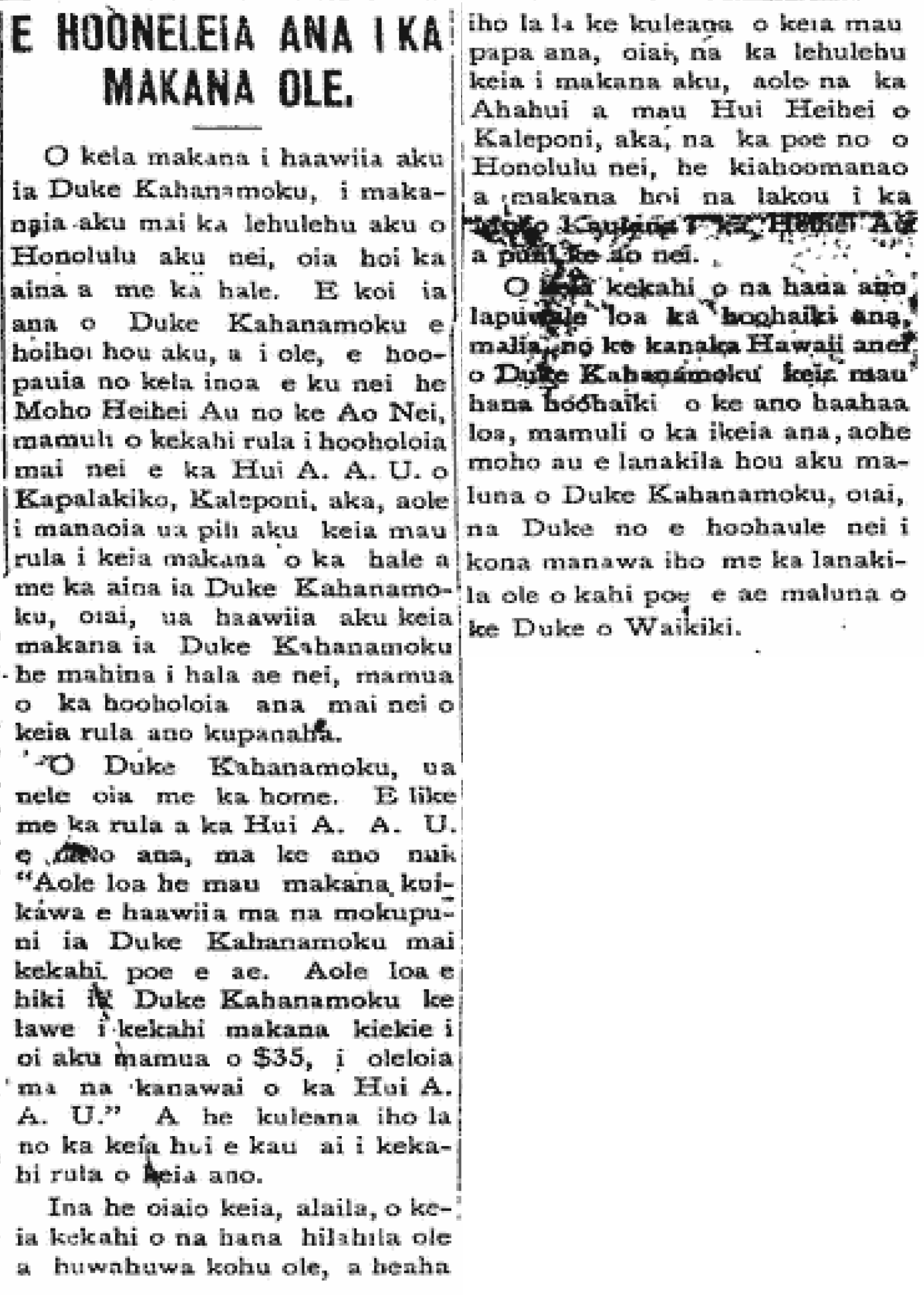
That gift was given to Duke Kahanamoku, given by the multitudes of Honolulu, that being land and a house. Duke Kahanamoku is being required to return  it, or his title of the Swimming Champion of the World will be no more, as a result of a rule just approved by the A. A. U. [Amateur Athletic Union] Association of San Francisco, California; but it is believed that this rule does not apply to this gift of land and a house to Duke Kahanamoku being that it was given to Duke Kahanamoku a month ago, before this astonishing rule was approved.

Duke Kahanamoku is left without a home. According to the rule of the A. A. U. Association, it says in general: “There shall be no special gifts given in the islands to Duke Kahanamoku from others. Duke Kahanamoku shall not be allowed to take gifts over $35, as stated in the rules of the A. A. U. Association.” And this association has authority to set rules of such nature.

Should this be true, then this is a shameless act and misplaced envy; and on what authority can this be disallowed, for  the gift is from the people and not from the Association, or Swimming Groups of California; it is from the people of Honolulu nei; it is a memorial and a gift from them to the Swimming Champion of the whole world.

This restriction is something so very contemptible; perhaps could it be because Duke Kahanamoku is Hawaiian that these terribly degrading restrictions were placed, because they knew that there would be no swimmer to triumph over Duke Kahanamoku, being that he is breaking his own records with no one else placing before the Duke of Waikiki.

(Holomua, 12/20/1913, p. 1)

E HOONELEIA ANA I KA MAKANA OLE.

Ka Holomua, Buke I, Helu 12, Aoao 1. Dekemaba 20, 1913.

Christmas at Iolani Palace, 1920.

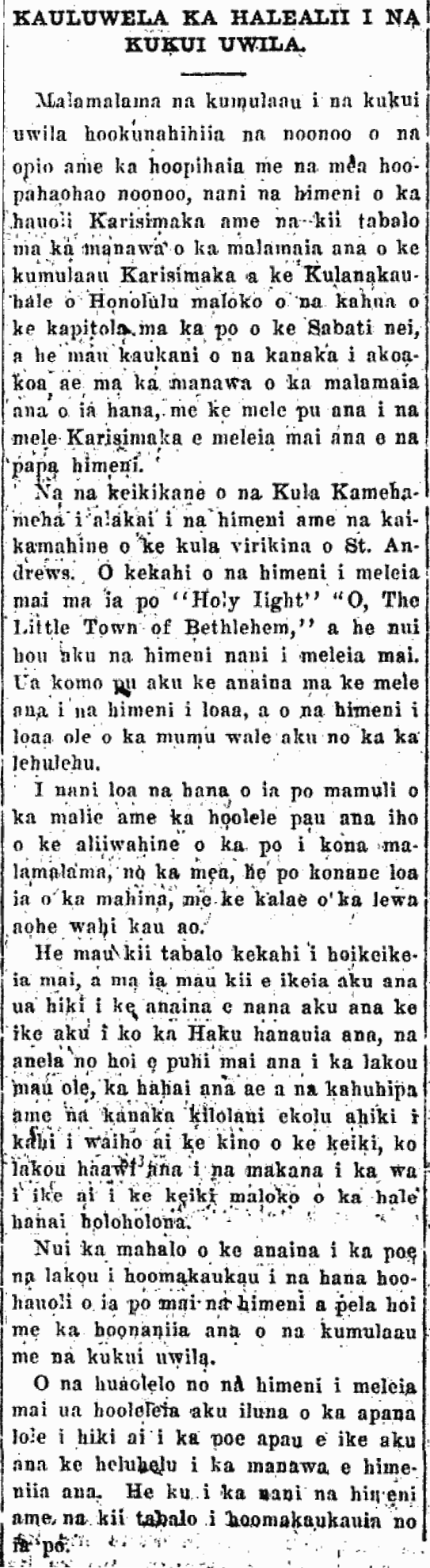
THE PALACE IS AGLOW WITH ELECTRIC LIGHTS.

The trees were bright with electric lights and the minds of the children were amazed, filled with wonder; the singing of Christmas joy and the skits were beautiful as the Christmas tree of the City of Honolulu was lit on the grounds of the capital this past Sunday; and there were thousands of people gathered while the event was held, while they sang along to Christmas carols being sung by choral groups.

The boys of the Kamehameha Schools led the singing along with the girls of the St. Andrews Priory School. Some of the songs sung that night were “Holy Light,” “O, The Little Town of Bethlehem,” a many other beautiful songs were sung. The crowd joined in the singing of the songs they knew, and when they did not know the words, they were silent.

The activities that night were wonderful because of the peace and because the queen of the night shone down her light, being this was a bright moonlit night, with a clear sky an no clouds.

There were skits performed as well, and in these performances to be seen, the crowd could watch the birth of the Lord, the angels blowing their trumpets, the following of the shepherds and the three magi to where the child lay, and their giving of gifts when they saw the child in the manger.

The audience was very appreciative of those who put on the joyous festivities that night, from the singing and so forth to the decorating of the trees with lights.

The words of the songs sung were projected onto a section of cloth so that everyone who could see could read it while the songs were being sung. The singing and the skits that were prepared for that night were wonderful.

(Kuokoa, 12/31/1920, p. 2)

KAULUWELA KA HALEALII I NA KUKUI UWILA.

Ka Nupepa Kuokoa, Buke LVIII, Helu 53, Aoao 2. Dekemaba 31, 1920.

Native plants! 2013.

There are many descriptions of plants and their uses and where they grew, found in the Hawaiian-Language Newspapers.

Check out this site from Kapiolani Community College and Leeward Community College, described as:

The goal of Native Plants Hawaiʻi (NPH) is to create and establish a single, comprehensive and searchable online knowledgebase of endemic and indigenous plants of Hawaiʻi.

NPH seeks to connect local nurseries to landscape architects and home growers to promote the purchase, use and understanding of local native plants. Information is constantly updated by participating nurseries and plant specialists.

Hopefully they will be able to integrate relevant articles from the Hawaiian-Language Newspapers into their descriptions!

Christmas acrostic, 1868.

Christmas Day.

Tomorrow is Christmas,
We should remember,
Its rays rise in triumph,
The drifting clouds lie outstretched,
Joyous were the angels, the people,
The [illegible word] beautiful day of the world;
When Jesus came down,
He became as a human,
And dwelt with us,
He shared the suffering,
And the sorrows of this world,
Weary, hurt, hungry, thirsty,
Hated, abused, scorned,
Betrayed and died,
Suspended from the cross
He died for the sins of the world,
And became our Redeemer,
Sabaoth of the whole world,
At the right hand of his father.

Tomorrow, Christmas day will arrive, and it is a day to remember in Christian lands, the day that the Savior of the world was born in human form, and he walked with the people of this world, and he bore the wounds so that those of this world would be saved, should they go before him oppressed and in woe, it is he that will give them relief.

In Christian lands, the commemoration of this day is cherished, and it is a great desire of the youth and the poor to come by, for they will receive presents. At 12 o’clock at night, a service will be held at the Catholic Church. Before we forget, we leave you while saying, “Mere Kalikimasa.”

[This poem works off the phrase “APOPO KA LA KALIKIMASA” [Tomorrow is Christmas Day]. With writing also came this new form of mele, acrostic. They are found quite often throughout the many Hawaiian-Language Newspapers.]

(Au Okoa, 12/24/1868, p. 2)

Ka La Kalikimasa.

Ke Au Okoa, Buke IV, Helu 36, Aoao 2. Dekemaba 24, 1868.

Children born on Christmas, 1920.

THERE WERE MANY BABIES BORN ON CHRISTMAS DAY.

There are perhaps many more babies that were born on Christmas Day, but there were not reported to the office of the board of health, where births must be recorded; the number reported was just five.

The babies born on Christmas day are these below:

To Mr. and Mrs. Antonio B. Andrade of Edward Street, near Mokauea, Kalihi, a boy, the name not known.

To Mr. and Mrs. John Akana Awana of South Queen Street, a son with the name Christy Ernest.

To Mr. and Mrs. Samuel J. Belisky of Miller Street, a daughter with the name Frances Jean.

To Mr. and Mrs. Joseph Correia of Kalihi Valley, a daughter with the name Mary Gertrude.

To Mr. and Mrs. Moses W. Kaululaau of Eighth Street, near Maunaloa Street in Kaimuki, a daughter with the name Nora Kahakalani.

On Christmas eve, a girl by the name Dorothy DeVaughan was born to Mr. and Mrs. Arthur Leasure of Kamehameha IV Road, Kalihi.

(Kuokoa, 12/31/1920, p. 2)

LEHULEHU NA BEBE I HANAUIA MAI MA KA LA KARISIMAKA.

Ka Nupepa Kuokoa, Buke LVIII, Helu 53, Aoao 2. Dekemaba 31, 1920.

On the name Kamehameha, 1838.

KAMEHAMEHA.

That is the name of the Alii nui of Hawaii nei. This name is known to the native people, but the spelling by the haole is confused; in their letters, this and that one’s spelling is strange. Here are what ten haole have written, each are different. All of them are old-timers. They are taken from haole documents.

1. Tameamea

2. MaihaMaiha

3. Cameamea

4. Comaamaa

5. Tomyhomyhaw

6. Tamaahmaah

7. Hameamea

8. Tomooma

9. Tamahama

10. Tamehameha

(Kumu Hawaii, 9/12/1838, p. 31.)

KAMEHAMEHA.

Ke Kumu Hawaii, Buke 4, Pepa 8, Aoao 31. Sepatemaba 12, 1838.

Now online: Guide to Sheet Music Collection from the Hawaiian Historical Society, 2013.

Guide to Sheet Music Collection Now On Line

sheet music image

The Hawaiian Historical Society library includes a modest but growing collection of Hawaiian and hapa-haole sheet music spanning the 1860s to the 1960s. An illustrated guide to the collection can now be consulted on line thanks to the work of HHS library intern Annemarie Aweau, who compiled the guide. Ron Williams photographed the cover pages of the music to provide the illustrations. (Click here to read on…)