Mauna Loa eruption, 1873.

Lava erupts on Mauna Loa.

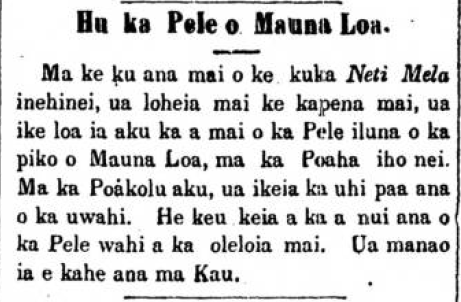
With the arrival of the schooner Nettie Merrill yesterday, heard from the captain was that they had seen the burning of Lava on top the summit of Mauna Loa this past Thursday. On the following Wednesday, seen was the spreading solid of the smoke. It is said that this is an exceptionally huge eruption. It is believed it will flow to Kau .

(Kuokoa 1/11/1873, p. 3)

Ka Nupepa Kuokoa, Buke XII, Helu 2, Aoao 3. Ianuari 11, 1879.

Where will she go? No one knows, 1880.

[Found under: “He Waiwai.”]

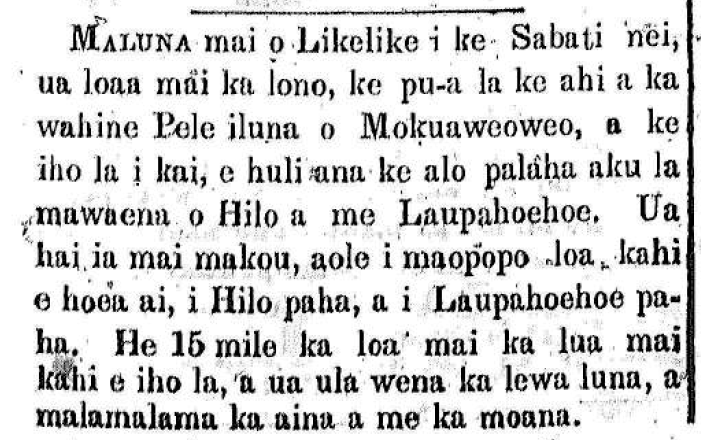
Aboard the Likelike this past Sunday, we received the news, the fires of the woman Pele were emerging from atop Mokuaweoweo, and it is headed down toward the sea. It will turn toward and flatten out between Hilo and Laupahoehoe. We were told, it is not certain where it will appear; maybe in Hilo, maybe in Laupahoehoe. It is 15 miles away from the crater from where it heads down, and the skies above glow red, and lights up the land and the sea.

(Elele Poakolu, 11/10/1880, p. 1)

Ka Elele Poakolu, Buke I, Helu 10, Aoao 1. Novemaba, 10, 1880.

Pele Consumes Hawaii, 1880.

It is believed that the beauty and the terror of this eruption at Mauna Loa will be greater than that of the earlier eruptions witnessed by those who are living. The lava will perhaps flow for a number of month more. In a letter to the Gazette newspaper from H. M. Whitney, it was said that the lava first appeared in the evening on the fifth of this month. It is thought that the crater from which the lava erupted was a little to the north of Mokuaweoweo, and it is about six miles from it. At times the lava shot up two hundred feet and crackled a bit, falling like burning charcoal. It is something remarkable to see. The night is overcome by the light of the fires. The lava flowed on the side of Mauna Loa facing Mauna Kea, and the unobstructed land lying between the two mountains is fifteen full miles in circumference is like a lake of blazing fire. It is something incomparably fierce to see. From this great lake of fire there appeared two lava flows. One that went down to the Puna and Kau side, and the second down the eastern side. According to the latest news, it is said that the lava nearly reached Volcano House [ka hale hookipa ma Kilauea]; it is only 10 miles away; as for the flow headed east, it is 15 miles from Hilo. But it is not believed that Hilo will face disaster. The kamaaina from there perhaps will not have forgotten the lava flows in the years 1855, 1859, and 1868, when people were anxious that their lives were in danger. But according to the old saying, “Aole i haawi ia o Hilo no Pele.” [Hilo shall not be given to Pele.]

Continue reading

Ka Luahine Pele, 1942.

The Old Woman Returned

But She Is Gone Once More

Because the land has entered in the war, local news cannot be published in the newspapers without being permitted by the war department. One of these local news stories is the return of the Old Woman Pele to Hawaii nei, but not to her regular home at Halemaumau, but at Mokuaweoweo.

Continue reading

“Kilauea has vanished, obscured by smoke…” 1875.

[Found under: “Nu Hou Kuloko.”]

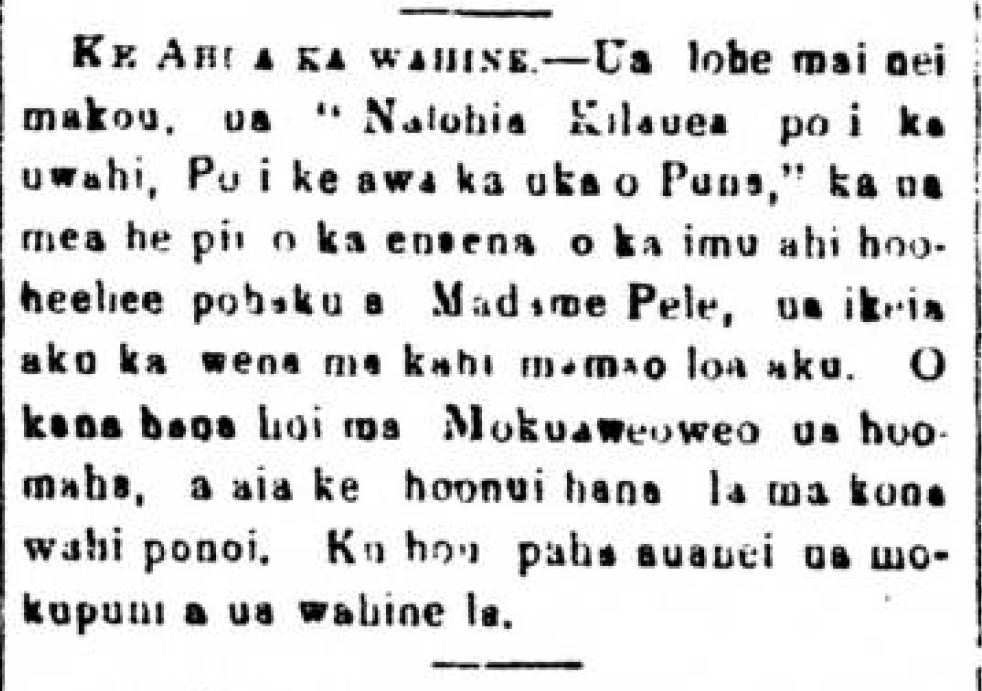
The fire of the woman.–We have heard, “Nalohia Kilauea po i ka uwahi, Po i ke awa ka uka o Puna,” [Kilauea has vanished, obscured by smoke, Obscured by the mist is the upland of Puna.] that risen is the red-heat of the fiery stone-melting oven of Madame Pele. The glow can be seen from very far off. Her activity at Mokuaweoweo has paused, and she is increasing her work at her own place. Perhaps that island of hers will recover.

(Kuokoa, 8/14/1875, p. 3)

Ka Nupepa Kuokoa, Buke XIV, Helu 33, Aoao 3. Augate 14, 1875.

Mauna Loa erupts, 1892.

EARTH-DEVOURING LAVA OF MOKUAWEOWEO.

From our many friends living all over on the island of Keawe, we recieved news of sightings of lava blazing atop the summit of Mauna Loa, from the crater of Mokuaweoweo. And we are indebt to them for their kindness. These are each of the letters showing:

Kailua, North Kona, Hawaii, Dec. 5.–1 o’clock at late night on this past Wednesday, in the Alenuihaha Channel, on the deck of the Malulani, seen was the lava of Mokuaweoweo. The red glow of the fires were incomparably great.

D. Makainai


Continue reading

From the eruption 99 years ago, 1919.

NEWS ABOUT THE LAVA IN KONA

According to the news in the Hilo Tribune newspaper from Tom C. White [Toma C. White] of Kainaliu, he reported on what he and some others witnessed of the activity of the lava these days. The lava is spouting with force from the Mauna Loa side, and it is about 7,150 feet from sea level, and the lava is spewing from six places from the side of the mountain, but these craters are joining together into a large caldera, and from this caldera, the lava flowing out into four branches. Continue reading

Volcanic activity, 1919.

Kilauea Displays Renewed Activity

According to a radiogram received by L. W. de Vis-Norton Wednesday night, a wonderful spectacle is developing at Halemaumau. The lava has risen to within 200 feet of the rim of the pit, and hundreds of fountains are in violent action. Continue reading

Eruption 150 years ago, 1868.

THE ERUPTION!

Up to Wednesday, 29th ult., there has been no further accounts of volcanic action on Hawaii. The earthquakes have ceased in violence and frequency, although the whole islands is still moved by slight vibrations. There was a smart shock felt in Kohala on Thursday, also the same day, a slight vibration here in Honolulu.

There are reports that the lava has again broken out in Kapapala, but we do not credit it.

We are happy to give our readers a clear and intelligent account of the late volcanic action on Hawaii, from the pen of the Hon. William Hillebrand, M. D., who has just returned from a close examination of the disturbed districts.

The account of the lava fissure at Kahuku, is entirely new to the public. H. I. M.’s Commissioner and Consul, M. Beranger, who made the tour with Dr. Hillebrand, has made a number of sketches of the most interesting volcanic appearances. Continue reading

More on prolific Charles Furneaux, 1881.

Mr. Furneaux’s Paintings.

A very interesting series of oil paintings by Mr. Furneaux is to be seen in the tower room of the Government Building [Aliiolani Hale]. These are chiefly sketches of the volcanic phenomena which have been displayed on Hawaii since November last. Having been on the spot from the beginning of the eruption, and taking a great interest in it, Mr. Furneaux has been able to secure illustrations of all its phases during the progress of the flow, from its source to the immediate proximity of the sea. The first of the series is a view taken from Kawaihae, in November last, after the flow had divided into two or more streams; one the Kau stream, which, after threatening the Kapapala Plantation, has long since ceased to flow; another the flow towards the plateau between Maunaloa and Maunakea, which, after many windings and doublings, is now threatening the town and harbor of Hilo. The next view was taken from Hilo Bay, and shows the three streams which were so conspicuous on the face of the mountain in November last. Immediately after his arrival Mr. Furneaux paid a visit to the crater of eruption, which is situated at an elevation of about 12,000 feet, or about 2,000 feet below the summit of the mountain. Three of the paintings depict this crater, one being from a point which gives a view of its interior. Another picture gives a near view of the blow-hole, or secondary crater, from which a discharge of lava was noticed on December 3rd. The next group of paintings gives us vivid illustrations of the conditions of things near Hilo in April and May last. In the former month Mr. Furneaux obtained a fine view of the main flow, as it appeared in the woods about eight miles from Hilo, at the time when its whole width of two to two and a half miles was in a molten and very active state, just at a point where the Puna, Waiakea and Hilo flows were being separately developed from it. In this picture we have a fine illustration of the “volcano cloud” with its deep red tinge looking more fiery than the very lava whose glow it reflects. The next of the series shows the curious phenomena of a waterspout on the lava flow, a sight frequently witnessed when the front face of the stream was lingering in the woods. Another picture also taken in April at the same distance from Hilo, shows the black and broken surface of the flow of 1856 and this new and greater flow creeping up to and over it. The next series of sketches were of the Waiakea flow taken two months before the sudden outburst by which it has threatened the sugar mill. One is of the artist’s camp in a dense growth of ohias, tree-ferns and wild bananas close to the edge of the flow. Another sketch from the tent door pictures some bananas, ferns and creepers with the red glare from the lava as a background. A third is a daylight view of the flow showing the havoc made in the lovely forest thus cruelly invaded. This sketch was taken when one tall ohia remained still erect with lava all round it. John Hall, whose place has since been destroyed, was Mr. Furneaux’s guide, and the latter made a sketch of his house before its fate was anticipated. This view was taken in May; a companion picture shows everything overwhelmed except a tree and part of the fence, with an extraordinary pit in the foreground, revealing the liquid lava flowing beneath the cooled crust. Later in May Mr. Furneaux paid a visit to what is known as the Hilo flow. Among the group of sketches then taken is one of the advanced part of the flow, with a group of Hawaiians getting specimens in the foreground; a sketch of Hale Laumaia, with the volcanic cloud hanging over the wooded scenery of the background; a sketch of the flow at the moment of one of the gas explosions, which are common when the lava is passing over the surface of previous flows, and penetrating into the caverns which about in the dead lava. Then comes a sketch in which we have a cascade of lava falling over a ledge of bare rock, and by way of contrast to its lurid fire, the flame of burning timber and undergrowth on the right hand of the picture. Following this series is a picture of the Waiakea flow as seen from a distance before its sudden advance; also a sketch of H. H. Ruth Keelikolani’s place, where that flow will probably reach the sea. The last group are from sketches taken late in July, after the Waiakea flow had pushed forward with so much violence. One of John Hall’s property has already been alluded to; another shows the lava flowing over a precipice about 60 feet wide, and 14 or 15 feet high, into a great pool of water—a scene already familiar to us through Mr. Dickson’s photographs; and a third shows the Waiakea mill, and the position of the flow on 25th July, with the intervening land. One interesting picture shows the way in which the lava at times pushes its way forward, throwing out snake-like tongues of fire from the black front of the stream.

Besides these paintings, there are some pictures of Halemaumau, and some views of forest and mountain scenery. Mr. Furneaux has also a number of other pictures, which he has not at present opened out for the public view, as he intends to return at once to Hilo to increase his store of sketches, and to catch, if possible, the lava stream in the very act of precipitating itself into the sea.

(Pacific Commercial Advertiser, 8/13/1881, p. 3)

PCA_8_13_1881_3.png

The Pacific Commercial Advertiser, Volume XXVI, Number 7, Page 3. August 13, 1881.