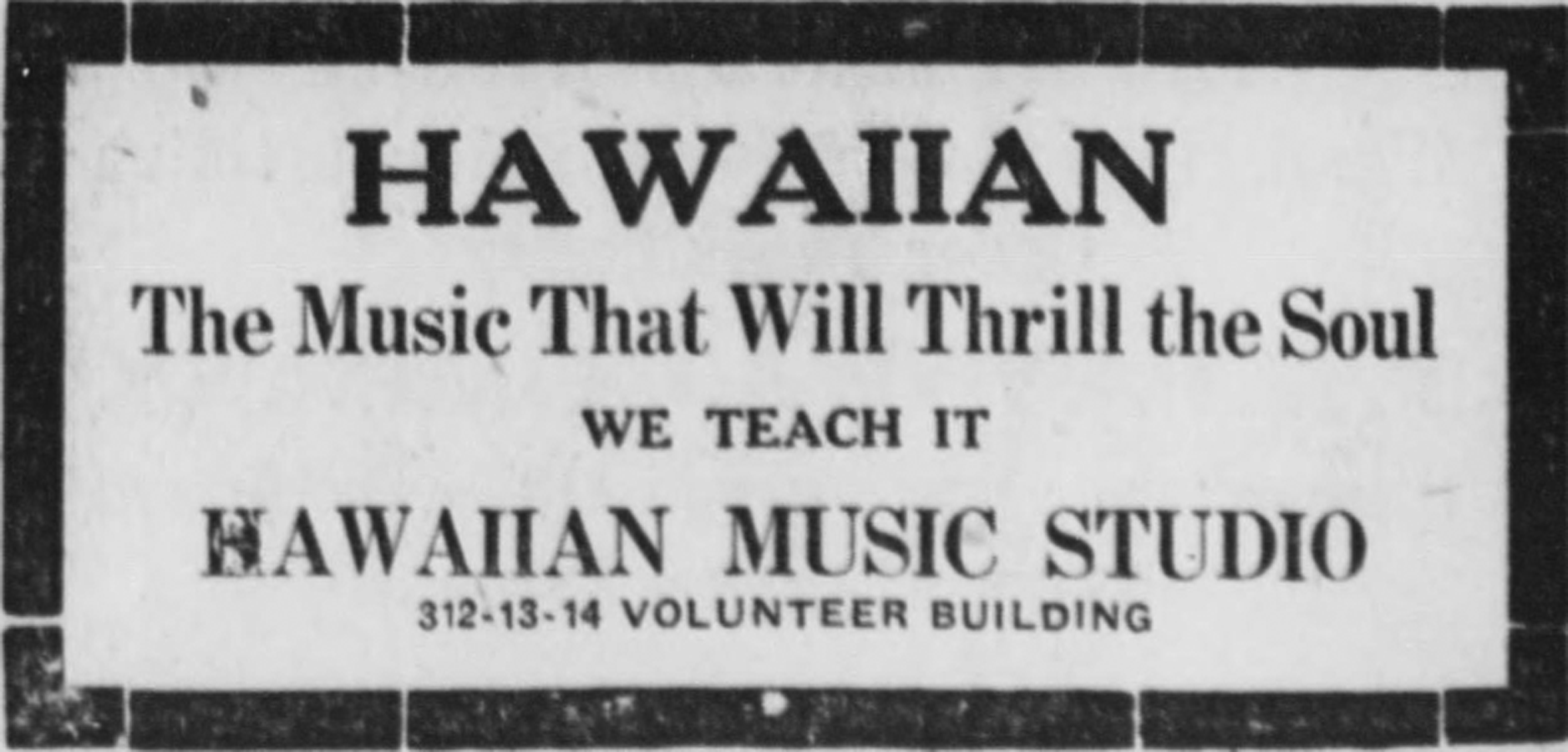
HAWAIIAN
The Music That Will Thrill the Soul
WE TEACH IT
HAWAIIAN MUSIC STUDIO
312-13-14 VOLUNTEER BUILDING
(Chattanooga News, 2/27/1920, p. 6)
The Chattanooga News, Volume XXXII, Number 50, Page 6. February 27, 1920.

WE TEACH IT
HAWAIIAN MUSIC STUDIO
312-13-14 VOLUNTEER BUILDING
(Chattanooga News, 2/27/1920, p. 6)
The Chattanooga News, Volume XXXII, Number 50, Page 6. February 27, 1920.
ZACHARY PALI JR.
Mr. Sol. Hanohano, Editor of the Nupepa Kuokoa, Aloha between us:—Please allow me in your boundless patience an open space in our untiring precious [newspaper] to carry this sad news all over the islands so that the multitudes, the family, and friends living from where the sun appears to where the sun sets at Lehua may know.
On the 9th of July of this year, at 5 o’clock a. m., we met with a letter informing us that our child, Zachary Pali Jr. had gone on the road of no return. Auwe, how painful and sorrowful, and we did not see how he looked when the beloved body of my dear child was left in foreign lands, at Chicago, Illinois.
My beloved child was born in Kaunakakai, Molokai, from the loins of Mrs. Rose Pali Kamohakau, in the year 1897, July 22, and he spent 22 years, 7 months, and 17 days breathing in the cool and pleasant air of this earth, when his life spirit given by God glided off, leaving his body for the bowels of the earth; for the body of man is a bit of dust, and dust returns to dust.
On the 9th of May of this year he left his friends, and left as well his parents and family, who are mourning and heavyhearted.
My beloved child left his land of birth, and went with his musician friends on the 8th of December 1916. My dear child and his friends went around different cities totaling 125, and went back to Chicago, Illinois, leaving his cold body for the bowels of the earth. Auwe, how regretful and saddened I am for my child, my dear child of my youth. Auwe for my beloved one!
It is God who blesses us all, and it is He who will lessen the sorrow and sadness that weighs upon us. Let us give much glory to God, for it is He who creates and He who takes away.
With much appreciation to the Editor and the workers.
We with aloha,
ZACHARY PALI PAHUPU,
MRS. ROSE P. PAHUPU,
MRS. ROSE KUALAAU,
J. S. NAILAU PAHUPU.
[I wonder if Zachary Pali Jr. has a marked grave somewhere in Illinois…]
(Kuokoa, 7/18/1919, p. 4)

Ka Nupepa Kuokoa, Buke LVII, Helu 29, Aoao 4. Iulai 18, 1919.
WITHIN THREE months a stalwart Hawaiian will leave Honolulu and journey to London to attend the reunion of the survivors of one of England’s wars of conquest fought more than thirty years ago. Upon the Hawaiian’s body are the scars inflicted by sword, spear and bullets, received while he was fighting under the flag of St. George in the service of Queen Victoria upon the battlefields of Southern Africa. According to a romantic story which the Hawaiian tells, few amongst the veterans who will gather in the capital of the British nation will have more honorable records for bravery and conspicuous gallantry in the face of a dark-skinned enemy than he, and few will there be whose entire lives are so wrapped in a halo of romance. Linked with this Hawaiian’s life are those of Kings and Queens, Dukes and Admirals, Generals and Captains, and yet today he is an humble resident of the Hawaiian Islands. Continue reading
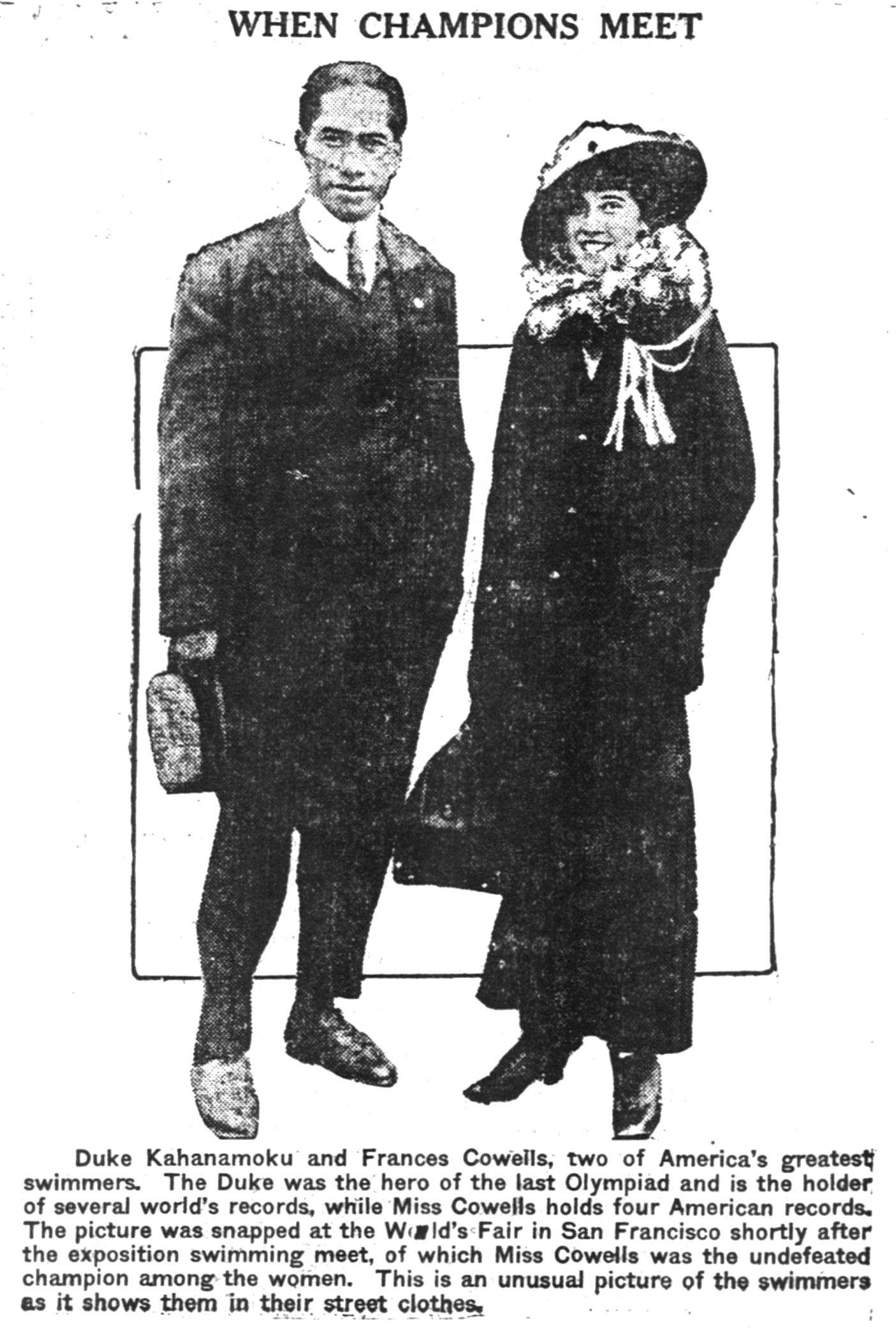
Duke Kahanamoku and Frances Cowells, two of America’s greatest swimmers. The Duke was the hero of the last Olympiad and is the holder of several world’s records, while Miss Cowells holds four American records. The picture was snapped at the World’s Fair in San Francisco shortly after the exposition swimming meet, of which Miss Cowells was the undefeated champion among the women. This is an unusual picture of the swimmers as it shows them in their street clothes.
(Day Book, 8/11/1915, p. 24)
The Day Book, Volume 4, Number 268, Page 24. August 11, 1915.
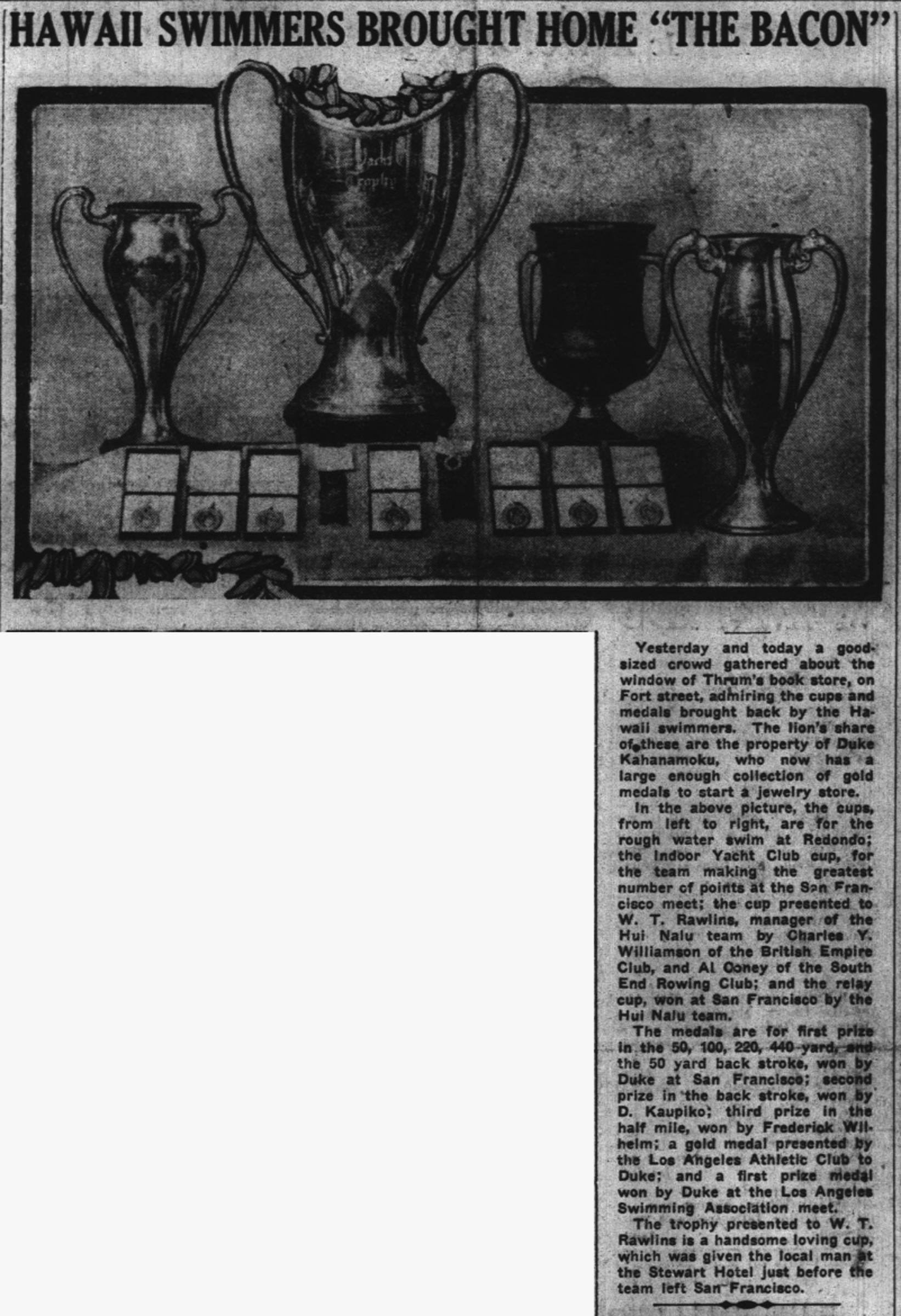
Yesterday and today a good-sized crowd gathered about the window of Thrum’s book store, on Fort street, admiring the cups and medals brought back by the Hawaii swimmers. The lion’s share of these are the property of Duke Kahanamoku, who now has a large enough collection of gold medals to start a jewelry store.
In the above picture, the cups, from left to right, are for the rough water swim at Redondo; the Indoor Yacht Club cup, for the team making the greatest number of points at the San Francisco meet; the cup presented to W. T. Rawlins, manager of the Hui Nalu team by Charles Y. Williamson of the British Empire Club, and Al Coney of the South End Rowing Club; and the relay cup, won at San Francisco by the Hui Nalu team.
The medals are for first prize in the 50, 100, 220, 440 yard, and the 50 yard back stroke, won by Duke at San Francisco; second prize in the back stroke, won by D. Kaupiko; third prize in the half mile, won by Frederick Wilhelm; a gold medal presented by the Los Angeles Athletic Club to Duke; and a first prize medal won by Duke at the Los Angeles Swimming Association meet.
The trophy presented to W. T. Rawlins is a handsome loving cup, which was given the local man at the Stewart Hotel just before the team left San Francisco.
[I wonder if we will be able to see any of these at the upcoming Duke exhibit at the Bishop Museum!]
(Honolulu Star-Bulletin, 7/22/1913, p. 9)
Honolulu Star-Bulletin, Volume XX, Number 6643, Page 9. July 22, 1913.
Duke Kahanamoku’s Trophy Is Utilized by Colonel Parker for Purpose Designed
Aboard the liner Sierra a loving cup was used yesterday for the purpose for which it was designed.
The cup was one of the trophies carried home by Duke Kahanamoku, the Hawaiian swimmer, who sailed on the vessel for his home.
Colonel Sam Parker was also a passenger. The colonel insisted on filling the cup with champagne. He then invited Duke’s friends into the Sierra’s saloon and, passing the brimming bowl to a pretty girl, begged her to drink [to] the dark skinned swimmer’s health.
Until the cup was empty everybody was Duke’s devoted friend.
(San Francisco Call, 8/13/1913, p. 4)
The San Francisco Call, Volume 114, Number 74, Page 4. August 13, 1913.
WHEN IT COMES TO A SWIMMING RACE, Duke Kahanamoku is as hard to beat as his name is to pronounce, and then some. Experts say this world’s champion is the last word of perfection in sprint swimming.
(Evening Public Ledger, 8/24/1918, p. 20)

Evening Public Ledger and The Evening Telegraph, Volume IV, Number 294, Page 20. August 24, 1918.
Athletes of the United States are looking to Duke Kahanamoku, full-blooded Hawaiian, as the only man on the Olympic team from this country who has a chance to win a place in the swimming events.
Kahanamoku is one of the best swimmers ever developed in Hawaii. The warm waters there make it possible to spend the whole day in the surf without becoming chilled, and from childhood the Hawaiians swim more than they walk, that is the younger ones do.
Duke has been tried out repeatedly and his speed and endurance won him a place on Uncle Sam’s Olympic team.
(Day Book, 7/3/1912, p. 29)
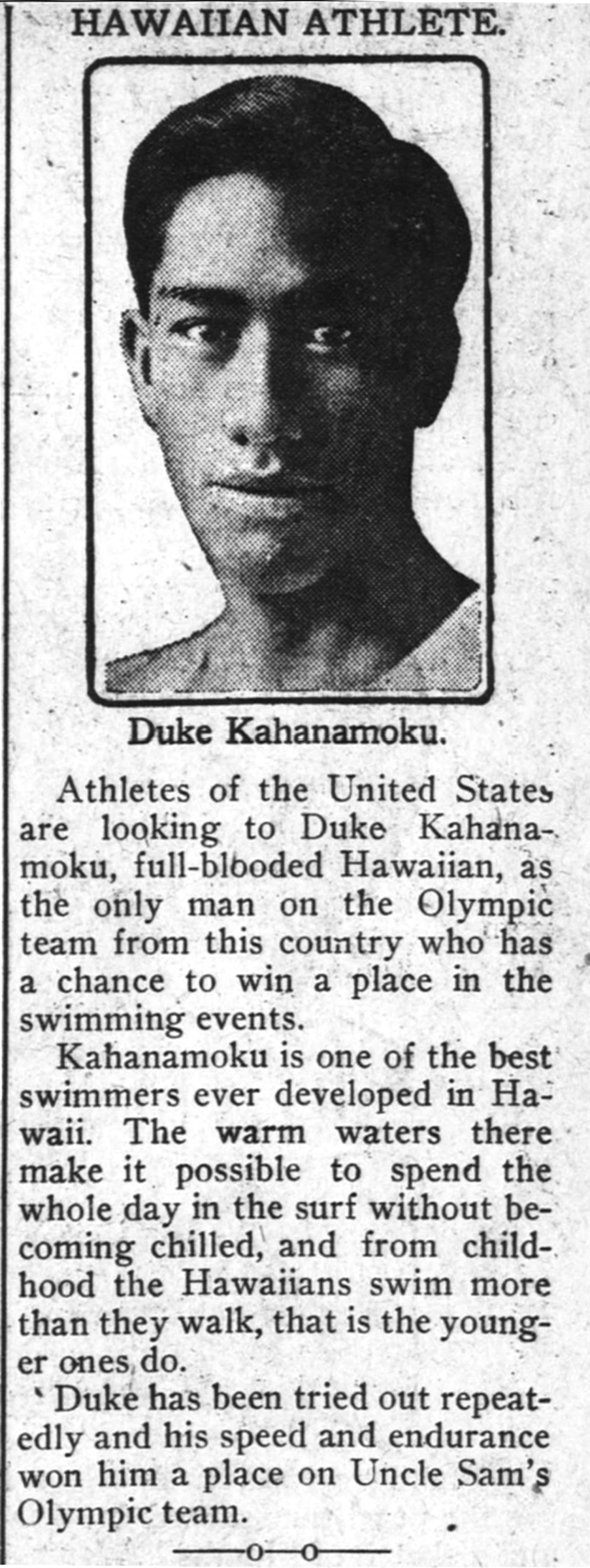
The Day Book, Volume 1, Number 240, Page 29. July 3, 1912.
Because of the brave and fearless rescue carried out by Duke P. Kahanamoku, the famous swimming champion of the world, just recently at Newport, California, in saving the lives of eight people from death, he was sent a gift of a medal to honor him, last Wednesday with a letter from Governor Farrington.
The news of this rescue carried out by Duke P. Kahanamoku arrived in this town, therefore, some people of Honolulu donated a sum of money to purchase a medal to present to him.
This presentation medal was sent along with a letter from the governor to Lorrin Andrews, living in Los Angeles, as the president of the Hawaiian Club of South California [Kalapu Hawaii ma Kalepooni Hema], and from that club the gift will be given to Mr. Kahanamoku.
[I noticed today’s post by Bishop Museum announcing their upcoming exhibit on this hero, Duke Paoa Kahanamoku!]
(Kuokoa, 8/27/1925, p. 4)
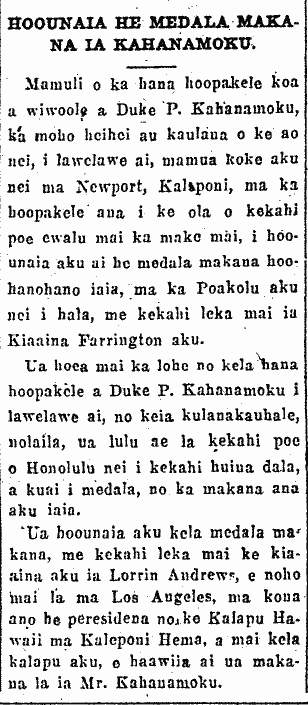
Ka Nupepa Kuokoa, Buke LXIV, Helu 35, Aoao 4. Augate 27, 1925.
O Mr. Editor of the Kuokoa, Aloha a nui:—Please in your kindness allow me some space in your thing of pride, so that the family and friends of my dear husband, Joseph Kahaulelio, may know that he left this life from the home of his daughter, Mrs. Kuuleialoha Whaley, at Pearl City, Ewa, on Monday, Aug. 18, 1924, at 2 o’clock p. m., before me, his wife, and our children and grandchildren, on that evening that he was taken by the Borthwick Company to Honolulu to be cleansed.
My husband was born at Honouliwai, Molokai, by Kamaka (f) and Joseph Naoo (m); there were three children, and the elder sibling and younger sibling of my husband were taken earlier, leaving just him, but there are many children and grandchildren living who…
JOSEPH KAHAULELIO NAOO.
…are living, who grieve from this side.
In the days of his youth, his occupation was caring for horses and breaking in new horses, and because he was proficient at this work, he became important to his employers, and as his bosses were getting ready to leave Hawaii nei, they instructed him to take a wife, and he carried out their instructions, and when his bosses were ready to go back, they urged Joseph Kahaulelio and his wife to go along to California, and their wishes were followed without any hesitation or uncertainty; his bosses instructed them to make ready, for they would be leaving Maui behind with Los Angeles as their destination, and they went with their bosses over the sea to this foreign land, and there he lived and worked with his beloved employers, Mr. and Mrs. Willie Bailey, for nine years, and from their garden sprang three children, two girls and one boy, and because his companion, his first wife, left him, he asked his employers to let him go back to the land of his birth, and when he stepped onto the shores of his birth sands, his heavy thoughts were lightened, and after living with his children, he found a new wife, this being his second wife, and this mother died as well, and he married once again with me, and in my bosom he grew weary of me and the children and grandchildren of ours.
He lived and worked aboard the government refuse collecting scow on the sea for a number of years, and was a sweeper at the dock, and he stayed there for a long time, for thirty years, and during the last session of the legislature he was one who received livelihood support.
My husband has a big family now living: three children with sons-in-law, sixteen grandchildren, and one great-grandchild, the precious pearls given by God as a monument to him.
He was a brethren of the joint Kawaiahao and Moiliili Church. It is He who giveth and He who taketh away; blessed always be His holy name.
Me in sorrow,
MRS. ANA KAHAULELIO,
And the Family.
(Kuokoa, 9/4/1924, p. 6)

Ka Nupepa Kuokoa, Buke LXIII, Helu 36, Aoao 6. Sepatemaba 4, 1924.
 nupepa