
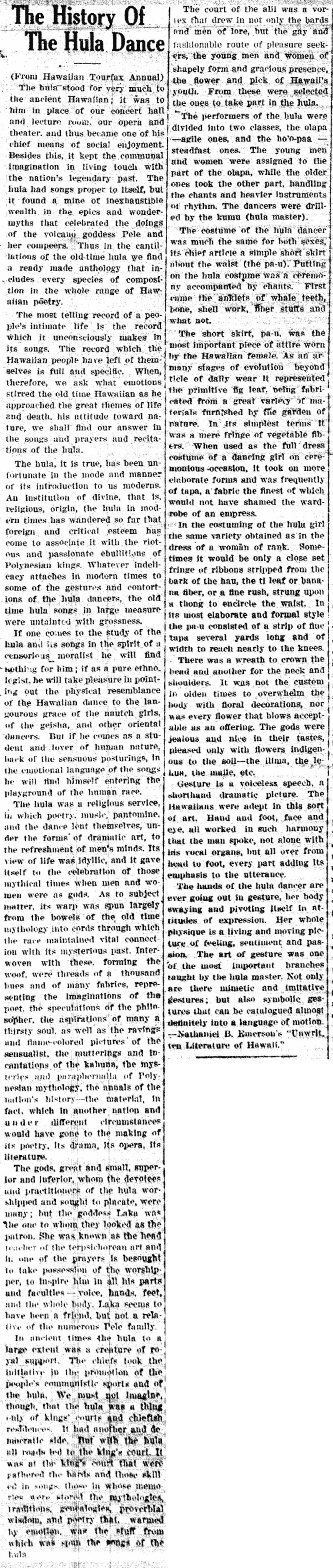
The History Of The Hula Dance
(From Hawaiian Tourfax Annual)
The hula stood for very much to the ancient Hawaiian; it was to him in place of our concert hall and lecture room our opera and theater, and thus became one of his chief means of social enjoyment. Besides this, it kept the communal imagination in living touch with the nation’s legendary past. The hula had songs proper to itself, but it found a mine of inexhaustible wealth in the epics and wonder myths that celebrated the doings of the volcano goddess Pele and her compeers. Thus in the cantillations of the old time hula we find a ready made anthology that includes every species of composition in the whole range of Hawaiian poetry.
The most telling record of a people’s intimate life is the record which it unconsciously makes in its songs. The record which the Hawaiian people have left of themselves is full and specific. When, therefore, we ask what emotions stirred the old Hawaiians as he approached the great themes of life and death, his attitude toward nature, we shall find our answer in the songs and prayers and recitations of the hula.
The hula, it is true, has been unfortunate in the mode and manner of its introduction to us moderns. An institution of divine, that is, religious, origin, the hula in modern times has wandered so far that foreign and critical esteem has come to associate it with the riotours and passionate ebullitions of Polynesian kings. Whatever indelicacy attaches in modern times to some of the gestures and contortions of the hula dancers, the old time hula songs in large measure were untainted with grossness.
If one comes to the study of the hula and its songs in the spirit of a censorious moralist he will find nothing for him; if as a pure ethnologist, he will take pleasure in pointing out the physical resemblance of the Hawaiian dance to the langourous race of the nautch girls, of the geisha, and other oriental dancers. But if he comes as a student and lover of human nature, back of the sensuous posturings, in the emotional language of the songs he will find himself entering the playground of the human race.
The hula was a religious service, in which poetry, music, pantomine, and the dance lent themselves, under the forms of dramatic art, to the refreshment of men’s minds. Its view of life was idyllic, and it gave itself to the celebration of those mythical times when men and women were as gods. As to subject matter, its warp was spun largely from the bowels of the old time mythology into cords through which the race maintained vital connection with its mysterious past. Interwoven with these, forming the woof, were threads of a thousand hues and of many fabrics, representing the imaginations of the poet, the speculations of the philosopher, the aspirations of many a thirsty soul, as well as the ravings and flame-colored pictures of the sensualist, the mutterings and incantations of the kahuna, the mysteries and paraphernalia of Polynesian mythology, the annals of the nation’s history—the material, in fact, which in another nation and under different circumstances would have gone to the making of its poetry, its drama, its opera, its literature.
The gods, great and small, superior and inferior, whom the devotees and practitioners of the hula worshipped and sought to placate, were many; but the goddess Laka was the one to whom they looked as the patron. She was known as the head teacher of the terpsichorean art and its one of the prayers is besought to take possession of the worshipper, to inspire him in all his parts and faculties—voice, hands, feet, and the whole body. Laka seems to have been a friend, but not a relative of the numerous Pele family.
In ancient times the hula to a large extent was a creature of royal support. The chiefs took the initiative to the promotion of the people’s communistic sports and of the hula. We must not imagine, though, that the hula was a thing only of kings’ courts and chiefish residences. It had another and democratic side. But with the hula all roads led to the king’s court. It was at the king’s court that were gathered the bards and those skilled in songs, those in whose memories were stored the mythologies, traditions, genealogies, proverbial wisdom, and poetry that warmed by emotion, was the stuff from which spun the songs of the hula.
The court of the alii was a vortex that drew not only the bards and men of lore, but the gay and fashionable route of pleasure seekers, the young men and women of shapely form and gracious presence, the flower and pick of Hawaii’s youth. From these were selected the ones to take part in the hula.
The performers of the hula were divided into two classes, the olapa—agile ones, and the hoolapa—steadfast ones. The young men and women were assigned to the part of the olapa, while the older ones took the other part, handling the chants and heavier instruments of rhythm. The dancers were drilled by the kumu (hula master).
The costume of the hula dancer was much the same for both sexes, its chief article a simple short skirt about the waist (the pa-u). Putting on the hula costume was a ceremony accompanied by chants. First came the anklets of whale teeth, bone, shell work, fiber stuffs and what not.
The short skirt, pa-u, was the most important piece of attire worn by the Hawaiian female. As an article of daily wear it represented many stages of evolution beyond the primitive fig leaf, being fabricated from a great variety of materials furnished by the garden of nature. In its simplest terms it was a mere fringe of vegetable fibers. When used as a full dress costume of a dancing girl on ceremonious occasion, it took on more elaborate forms and was frequently of tapa, a fabric the finest of which would not have shamed the wardrobe of an empress.
In the costuming of the hula girl the same variety obtained as in the dress of a woman of rank. Sometimes it would be only a close set fringe of ribbons stripped from the bark of the hau, the ti leaf or banana fiber, or a fine rush, strung upon a thong to encircle the waist. In its most elaborate and formal style the pa-u consisted of a strip of fine tapa several yards long and of width to reach nearly to the knees.
There was a wreath to crown the head and another for the neck and shoulders. It was not the custom in olden times to overwhelm the body with floral decorations, nor was every flower that blows acceptable as an offering. The gods were jealous and nice in their tastes, pleased only with flowers indigenous to the soil—the ilima, the lehua, the maile, etc.
Gesture is a voiceless speech, a shorthand dramatic picture. The Hawaiians were adept in this sort of art. Hand and foot, face and eye, all worked in such harmony that the man spoke, not alone with his vocal organs, but all over from head to foot, every part adding its emphasis to the utterance.
The hands of the hula dancer are ever going out in gesture, her body swaying and pivoting itself in attitudes of expression. Her whole physique is a living and moving picture of feeling, sentiment and passion. The art of gesture was one of the most important branches taught by the hula master. Not only are there mimetic and imitative gestures; but also symbolic gestures that can be catalogued almost definitely into a language of motion.—Nathaniel B. Emerson’s “Unwritten Literature of Hawaii.”
(Hoku o Hawaii, 4/26/1939, p. 3)
Ka Hoku o Hawaii, Volume XXXIII, Number 52, Aoao 3. April 26, 1939.

 nupepa