A Mele for the Returning of Sovereignty to the Land, 1847

HE MELE NO KA HOʻI HOU MAI O KE EA O KA ʻĀINA

E mele me ka hoʻomaikaʻi,
Hauʻoli pū kākou a pau,
Ka ea o Hawaiʻi nei,
Ua lilo a ua hoʻi hou mai.

Mai pio kō Hawaiʻi nei,
Mai noho kauā hoʻi nā aliʻi,
I kēia wā, ua hoʻi hou mai,
Ka ea o ka ʻāina nei.

Aloha ko kākou Mōʻī,
Aloha hoʻi nā aliʻi a pau,
E ola me ka pōmaikaʻi,
Ke aupuni me ka nani mau.

Aloha ke aliʻi moku hoʻi,
E kau ka lei ma kona poʻo,
Ka haole holokikī mai,
E hoʻopakele iā kākou.

E ke Akua nani ē,
He kamahaʻo kau hana nei,
Iā ʻoe nō ka hoʻomaikaʻi,
No kēia hae i kau mai nei.

[Sing with gratitude,
Let us all be happy,
The sovereignty of Hawaiʻi nei,
Was lost and has returned.

Hawaiʻi’s people were nearly captives,
The chiefs were nearly servants,
Now, it has returned,
The sovereignty of the land.

Aloha to our Sovereign,
Aloha to all the chiefs,
Thrive with the blessing
A nation of everlasting glory.

Aloha to the ship’s officers,
Place a lei upon his head,
The haole that sailed speedily,
To set us free.

O glorious God,
Wondrous are your works,
Thanks is yours,
For this flag that was raised.]
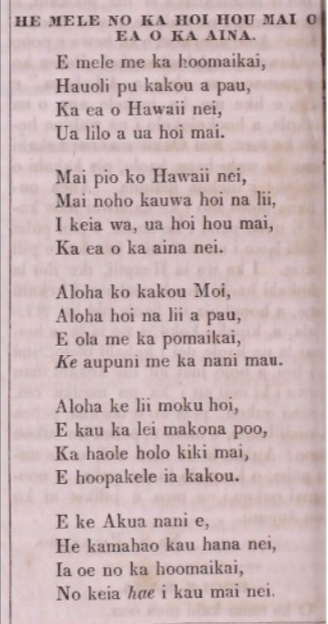
Ka Elele, Buke 3, Pepa 8, Aoao 64. Iulai 15, 1847.

What should and should not be printed in the newspapers, 1864.

South Kona, Hawaii
12 of December, 1864.

Rev. L. H. Gulick; Aloha oe:–

At the meeting of church leaders here in South Kona, on the 9th of this month, I was selected as the Committee to write to you about some opinions decided upon by that assembly, pertaining to the newspaper you are thinking to publish. And here are those opinions:

First. They discussed with much consideration words that are appropriate to publish in the Kuokoa Newspaper, and those that are improper. And they believe it is not proper to publish Hawaiian mele in the newspaper. They believe that by publishing mele in the newspaper, it will lead the young ones of the lahui toward its old ways. Being that some mele published in Whitney’s Kuokoa ; the extremities of this nation have much delight in those mele, and they are memorized by the youth; just like this mele:

“O Kilauea no ke aloha,
O ka ihu lolilua i ka ale.”

Kilauea is beloved,
Its prow unstable on the billows.”

And so forth, and there are many mele of that nature.

Second. The Assembly believes it is improper to publish certain local news of Hawaii nei, such at this. People start to hula on Kauai, and someone there sees this and announces it in the newspaper. That announcement to them is something inappropriate to print in the newspaper. It will give people living on the other islands the idea to imitate this behavior.

But they consider it is proper to print in the newspapers should hula practitioners from this location or that location be punished under the law.

Third. The Assembly believes that fighting words and filth should not be constantly printed in the newspaper–That is what they decided to report to you through me.

Aloha olua,
J. W. Kupakee, Committee.

(Kuokoa, 12/24/1864, p. 5)

Ka Nupepa Kuokoa, Buke III, Helu 52, Aoao 5. Dekemaba 24, 1864.

Hush, My Dear, Say Nothing Lest the Winds Arise, 1932.

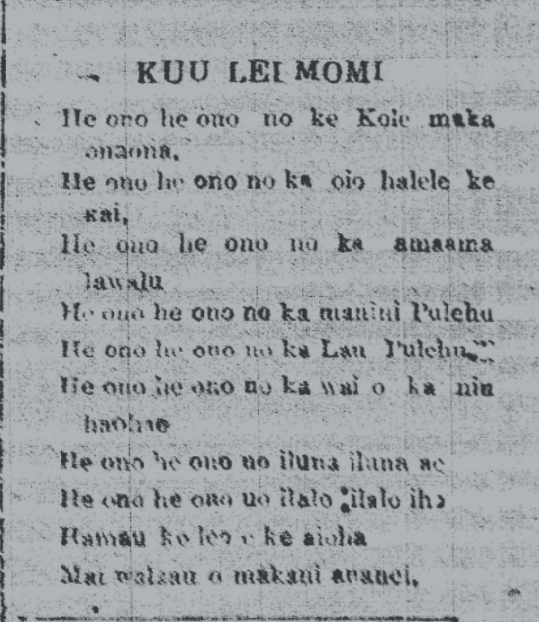
Kuu Lei Momi

He ono, he ono no ke kole maka onaona,
He ono, he ono no ka oio halale ke kai,
He ono, he ono no ka amaama lawalu,
He ono, he ono no ka manini pulehu,
He ono, he ono no ka luau pulehu,
He ono, he ono no ka wai o ka niu haohao,
He ono, he ono no i luna, i luna ae,
He ono, he ono no i lalo, i lalo iho,
Hamau ko leo e ke aloha,
Mai walaau o makani auanei.

(Hoku o Hawaii, 10/4/1932, p. 4)

Ka Hoku o Hawaii, Buke XXVI, Helu 17, Aoao 4. Okatoba 4, 1932.

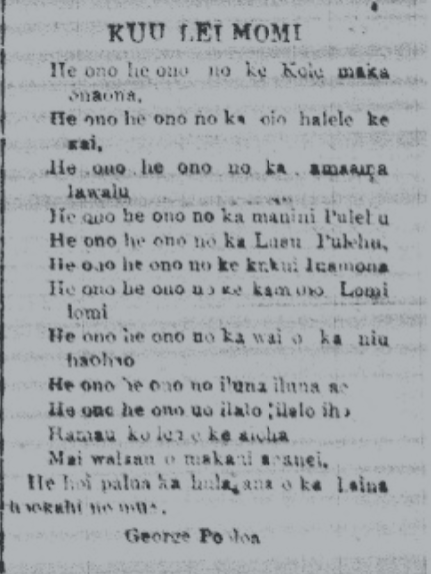
Kuu Lei Momi

He ono, he ono no ke kole maka onaona,
He ono, he ono no ka oio halale ke kai,
He ono, he ono no ka amaama lawalu,
He ono, he ono no ka manini pulehu,
He ono, he ono no ka luau pulehu,
He ono, he ono no ke kukui inamona,
He ono, he ono no ke kamano lomilomi,
He ono, he ono no ka wai o ka niu haohao,
He ono, he ono no i luna, i luna ae,
He ono, he ono no i lalo, i lalo iho,
Hamau ko leo e ke aloha,
Mai walaau o makani auanei.

He hoi palua ka hula ana o ka laina hookahi no mua.

George Pooloa.

(Hoku o Hawaii, 9/13/1932, p. 2)

Ka Hoku o Hawaii, Buke XXVI, Helu 14, Aoao 2. Sepatemaba 13, 1932

Mrs. Kala of Honuakaha, composer of many patriotic mele, 1893.

Does anyone know who Mrs. Kala was?

“He Wehi no Liliulani”

“He Wehi no ka Lahui”

“He Wehi no Hawaii”

“He Lei no Kaiulani”

“He Wehi no Ailuene Buki’

“He Ohu no Kaiulani”

“He Wehi no ka Lahui”

“He Lei no Kawananakoa”

“He Lei no Nawahi”

“He Wehi no Le’akahele”

“He Inoa no Napelakapu”

A mele honoring William Ulunui Sheldon, 1891.

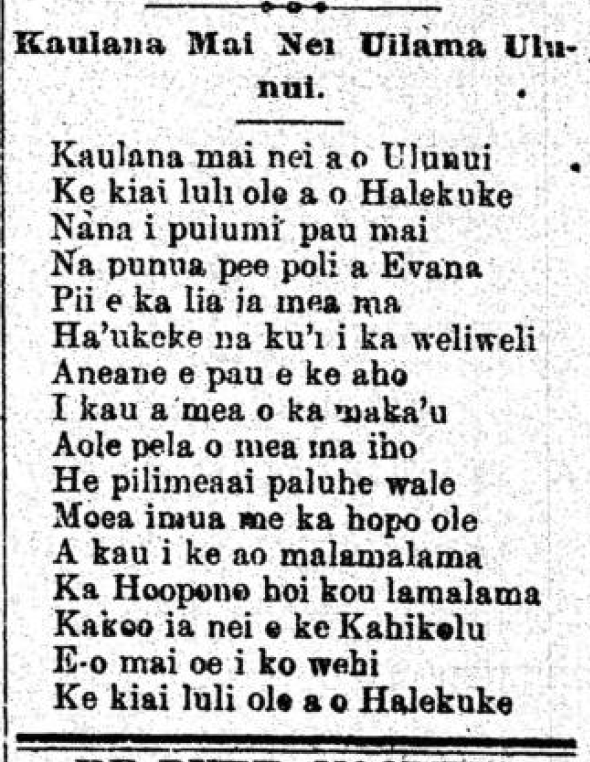
Kaulana mai nei a o Uilama Ulunui

Kaulana mai nei a o Ulunui
Ke kiai luli ole a o Halekuke
Nana i pulumi pau mai
Na punua pee poli a Evana
Pii e ka lia ia mea ma
Ha’ukeke na ku’i i ka weliweli
Aneane e pau e ke aho
I kau a mea o ka maka’u
Aole pela o mea ma iho
He pili meaai paluhe wale
Moea imua me ka hopo ole
A kau i ke ao malamalama
Ka Hoopono hoi kou lamalama
Kakoo ia nei e ke Kahikolu
E-o mai oe i ko wehi
Ke kiai luli ole a o Halekuke

Famous is William Ulunui

Famous is Ulunui
Unwavering keeper of the Customs House
He sweeps away
Bosom-hiding fledglings of Evans
Those folks become fearful
Knees shake in fright
Nearly out of breath
For the fear
Not so for the others
Sycophants so meek
Go forward without trepidation
Until reaching the world of light
Righteousness being your torch
Supported by the Trinity
Respond to your adornment
Unwavering keeper of the Customs House

Ka Leo o ka Lahui, Buke II, Helu 182, Aoao 2. Aperila 29, 1891.

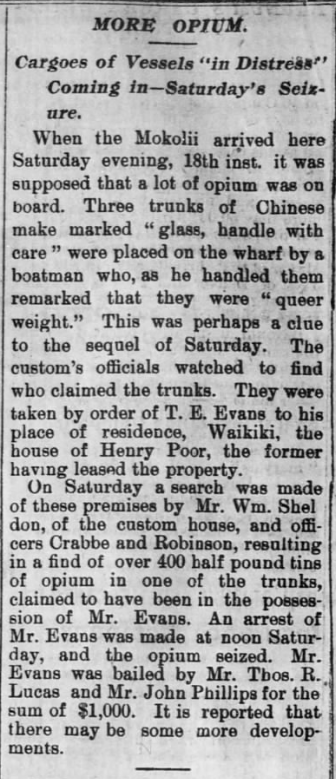
This mele seems to be based on the following scandal:

Hawaiian Gazette, Vol. XXVI, No. 17, P. 7. April 28, 1891.

Putting the New Year in Perspective, 1890 / 2023.

A NEW YEAR SONG.

1

Afflicted with the frightful disease
That is hated by the multitudes
Faces turn away when seen
Shame fills the heart.

Cho.

Happy New Year! Happy New Year!! to you all,
All you friends,
Placed by the government,
On these unfamiliar shores.

2

I will have aloha
For the days of victory
We will rejoice together
The new year with family

3

The previous year has gone
With all of its hope
Here we all are
In this new year

4

Cheer up, cheer up
Don’t agonize and dismay
Remember the Heavenly Father
On this new year day

J. F. Allen,
Kalaupapa, Molokai.

(Kuokoa, 1/11/1890, p. 1)

Ka Nupepa Kuokoa, Buke XXIX, Helu 2, Aoao 1. Ianuari 11, 1890.

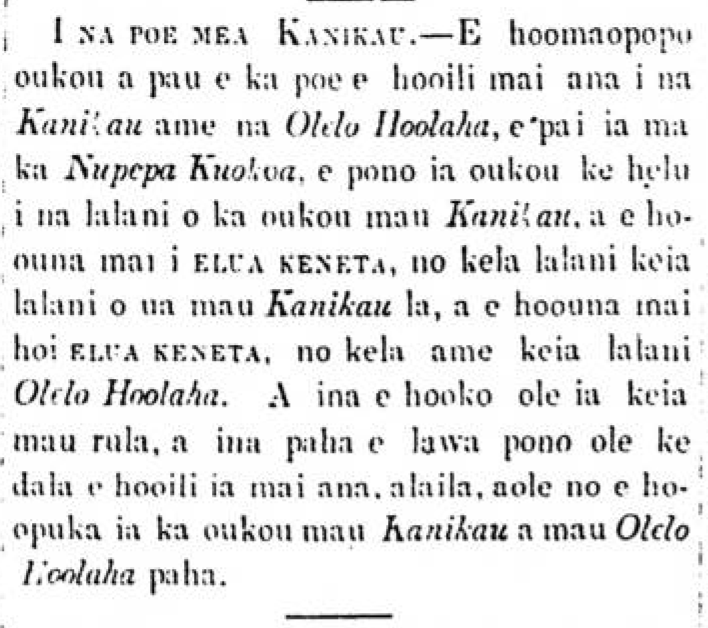
Advice for Writers of Kanikau and Olelo Hoolaha, 1863.

[Found under: “NA MEA HOU O HAWAII NEI.”]

For those of you with Kanikau.—Let it be known to all of you who are sending in Kanikau and Announcements to be printed in the Kuokoa Newspaper, you must count the lines of your Kanikau, and send in two cents for each line of the Kanikau, and two cents for each line of Advertisement. If you do not follow these rules, and the money you send in is not adequate, then your Kanikau or Announcement will not be printed.

(Kuokoa, 8/8/1863, p 2)

Ka Nupepa Kuokoa, Buke II, Helu 32, Aoao 2. Augate 8, 1863.

Rally ’Round the Flag, Boys, 1871.

For La Kuokoa.

Melody.—Rally round the flag, Happy Hours, p. [162].

1 Rally ’round the flag, boys,
Rally ’round the flag;
On this Independence Day, rejoice;
Join together, from the green valleys,
And, from the plains;
On this Independence Day, rejoice.

Cho.—Hawaii forever,
Hurrah boys, hurrah;—
The rebels run,
Long live the King,
And, rally ’round the flag, boys
Rally ’round the flag;
On this Independence Day, rejoice. Continue reading

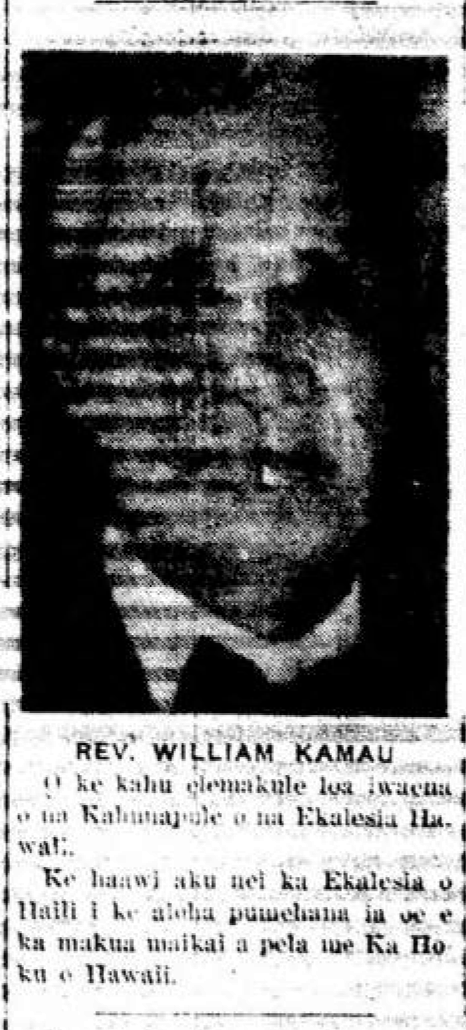
Rev. William Kamau, oldest minister in the Hawaiian church, 1940.

[Found under “Aloha Pumehana”]

REV. WILLIAM KAMAU

He is the oldest amongst the ministers of Hawaii’s Churches.

The Haili Church gives its warm aloha to you, oh good father, and so too with Ka Hoku o Hawaii.

[Rev. William Kamau was one of the contributors to Bishop Museum’s Roberts Collection of mele. See this week’s He Aupuni Palapala blog for more information on a new exhibit about the collection and an better image of William Kamau!]

(Hoku o Hawaii, 6/19/1940, p. 1)

Ka Hoku o Hawaii, Volume XXXV, Number 8, Aoao 1. Iune 19, 1940.