Another “Memoirs of Obookiah” translation, 1867.

Book of the Moolelo of Heneri Opukahaia.

We are printing below the first pages of and the Table of Contents of the Chapters of the story of this Hawaiian that was educated in America. In this book is seven chapters, and it is almost a hundred pages. It is being printed in America and it will be here in a few more months.

THE STORY OF HENERI OPUKAHAIA—Born in Hawaii, A. D. 1787, and Died in America, February 17, 1818—The First Fruit of Hawaii nei. Printed by the American Tract Society [Amerika Ahahui Teraka], New York, 1867.

INTRODUCTION.

The majority of this Moolelo was translated from a book published in English in the United States of America. However, information was researched, and some of the errors of the book was corrected. Some things were added from the moolelo that Rev. S. W. Papalua investigated at Kealakeakua, Hawaii.

This story of Heneri Opukahaia is something important to us Hawaiians; for this is the first of the miracles that God performed benevolently upon our People; and through this start, the enlightenment, the knowledge, and the righteousness of Hawaii has increased until this day.

Should this moolelo become something which increases our love for God and our glorification of Jehovah, that will be enough…

[A couple of years later in 1867, the original translation was appended to and corrected with the information collected by that same S. W. Papaula of Napoopoo, and published in book form under the title: “KA MOOLELO O HENERI OPUKAHAIA, UA HANAUIA MA HAWAII, M. H. 1787, A UA MAKE MA AMERIKA, FEBERUARI 17, 1818. OIA KA HUA MUA O HAWAII NEI.”]

(Kuokoa, 5/18/1867, p. 3)
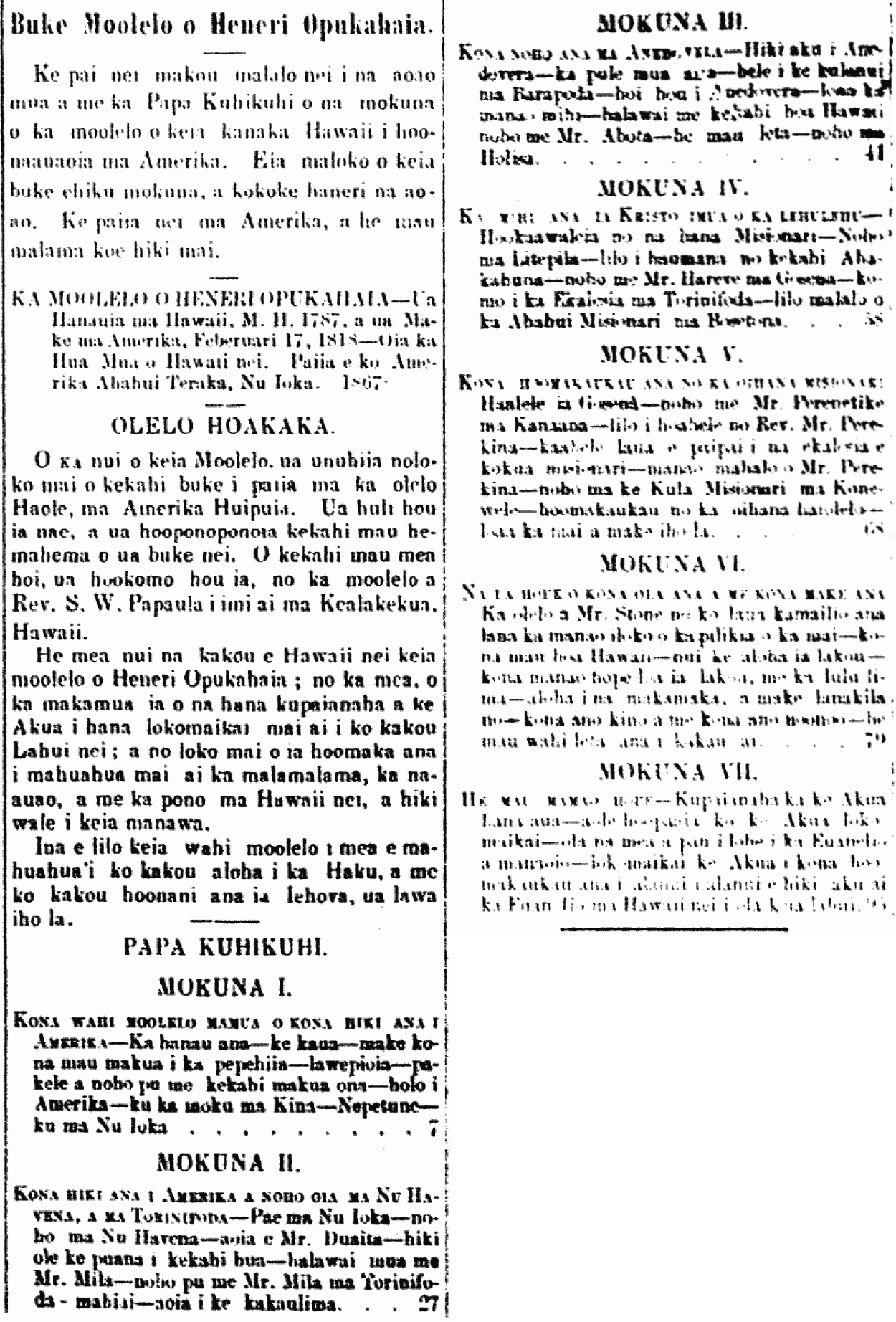
Buke Moolelo o Heneri Opukahaia.

Ka Nupepa Kuokoa, Buke VI, Helu 20, Aoao 3. Mei 18, 1867.
Speaking of Hewahewa, the great kahuna o Kamehameha…, 1837.

[Found under: “DEATHS.”]

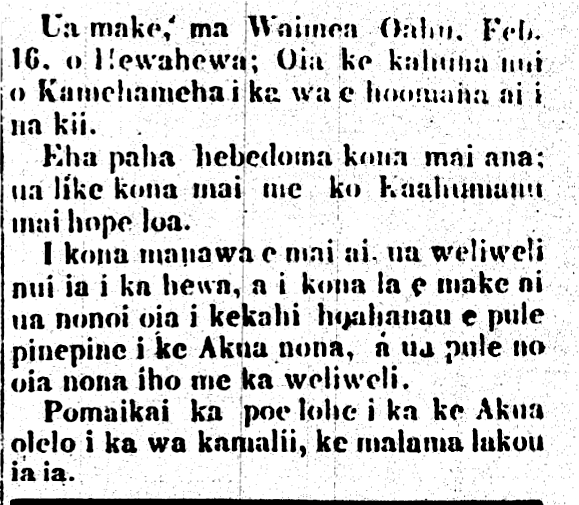
Hewahewa died at Waimea, Oahu, Feb. 16; he was the great kahuna of Kamehameha during the time when the idols were worshiped.

He was ill for perhaps four months; his illness was like that of Kaahumanu’s final illness.

While he was sick, he was terrified of sins, and on the day that he died, he asked one of the brethren to pray often to God for him, and he prayed for himself in fear.

Blessed are those who hear Godʻs teachings while they are young, should they heed them.

(Kumu Hawaii, 4/26/1837, p. 96)

Ua make ma Waimea, Oahu...

Ke Kumu Hawaii, Buke 2, Pepa 24, Aoao 96. Aperila 26, 1937.

More on Opukahaia, 1865.

The Story of Opukahaia.

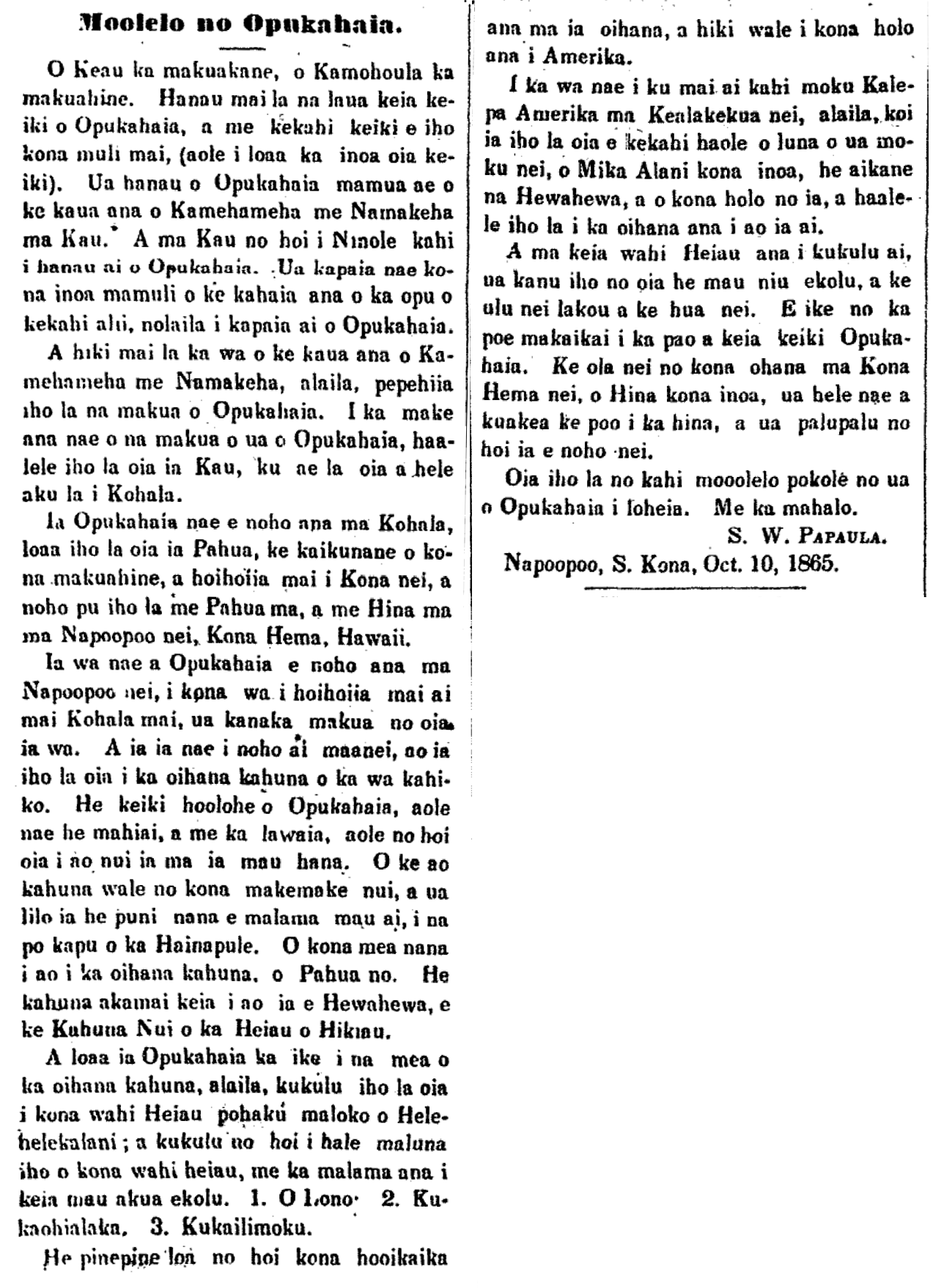
Keau was the father, Kamohoula was the mother. From the two was born this child, Opukahaia, along with another younger child (the name of that child is not known). Opukahaia was born soon before the battle between Kamehameha and Namakeha at Kau. And at Kau in Ninole, is where Opukahaia was born. He was named for the slitting of the stomach of a certain alii, and that is why he was called Opukahaia [“the cutting of the stomach”].

When the time of warfare between Kamehameha and Namakeha arrived, the parents of Opukahaia were killed. When his parents were killed, Opukahaia fled Kau, and went to Kohala.

While he lived in Kohala, Opukahaia was found by Pahua, the brother of his mother, and he was returned here to Kona, and lived with Puhua them and Hina them here in Napoopoo, South Kona, Hawaii.

The time when Opukahaia was living here in Napoopoo, when he was brought back from Kohala, he was an adult at the time. While he lived here, to him belonged the occupation of the kahuna of the olden days. Opukahaia was obedient; he was however not a farmer nor a fisherman, for he was not taught much about those things. He really just wanted to be taught kahuna things, and this was something that he was very interested in doing constantly, on sacred nights of Prayer [? Hainapule]. The one who taught him the ways of the kahuna was Pahua. He was a skilled kahuna taught by Hewahewa, the Great Kahuna of the Heiau of Hikiau.

After Opukahaia received the knowledge of the occupation of the kahuna, he constructed his stone Heiau within Helehelekalani, and he built a house atop his heiau, while he worshiped three gods. 1. Lono, 2. Kukaohiakala, 3. Kukailimoku.

He was constantly honing his skills, until he left for America.

When the American trading ship appeared here at Kealakekua, he was prodded by a haole aboard the ship, named Mika Alani, who was an aikane of Hewahewa; and so he went and left the work that he was trained in.

And at this Heiau which he built, he planted three coconuts, and they are growing and fruiting. The cave [? pao] of this boy, Opukahaia, can be seen by those who visit here. His relative still lives here in South Kona, her name is Hina; she is gray-haired and is frail now.

This is a short story of what is heard of Opukahaia. With mahalo.

S. W. Papaula.

Napoopoo, S. Kona, Oct. 10, 1865.

[This seems to be written in response to the translation being published in Kuokoa at the same period. Papaula is adding to the information given in the translation. This ability to quickly add to or correct information published in the newspapers was one of the many advantages newspapers had over books.]

(Kuokoa, 11/4/1865, p. 4)

Moolelo no Opukahaia.

Ka Nupepa Kuokoa, Buke IV, Helu 44, Aoao 4. Novemaba 4, 1865.

Translation of “Memoirs of Henry Obookiah: A Native of Owhyhee, and a Member of the Foreign Mission School…” 1865.

Ka Moolelo o Heneri Opukahaia.

HELU 1.
Kona wahi moolelo mamua o kona hiki ana i Amerika.

He kanaka o Heneri Opukahaia no Hawaii ka mokupuni kaulana a laukanaka hoi o ka Pae Aina Hawaii. Ua hanau ia i ka makahiki 1792. He mau makaainana kona mau makua; aka ua pili nae kona makuahine i ka ohana o na’lii. O kona inoa o Kumuola; a o ka inoa o kona makuakane aole i maopopo. I ka wa i hiki aku ai o ko Opukahaia mau makahiki i ka umi a umikumamalua paha, pepehiia kona mau makua mamua pono o kona mau maka. Elua wale no laua o kona ohana i ola, oia a me kona wahi muli loa nona na malama ekolu. Ua manao lana ia e hoola i kona wahi pokii mai ka popilikia mai i ili iho ai maluna o kona mau makua, nolaila, ua hopu akuu ia i kona wahi pokii a kau ae la ma kona kua, a holo aku la mai ka enemi aku; aka, ua loaa aku no ia i ka poe i alualu aku, a pepehi mainoino ia ua wahi pokii la ona. O ka moolelo o ia wahi ua kakau ia ma kekahi buke e aku mamuli o ka mea i hai waha ia aku e Opukahaia…

[This translation of Edwin Welles Dwight’s “Memoirs of Henry Obookiah, a Native of Owhyhee, and a Member of the Foreign Mission School; Who Died at Cornwall, Conn. Feb. 17, 1818, Aged 26 Years.” begins on 9/9/1865 and is completed on 3/24/1866.]

(Nupepa Kuokoa, 9/9/1865, p. 2)

Ka Moolelo o Heneri Opukahaia.

Ka Nupepa Kuokoa, Buke IV, Helu 36, Aoao 2. Sepatemaba 9, 1865.

Daniel Defoe’s “Life and Adventures of Robinson Crusoe” in Hawaiian, 1860.

STORY OF ROBINSON CRUSOE,

A Castaway Who Lived Twenty-Eight Years On a Deserted Island, and His Rescue.

MOKUNA I.

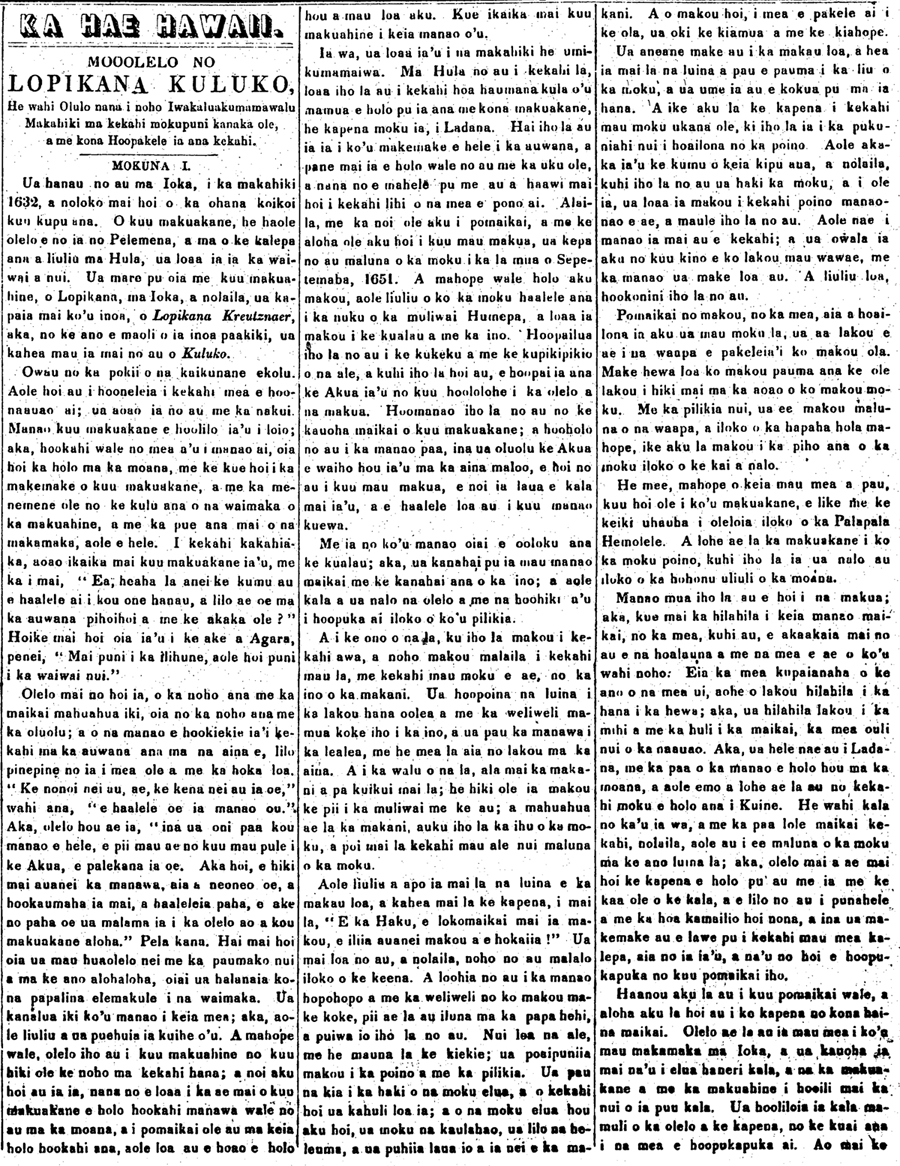
Ua hanau no au ma Ioka, i ka makahiki 1632, a noloko mai hoi o ka ohana koikoi kuu kupu ana. O kuu makuakane, he haole olelo e no ia no Pelemana, a ma o ke kalepa i ana a liuliu ma Hula, ua loaa ia ia ka waiwai a nui. Ua mare pu oia me kau makuahine, o Lopikana, ma Ioka, a nolaila, ua kapaia mai ko’u inoa, o Lopikana Kreutznaer, aka, no ke ano e maoli o ia inoa paakiki, ua kahea mau ia mai no au o Kuluko…

[This is one of the earlier foreign stories that was translated in the Hawaiian-Language Newspapers. “Mooolelo no Lopikana Kuluko” appeared in Hae Hawaii from 11/21/1860 and concluded on 5/8/1861. The translator is given at the conclusion as L. K.]

(Hae Hawaii, 11/21/1860, p. 139–140.)

MOOOLELO NO LOPIKANA KULUKO,...

Ka Hae Hawaii, Buke 5, Ano Hou.—Helu 34, Aoao 139. Novemaba 21, 1860.

...kapena ia'u i ka hooholoholo moku...

Ka Hae Hawaii, Buke 5, Ano Hou.—Helu 34, Aoao 140. Novemaba 21, 1860.

“Three Musketeers,” a follow-up, 1891.

He Moolelo
NO

De Atanani.

Ke Koa o ka Lio Olohe,
—A I OLE—
NA KIAI EKOLU O FARANI.

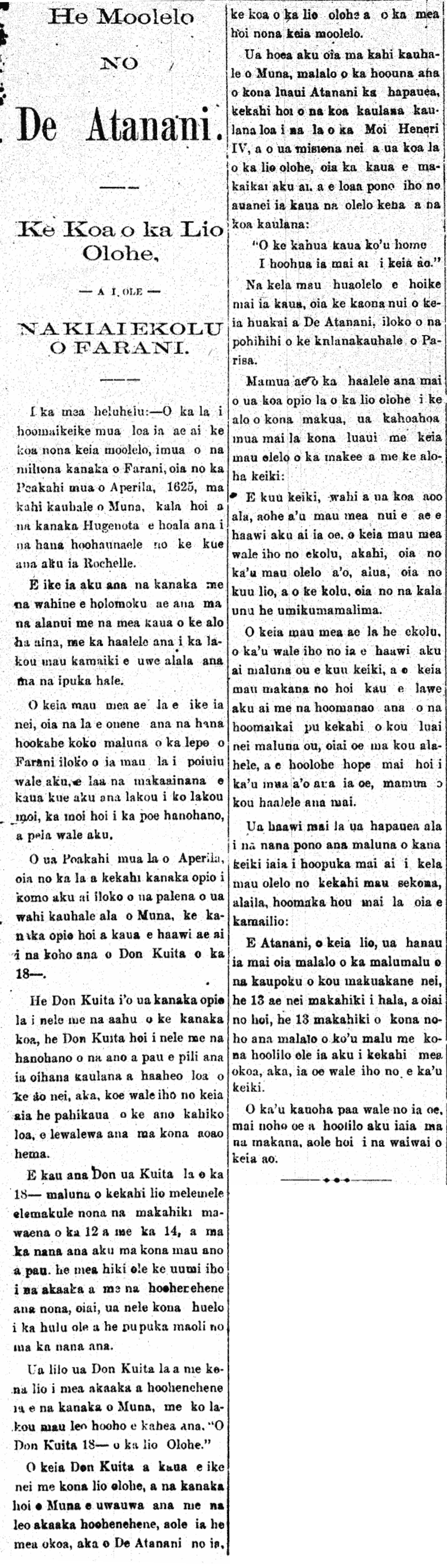
I ka mea heluhelu:—O ka la i hoomaikeike mua loa ia ae ai ke koa nona keia moolelo, imua o na miliona kanaka o Farani, oia no ka Poakahi mua o Aperila, 1625, ma kahi kauhale o Muna, kala hoi a na kanaka Hugenota e hoala ana i na hana hoohaunaele no ke kue ana aku ia Rochelle.

E ike ia aku ana na kanaka me na wahine e holomoku ae ana ma na alanui me na mea kaua o ke aloha aina, me ka haalele ana i ka lakou mau kamaiki e uwe alala ana ma na ipuka hale.

O keia mau mea ae la e ike ia nei, oia na la e onene ana na hana hookahe koko maluna o ka lepo o Farani iloko o ia mau la i poiuiu wale aku, e laa na makaainana e kaua kue aku ana lakou i ko lakou moi, ka moi hoi i ka poe hanohano, a pela wale aku…

[This translation of Dumas’ “Three Musketeers” first appears in this daily newspaper on 4/14/1891 and is last found on 1/21/1892. This is probably the last section printed (on page 4). The images of this newspaper are particularly bad, and I am having a difficult time trying to figure out in which chapter this story comes to an end. This is just one more reason why we need to have the newspapers rescanned as clearly as possible!]

(Leo o ka Lahui, 4/14/1891, p. 3)

He Moolelo NO De Atanani.

Ka Leo o ka Lahui, Buke II, Helu 171, Aoao 3. Aperila 14, 1891.

More from Dumas: “Three Musketeers,” 1878.

HE MOOLELO
—NO NA—

KIAI EKOLU.

—A ME KE—
Koa Opio Wiwo Ole!
ATAGANANA.

{Translated by a generous pen for the Pride of the Hawaiian Nation.}

CHAPTER 1
NUMBER 1.

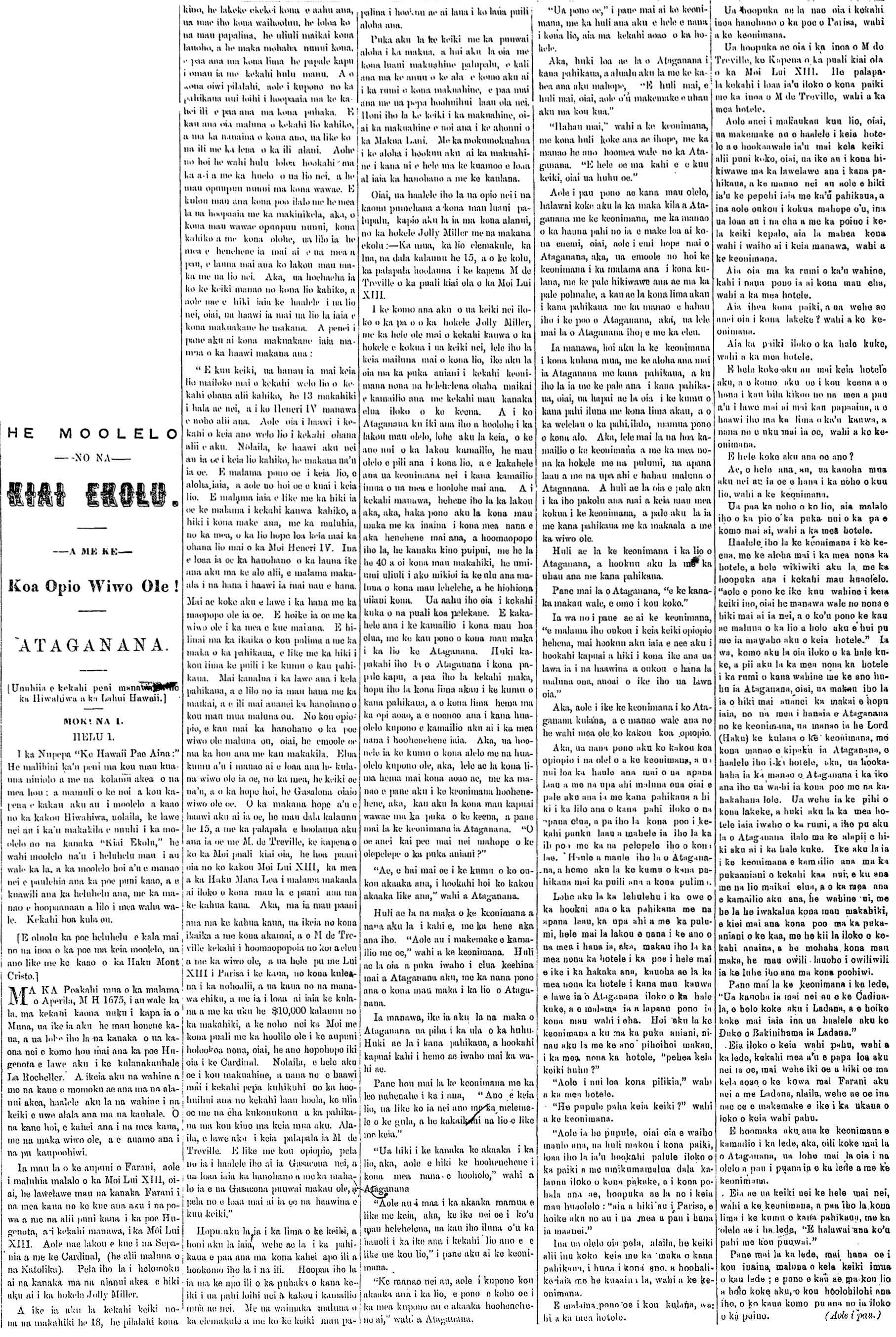
To the Newspaper “Ko Hawaii Pae Aina:” My pen is a stranger to your straight borders and your wide columns of news: and at the request of your captain that I write a moolelo or kaao for our Pride, therefore, I have taken my pen nib to translate the story of the “Three Musketeers,” a moolelo that I used to read all the time in days gone by, and a moolelo that I believe will mesmerize those who love kaao, and they will read it over and over so that they can memorize it and tell it by heart. One of my schoolmates.

{O Readers, do be so kind as to forgive me for the names of the people in this moolelo; they are similar with the kaao of The Count of Monte Cristo.}

MA KA Poakahi mua o ka malama o Aperila, M. H. 1675, i au wale ka la, ma kekahi kaona nuku i kapa ia o Muna, ua ike ia aku he mau honene kaua, a ua lohe iho la na kanaka o ua kaona nei e komo hou mai ana ka poe Hugenota e lawe aku i ke kulanakauhale La Rocheller. A ikeia aku na wahine a me na kane e momoku ae ana ma na alanui akea, haalele aku la na wahine i na keiki e uwe alala ana ma na kauhale. O na kane hoi, e kahei ana i na mea kaua, me na maka wiwo ole, a e auamo ana i na pu kaupoohiwi…

[The translation of Alexander Dumas’ “The Three Musketeers” began on 3/2/1878, and the last segment found is on 12/7/1878 (mid-Chapter XVI). I could find no explanation for there only being a quarter of the entire work.]

(Ko Hawaii Pae Aina, 3/2/1878, p. 1)

HE MOOLELO NO NA KIAI EKOLU.

Ko Hawaii Pae Aina, Buke I, Helu 9, Aoao 1. Mei 2, 1878.

Celebrated historian Samuel Manaiakalani Kamakau passes away, 1876.

S. M. Kamakau Dies.

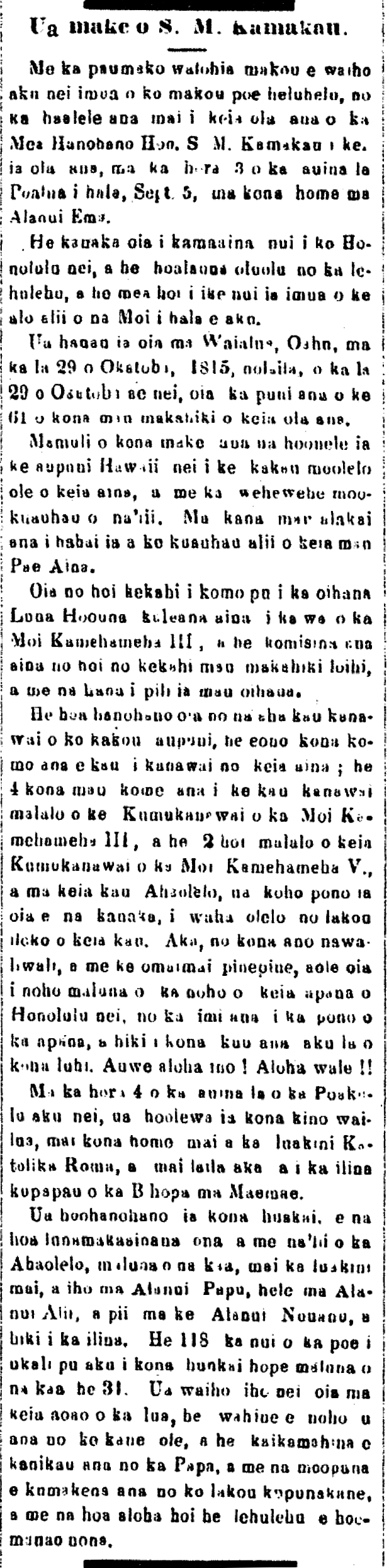
With heartfelt grief we put before you, our readers, news of the leaving of this life of the Honorable S. M. Kamakau, at 3 o’clock in the afternoon of this past Tuesday, Sept. 5, at his home on Emma Street.

He was a man greatly familiar to Honolulu’s people, and he was a good-hearted companion of the people, and he was someone that was seen often in the courts of the Monarchs past.

He was born in Waialua, Oahu, on the 29th of October, 1815, therefore, on the upcoming 29th of October, he would have made 61 years of this life.

As a result of his death, the nation of Hawaii is without a historian of this land, and an interpreter of genealogies of the chiefs. The alii genealogies of this archipelago follow his guidance.

He was a part of the board of commissioners to quiet land titles during the time of King Kamehameha III, and he was a commissioner of land surveying for many years, along with work associated with it.

He was an honorable member of the legislature of our kingdom; he joined this body six times to pass laws for this land; he was in 4 sessions under the Constitution of King Kamehameha III, and 2 under this Constitution of King Kamehameha V, and in this Legislative session, he was rightly chosen by his constituents as a spokesman for them in this session. But because of his infirmity, and his getting sick often, he did not sit in the seat of this district of Honolulu, to search for the good of the district, until he was freed from his weariness. Auwe, how sad! How pitiful!!

At 4 o’clock in the afternoon of this past Wednesday, a funeral was held over his body, from his home until the Roman Catholic Church, and from there to the cemetery of the Episcopalians at Maemae.

His procession was given honor by his fellow representatives, and the nobles of the Legislature, on cars, from the church and down Fort Street, onto King Street, and up Nuuanu Avenue until the cemetery. There were 118 people who accompanied his last journey in 31 cars. He has left behind on this side of the grave, a wife grieving over her lost husband, and a daughter mourning her Papa, and grandchildren bewailing their grandfather, along with the many friends reminiscing over him.

(Kuokoa, 9/9/1876, p. 2)

Ua make o S. M. Kamakau.

Ka Nupepa Kuokoa, Buke XV, Helu 37, Aoao 2. Sepetemaba 9, 1876.

Dumas’ “Count of Monte Cristo,” 1868.

KA HAKU MONEDE KARISO.

(COUNT OF MONTE CRISTO.)

CHAPTER I.
O Maisela ma Farani—ke ku ana mai o ka moku Pharaon.

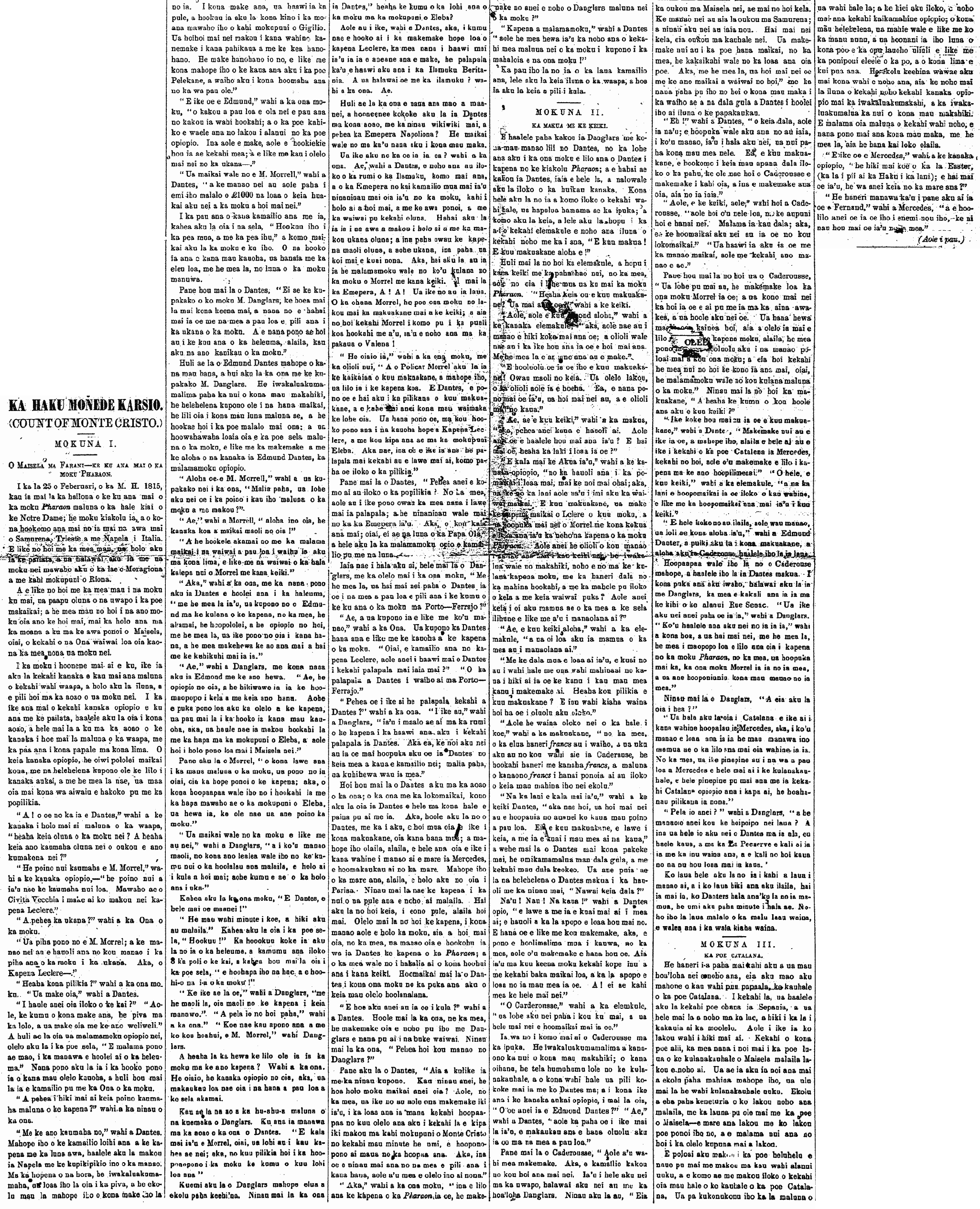
I ka la 25 o Feberuari, o ka M. H. 1815, kau ia mai la ka hailona o ke ku ana mai o ka moku Pharaon maluna o ka hale kiai o ke Notre Dame; he moku kiakolu ia, a o kona hookomo ana mai no ia mai na awa mai o Samurena, Trieste a me Napela i Italia. E like no hoi me ka mea mau, ua holo aku la ke pailata, a ua halawai aku la me na moku mawaho aku o ka lae o Moragiona a me kahi mokupuni o Riona…

[Alexandre Dumas’ “Count of Monte Cristo” is translated in the newspaper Au Okoa, and ran for two and a half years, from 8/6/1868 to 2/9/1871! This is the opening of the story.

Chapter 1.
Marseilles—The Arrival.

On the 24th of February, 1815, the look-out at Notre-Dame de la Garde signalled the three-master, the Pharaon from Smyrna, Trieste, and Naples.
As usual, a pilot put off immediately, and rounding the Chateau d’If, got on board the vessel between Cape Morgion and Rion island…
]

(Kuokoa, 8/6/1868, p. 1)

KA HAKU MONEDE KARISO.

Ka Nupepa Kuokoa, Buke IV, Helu 16, Aoao 1. Augate 6, 1868.